

P0222 on 2005-2014 Ford Mustang: Throttle Position Sensor 'B' Circuit Low Causes and Fixes
On a 2005-2014 Mustang, code P0222 is almost always caused by a failing electronic throttle body assembly. This triggers a 'wrench' light and limp mode. Replacing the entire throttle body is the common fix, costing around $100-$250 for the part. This is a well-documented failure on this platform.
- P0222 on a 2005-2014 Mustang almost always means you need a new electronic throttle body.
- Symptoms are sudden and severe, including a 'wrench' light and the car entering 'limp mode' with very little power.
- Do not waste time cleaning the throttle body; this is an internal electronic failure, not a carbon buildup issue.
- Replacing the throttle body is a DIY-friendly job that can be done in under an hour with basic tools. A throttle relearn procedure is mandatory after installation.
What's Unique About the 2005-2014 Ford Mustang
The electronic throttle body (ETB) on the S197 Mustang platform is a widely documented weak point. Unlike many vehicles where cleaning the throttle body can resolve issues, P0222 on this Mustang almost always points to an internal electronic failure of the sensors integrated within the throttle body assembly. The internal motor contacts or carbon-based potentiometer tracks for the sensors wear out or get contaminated, leading to the low voltage signal. Ford acknowledged these widespread ETB issues through Customer Satisfaction Programs (like 13N03 and 16B32) for many vehicles of this era, including the Mustang, which extended warranty coverage for these specific failures.
Generation note: This guide covers the entire S197 Mustang generation, which includes the 2005-2009 models (4.0L V6, 4.6L V8) and the facelifted 2010-2014 models (3.7L V6, 5.0L V8). The electronic throttle body is a known failure point on both versions. While the core issue is the same, the specific part numbers for the throttle body differ between engine types. Ford issued TSBs and customer satisfaction programs that covered various engines and years within this generation, highlighting the persistent nature of the problem.
Symptoms You May Notice
- Sudden loss of engine power (Limp Mode)
- Wrench-shaped warning light illuminated on the dashboard
- Check Engine Light is on
- Poor, hesitant, or no throttle response
- Rough or unstable idle
- Difficulty starting the engine
- Jerky or hesitant acceleration
- Cleaning the throttle body. While a dirty throttle body can cause idle issues, it will not fix the internal electronic failure that triggers a P0222 code.
- Replacing the spark plugs or fuel filter. These parts are unrelated to the throttle position sensor circuit and will not resolve the code.
- Replacing only the Throttle Position Sensor. On most S197 Mustangs, the TPS sensors are integrated into the throttle body assembly and are not sold as separate, replaceable components. The entire unit must be replaced.
Most Likely Causes
- Faulty Electronic Throttle Body (ETB) Assembly 🔴 High Probability → Shop Fuel Injection Throttle Body The original equipment (OEM) throttle bodies on this generation of Mustang are known for high failure rates due to wear and contamination of the internal electronic contacts and sensors. This is a well-documented issue across many Ford platforms from this era.
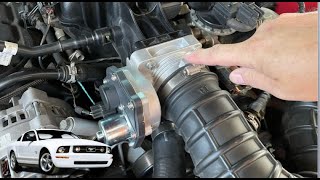
How to confirm: Using a scan tool with live data, monitor the voltage for Throttle Position Sensor B (TPS B). With the key on, engine off, the voltage should sweep smoothly from ~0.5V to ~4.5V as the accelerator is pressed. If the voltage for TPS B is stuck low (e.g., < 0.5V) and does not change, and the wiring is confirmed to be good, the throttle body assembly is faulty. 🎬 Watch: How to test and replace an electronic throttle body.
Typical fix: Replace the entire electronic throttle body assembly. Cleaning the unit will not fix this internal electronic fault. After replacement, a throttle relearn procedure is required.
Est. part cost: $100-$280 - Damaged Wiring or Poor Connection 🟡 Medium Probability Engine harnesses can be subject to chafing, especially around sharp corners of the engine or where they are secured by clips. Over time, vibration and heat can cause wires to break or short to ground, particularly in the harness leading to the throttle body.
How to confirm: Visually inspect the wiring harness and connector going to the throttle body for any signs of damage, corrosion, or loose pins. Use a multimeter to perform a continuity test on the signal wire and check for a short to ground. Wiggling the harness while monitoring live data can sometimes reveal an intermittent connection.
Typical fix: Repair the damaged section of the wiring harness or clean/replace the connector. In some cases of extensive damage, a new engine harness pigtail or entire harness may be needed.
Est. part cost: $10-$150
Rare But Worth Checking
- Faulty Accelerator Pedal Position (APP) Sensor: → Shop Accelerator Pedal Assembly While the throttle body is the more common failure point on this car, the APP sensor sends the driver's input to the PCM. A failure in the APP sensor can produce similar symptoms and codes. The diagnostic process of checking sensor voltages on both the throttle body and the pedal assembly will differentiate between the two.
- Faulty Powertrain Control Module (PCM): → Shop Engine Control Module (ECM) This is the least likely cause. The PCM should only be considered after definitively ruling out the throttle body, pedal sensor, and all related wiring. A PCM failure is rare but possible, sometimes due to internal software glitches or hardware failure.
Diagnosis Steps
- Connect an OBD-II scanner and confirm P0222 is present. Note any other codes, such as P2111, P2112, or P2135.
- Visually inspect the wiring harness and electrical connector at the throttle body. Look for chafed wires, corrosion, or bent pins. Pay attention to areas where the harness bends or is clipped to the engine/chassis.
- Using a scan tool with live data, observe the voltage readings for both TPS 'A' (TP1) and TPS 'B' (TP2).
- With the key on and engine off, slowly press the accelerator pedal. The voltage for TPS 'A' should sweep smoothly (e.g., ~1.0V to ~4.5V).
- Observe the voltage for TPS 'B'. If it remains stuck at a very low value (e.g., below 0.5V) and does not change, the fault is likely with the sensor inside the throttle body.
- If the wiring and connector are confirmed to be in good condition via a multimeter test, the electronic throttle body assembly is the defective component and should be replaced.
- After replacement, perform the throttle body relearn procedure: Turn the key to 'On' (engine off), wait 10 seconds, slowly press the gas pedal to the floor, slowly release it, then turn the key off. This calibrates the new sensor.
Parts You'll Likely Need
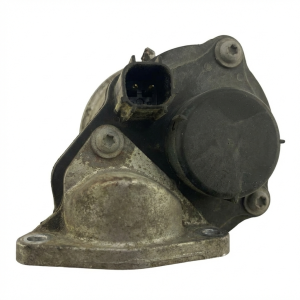
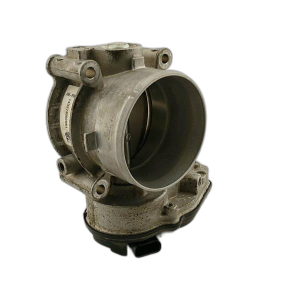
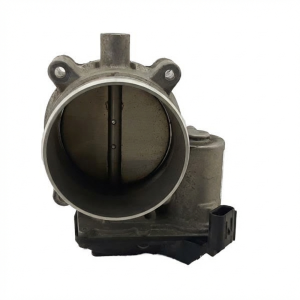
- Electronic Throttle Body Assembly
(OEM #Varies by engine: 4.6L V8 (2005-10): 9R3Z-9E926-B; 5.0L V8 (2011-14): BR3Z-9E926-C; 🎬 See this walkthrough for installing a new throttle body on 5.0L engines. 3.7L V6 (2011-14): AT4Z-9E926-B; 4.0L V6 (2005-10): 9R3Z-9E926-A)🎬 Watch: How to replace the throttle body on 2005-2009 V6 models. — This is the most common failure point for code P0222 on this platform. The throttle position sensors are integrated into this assembly and typically fail internally.
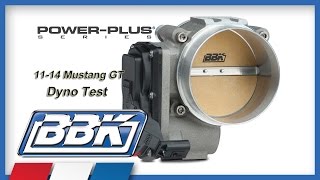
Trusted brands: Motorcraft (OEM), Dorman (OE FIX), BBK, TRQ
OEM price range: $180-$280
Aftermarket price range: $100-$220
Related Codes That Often Appear With This One
- P2111 — This code means 'Throttle Actuator Control System - Stuck Open' and often appears alongside P0222 when the PCM detects a throttle body failure.
- P2112 — This code means 'Throttle Actuator Control System - Stuck Closed' and is also commonly associated with a failing electronic throttle body.
- P0223 — This code indicates 'Throttle/Pedal Position Sensor/Switch 'B' Circuit High Input,' which is the opposite of P0222 but points to a fault in the same sensor circuit.
- P2135 — This code, 'Throttle/Pedal Position Sensor/Switch A/B Voltage Correlation,' is often seen with P0222. It means the PCM sees a disagreement between the two redundant TPS signals, which is exactly what happens when one sensor fails low. TSB 05-09-15 was issued for this combination of codes on early S197 models.
Technical Service Bulletins (TSBs) & Recalls
- TSB 10-21-6: Addressed fluctuating idle and codes P2111/P2112 on various 2010-2011 Ford vehicles, including Mustangs with 3.7L and 4.6L engines, by recommending throttle body replacement for certain build dates.
- TSB 05-09-15: For 2005 Mustangs (built before 11/29/2004) with codes P2106 and P2135, this bulletin advised replacing the TPS and reprogramming the PCM.
- TSB 16-0163: A manufacturer service bulletin notes that various Ford vehicles may exhibit drivability issues and an illuminated MIL with codes including P0222, P2111, and P2112.
- TSB 18-2062: This bulletin addresses concerns of rough running, loss of power, and illuminated MIL with codes P0222, P2111, and P2135, recommending specific service procedures to resolve these faults.
- Customer Satisfaction Program 16B32: While officially for 2016 Mustangs, this program to replace the ETB due to internal contamination confirms the known failure mode of these components.
- Customer Satisfaction Program 13N03: Extended the warranty on the ETB for many Ford vehicles, further acknowledging the high failure rate.
Platform-Specific Known Issues
- The original equipment electronic throttle bodies on 2005-2014 Mustangs are a well-known weak point, with high rates of failure leading to limp mode.
- Ford issued Customer Satisfaction Program 16B32 for some 2016 Mustangs to replace the ETB free of charge due to contamination of internal motor contacts. While this specific program targeted a later model year, it highlights the prevalence of this issue.
- An earlier program, 13N03, extended the ETB warranty to 10 years/150,000 miles for many Ford vehicles, acknowledging the widespread problem.
- TSB 05-09-15 was released for early 2005 Mustangs exhibiting codes P2106 and P2135, which involved replacing the TPS and reprogramming the PCM.
- Manufacturer records such as TSB 16-0163 and TSB 18-2062 further document the persistence of P0222 and related throttle actuator codes across the Ford lineup during this era.
Mechanic-Grade Diagnostic Values
- Throttle Position Sensor 'B' (TP2) Signal Voltage — expected: Smoothly sweeps from approximately 0.5V to 4.5V as the accelerator pedal is pressed (Key On, Engine Off).. Failure: Voltage is stuck below the minimum threshold, typically < 0.5V, and does not change with pedal movement.
- Throttle Position Sensor 'A' (TP1) Signal Voltage (for comparison) — expected: For 2005-2010 4.6L GT, a specific source cites a Key On, Engine Off voltage of 1.19V - 1.31V at closed throttle. This sensor's voltage often sweeps inverse to TP2.. Failure: While not the direct cause of P0222, an erratic reading here could point to a related P2135 correlation fault.
- Throttle Body Motor Resistance — expected: According to a workshop manual, the resistance between the two motor pins should be between 1 and 900 ohms.. Failure: A reading outside this range (e.g., open circuit) indicates a failed throttle motor inside the assembly.
Scan Tool Commands That Help
- Ford IDS (Integrated Diagnostic System): TPS Calibration / Reset Functions — Used after replacing the throttle body to calibrate the new sensor's position and ensure the PCM recognizes the new component's idle and wide-open throttle positions correctly. The tool can also be used to command the throttle plate to sweep, verifying motor and sensor function without touching the pedal.
- Manual Procedure or Scan Tool: Keep Alive Memory (KAM) Reset / Throttle Relearn — This procedure is required after disconnecting the battery or replacing the throttle body. It clears the old adaptive learning and forces the PCM to relearn the idle and throttle positions. The manual method involves disconnecting the battery and shorting the cables (off the battery) to drain capacitors.
Wiring & Ground Locations
- G201 — Located on the passenger side kick panel, near the PCM.. This is a primary ground for the Powertrain Control Module (PCM). A poor connection at G201 can cause erratic sensor readings and numerous engine control faults, including P0222, as it can disrupt the reference voltage or signal return for the throttle sensors.
- G104 — Located in the engine bay, next to the battery on the driver's side inner fender.. This ground point serves the Data Link Connector (DLC). While not directly causing P0222, a bad ground here can interfere with scan tool communication, making diagnosis difficult.
- G103 — Located in the engine bay on the passenger side, near the hood prop rod attachment point.. This ground serves the engine cooling fan and other front-end components. Electrical noise from a poor ground here could potentially interfere with sensitive sensor signals in the nearby harness.
- Throttle Body Connector (C168) — The 6-pin electrical connector on the electronic throttle body itself.. This is the primary connection point for all tests. The pins for TPS 'A', TPS 'B', their shared ground, 5V reference, and the two throttle motor wires are located here. Corrosion or loose pins in this connector are a common cause of intermittent faults.
- Harness Chafe Point — Inspect the engine harness where it may contact the ECM/TCM bracket, the upper control arm, and the shock tower bolts in the driver's side wheel well area.. Vibrations can cause the harness loom to wear through at these contact points, potentially shorting the TPS signal wire to ground and causing a P0222 code.
Real Owner Repair Stories
- S197Forum.com user 'GT-apb' (Ford Mustang GT (S197 platform)) — Throttle body related issues, communication failure with the instrument cluster (no mileage display, fuel level errors) when the throttle body motor was connected.
❌ Tried (didn't work) Full diagnostic check with workshop manual, Checking grounds, Checking wiring to/from PCM, TPS, and throttle motor, Checking relays and diodes, Swapping in a known-good throttle body
✅ What actually fixed it Replacing a blown 'Engine #3' fuse. The shorted throttle motor, when connected, would blow the fuse, which also powered other systems, leading to the cluster communication errors and preventing the car from running properly. - NHTSA ODI #11629480 — An owner reported that their vehicle stalled and dashboard lights illuminated; service paperwork documented code P0222 and technicians discovered a "chaffed wire" as the root cause.
- NHTSA ODI #10817084 — A driver experienced a loss of power while in stop-and-go traffic; the check engine light came on with codes P0122, P0222, P2111, and P2135, with the TPS reading stuck at 82% due to a defective throttle body.
- NHTSA ODI #10561056 — One report describes an incident where the car would not accelerate above 1,000 RPM, with P0222 appearing alongside a long list of related codes including P2135 and P2104.
OEM Part Supersession History
7R3Z-9E926-AA, 9R3Z-9E926-B→9R3Z-9E926-A— Part revision and consolidation by Ford for the 4.6L V8 engine.
Heads up: These part numbers are specific to the 2005-2010 4.6L V8 and are not compatible with V6 or 5.0L V8 engines. 9R3Z-9E926-A is the most current replacement for the earlier numbers.
Model Year Variations Within This Range
- 2005-2010 vs 2011-2014: The engine options are completely different (4.0/4.6L vs 3.7/5.0L), meaning the throttle bodies, intake manifolds, and associated part numbers are not interchangeable between these two groups. While the P0222 diagnostic theory is the same, the physical parts and some wiring specifics will vary.
- All: Wire colors for testing at the TPS connector can vary. While one source for older models may cite specific colors like Green and Black for the signal and ground, another may cite Yellow. Always use a pinout diagram for the specific year and engine to confirm which pin is the signal, ground, and reference voltage before probing.
Diagnostic Flowchart
Used vs. New Parts: Buying Guide for This Vehicle
When a used part is the smart pick: Buying a used part is generally NOT recommended for this specific failure. The OEM throttle body has a known high failure rate, so a used part from a salvage yard is likely to have the same wear-prone internal sensor and could fail soon after installation. The only exception might be acquiring a used Dorman 'OE FIX' (Hall Effect sensor) version, as it is designed to be more durable than the original.
Donor-vehicle mileage cap: roughly under 30000 miles for the part to have meaningful remaining life.
What to inspect on the donor part:
- If buying used, verify it is a Dorman 'OE FIX' or other aftermarket unit with non-contact sensors.
- Check the electrical connector pins for any signs of corrosion, moisture, or damage.
- Ensure the throttle plate moves freely by hand (with power off) and doesn't show signs of binding or excessive carbon buildup around the edges.
- Ask for the donor vehicle's mileage; lower is always better.
Aftermarket brands forum-validated for this vehicle:
- Motorcraft (New OEM)
- Dorman OE FIX (Specifically the version with non-contact Hall Effect sensors, which is considered an upgrade over the original design)
Brands owners have reported issues with on this vehicle:
- Unnamed, no-brand, or exceptionally cheap throttle bodies from online marketplaces. These often have poor quality control and may fail quickly or be dead-on-arrival. Sticking to a reputable brand is highly advised for this critical part.
Real Owner Stories
Aggregated from forums and TSBs cited above. Mileages and costs reflect what owners reported in those sources.
2006 Mustang GT
Symptoms: The vehicle entered a 'classic limp mode scenario'.
What fixed it: The owner was advised to return to OEM parts for diagnosis, as an aftermarket throttle body was suspected to be the cause of the issue.
Source hint: MustangForums.com (2017-07-26)
2010-2011 Mustang with 3.7L or 4.6L engine
Symptoms: The owner experienced a fluctuating idle and had codes P2111/P2112 stored.
What fixed it: For certain build dates, the official fix was a complete throttle body replacement, as outlined by Ford.
Source hint: TSB 10-21-6
2005 Mustang (built before 11/29/2004)
Symptoms: The Check Engine Light was on with codes P2106 and P2135.
What fixed it: The repair specified by Ford involved replacing the Throttle Position Sensor (TPS) and reprogramming the Powertrain Control Module (PCM).
Source hint: TSB 05-09-15
Related OBD-II Codes
Frequently Asked Questions
Is the electronic throttle body on my 2007 Mustang a known problem?
I heard Ford extended the warranty for this part. Does it apply to my 2012 Mustang?
Can I just clean my throttle body to fix code P0222?
After replacing the throttle body on my Mustang, do I need to do a reset?
What is the best aftermarket replacement throttle body for a 2005-2014 Mustang?
My 2005 Mustang has codes P2135 and P2106. Is this related to the P0222 problem?
Helpful Videos

We Have This Part in Stock

The information in this article is provided for general reference and educational purposes only. Vehicle specifications, procedures, and part compatibility can vary by production date, trim level, and region. Always consult your vehicle's factory service manual and verify part numbers before purchasing or performing repairs. Safety-critical components such as airbags, seat belts, and braking systems should be installed by a qualified professional.
- Ford Mustang:
- 🧭 Diagnostic Flowchart
- 🎬 Helpful Videos
- 🛍️ Shop This Part
- What's Unique About the 2005-2014 Ford Mustang
- Symptoms You May Notice
- Most Likely Causes
- Rare But Worth Checking
- Diagnosis Steps
- Parts You'll Likely Need
- Related Codes That Often Appear With This One
- Technical Service Bulletins (TSBs) & Recalls
- Platform-Specific Known Issues
- Mechanic-Grade Diagnostic Values
- Scan Tool Commands That Help
- Wiring & Ground Locations
- Real Owner Repair Stories
- OEM Part Supersession History
- Model Year Variations Within This Range
- Used vs. New Parts: Buying Guide for This Vehicle
- Real Owner Stories
- 2006 Mustang GT
- 2010-2011 Mustang with 3.7L or 4.6L engine
- 2005 Mustang (built before 11/29/2004)
- Related OBD-II Codes
- Frequently Asked Questions
- 🎟️ Get 5% Off