

P0222 on 2019-2025 Genesis G70 3.3T: Throttle Position Sensor 'B' Circuit Low Causes and Fixes
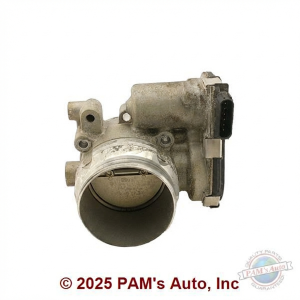
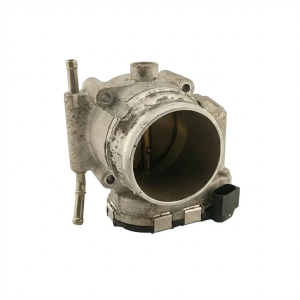
P0222 on a Genesis G70 3.3T almost always indicates a fault within the electronic throttle body assembly. The internal throttle position sensor ('B') has failed, requiring replacement of the entire throttle body unit. Expect to pay $250-$450 for an OEM part, with a DIY difficulty of 2/5.
- P0222 on the G70 3.3T is a serious code that will cause significant drivability issues, including limp mode.
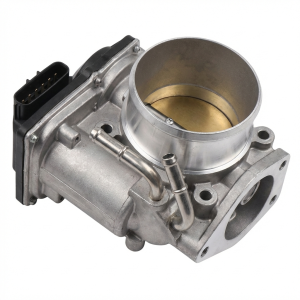
- The most common cause by far is a failed electronic throttle body assembly (part #35100-3L000).
- The repair involves replacing the entire throttle body; the internal sensors cannot be replaced separately.
- Before replacing, check wiring and consider cleaning the throttle body, though replacement is usually necessary.
- A throttle relearn procedure is required after replacement.
What's Unique About the 2019-2025 Genesis G70
The Genesis G70 shares its 3.3T engine and electronic throttle body (OEM part #35100-3L000) with the Kia Stinger GT, Genesis G80, and Genesis G90. While there are no specific recalls for P0222, failure of this throttle body assembly is a known issue across these platforms, commonly causing sudden limp mode and stalling. Unlike some older vehicles where the TPS could be unbolted and replaced individually, on the Lambda II V6, the sensors are built into the throttle body and the entire assembly must be replaced as a single unit.
Symptoms You May Notice
- Check Engine Light is on
- Vehicle enters 'limp mode' (drastically reduced engine power)
- Poor, hesitant, or jerky acceleration
- Engine stalls, especially at low speeds or when coming to a stop
- Rough or unstable idle
- Flashing Check Engine light during acceleration
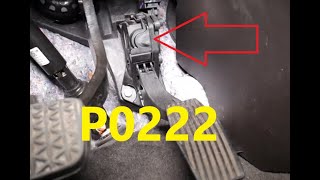
- Replacing the accelerator pedal position (APP) sensor. While the APP sensor is part of the same overall system, code P0222 specifically points to the sensor circuit at the throttle body, not the pedal.
Most Likely Causes
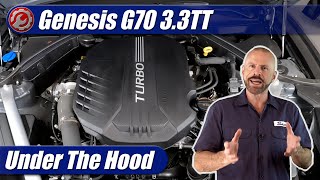
- Failed Electronic Throttle Body Assembly 🔴 High Probability → Shop Fuel Injection Throttle Body The throttle position sensors (TPS) are integrated into the throttle body and are not sold separately. This component is a known failure point on the 3.3T engine platform used in the G70 and its platform mates like the Kia Stinger. 🎬 Watch: A detailed breakdown of the 3.3T engine
How to confirm: Using a scan tool, monitor the live data for Throttle Position Sensor 'A' (TPS1) and 'B' (TPS2). For P0222, Sensor 'B' voltage will be stuck at a very low value (e.g., <0.25V) and will not change as the accelerator is pressed (with the key on, engine off). TPS1 and TPS2 have an inverse relationship; as one's voltage rises, the other's should fall.
Typical fix: Replace the entire electronic throttle body assembly. After replacement, a throttle relearn procedure is necessary.
Est. part cost: $250-$450 - Wiring Harness or Connector Issue 🟡 Medium Probability The engine bay of the 3.3T runs hot, which can make wiring and plastic connectors brittle over time. Vibration can also lead to chafing or loose connections.
How to confirm: Visually inspect the wiring harness and connector going to the throttle body for any signs of damage, corrosion, or loose pins. Perform a 'wiggle test' on the harness while monitoring the TPS 'B' voltage on a scan tool to see if the signal fluctuates.
Typical fix: Repair the damaged section of the wiring harness or clean/replace the connector.
Est. part cost: $10-$100 - Excessive Carbon Buildup ⚪ Low Probability As a direct-injection (GDi) engine, carbon can build up on the intake valves and throttle plate over time, potentially restricting the movement of the throttle blade and causing the sensor readings to be out of range.
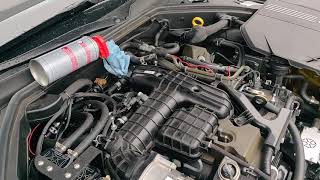
How to confirm: Remove the intake tube from the throttle body and visually inspect the throttle plate and bore for heavy carbon deposits that could restrict movement. A Hyundai TSB for other models (12-FL-003) validates cleaning as a first step for throttle-related issues. 🎬 See: How to clean the intake valves with spray
Typical fix: Clean the throttle body thoroughly with a dedicated throttle body cleaner and a soft brush. This is often attempted before replacing the part.
Est. part cost: $10-$20
Rare But Worth Checking
- Faulty Powertrain Control Module (PCM): → Shop Engine Control Module (ECM) This is very rare. The PCM should only be considered after all other possibilities, including the throttle body and wiring, have been definitively ruled out. One owner of a 2012 Genesis sedan reported a persistent P0222 even after replacing the pedal, throttle body, and ECU, indicating how difficult a rare wiring or module issue can be to trace.
Diagnosis Steps
- Connect an OBD-II scanner and confirm P0222 is present. Check for other related codes like P2135 or P2106.
- With the key in the 'ON' position (engine off), use the scanner's live data function to observe the voltage of both Throttle Position Sensor 'A' (TPS1) and 'B' (TPS2).
- Sensor 'A' should show a low voltage at rest (e.g., ~0.5V) and increase smoothly as the pedal is pressed. Sensor 'B' will often show the opposite (high voltage at rest, decreasing with pedal press). For P0222, you will likely see Sensor 'B' voltage stuck at an abnormally low value (<0.25V) that does not change.
- If the signal is stuck low, perform a visual inspection of the throttle body connector and its wiring harness. Look for any chafed wires, corrosion on the pins, or loose connections.
- As a low-cost first step, consider cleaning the throttle body. Heavy carbon buildup can sometimes cause the plate to stick, leading to sensor correlation faults.
- If the wiring appears intact and cleaning does not resolve the issue, the failure is almost certainly internal to the electronic throttle body assembly.
- Replace the throttle body assembly and the associated gasket.
- After installation, perform a throttle relearn procedure. A common method is to disconnect the battery for 15-30 minutes, reconnect, turn the ignition to 'ON' (engine off) for 10-15 seconds, then 'OFF' for 10-15 seconds, and repeat before starting. A scan tool provides the most reliable relearn.
- Clear all codes with the scan tool and perform a test drive to ensure the issue is resolved.
Parts You'll Likely Need
- Electronic Throttle Body Assembly
(OEM #35100-3L000)— This is the primary cause of code P0222 on this engine, as the internal throttle position sensors are not serviceable separately.
Trusted brands: Hyundai/Kia Genuine
OEM price range: $250-$622
Aftermarket price range: $150-$300 - Throttle Body Gasket
(OEM #35101-3L000)— It is best practice to replace the gasket whenever the throttle body is removed to ensure a proper seal and prevent vacuum leaks.
Trusted brands: Hyundai/Kia Genuine
OEM price range: $10-$20
Aftermarket price range: $5-$15
Related Codes That Often Appear With This One
- P2135 — This code means 'Throttle/Pedal Position Sensor/Switch 'A'/'B' Voltage Correlation'. It is often triggered alongside P0222 because the ECM sees a disagreement between the two internal throttle position sensors, which is a direct result of sensor 'B' failing.
- P2106 — This code means 'Throttle Actuator Control System - Forced Limited Power'. It is a common companion code that indicates the ECM has intentionally put the vehicle into 'limp mode' as a safety response to the fault detected by P0222.
- P2110 — This code means 'Throttle Actuator Control System - Forced Limited RPM'. Similar to P2106, this is a failsafe code triggered by the ECM when it detects a critical fault like P0222.
Technical Service Bulletins (TSBs) & Recalls
- TSB 12-FL-003: While not for the G70 specifically, this Hyundai TSB advises cleaning the Electronic Throttle Control (ETC) system for issues like rough idle before replacement, validating cleaning as a potential first step.
- TSB SA514: Issued for some 2022-2023 Hyundai/Kia models, this TSB addresses a cold-weather issue where the throttle plate could freeze, triggering code P2118 and limp mode. The fix was a software update, highlighting that ECM logic can be a factor in throttle-related codes.
Platform-Specific Known Issues
- Owner Experience: P0222, P2106, P2110 on a 2013 Genesis Coupe 3.8: While a different model, a user on the Gencoupe.com forums reported getting codes P0222, P2106, and P2110 simultaneously, resulting in limp mode. After cleaning the throttle body with no success, replacing the entire throttle body assembly resolved all codes and restored normal operation. The repair was performed DIY in under an hour, demonstrating the commonality of this failure mode across the Genesis brand.
Mechanic-Grade Diagnostic Values
- Throttle Position Sensor 'B' (TPS2) Voltage — expected: Decreases from ~5.0V at closed throttle to a lower voltage at wide-open throttle.. Failure: Voltage is stuck below 0.25V for more than 0.1 seconds.
- Throttle Position Sensor 'A' (TPS1) Voltage — expected: Increases from a low voltage (~0.5V) at closed throttle to a high voltage (~4.5V) at wide-open throttle.. Failure: While not the direct cause of P0222, its signal should be smooth and opposite to TPS2; a failure in both indicates a wider issue.
Scan Tool Commands That Help
- Hyundai/Kia GDS (Global Diagnostic System): Actuation Test > ETC Motor — To force the throttle motor to operate, verifying if the motor and its drive circuit are functional, which helps isolate the fault to the position sensors themselves.
- Professional Bi-Directional Scan Tool: Throttle Adaptation / Throttle Position Reset — This is a mandatory step after replacing the throttle body to make the ECU learn the closed, open, and intermediate positions of the new component. Failure to perform this can result in high or unstable idle.
Wiring & Ground Locations
- Main Engine Ground — A heavy gauge wire from the engine block to the vehicle's chassis, often located near the alternator or on the cylinder head.. A poor or corroded main engine ground can cause a host of electrical issues, including incorrect sensor readings and erratic actuator behavior. Verifying this ground is clean and tight is a crucial step in diagnosing any electronic fault, as it can cause voltage drops that mimic a sensor failure.
- ECM Pin 40 — Pin 40 on the Engine Control Module connector.. This pin is the ETC Motor Output (+), which controls the throttle motor. While not a sensor input, testing this pin can be part of an advanced diagnosis to rule out a driver failure in the ECM.
OEM Part Supersession History
35100-3L000→No supersession found.— This part number appears to be consistent for the specified vehicle range.
Heads up: Crucially, different engines (2.0T, 2.5T, 3.3T) used in the Genesis/Kia lineup have different, incompatible throttle bodies. You must verify the part number is 35100-3L000 for the 3.3T engine; do not rely on visual similarity.
Model Year Variations Within This Range
- 2019-2025: No significant variations have been identified for the 3.3T engine's electronic throttle body or its related diagnostics within this model year range. The part number 35100-3L000 applies across these years for the G70 3.3T.
Diagnostic Flowchart
Other Known Issues on This Vehicle
Issues unrelated to this code that are worth knowing about as an owner of this generation:
- Brake Vibration / Warped Rotors 🟠 Medium — Very common, often reported within 20,000-40,000 miles. Many owners attribute it to the OEM brake pad compound causing uneven deposits on the rotors, leading to a shaking steering wheel under braking. (Ref: TSB #18-01-005-G was issued for 2019 models to address brake pulsation on dealer stock vehicles.)
- Thin Paint / Clear Coat Peeling 🟡 Low — Common complaint, especially on early models and specific colors like white. Owners report paint chipping easily and, in some cases, clear coat peeling or fading prematurely. A class-action lawsuit was filed regarding this issue.
- Minor Interior Rattles 🟡 Low — Frequently mentioned in owner forums. Common sources include the sunroof assembly and the plastic housing behind the rearview mirror. Often addressed under warranty.
- Left Turbocharger Oil Feed Pipe Leak 🔴 High — Less common than other issues but a significant safety risk. The oil feed pipe can deteriorate, leaking oil onto the hot turbocharger, which can cause a fire. (Ref: Recall for 2018-2023 Kia Stingers and 2019-2020 Kia K900s with the 3.3T engine (NHTSA Recall No. 23V-112). While not a Genesis recall, it applies to the same engine.)
- Infotainment System Glitches 🟡 Low — Reported by some owners, particularly on pre-facelift models. Issues include Bluetooth connectivity problems, screen freezing, or Apple CarPlay/Android Auto disconnecting. Often resolved with a software update.
Used vs. New Parts: Buying Guide for This Vehicle
When a used part is the smart pick: For this repair, a used OEM throttle body from a reputable recycler is often a smart and cost-effective choice, providing a genuine factory part for significantly less than a new one from a dealer.
Donor-vehicle mileage cap: roughly under 80000 miles for the part to have meaningful remaining life.
What to inspect on the donor part:
- Absolutely confirm the part number is 35100-3L000.
- Obtain the VIN or, at minimum, the year/model of the donor vehicle to ensure it came from a 3.3T engine.
- Inspect the electrical connector for any broken plastic, bent pins, or signs of green or white corrosion.
- Look inside the throttle bore; the butterfly valve should be relatively clean and move without sticking.
OEM-only on this vehicle (don't cheap out):
- Electronic Throttle Body
Brands owners have reported issues with on this vehicle:
- Unbranded or no-name units. While major brands like Dorman or Cardone may offer replacements, their long-term reliability on this specific platform is not as well-documented in owner forums as OEM parts. Given the critical safety function (preventing limp mode), sticking with new or used OEM is the safer recommendation.
Real Owner Stories
Aggregated from forums and TSBs cited above. Mileages and costs reflect what owners reported in those sources.
2013 Genesis Coupe 3.8
Symptoms: Vehicle entered limp mode with codes P0222, P2106, and P2110 appearing simultaneously.
What fixed it: Replacing the entire throttle body assembly after cleaning the original unit failed to resolve the issue.
Source hint: vehicle_specific_issues: Owner Experience on Gencoupe.com forums
Related OBD-II Codes
Frequently Asked Questions
Does TSB 12-FL-003 mean I should clean the throttle body on my G70 before replacing it?
Can I just replace the Throttle Position Sensor (TPS) on my 3.3T engine to fix P0222?
Is there a TSB for throttle issues in cold weather for the G70 platform?
What is the correct throttle relearn procedure for the G70 after replacing the throttle body?
Are there any other common G70 issues I should look out for while fixing this code?
Helpful Videos
We Have This Part in Stock

The information in this article is provided for general reference and educational purposes only. Vehicle specifications, procedures, and part compatibility can vary by production date, trim level, and region. Always consult your vehicle's factory service manual and verify part numbers before purchasing or performing repairs. Safety-critical components such as airbags, seat belts, and braking systems should be installed by a qualified professional.
- Genesis G70:
- 🧭 Diagnostic Flowchart
- 🎬 Helpful Videos
- 🛍️ Shop This Part
- What's Unique About the 2019-2025 Genesis G70
- Symptoms You May Notice
- Most Likely Causes
- Rare But Worth Checking
- Diagnosis Steps
- Parts You'll Likely Need
- Related Codes That Often Appear With This One
- Technical Service Bulletins (TSBs) & Recalls
- Platform-Specific Known Issues
- Mechanic-Grade Diagnostic Values
- Scan Tool Commands That Help
- Wiring & Ground Locations
- OEM Part Supersession History
- Model Year Variations Within This Range
- Other Known Issues on This Vehicle
- Used vs. New Parts: Buying Guide for This Vehicle
- Real Owner Stories
- 2013 Genesis Coupe 3.8
- Related OBD-II Codes
- Frequently Asked Questions
- 🎟️ Get 5% Off