

P0222 on 2015-2019 Subaru Outback 2.5L: Throttle Position Sensor Circuit Low Fixes
On a 2015-2019 Subaru Outback, code P0222 is most often caused by a failing electronic throttle body assembly. The throttle position sensor is integrated and not sold separately. Expect to pay $300-$500 for a new OEM throttle body, with DIY replacement being moderately difficult. After replacement, an idle relearn procedure is mandatory.
- P0222 on a 2015-2019 Outback almost always points to an issue with the electronic throttle body.
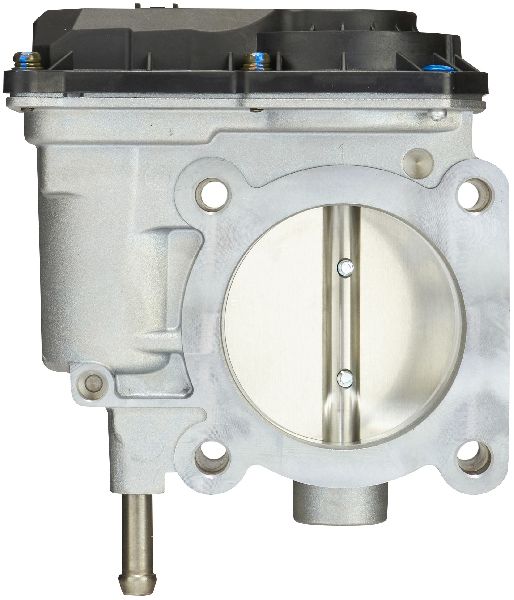
- The throttle position sensor is not sold separately; you must replace the entire throttle body assembly (OEM Part # 16112AA380 or 16112AA38A).
- Before replacing parts, inspect the wiring and consider cleaning the throttle body first, as carbon buildup can cause the code.
- An 'Idle Relearn' procedure is NOT optional after cleaning or replacing the throttle body; skipping it will cause idling problems.
- Do not drive the vehicle extensively with this code, as it can enter a low-power limp mode unexpectedly, creating a safety hazard.
What's Unique About the 2015-2019 Subaru Outback
For this generation of Subaru Outback with the FB25 engine, the throttle position sensor (TPS) that triggers P0222 is not a separate, replaceable part. It is integrated into the electronic throttle body assembly. While wiring issues can be a cause, complete failure of the electronic throttle body is a known issue on these platforms. Simply cleaning the throttle body is a common first step, but if the internal electronics have failed, the entire unit must be replaced. A mandatory 'idle relearn' procedure must be performed after cleaning or replacement to prevent erratic idle.
Symptoms You May Notice
- Check Engine Light is on
- Flashing cruise control light on the dashboard
- Vehicle enters 'limp mode' with drastically reduced engine power
- Hesitation or stumbling during acceleration
- Unresponsive or delayed throttle response
- Rough or unstable idle
- Engine may stall when coming to a stop
- Difficulty starting the engine
- Replacing only the accelerator pedal sensor without testing the throttle body circuits.
- Assuming the code is a simple sensor swap, not realizing the entire throttle body must be replaced on this vehicle.
- Replacing the throttle body without first checking for a simpler wiring or connector fault.
Most Likely Causes
- Failing Electronic Throttle Body Assembly 🔴 High Probability → Shop Fuel Injection Throttle Body The throttle position sensor is integrated into the throttle body, and failure of the internal electronics is a common wear item on modern Subarus. The precision circuitry for the TPS can fail, leading to voltage readings below the specified range.
How to confirm: After ruling out wiring issues, use a scan tool to monitor the voltage of TPS 'A' and 'B' while pressing the accelerator. If Sensor 'B' voltage remains abnormally low (e.g., <0.2V) or doesn't change smoothly while Sensor 'A' does, the unit has likely failed. 🎬 Watch: How to test and replace the electronic throttle body A user on the ScannerDanner forum diagnosed P0122 and P0222 on a 2016 Outback by scoping the 5v reference and sensor data.
Typical fix: Replace the entire electronic throttle body assembly. An idle relearn procedure is required after replacement.
Est. part cost: $300-$500 for an OEM part - Dirty or Sticking Throttle Body 🟡 Medium Probability → Shop Fuel Injection Throttle Body Carbon and oil vapor buildup from the PCV system can restrict the movement of the throttle plate, causing the sensor to report an incorrect position at idle or low throttle angles. This can prevent the plate from closing fully, causing a mismatch between expected and actual sensor voltage.
How to confirm: Visually inspect the throttle bore and plate for significant black carbon buildup. The plate may feel sticky or not close smoothly. This should be done before deciding to replace the entire unit.
Typical fix: Clean the throttle body bore and plate with a dedicated throttle body cleaner and a soft cloth. Be careful not to damage the electronic components. An idle relearn procedure is required after cleaning.
Est. part cost: $10-$20 for cleaner - Wiring or Connector Issue ⚪ Low Probability Vibrations and heat in the engine bay can lead to chafed wires or corrosion in the connector pins at the throttle body over time. A short to ground in the signal wire is a specific cause for a 'low input' code like P0222.
How to confirm: Visually inspect the wiring harness leading to the throttle body for any signs of damage. Unplug the connector and check for corrosion or bent pins. Use a multimeter to check for continuity and for a short to ground on the signal wire ('B' circuit).
Typical fix: Repair the damaged section of wiring or clean/replace the connector pigtail. A replacement pigtail connector is available as Standard Motor Products #S2817.
Est. part cost: $15-$50
Rare But Worth Checking
- Faulty Accelerator Pedal Position (APP) Sensor: → Shop Accelerator Pedal Assembly While P0222 points to the throttle body sensor, the system is related. The APP sensor also has redundant circuits, and a failure there can sometimes cause confusing throttle-related codes. However, this is less likely than the throttle body itself.
- Faulty Engine Control Module (ECM): → Shop Engine Control Module (ECM) This is extremely rare. The ECM is the last component to suspect after all other possibilities, including wiring and the 5V reference circuit, have been exhaustively tested.
Diagnosis Steps
- Read the code with an OBD-II scanner and confirm P0222 is present. Note any other codes like P0122, P0223, or P2135.
- With the key on and engine off, use a scan tool to observe live data for both Throttle Position Sensor 'A' and 'B'.
- Slowly press and release the accelerator pedal. Both sensor voltage readings should change smoothly. P0222 suggests Sensor 'B' will be stuck at a very low voltage (typically <0.5V).
- If the data is erratic or stuck low, turn the vehicle off.
- Visually inspect the wiring harness leading to the throttle body for any visible damage, chafing, or melting.
- Disconnect the throttle body connector and inspect the pins for corrosion, moisture, or damage. A wiggle test on the harness while monitoring live data can help identify intermittent shorts.
- If wiring looks good, remove the air intake duct and inspect the throttle body for heavy carbon buildup that could be preventing the throttle plate from closing properly.
- If dirty, clean the throttle body thoroughly with appropriate cleaner and a soft cloth. Reconnect everything, perform the idle relearn procedure, and see if the code returns.
- If the code persists or the throttle body was clean, the electronic throttle body assembly is the most likely culprit and should be replaced.
- After replacement, perform the mandatory idle relearn procedure to prevent high or erratic idle.
Parts You'll Likely Need
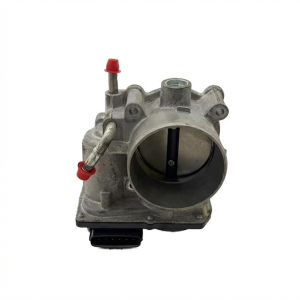
- Electronic Throttle Body Assembly
(OEM #16112AA380, 16112AA38A)— This is the most common failure for code P0222 on this platform, as the faulty sensor is integrated into this assembly.
Trusted brands: Hitachi (OEM supplier, part ETB0024), Subaru (Genuine OEM), Bosch, Denso
OEM price range: $350-$500
Aftermarket price range: $170-$350
Related Codes That Often Appear With This One
- P0122 — This code is for 'Throttle/Pedal Position Sensor 'A' Circuit Low'. If both P0122 and P0222 appear together, it strongly points to an issue affecting the entire throttle body, such as a loss of the 5V reference voltage or a major connector/ground issue.
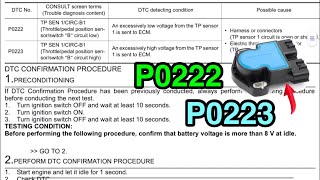
- P0223 — This is for 'Throttle/Pedal Position Sensor 'B' Circuit High'. Seeing intermittent P0222 and P0223 codes together strongly suggests a wiring problem (like a frayed wire making intermittent contact) or a failing sensor sending erratic signals.
- P2135 — This code means 'Throttle/Pedal Position Sensor/Switch 'A'/'B' Voltage Correlation'. It is set when the ECM sees that the signals from Sensor 'A' and Sensor 'B' do not agree with each other, which is a direct consequence of the fault causing P0222.
Platform-Specific Known Issues
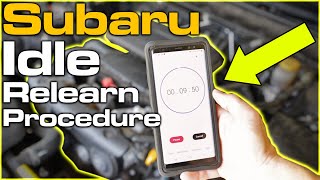
- Mandatory Idle Relearn Procedure: An 'Idle Relearn' procedure is mandatory after cleaning, disconnecting, or replacing the throttle body. Failure to do so will result in a high or erratic idle. The procedure allows the ECU to learn the new closed-throttle position. A common method is: 1) Disconnect the battery for 30 minutes. 2) Reconnect. 3) Turn key to 'ON' (do not start) for 10-15 seconds. 4) Start the engine and let it idle with no accessories on for 10 minutes. The idle may fluctuate; do not touch the accelerator. 5) Turn engine off for 20+ seconds. 6) Turn key to 'ON' again for 10-15 seconds. 7) Restart and idle for another 5 minutes. The relearn should then be complete. 🎬 Watch: A step-by-step walkthrough of the Subaru idle relearn procedure
Mechanic-Grade Diagnostic Values
- 5V Reference Voltage at Throttle Body Connector — expected: 4.8V to 5.2V with key on, engine off (KOEO).. Failure: Voltage below 4.8V or missing entirely indicates a wiring issue or a problem with the ECM.
- TPS 'B' Signal Voltage (Live Data or Backprobe) — expected: Should sweep smoothly from ~0.5V at closed throttle to ~4.5V at wide-open throttle (WOT).. Failure: Voltage is stuck below the specified threshold (e.g., < 0.3V) and does not change when the accelerator is pressed.
- TPS Resistance Check (Main vs. Sub) — expected: When opening the throttle plate manually (with connector unplugged), the resistance for the MAIN sensor circuit should start high and go low. The SUB sensor circuit (related to P0222) should do the opposite: start low and go high.. Failure: Resistance does not change, jumps erratically, or shows an open circuit (infinite resistance).
Hidden / Shadow Codes Worth Checking
- Mode $06 Test Results: This is not a 'shadow code' but a function on advanced scan tools that shows the results of the ECM's self-tests for non-continuous monitors. It can reveal if a component like the TPS is nearing a failure threshold before a persistent DTC is set. (see via Use a professional scan tool or an app with Mode $06 capabilities. Navigate to 'On-Board Monitoring Test Results'.)
Scan Tool Commands That Help
- Subaru Select Monitor (or equivalent professional scan tool): Current Data Display / Live Data — This is the primary diagnostic step. Monitor the PIDs 'Throttle Sensor Voltage' for both sensors (VTA1 and VTA2) and 'Throttle Opening Angle' while operating the accelerator pedal to see if the 'B' circuit (VTA2) is stuck low or not responding.
Wiring & Ground Locations
- Throttle Body Connector (E57 / B315) — On the electronic throttle body itself, located between the air filter housing and the intake manifold.. This 6-pin connector provides power, ground, and signal paths for both throttle position sensors. Corrosion or a loose pin here is a direct cause of P0222. The typical pinout functions are: 2 pins for the throttle motor, 1 for 5V reference, 1 for sensor ground, 1 for TPS 'A' signal, and 1 for TPS 'B' signal.
- Sensor Signal Shielding Ground — This is a thin wire wrapped around the two throttle position signal wires within the harness, which is then connected to ground at one end.. This shield protects the low-voltage TPS signals from electromagnetic interference from other components. If this shield is damaged during a repair or chafes through, it can cause erratic voltage readings and trigger correlation codes or intermittent low/high input codes.
- Main Engine and Chassis Grounds — Key grounds are typically located on the intake manifold, the engine block itself (often near the alternator), and where the negative battery cable bolts to the chassis.. A poor engine or sensor ground can cause a floating reference, leading to incorrect voltage readings. While less common than a failed sensor, verifying that main grounds are clean and tight is a crucial step in diagnosing any electronic fault.
OEM Part Supersession History
16112AA380→16112AA38A— Part revisions are common to improve reliability or make minor manufacturing changes. The letter change at the end of the part number typically signifies a newer revision.
Heads up: Always verify the correct part number with a Subaru dealer using the vehicle's VIN before purchasing. While revisions are often backward compatible, it is not guaranteed.
Diagnostic Flowchart
Used vs. New Parts: Buying Guide for This Vehicle
When a used part is the smart pick: A used throttle body is a significant gamble due to the integrated electronics being a common failure point. It should only be considered if it comes from a very low-mileage donor vehicle (e.g., under 50,000 miles) and offers substantial cost savings over a new OEM part.
Donor-vehicle mileage cap: roughly under 50000 miles for the part to have meaningful remaining life.
What to inspect on the donor part:
- Check the connector pins for any signs of corrosion (green or white powder) or bent pins.
- Manually move the throttle plate (if possible); it should feel smooth with no sticking or binding points.
- Ensure there is no physical damage to the housing or connector.
- Ask for the donor vehicle's VIN to check its history if possible.
OEM-only on this vehicle (don't cheap out):
- Electronic Throttle Body Assembly: Due to the sensitive, integrated nature of the throttle position sensors and the requirement for precise operation with the ECM, aftermarket units have a higher risk of premature failure or causing compatibility issues. Sticking with Genuine Subaru or the verified OEM supplier (Hitachi) is strongly recommended.
Aftermarket brands forum-validated for this vehicle:
- Hitachi (Astemo): Hitachi is the original equipment manufacturer for many Subaru parts. Ensure you are buying the exact part number specified for the 2015-2019 Outback, not a generic part like ETB0024 which fits other makes.
Brands owners have reported issues with on this vehicle:
- Unbranded or 'white-box' parts from online marketplaces. While the price is tempting, these often use lower-quality internal components that can fail quickly, leading you to do the job a second time.
Real Owner Stories
Aggregated from forums and TSBs cited above. Mileages and costs reflect what owners reported in those sources.
2020 Subaru Outback Premium
Symptoms: Dropped into limp mode while driving; multiple powertrain codes including P0222.
What fixed it: The user identified a known issue with the thermal control valve and had it repaired for free at a Subaru dealership, which resolved the problem.
Cost: $0
Source hint: Reddit r/Subaru_Outback, from a post titled '2020 Subaru Outback TCV issue and CVT Transmission Flush.'
2016 Subaru Outback 2.5i Premium
Symptoms: The car set codes P0122 and P0222 once, causing the car to go into fail-safe mode.
What fixed it: The source is a diagnostic discussion analyzing the sensor signals with an oscilloscope and does not state the final repair.
Source hint: ScannerDanner Forum - '2016 Subaru Outback 2.5i Premium 5 v reference irregularity P0122 and P0222'
Related OBD-II Codes
Frequently Asked Questions
After cleaning or replacing the throttle body on my Outback, is there a special procedure I need to follow?
My 2016 Outback is showing both P0222 and P0122. Is it common for these codes to appear together?
What is the most likely part I'll need to fix a P0222 code on my 2015-2019 Outback?
Can I just clean my throttle body to fix P0222 instead of replacing it?
My Outback went into 'limp mode' and the cruise control light is flashing. Is this related to P0222?
I've confirmed the wiring connector to the throttle body is bad. Is there a specific part number for the replacement pigtail?
Does this P0222 throttle body issue affect other Subarus besides the Outback?
Helpful Videos


Used OEM Parts in Stock
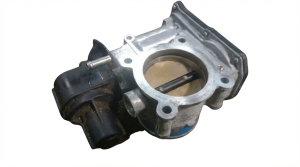
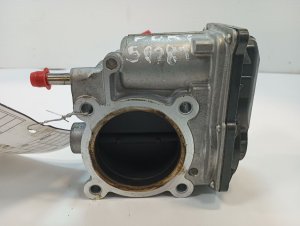
New Aftermarket Parts Available
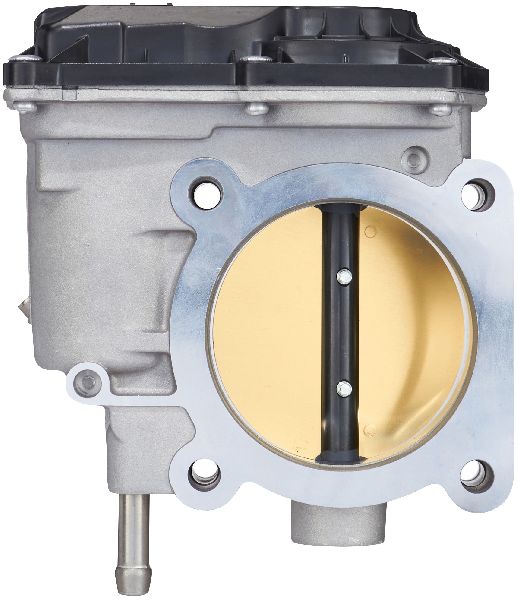


The information in this article is provided for general reference and educational purposes only. Vehicle specifications, procedures, and part compatibility can vary by production date, trim level, and region. Always consult your vehicle's factory service manual and verify part numbers before purchasing or performing repairs. Safety-critical components such as airbags, seat belts, and braking systems should be installed by a qualified professional.
- Subaru Outback:
- 🧭 Diagnostic Flowchart
- 🎬 Helpful Videos
- 🛍️ Shop This Part
- What's Unique About the 2015-2019 Subaru Outback
- Symptoms You May Notice
- Most Likely Causes
- Rare But Worth Checking
- Diagnosis Steps
- Parts You'll Likely Need
- Related Codes That Often Appear With This One
- Platform-Specific Known Issues
- Mechanic-Grade Diagnostic Values
- Hidden / Shadow Codes Worth Checking
- Scan Tool Commands That Help
- Wiring & Ground Locations
- OEM Part Supersession History
- Used vs. New Parts: Buying Guide for This Vehicle
- Real Owner Stories
- 2020 Subaru Outback Premium
- 2016 Subaru Outback 2.5i Premium
- Related OBD-II Codes
- Frequently Asked Questions
- 🎟️ Get 5% Off