

P0223 on 2007-2014 Ford Edge 3.5L: Throttle Body Failure Causes, Symptoms, and Fixes
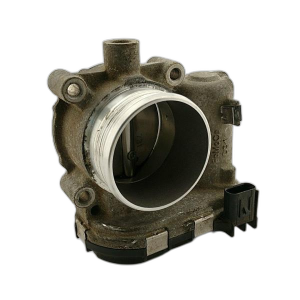
Code P0223 on a 2007-2014 Ford Edge almost always means the electronic throttle body has failed, a very common issue for this vehicle. This will cause a sudden loss of power ('limp mode') and turn on the wrench light. The only reliable fix is to replace the entire throttle body assembly, which costs about $150-$300 for the part. Cleaning the old unit will not fix this electronic fault.
- P0223 on a 2007-2014 Edge is almost certainly a failed electronic throttle body, a known widespread defect.
- The main symptom is a sudden, dangerous loss of power ('limp mode') with an illuminated wrench light.
- Do not attempt to just clean the throttle body; the problem is internal electronics and requires full replacement.
- After replacing the part, a KAM reset (battery disconnect) or scan tool relearn is necessary.
- Always verify you have the correct part number for your specific model year (2007-2010 vs. 2011-2014).
What's Unique About the 2007-2014 Ford Edge
The electronic throttle body on the 3.5L V6 used in the Ford Edge is a well-documented, widespread failure point. The issue was so common that Ford issued a Customer Satisfaction Program (13N03) extending the warranty on this part to 10 years or 150,000 miles due to contamination on the internal electrical contacts. While this warranty has now expired for all 2007-2014 models, it confirms that the throttle body itself is the overwhelmingly likely culprit for this code, not a simple sensor or wiring problem. Owners typically experience a sudden and alarming loss of power, known as 'limp mode', accompanied by a wrench light on the dash. At one point, the failure was so frequent that a Ford dealer reported a national backorder of 7,000 units.
Generation note: This guide covers the entire first generation Ford Edge (2007-2010) and its facelift (2011-2014). The throttle body failure is a known issue across this whole period. While the fundamental problem is the same, be aware that the OEM part number for the throttle body is different for 2007-2010 models versus 2011-2014 models.
Symptoms You May Notice
- Sudden and severe loss of engine power (Limp Mode).
- Wrench warning light illuminated on the dashboard.
- Check Engine Light illuminated.
- Unstable, rough, or high idle.
- Engine stalling, especially when coming to a stop.
- Poor or hesitant acceleration.
- Vehicle will not accelerate at all, even when pressing the gas pedal.
- Car may crank for several seconds before starting after a limp mode event.
- Replacing only a throttle position sensor (The sensors are integrated and not sold separately for this vehicle).
- Replacing the accelerator pedal assembly (While it has position sensors, it is a different component and typically sets different codes).
- Cleaning the throttle body (This may help with a sticky throttle plate or rough idle due to carbon, but it will not fix the internal electronic failure that causes code P0223 and limp mode).
Most Likely Causes
- Failed Electronic Throttle Body Assembly 🔴 High Probability → Shop Fuel Injection Throttle Body A known manufacturing defect led to contamination, often from oil vapor via the PCV system, on the throttle body's internal electrical contacts, causing intermittent signal loss. Ford acknowledged this with Customer Satisfaction Program 13N03.
How to confirm: Scan the vehicle for codes P0223, often accompanied by P0122, P2111, or P2112. The primary symptom is the vehicle entering 'limp mode' with the wrench light on. Cleaning the unit rarely works; if the symptoms are present, the part has failed internally and must be replaced.
Typical fix: Replace the entire electronic throttle body assembly. After replacement, a 'Keep Alive Memory' (KAM) reset or throttle relearn procedure must be performed.
Est. part cost: $150-$300
Rare But Worth Checking
- Wiring Harness Damage: While far less common than throttle body failure for this specific code, it's worth visually inspecting the wiring harness and connector going to the throttle body for any signs of chafing, corrosion, or loose pins before replacing the part.
- Jammed or Improperly Placed Floor Mats: In some cases, a floor mat can physically obstruct the accelerator pedal's movement, causing a discrepancy between pedal position and throttle position that may trigger various codes. A Ford dealership has also anecdotally cited the close proximity of the gas and brake pedals causing drivers to press both, which can trip a sensor and illuminate the wrench light.
- Powertrain Control Module (PCM) Fault: → Shop Engine Control Module (ECM) This is extremely rare. The PCM should only be considered a potential cause after the throttle body has been replaced with a known-good part and the wiring has been confirmed to be intact.
Diagnosis Steps
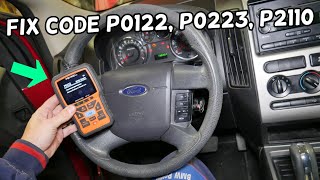
- Confirm the presence of code P0223 🎬 Watch: How to fix codes P0122, P0223, and P2110. using an OBD-II scanner. Check for other related codes like P2111, P2112, or P0122.
- Note the symptoms. If the vehicle is in 'limp mode' with the wrench light on, a failed throttle body is the most probable cause.
- Visually inspect the electrical connector and wiring harness leading to the throttle body. Look for any obvious damage, corrosion, or loose connections.
- Given the extremely high failure rate of this part on the Ford Edge, if codes and symptoms point to the throttle body, the most effective step is to replace the assembly.
- After replacing the throttle body, perform a KAM (Keep Alive Memory) reset. This can be done with a capable scan tool or by disconnecting the battery's negative terminal for at least 15-30 minutes.
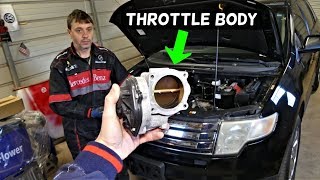
- Perform a throttle relearn procedure. 🎬 Watch: How to perform a proper electronic throttle body calibration. A common manual method is to turn the ignition to 'ON' (engine off) for 2-3 minutes, then turn 'OFF' for 1 minute. Then, start the engine and let it idle without touching the accelerator for 10-15 minutes as it warms up to operating temperature.
- Alternatively, a more thorough manual relearn involves: letting the engine idle for one minute at normal temp, turning the A/C on and idling for another minute, then putting the car in Drive (with foot on brake) and idling for one more minute before driving.
Parts You'll Likely Need
- Electronic Throttle Body Assembly
(OEM #AT4Z-9E926-B (for 2011-2014, supersedes AT4Z-9E926-A), 7T4Z-9E926-FA (for 2007-2010))— This is the root cause of the problem in the vast majority of cases due to a known design flaw. The internal electronics fail, causing the P0223 code and limp mode.
Trusted brands: Motorcraft, Bosch, Standard Motor Products, Hitachi
OEM price range: $180-$300
Aftermarket price range: $150-$250
Related Codes That Often Appear With This One
- P2111 — Indicates 'Throttle Actuator Control System - Stuck Open'. This code is frequently stored alongside P0223 as the PCM detects a conflict between the commanded and actual throttle position.
- P2112 — Indicates 'Throttle Actuator Control System - Stuck Closed'. Similar to P2111, this points directly to a malfunctioning throttle body.
- P0122 — Indicates 'Throttle/Pedal Position Sensor 'A' Circuit Low Input'. It's common for both sensor circuits ('A' and 'B') to log faults when the throttle body fails.
- P2110 — Indicates 'Throttle Actuator Control System - Forced Limited RPM'. This is the code that directly corresponds to the PCM forcing the engine into 'limp mode'.
Technical Service Bulletins (TSBs) & Recalls
- Customer Satisfaction Program 13N03 - Extended warranty coverage for the electronic throttle body due to contamination of internal contacts causing intermittent electrical connectivity. The program authorized dealers to replace the throttle body at no charge if it was diagnosed as the cause of the failure within 10 years or 150,000 miles.
- TSB Bulletin #TSB 16-0163 - While issued for the Transit Connect, this manufacturer bulletin highlights that P0223 can be associated with various drivability issues and other DTCs such as P0122, P2111, and P2112, reflecting common Ford throttle system failure patterns.
Platform-Specific Known Issues
- Ford's Customer Satisfaction Program 13N03 was issued specifically to address the high rate of throttle body failures on this and other models. It provided an extended warranty (10 years/150,000 miles) for a one-time replacement. This program has now expired for the 2007-2014 model years, but its existence confirms the widespread nature of the problem.
- Owner experiences frequently describe the failure happening without warning at highway speeds, creating a dangerous situation as the vehicle rapidly decelerates. Restarting the car often temporarily clears the fault, but it inevitably returns.
Mechanic-Grade Diagnostic Values
- Throttle Position Sensor (TPS) Voltage — expected: Smoothly increases from ~0.5V (closed) to ~4.5V (wide open).. Failure: Code P0223 is set when the PCM sees a voltage persistently above the expected maximum, often over 4.5 volts.
- PCM Connector C175E, Pin 16 (TP1 Signal) — expected: Voltage should correspond to the TPS 'A' sensor reading.. Failure: No voltage or erratic voltage when testing continuity back to the throttle body connector.
- PCM Connector C175E, Pin 4 (ETCRTN - Signal Return) — expected: Should provide a stable ground reference for the TPS sensors.. Failure: High resistance to ground, indicating a bad ground connection which can cause high voltage codes like P0223.
Scan Tool Commands That Help
- FORScan: PCM - Reset All Adaptations / Clear Transmission Adaptive Tables / KAM Reset — This function should be used after replacing the throttle body to clear the Keep Alive Memory (KAM). This forces the PCM to relearn idle and throttle position values with the new part, which is essential for proper operation.
- Ford IDS (Integrated Diagnostic System): Throttle Body Relearn Procedure — The official dealer tool has a specific guided function to perform the relearn after a new throttle body is installed. This is the most reliable method to ensure the PCM correctly calibrates the new component.
Wiring & Ground Locations
- C175E — This is one of the main connectors at the Powertrain Control Module (PCM).. Pin 4 is the signal return (ground) for the throttle position sensor, and Pin 16 is the signal wire for TPS 'A'. A poor connection at this connector or a wiring fault between here and the throttle body can cause P0223.
- G103 / G104 — Common Ford engine compartment ground points, often located on the frame rail or inner fender in the engine bay, sometimes near the core support.. The PCM and its sensors rely on clean ground connections. A corroded or loose main engine ground at G103 or G104 can create a floating ground reference, causing sensor voltage readings to be artificially high and triggering codes like P0223.
Real Owner Repair Stories
- YouTube Channel 'Auto Repair Guys' (2009 Ford Edge) — Check engine light on, no throttle response when pressing the gas pedal, car starts but won't accelerate.
❌ Tried (didn't work) Cleaning the original throttle body did not resolve the issue.
✅ What actually fixed it Replacing the entire electronic throttle body assembly and then clearing the codes with an OBD-II scanner restored full functionality and fixed codes P0122, P0223, and P2110. - NHTSA ODI #11467242 — An owner of a similar Ford platform reported that after running a diagnostics test, the TAC system was found to be faulty with codes P0122, P0223, and P0110. The vehicle would start and idle briefly but would die while driving, requiring the driver to pull over and use hazards.
OEM Part Supersession History
AT4Z-9E926-A→AT4Z-9E926-B— Revision by manufacturer to improve reliability.
Heads up: The -B revision is the current replacement for the -A part.7T4Z-9E926-EA→7T4Z-9E926-FA— Revision by manufacturer to improve reliability.
Heads up: The -FA revision is the current replacement for the -EA part.
Model Year Variations Within This Range
- 2007-2010 vs 2011-2014: The first generation Ford Edge received a significant facelift for the 2011 model year. This included cosmetic updates, a redesigned interior with the MyFord Touch system, and different part numbers for the electronic throttle body. The 2007-2010 models use part number 7T4Z-9E926-FA, while the 2011-2014 models use AT4Z-9E926-B.
Diagnostic Flowchart
Used vs. New Parts: Buying Guide for This Vehicle
When a used part is the smart pick: For this specific repair, a used part from a junkyard is almost never a smart choice. The P0223 code on a Ford Edge is overwhelmingly caused by a known design flaw in the original electronic throttle body, leading to internal electronic failure. A used part of the same vintage is highly likely to have the same defect and could fail at any time.
Donor-vehicle mileage cap: roughly under 10000 miles for the part to have meaningful remaining life.
What to inspect on the donor part:
- If considering used is unavoidable, only select a part from a very low-mileage, late-model-year donor (e.g., a 2014 model).
- Verify the part number is the latest revision (e.g., AT4Z-9E926-B for 2011-2014 models).
- Inspect the electrical connector pins for any signs of corrosion, damage, or moisture.
OEM-only on this vehicle (don't cheap out):
- Electronic Throttle Body
Aftermarket brands forum-validated for this vehicle:
- Motorcraft (OEM)
- Hitachi
- Bosch
- Dorman OE FIX (specifically mentions upgraded non-contact sensors and seals to prevent common failure modes)
Brands owners have reported issues with on this vehicle:
- Unbranded, no-name parts from online marketplaces should be avoided. The complexity of the electronics and the critical safety function of this part make it a poor candidate for budget, unverified brands.
Real Owner Stories
Aggregated from forums and TSBs cited above. Mileages and costs reflect what owners reported in those sources.
2007 Ford Edge SE
Symptoms: While driving on the highway, the car seemingly lost all power, and a ton of dash lights lit up, including the wrench light. After an initial replacement attempt, the car had high/erratic RPMs at idle (around 1200) and threw codes P0122 and P0223.
What fixed it: The owner had replaced the electronic throttle body but initially forgot to reconnect the power to the new part. Properly connecting the new assembly resolved the issue.
Source hint: reddit.com - 2007 FORD EDGE SE - Electronic Throttle Body failure
2011 Ford Edge — 115000 miles
Symptoms: The wrench symbol lit up on the dash and the car went into limp mode.
What fixed it: The community consensus pointed to replacing the failed electronic throttle body.
Source hint: Reddit (r/MechanicAdvice) - '2011 Ford Edge Wrench Light/Limp Mode'
2013 Ford Edge Sport
Symptoms: The vehicle would go into limp mode with the wrench icon illuminated, but the issue would temporarily go away after shutting off and restarting the car.
What fixed it: The owner identified the throttle body as the most likely cause, noting it's a very common problem.
Source hint: Reddit (r/Ford) - '2013 Ford Edge Limp Mode'
2013 Ford Edge
Symptoms: The owner first noticed the vehicle was shifting hard. A subsequent diagnosis by a shop confirmed the throttle body was bad.
What fixed it: The vehicle was taken to a shop to have the throttle body replaced.
Source hint: FordEdgeForum.com - Thread 'Throttle Body Service or Failure - 3.5L'
2011 Ford Edge
Symptoms: Vehicle loses power and the wrench light comes on.
What fixed it: The owner attempted to order a new throttle body from Ford in 2016 but was told there was a backorder with 7,000 people on the waiting list, indicating replacement was the required fix.
Source hint: CarComplaints.com - '2011 Ford Edge Loses Power, Wrench Light On'
Related OBD-II Codes
Frequently Asked Questions
My 2013 Ford Edge just went into 'limp mode' with the wrench light on. Is this covered by a recall or extended warranty?
Why is the throttle body failure so common on the 3.5L Ford Edge?
Can I just clean the throttle body to fix the P0223 code on my Edge?
After replacing the throttle body myself, what procedures do I need to perform?
My Edge suddenly lost all power on the highway. Is this a typical symptom for this problem?
Are other Ford vehicles with the 3.5L V6 also affected by this throttle body issue?
Helpful Videos

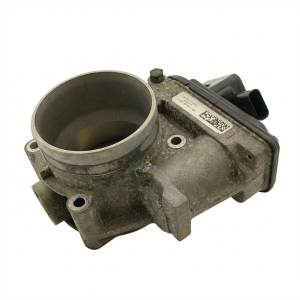
Used OEM Parts in Stock
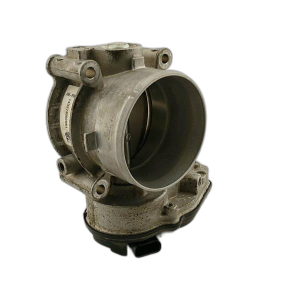
New Aftermarket Parts Available


The information in this article is provided for general reference and educational purposes only. Vehicle specifications, procedures, and part compatibility can vary by production date, trim level, and region. Always consult your vehicle's factory service manual and verify part numbers before purchasing or performing repairs. Safety-critical components such as airbags, seat belts, and braking systems should be installed by a qualified professional.
- Ford Edge:
- 🧭 Diagnostic Flowchart
- 🎬 Helpful Videos
- 🛍️ Shop This Part
- What's Unique About the 2007-2014 Ford Edge
- Symptoms You May Notice
- Most Likely Causes
- Rare But Worth Checking
- Diagnosis Steps
- Parts You'll Likely Need
- Related Codes That Often Appear With This One
- Technical Service Bulletins (TSBs) & Recalls
- Platform-Specific Known Issues
- Mechanic-Grade Diagnostic Values
- Scan Tool Commands That Help
- Wiring & Ground Locations
- Real Owner Repair Stories
- OEM Part Supersession History
- Model Year Variations Within This Range
- Used vs. New Parts: Buying Guide for This Vehicle
- Real Owner Stories
- 2007 Ford Edge SE
- 2011 Ford Edge — 115000 miles
- 2013 Ford Edge Sport
- 2013 Ford Edge
- 2011 Ford Edge
- Related OBD-II Codes
- Frequently Asked Questions
- 🎟️ Get 5% Off