

P0234 on 2016-2022 Chevrolet Malibu 1.5L: Turbo Overboost Causes and Fixes
On a 2016-2022 Malibu with the 1.5L turbo, code P0234 is most often caused by a faulty Turbocharger Wastegate Regulator Solenoid Valve (GM Part #12684144) that sticks due to frozen condensation, especially in cold weather. This is a well-documented issue in GM TSB PIP5812C. Replacing this solenoid is the most common fix, with the part costing between $40 and $150.
- P0234 on a 2016-2022 Malibu 1.5L is a serious code indicating the turbo is creating dangerously high pressure.
- The most likely cause, especially in cold weather, is a sticking Turbocharger Wastegate Regulator Solenoid Valve (Part #12684144).
- A secondary common cause in very cold climates is ice buildup inside the Charge Air Cooler (intercooler).
- Do not immediately assume the expensive turbocharger has failed; the problem is almost always a less expensive, external control component.
- Check for related GM Technical Service Bulletins (TSBs) as there are several well-documented fixes for this exact issue.
What's Unique About the 2016-2022 Chevrolet Malibu
The 1.5L LFV turbo engine in the ninth-generation Malibu is particularly prone to P0234, especially in cold climates. GM has issued multiple Technical Service Bulletins (TSBs) acknowledging that moisture and oil from the PCV system can freeze inside the Turbocharger Wastegate Regulator Solenoid Valve (also called a TCV), causing it to stick. This makes the solenoid the primary suspect on this specific vehicle, far more so than on other turbocharged cars. In some cases, ice can also form in the Charge Air Cooler (CAC), restricting airflow and causing erratic boost behavior, a condition addressed in TSB 18-NA-069. Manufacturer TSB Bulletin #PIP5812C specifically communicates the possibility of DTC P0234 setting due to oil and moisture condensate freezing in the TCV during cold weather driving.
Symptoms You May Notice
- Check Engine Light illuminated
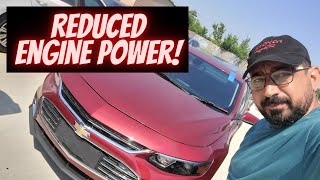
- Reduced engine power or 'limp mode' message on dash
- Hesitation or surging on acceleration
- Unusual whooshing or whistling sounds from the engine bay
- In rare cases, stalling or engine shutdown under load
- Replacing the turbocharger when only the external wastegate regulator solenoid is faulty. The solenoid is a much cheaper and more common failure point on this engine, as documented in TSB PIP5812C.
- Replacing the boost pressure (MAP) sensor without verifying its readings are incorrect with a scan tool.
Most Likely Causes
- Sticking/Failed Turbocharger Wastegate Regulator Solenoid Valve (TCV) 🔴 High Probability → Shop Turbocharger As documented in GM TSB PIP5812C, oil and moisture from the PCV system can contaminate the solenoid. In cold weather, this mixture freezes, causing the valve to stick closed and not allow the wastegate to open and regulate boost. This issue is common across multiple GM models using similar systems.
How to confirm: A technician can command the solenoid on and off with a diagnostic scan tool to check for operation. Per TSB PIP5812C, the definitive test is to remove the valve, turn it upside down to drain any liquid, and blow low-pressure (15-20 PSI) air through its ports. Air applied to port #2 should not dead-head, indicating the internal plunger is free. If it does, the valve is stuck and must be replaced.
Typical fix: Replace the Turbocharger Wastegate Regulator Solenoid Valve. The TSB also advises clearing any frozen condensation from the lines before reinstalling the new part.
Est. part cost: $40-$150 - Icing in the Charge Air Cooler (CAC) 🟡 Medium Probability → Shop Intercooler In extremely cold weather (-18°C / 0°F or less), moisture in the intake system can freeze and accumulate inside the charge air cooler, restricting airflow and causing erratic boost pressure readings, which can set P0234 or P0299.
How to confirm: This is diagnosed by parking the vehicle in a warm garage to allow the CAC to thaw. If a significant amount of water (>100mL) drains from the CAC afterward, icing is confirmed. This is often accompanied by codes P0299 and P2227.
Typical fix: GM has released an updated CAC with a different fin design to mitigate this issue. For 2016-2018 models, installing a winter grille cover (Part #84541893) is also recommended per TSB 18-NA-069 to reduce the problem. In some cases, an ECM software update is also performed to change transmission shift patterns to keep engine RPMs higher in cold weather.
Est. part cost: $200-$400 for the CAC, $50-$75 for the grille cover. - Sticking or Damaged Turbocharger Wastegate ⚪ Low Probability → Shop Turbocharger
How to confirm: Visually inspect the wastegate actuator rod and linkage for free movement. A vacuum pump can be used to test the actuator's function to see if it moves smoothly through its range of motion without binding.
Typical fix: If the wastegate actuator is faulty, it may be replaceable separately. If the internal wastegate valve is seized, the entire turbocharger assembly usually needs to be replaced.
Est. part cost: $500-$1500+ - Faulty Boost Pressure (MAP) Sensor ⚪ Low Probability
How to confirm: Use a scan tool to monitor the boost pressure sensor reading with the key on, engine off. The reading should be close to the barometric pressure. If the reading is skewed or doesn't change with engine load, the sensor is likely faulty.
Typical fix: Replace the boost pressure sensor.
Est. part cost: $40-$140
Rare But Worth Checking
- Leaking or Blocked Vacuum Lines: The vacuum lines control the wastegate actuator via the solenoid. A crack, split, or blockage in one of these cheap-to-fix hoses can prevent the wastegate from opening, causing an overboost condition.
- Aftermarket Engine Tune: If the vehicle has been modified with an aftermarket ECU tune, it may be commanding higher-than-stock boost levels, which can trigger the P0234 code if not calibrated correctly or if the boost target exceeds the factory safety limits.
Diagnosis Steps
- Read the DTCs with an OBD-II scanner and note any other codes present, especially P0299 or P2227.
- Review freeze-frame data to see the conditions (engine speed, load, temperature) when the code was set. Note if it occurred in very cold weather (below 0°F / -18°C).
- Inspect all vacuum lines connected to the turbocharger, wastegate solenoid, and intake manifold for cracks, kinks, or loose connections.
- Using a scan tool, monitor the live data for the desired boost pressure versus the actual boost pressure while driving. This will confirm the overboost condition.
- If in a cold climate and the code set at low temperatures, suspect the Turbocharger Wastegate Regulator Solenoid Valve (TCV) or Charge Air Cooler (CAC) icing. Follow TSB procedures (PIP5812C, 18-NA-069) for diagnosis.
- Test the TCV per TSB PIP5812C: Remove, drain, and perform a low-pressure air test on all three ports to check for a stuck internal plunger.
- Inspect the wastegate actuator arm for free movement. Use a vacuum pump to ensure the actuator holds vacuum and moves the arm smoothly.
- If CAC icing is suspected, park the vehicle in a warm location to thaw and check for water draining from the intercooler system.
- If all other components test good, inspect the boost pressure sensor data for accuracy.
Parts You'll Likely Need
- Turbocharger Wastegate Regulator Solenoid Valve
(OEM #12684144 (also listed as 55499323))— This is the most common failure point for P0234 on this engine, often due to freezing from oil/moisture contamination as documented in GM TSB PIP5812C.
Trusted brands: ACDelco, GM Genuine Parts
OEM price range: $100-$150
Aftermarket price range: $40-$80 - Charge Air Cooler (Intercooler)
(OEM #84768953 (supersedes 84493634))— Required if diagnosis per TSB 18-NA-069 confirms significant moisture buildup and icing in extreme cold weather. The updated part has a revised design to mitigate freezing.
Trusted brands: GM Genuine Parts
OEM price range: $200-$400
Aftermarket price range: $150-$250 - Winter Grille Cover
(OEM #84541893)— Recommended by GM in TSB 18-NA-069 for 2016-2018 models operating in extreme cold to help prevent the charge air cooler from icing over.
Trusted brands: GM Genuine Parts
OEM price range: $50-$75
Related Codes That Often Appear With This One
- P0299 — P0299 is 'Turbocharger Underboost'. It's very common to see both codes because a single faulty component, like a sticking wastegate solenoid or a frozen CAC, can cause erratic turbo behavior—sometimes providing too much boost (P0234) and other times not enough (P0299). Multiple TSBs (PIP5812C, 18-NA-069, 22-NA-002) address both codes together.
- P2227 — This code relates to 'Barometric Pressure Sensor Performance'. It often appears with P0234/P0299 during CAC icing events, as the restricted airflow affects pressure readings throughout the intake system. TSB 18-NA-069 explicitly lists P2227 as a related code.
Technical Service Bulletins (TSBs) & Recalls
- PIP5812C: Diagnostic Tip: Potential For Oil/Moisture Condensate Freezing Up in Turbocharger Wastegate Regulator Solenoid Valve (TCV). Addresses P0234/P0299 in cold weather.
- 18-NA-069: Poor Engine Performance in Extremely Cold Weather Conditions, Charge Air Cooler Icing. Addresses P0234/P0299 and recommends a new CAC and/or winter grille cover.
- 22-NA-002: Malfunction Indicator Lamp Illuminated with DTCs P0299/P0234 Set During Cold or Freezing Temperatures. Primarily for Equinox/Terrain, but details the icing cause and an ECM update fix.
- 22-NA-067: Poor Engine Performance in Extremely Cold Weather Conditions. A broader TSB that lists P0234 as a possible code resulting from various forms of intake system icing, including plugged PCV tubes and contaminated bypass valves.
Platform-Specific Known Issues
- GM has issued multiple TSBs directly addressing P0234 and P0299 on this engine due to issues with the wastegate solenoid and charge air cooler icing in cold weather.
- TSB PIP5812C gives a specific diagnostic procedure for testing the Turbocharger Wastegate Regulator Solenoid Valve with low-pressure air to confirm if it's sticking internally from frozen condensate.
- TSB 18-NA-069 recommends installing an updated Charge Air Cooler and, for 2016-2018 models, a winter grille cover to prevent icing.
- TSB 22-NA-002, for the related Equinox/Terrain, recommends an ECM update that alters transmission shift patterns to increase engine RPMs during cold weather to help prevent ice buildup.
Mechanic-Grade Diagnostic Values
- MAP Sensor Voltage (Key On, Engine Off) — expected: Approximately 4.5-5.0V on the 5V reference wire. Signal voltage should correspond to barometric pressure (typically 1.5V to 4.5V depending on altitude).. Failure: A voltage reading of 0V or a fixed voltage that doesn't change with pressure indicates a faulty sensor or wiring issue.
- Barometric Pressure vs. Altitude (Scan Tool) — expected: At sea level (0 ft), the BARO reading should be between 13.9 and 15.1 PSI.. Failure: A reading that is significantly outside the expected range for your altitude points to a sensor issue.
- New vs. Shorted ECM Resistance — expected: A known-good ECM should show a resistance of approximately 3.065 kilo-ohms (3,065 ohms) between the main power input pin (Pin 49) and the main ground pin (Pin 73).. Failure: A direct connection (near 0 ohms resistance) between the power and ground pins indicates an internally short-circuited ECM.
Scan Tool Commands That Help
- GM GDS2 (Global Diagnostic System 2): Turbocharger Boost Control Solenoid Valve Test — This bidirectional command allows a technician to manually cycle the wastegate regulator solenoid to verify its mechanical and electrical operation without having to remove it. It's a primary step to confirm if the solenoid is responding to ECM commands before performing the more involved physical air-pressure test from TSB PIP5812C.
- GM GDS2 (Global Diagnostic System 2): Data Bus Diagnostic Tool — If electrical issues are suspected (e.g., no communication with sensors, intermittent failures), this tool can analyze the vehicle's CAN bus network to identify modules that are not communicating or to find open/short circuits in the data lines that could affect the turbo control system.
Wiring & Ground Locations
- ECM Main Ground — On the back of the cylinder head, held by a 10mm bolt. This ground wire is part of the main harness connector (Pin 73 on connector X3).. A poor ECM ground can cause erratic behavior in all engine management systems, including the turbocharger boost control. It can lead to incorrect sensor readings and faulty command signals to the wastegate solenoid, potentially causing overboost or underboost conditions.
Real Owner Repair Stories
- Reddit user in r/Chevrolet (2016 Chevrolet Malibu, 1.5L LFV engine. Failed at 60,000 miles.) — P0234 code, likely accompanied by poor performance and check engine light.
❌ Tried (didn't work) Using 87 octane fuel as recommended by GM.
✅ What actually fixed it The engine had to be replaced due to a cracked piston. The root cause was suspected to be Low-Speed Pre-Ignition (LSPI), which can be made worse by boost control problems. The owner advised using higher-quality fuel as a preventative measure on the new engine. - NHTSA ODI #11725932 — An owner reported that after a diagnostic test at a local parts store, the code P0234 (Turbocharger/Supercharger "A" Over Boost Condition) was retrieved, indicating an engine and engine cooling system failure.
OEM Part Supersession History
84493634, 84403753→84768953— The updated Charge Air Cooler (CAC) features a new wide fin design to mitigate moisture accumulation and freezing, which is a primary cause of P0234/P0299 in cold climates per TSB 18-NA-069.55499323→12684144— This is a common supersession for the Turbocharger Wastegate Regulator Solenoid Valve across multiple GM platforms. The newer part number is the current recommended replacement.
Model Year Variations Within This Range
- 2016-2018: These models are eligible for the Winter Grille Cover (Part #84541893) as recommended in TSB 18-NA-069 to prevent CAC icing. Later models may have different grille designs that make this part incompatible or unnecessary.
- 2019-2022: For the 2019 model year refresh, the 1.5L LFV engine's horsepower was slightly rerated from 163 hp to 160 hp. Additionally, a new CVT transmission was introduced. TSBs related to cold weather performance may include an ECM update that alters transmission shift patterns to keep engine RPMs higher, helping to prevent CAC icing.
Diagnostic Flowchart
Other Known Issues on This Vehicle
Issues unrelated to this code that are worth knowing about as an owner of this generation:
- Cracked Pistons (Low-Speed Pre-Ignition) 🔴 High — Common on 2016-2017 models. Less frequent on later years but still possible, especially with poor maintenance. Can occur under 100k miles. (Ref: Customer Satisfaction Program N162071350 (later 17019) was issued to reprogram the ECM and switch to a specific synthetic oil to prevent this.)
- Failing Brake Vacuum Pump 🔴 High — Widespread issue affecting 2016-2022 models with the 1.5L engine. Leads to a hard brake pedal and significantly increased stopping distance. (Ref: No recall, but subject of a class-action lawsuit. The failure is often due to debris clogging the pump's oil inlet screen.)
- Clogged PCV Orifice / Failing PCV System 🟠 Medium — Common across all model years. The PCV orifice is integrated into the valve cover and is prone to clogging, causing high crankcase pressure, oil leaks, and codes like P1101. (Ref: TSB 20-NA-047 addresses testing for this condition.)
- Disconnected Charge Air Cooler (CAC) Outlet Pipe 🟠 Medium → Shop Intercooler — Very common. The retaining clip for the pipe at the throttle body is a known weak point, causing the pipe to blow off under boost, leading to a sudden loss of power and codes like P0299, P1101, and P0506. (Ref: TSB 22-NA-224 (supersedes PIP5651G) details this exact failure. An updated retainer clip (P/N 13434668) is available.)
Used vs. New Parts: Buying Guide for This Vehicle
When a used part is the smart pick: For major mechanical components like the turbocharger assembly or the charge air cooler, a used part from a low-mileage, accident-damaged donor vehicle can be a cost-effective option. These parts have low failure rates outside of the specific issues (solenoid, icing) addressed by TSBs.
Donor-vehicle mileage cap: roughly under 60000 miles for the part to have meaningful remaining life.
What to inspect on the donor part:
- For a turbocharger, check for zero shaft play (in/out or side-to-side) and ensure the turbine and compressor wheels spin freely with no signs of blade damage or housing contact.
- For a charge air cooler, inspect for any bent or damaged fins, and look inside the inlet/outlet for excessive oil residue, which could indicate a donor engine with blow-by issues.
- Verify the donor vehicle's VIN to ensure it wasn't from an early 2016-2017 model, which had a higher incidence of piston issues.
OEM-only on this vehicle (don't cheap out):
- Turbocharger Wastegate Regulator Solenoid Valve (TCV): Given that this is a known high-failure item due to a design sensitivity to contamination, using a new GM Genuine or ACDelco part (12684144) is critical to ensure the fix lasts.
- Sensors (MAP/Boost): Electronic sensors are best purchased new (OEM or reputable aftermarket like Bosch/Denso) to avoid chasing intermittent electrical faults from a used part with unknown history.
Aftermarket brands forum-validated for this vehicle:
- ACDelco (often the same as GM Genuine)
- Bosch (for sensors)
Brands owners have reported issues with on this vehicle:
- Unbranded, no-name turbochargers and electronic solenoids from online marketplaces. These often have poor quality control and can fail quickly or not perform to OEM specifications, causing the code to return.
Real Owner Stories
Aggregated from forums and TSBs cited above. Mileages and costs reflect what owners reported in those sources.
2018 Chevrolet Equinox 1.5L Turbo
Symptoms: Experienced 'Reduced Engine Power' message on the dash and a P0234 code.
What fixed it: The dealer diagnosed and replaced the wastegate solenoid under warranty.
Source hint: BobIsTheOilGuy.com - 2018 Equinox 1.5L turbo P0234 code
2016 Chevrolet Malibu 1.5L Turbo
Symptoms: Turbo underboost/overboost issues; owner followed TSB PIP5812C to test the wastegate solenoid.
What fixed it: The wastegate solenoid failed the prescribed air test (internal plunger stuck) and required replacement.
Source hint: GM-Trucks.com Forum - 2016 Malibu, P0299 (turbo underboost) and TSB PIP 5812C
2016 Chevrolet Malibu 1.5L Turbo — 84000 miles
Symptoms: Low compression (20psi) in cylinder 2.
What fixed it: Failed piston replacement; though not a direct fix for P0234, it is a documented common failure mode for this specific engine and mileage.
Source hint: Reddit r/Justrolledintotheshop - 1.5L Malibu... Notorious for pistons
Related OBD-II Codes
Frequently Asked Questions
My 2017 Malibu is losing power in sub-zero temperatures. Does TSB 18-NA-069 apply to me?
How can I tell if my Wastegate Regulator Solenoid Valve (TCV) is actually stuck?
Is there a software update to help prevent these overboost codes on the 1.5L Turbo?
Why does my Malibu only throw the P0234 code during the winter?
What is the estimated cost to fix the 'Reduced Engine Power' message related to P0234?
Helpful Videos
Used OEM Parts in Stock
New Aftermarket Parts Available

The information in this article is provided for general reference and educational purposes only. Vehicle specifications, procedures, and part compatibility can vary by production date, trim level, and region. Always consult your vehicle's factory service manual and verify part numbers before purchasing or performing repairs. Safety-critical components such as airbags, seat belts, and braking systems should be installed by a qualified professional.
- Chevrolet Malibu:
- 🧭 Diagnostic Flowchart
- 🎬 Helpful Videos
- 🛍️ Shop This Part
- What's Unique About the 2016-2022 Chevrolet Malibu
- Symptoms You May Notice
- Most Likely Causes
- Rare But Worth Checking
- Diagnosis Steps
- Parts You'll Likely Need
- Related Codes That Often Appear With This One
- Technical Service Bulletins (TSBs) & Recalls
- Platform-Specific Known Issues
- Mechanic-Grade Diagnostic Values
- Scan Tool Commands That Help
- Wiring & Ground Locations
- Real Owner Repair Stories
- OEM Part Supersession History
- Model Year Variations Within This Range
- Other Known Issues on This Vehicle
- Used vs. New Parts: Buying Guide for This Vehicle
- Real Owner Stories
- 2018 Chevrolet Equinox 1.5L Turbo
- 2016 Chevrolet Malibu 1.5L Turbo
- 2016 Chevrolet Malibu 1.5L Turbo — 84000 miles
- Related OBD-II Codes
- Frequently Asked Questions
- 🎟️ Get 5% Off