

P0234 on 2018-2021 GMC Terrain: Engine Overboost Causes and Fixes
On a 2018-2021 GMC Terrain, code P0234 is most often caused by a faulty or frozen Turbocharger Wastegate Regulator Solenoid Valve, especially in cold weather below 0°F (-18°C). This is a well-documented issue covered by GM Technical Service Bulletin #PIP5812C. Replacing the solenoid (Part #55573259) is an affordable and straightforward DIY fix. The issue is also common on its platform mate, the Chevrolet Equinox.
- For a 2018-2021 GMC Terrain, P0234 is very frequently caused by a frozen Turbocharger Wastegate Regulator Solenoid Valve (TCV), especially if you live in a cold climate.
- This is a known issue acknowledged by General Motors in TSB #PIP5812C.
- Before suspecting a costly turbo replacement, always check the inexpensive solenoid valve (Part #55573259) and the related vacuum hoses first.
- Also, be aware that moisture freezing in the charge air cooler (intercooler) is another known platform issue that can trigger this code.
What's Unique About the 2018-2021 Gmc TERRAIN

The 2018-2021 GMC Terrain, particularly with the 1.5L engine, is highly susceptible to this code in cold climates where temperatures drop below freezing (0°F / -18°C). General Motors has issued multiple Technical Service Bulletins (TSBs) acknowledging that oil and moisture from the PCV system can freeze inside the Turbocharger Wastegate Regulator Solenoid Valve (TCV). This freezing prevents the valve from properly regulating the turbo's wastegate, leading directly to an overboost condition. This is a very specific and common failure point for this platform and its sibling, the Chevy Equinox, unlike the more generic causes seen on other vehicles.
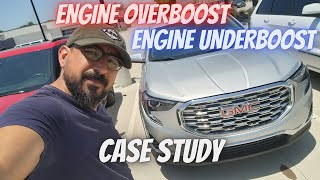
🎬 Watch: A detailed case study on this Terrain overboost issue.Diagnostic Flowchart

Tap your situation to follow the diagnostic path that matches what you're seeing on this vehicle.
Symptoms You May Notice

- Check Engine Light is on
- Vehicle enters 'limp mode' or a 'Reduced Engine Power' message appears on the dash
- Noticeable loss of engine power and slow acceleration
- Abnormal hissing or whistling sounds from the engine bay
- Engine misfiring or running rough
- The problem may disappear on its own after the vehicle warms up or ambient temperatures rise
- Replacing the boost pressure (MAP) sensor without first checking for the common frozen solenoid valve (TCV) issue, especially in cold weather, as per TSB #PIP5812C.
- Replacing the entire turbocharger when only the external wastegate actuator or control solenoid is faulty.
- Assuming a boost leak is present when the actual cause is an internal blockage from ice in the charge air cooler.
Most Likely Causes

- Frozen or Faulty Turbocharger Wastegate Regulator Solenoid Valve (TCV) 🔴 High Probability → Shop Turbocharger As documented in GM TSB #PIP5812C, moisture and oil condensate from the PCV system can freeze inside the solenoid during cold weather (typically below 0°F / -18°C), causing it to stick. This prevents it from controlling the wastegate, leading to overboost.
How to confirm: The issue is most likely to occur in freezing temperatures, often resolving itself when the engine bay warms up. TSB #PIP5812C outlines a specific test: remove the valve, turn it upside down to drain any moisture, then apply 15-20 PSI of shop air to its three ports. If air applied to port #2 dead-heads and doesn't allow a small amount of air to pass to the other ports, the plunger is stuck and the valve should be replaced.
Typical fix: The TSB procedure involves removing the solenoid, thawing it, draining moisture, and blowing it out with compressed air. However, due to the low cost of the part and the high likelihood of recurrence, replacement is often the best long-term solution. One owner on a GM forum noted that even new-in-box replacement parts could fail the TSB's air test, suggesting potential quality control issues.
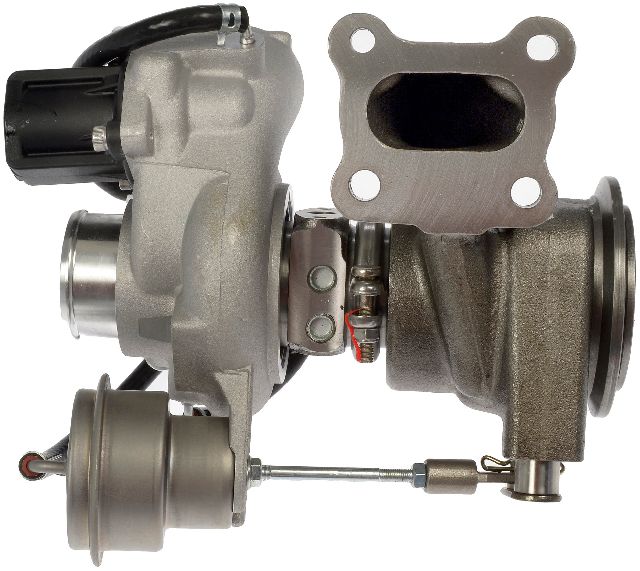
Est. part cost: $25-$50 - Sticking or Binding Turbocharger Wastegate 🟡 Medium Probability → Shop Turbocharger The wastegate actuator arm, which is exposed to the elements, can seize due to carbon buildup or corrosion. This prevents it from opening to relieve excess boost pressure.
How to confirm: With the engine off and cool, attempt to move the wastegate actuator arm by hand or with a vacuum pump. It should move freely through its full range of motion without binding. If it is stuck, the wastegate actuator or the turbo's internal wastegate is the problem.
Typical fix: Sometimes the linkage can be freed up with penetrating oil and manual manipulation. In more severe cases, the turbocharger wastegate actuator may need to be replaced. For the 1.5L engine, the actuator is available separately.
Est. part cost: $100-$250 - Moisture or Ice in Charge Air Cooler (CAC) 🟡 Medium Probability → Shop Intercooler GM TSBs 18-NA-020 and 22-NA-002 note that moisture can accumulate and freeze in the charge air cooler (intercooler), especially on the 1.5L engine. This creates a restriction that can cause erratic pressure readings and trigger P0234. TSB 18-NA-069 specifies that draining more than 100 mL (3.4 oz) of moisture from a thawed CAC confirms the issue.
How to confirm: Inspect the charge air cooler and its piping for signs of moisture, oily residue, or ice in cold weather. The issue is confirmed if a significant amount of water is drained after thawing the cooler. A smoke test should also be performed to rule out leaks.
Typical fix: The charge air cooler must be removed, thawed, and cleaned out. GM also recommends an ECU calibration update which changes transmission shift patterns in cold weather to keep engine RPMs higher, reducing moisture buildup. 🎬 See why a software update might be the required fix. In severe cold climates, installing a winter grille cover (GM Part #84428035 for some models) is also recommended to block cold air from the CAC.
Est. part cost: $0 (if cleaning) - $200 (for grille cover/shutter) - Damaged or Leaking Wastegate Control Hoses ⚪ Low Probability
How to confirm: Visually inspect all vacuum and pressure hoses connected to the turbocharger wastegate solenoid and actuator for cracks, splits, or loose connections. A smoke test can also reveal hard-to-see leaks.
Typical fix: Replace any damaged or leaking hoses.
Est. part cost: $10-$30
Rare But Worth Checking
- Faulty Boost Pressure Sensor (MAP Sensor): While possible, this is less common than the solenoid or wastegate issues. The sensor can send incorrect high-pressure readings to the ECM. This is often accompanied by other sensor-related fault codes. A key diagnostic step is to verify with the engine off that the boost pressure sensor and barometric pressure sensor read nearly identically.
- Restricted Exhaust: A clogged catalytic converter can trap exhaust gases, preventing the turbo from regulating boost properly. This would typically be accompanied by other codes and more severe performance issues, such as a noticeable lack of power at all times.
- Failed Turbocharger: → Shop Turbocharger In rare cases, an internal failure of the turbocharger itself, such as with the variable geometry vanes or bearings, can cause an overboost condition. This is usually a last-resort diagnosis after all other components have been checked. A Reddit user reported getting a P0234 code shortly after a dealer replaced the turbo for a P0299 code, indicating a potential installation or new part issue.
Diagnosis Steps
- Scan the vehicle for all DTCs. Note if P0234 is accompanied by P0299, P0300, or P2227, which strongly points to the TSB-related moisture issues in the TCV or CAC.
- If in a cold climate (below 0°F / -18°C), prioritize inspecting the Turbocharger Wastegate Regulator Solenoid Valve (TCV) for freezing, per TSB #PIP5812C. Perform the air pressure test described in the TSB.
- Inspect the charge air cooler (intercooler) and associated piping for moisture, oil, or ice. If icing is suspected, thaw the CAC and measure the amount of drained fluid. More than 100mL is a positive confirmation.
- Visually inspect all vacuum lines connected to the turbo control solenoid and wastegate actuator for cracks, kinks, or disconnections.
- With the engine off, check the movement of the turbocharger wastegate actuator arm. It should move smoothly without sticking.
- With the engine off, use a scan tool to compare the boost pressure sensor and barometric pressure sensor readings. They should be nearly identical.
- Perform a smoke test on the entire charge air system from the turbo to the throttle body to rule out any leaks.
- Check the exhaust system for any restrictions, such as a clogged catalytic converter.
Parts You'll Likely Need
- Turbocharger Wastegate Regulator Solenoid Valve
(OEM #55573259)— This is the most common failure point for P0234 on this vehicle, especially in cold weather, as documented by GM TSB #PIP5812C.
Trusted brands: ACDelco, GM Genuine Parts
OEM price range: $25-$45
Aftermarket price range: $20-$40 - Turbocharger Wastegate Actuator
(OEM #25204268 (for 1.5L, supersedes 12669119, 12687056, 12690542), 12650093 (for 2.0L))— If the actuator diaphragm fails or the rod seizes, it cannot open the wastegate to regulate boost, leading to an overboost condition.
Trusted brands: ACDelco, Dorman
OEM price range: $100-$150
Aftermarket price range: $80-$120
Related Codes That Often Appear With This One
- P0299 — This code for 'Engine Underboost' often appears with P0234 because the same faulty component (like the TCV or a frozen CAC) can cause both erratic overboost and underboost conditions at different times.
- P0300 — A 'Random Misfire' code can be triggered if moisture from a frozen charge air cooler is ingested by the engine, causing combustion issues. This is specifically mentioned in TSB 18-NA-020.
- P2227 — This 'Barometric Pressure Circuit Range/Performance' code can be set when a frozen charge air cooler causes implausible pressure readings across the intake system. TSB 18-NA-020 links this code directly to the CAC icing issue.
Technical Service Bulletins (TSBs) & Recalls
- PIP5812C: Communicates the possibility of DTC P0234/P0299 setting due to oil/moisture condensate freezing in the Turbocharger Wastegate Regulator Solenoid Valve (TCV) during cold weather driving.
- 22-NA-002: Addresses MIL illumination with DTCs P0299/P0234 in freezing temperatures due to moisture buildup in the Charge Air Cooler (CAC) and directs technicians to also check the TCV per PIP5812C.
- 18-NA-020: Details issues with codes P0300, P0299, P0234, and/or P2227 due to moisture freezing in the CAC and outlines multi-step corrections including potential CAC replacement, shutter installation, and ECM updates.
- 18-NA-069: A bulletin for the related Chevrolet Malibu that details CAC icing in extreme cold (-18°C / 0°F or less) and recommends a new design CAC, a winter grille cover, and an ECM reprogram.
Platform-Specific Known Issues
- GM Technical Service Bulletin #PIP5812C directly addresses P0234 and P0299 being caused by oil/moisture condensate freezing in the Turbocharger Wastegate Regulator Solenoid Valve (TCV) during cold weather. It provides a specific diagnostic test using low-pressure air.
- GM Technical Service Bulletin #22-NA-002 and #18-NA-020 describe a related issue where moisture builds up and freezes in the Charge Air Cooler (CAC), causing airflow restrictions and setting codes P0234, P0299, and P2227. The fix can include cleaning the CAC, installing a grille cover, and an ECM update to change transmission shift logic in cold weather to keep engine RPMs higher.
Mechanic-Grade Diagnostic Values
- MAP Sensor Reference Voltage — expected: ~5.0 V. Failure: Voltage is significantly lower than 5.0V, indicating a wiring or ECM issue.
- MAP Sensor Ground Circuit — expected: < 0.10 V (100 millivolts). Failure: Voltage higher than 0.10V indicates a poor ground connection.
- MAP Sensor Signal Voltage (Key On, Engine Off) — expected: ~4.5 V - 4.7 V. Failure: Voltage significantly different from this range may indicate a faulty sensor.
- MAP Sensor Signal Voltage (Engine at Idle) — expected: 1.0 V - 2.0 V. Failure: Voltage that does not drop into this range after starting the engine suggests a sensor or vacuum issue.
- TCV (Wastegate Solenoid) Air Flow Test — expected: When 15-20 PSI of air is applied to port #2, a small amount of air should be observed at port #3 and even less at port #1.. Failure: Air dead-heads when applied to port #2, indicating a stuck internal plunger.
Scan Tool Commands That Help
- GDS2 (GM Dealer Tool): Turbocharger Wastegate Solenoid Bidirectional Test — To command the solenoid on and off to audibly verify its operation and check for a corresponding change in vacuum at the wastegate actuator. This helps isolate a faulty solenoid from a mechanical issue with the actuator or wastegate.
- GDS2 (GM Dealer Tool): Diagnostic Repair Verification — After completing a repair, this function is used to run the vehicle through specific parameters to confirm the fault has been corrected and prevent comebacks.
- GDS2 (GM Dealer Tool): Clear All DTCs — Required after performing the TCV cleaning/thawing procedure per TSB #PIP5812C to reset the system and evaluate if the fix was successful.
Wiring & Ground Locations
- G101 — Located at the front of the engine, lower block.. This ground serves the Engine Control Module (ECM) and Transmission Control Module (TCM). A poor connection here can cause a wide range of erratic sensor readings and actuator control problems, including incorrect command of the turbocharger wastegate solenoid.
- G103 — Located at the left rear of the engine compartment on the cowl, above the brake booster.. Grounds the Body Control Module (BCM) and the Data Link Connector (DLC). A fault at this ground could interfere with scan tool communication and diagnostics.
- TCV Electrical Connector — On the Turbocharger Wastegate Regulator Solenoid Valve itself.. This is the direct electrical connection for the solenoid. If a replacement solenoid is needed, the connector may also need to be replaced. The service part number for the connector is often listed as 13577536.
"I Checked Everything" — The Actual Cause
- In the case of the 2018-2021 Terrain, a smoke test on the charge air system may come back clean, showing no leaks. However, the root cause of P0234 can be an internal blockage from ice within the Charge Air Cooler (CAC) or a frozen Turbocharger Wastegate Regulator Solenoid Valve (TCV), especially in temperatures below 0°F (-18°C). These issues are not leaks and won't be found by a smoke test, as documented in GM TSBs 18-NA-020 and PIP5812C.
OEM Part Supersession History
ACDelco GM Original Equipment (OE)→GM Genuine Parts 55573259— GM regularly updates production and service part designs to integrate new materials and technologies. Some parts formerly sold under the ACDelco OE brand are now branded as GM Genuine Parts.
Model Year Variations Within This Range
- 2018-2022: GM issued an updated ECM calibration for the 1.5L LYX engine. This new software revises the transmission shift pattern in cold weather to use overdrive less frequently, keeping engine RPMs higher to reduce moisture buildup in the CAC.
- 2018+: A service procedure was updated in May 2022 to include the installation of a thermal wrap around the Turbocharger Wastegate Regulator Solenoid Valve (TCV) to help prevent freezing.
Helpful Videos

We Have This Part in Stock


The information in this article is provided for general reference and educational purposes only. Vehicle specifications, procedures, and part compatibility can vary by production date, trim level, and region. Always consult your vehicle's factory service manual and verify part numbers before purchasing or performing repairs. Safety-critical components such as airbags, seat belts, and braking systems should be installed by a qualified professional.
- Gmc TERRAIN:
- 🧭 Diagnostic Flowchart
- 🎬 Helpful Videos
- 🛍️ Shop This Part
- What's Unique About the 2018-2021 Gmc TERRAIN
- Symptoms You May Notice
- Most Likely Causes
- Rare But Worth Checking
- Diagnosis Steps
- Parts You'll Likely Need
- Related Codes That Often Appear With This One
- Technical Service Bulletins (TSBs) & Recalls
- Platform-Specific Known Issues
- Mechanic-Grade Diagnostic Values
- Scan Tool Commands That Help
- Wiring & Ground Locations
- "I Checked Everything" — The Actual Cause
- OEM Part Supersession History
- Model Year Variations Within This Range
- 🎟️ Get 5% Off