

OBD-II Code P0235: Turbocharger/Supercharger Boost Sensor 'A' Circuit Malfunction
The Ultimate 2026 Guide to Meaning, Diagnosis, and Repair
- P0235 indicates an electrical fault in the boost sensor 'A' circuit, requiring a check of the sensor, wiring, and connector before replacing parts.
- Expect an immediate Check Engine Light and a 50% or greater reduction in engine power as the vehicle enters protective limp mode.
- Limit driving to essential trips under 10 miles to prevent unburnt fuel from destroying your catalytic converter, a $1,500+ repair.
- Compare the MAP and BARO sensor readings with the key on and engine off; a difference greater than 1.0 PSI confirms a sensor or circuit failure.
What Does P0235 Mean?
Your car's Engine Control Module (ECM) detected an electrical malfunction in the turbocharger or supercharger boost sensor 'A' circuit. This sensor measures the pressurized air (boost) forced into the engine. The P0235 code means the sensor's signal is illogical, out of range, or missing entirely, forcing the ECM to cut engine power to prevent internal damage.
Technical definition: The SAE/OBD-II definition is "Turbocharger/Supercharger Boost Sensor 'A' Circuit Malfunction." The ECM sets this DTC when the input voltage from the intake boost pressure sensor 'A' is abnormal. The ECM cross-references this reading with the Manifold Absolute Pressure (MAP) and Barometric Pressure (BARO) sensors during the Key On, Engine Off (KOEO) phase. If values do not correlate, the code triggers, indicating an electrical fault rather than a mechanical boost issue.
Can I Drive With P0235?
Yes, But With Caution. You can drive for essential trips under 10 miles, but immediate repair is required. Your vehicle enters a protective 'limp mode,' severely reducing engine power. Continuing to drive forces a dangerously rich or lean air-fuel mixture, destroying the catalytic converter over time (a $1,500+ repair). If you notice a flashing check engine light, loud whistling, or significant black smoke, stop driving immediately.
Common Causes
- Faulty Boost Pressure Sensor (MAP Sensor) (Very Common) — This is the most frequent culprit. 🎬 See this walkthrough on replacing a boost pressure sensor The sensor fails due to age, internal electronic burnout, oil vapor contamination, or a cracked sensing element.
- Damaged Wiring or Connectors (Common) — Engine bay heat and vibration fray, melt, or break wires. The plastic connector becomes brittle and cracks, or pins corrode, causing intermittent electrical connections.
- Boost or Vacuum Leaks (Common) — Cracked intake hoses, loose clamps, or a damaged intercooler let pressurized air escape. Disconnected vacuum lines cause improper turbo regulation, creating irrational sensor readings.
- Stuck or Faulty Turbocharger Wastegate (Less Common) — The wastegate controls turbo speed. If it sticks open (low boost) or closed (overboost) from carbon buildup or mechanical failure, the resulting pressure triggers the code.
- Faulty Boost Control Solenoid (Less Common) — This ECM-controlled solenoid manages wastegate vacuum. When it fails, it cannot regulate boost, causing out-of-spec pressure readings.
- Clogged Catalytic Converter (Less Common) — A severely clogged catalytic converter creates excessive exhaust backpressure, preventing the turbocharger from spooling and building boost.
- Severely Clogged Air Filter (Rare) — A completely blocked air filter starves the turbocharger of air, preventing it from building expected boost levels.
- Faulty Engine Control Module (ECM) (Rare) — Rarely, the ECM suffers an internal circuit failure and cannot process the sensor signal. Consider this only after exhausting all other diagnostic options.
Symptoms
- Drastically Reduced Engine Power ('Limp Mode') — The vehicle feels sluggish and struggles to accelerate. The ECM intentionally limits power and disables boost to prevent engine damage.
- Hesitation or Stumbling During Acceleration — The engine feels flat, hesitates, or surges unpredictably during acceleration because the ECM cannot manage the air-fuel mixture.
- Unusual Whistling, Hissing, or Rattling Noises — Loud hissing or whistling from the engine bay indicates a significant boost leak from a hose or the intercooler. Rattling indicates a failing turbocharger.
- Black Smoke from Exhaust — In diesel engines, an incorrect signal causes the ECM to inject excessive fuel, resulting in unburnt fuel exiting as black smoke.
- Poor Fuel Economy — The ECM runs a rich fuel mixture as a default fail-safe, causing a noticeable drop in miles per gallon.
- Check Engine Light is On (also visible on scanner) — The primary and immediate indicator of a circuit fault.
- Erratic Boost Gauge Reading (also visible on scanner) — Factory or aftermarket boost gauges read zero, fluctuate wildly, or show pressure levels that contradict engine behavior.
Diagnostic Flowchart
Tap your situation to follow the diagnostic path that matches what you're seeing on this code.
Common Fixes & Costs
- Replace Boost Pressure Sensor
— Parts: $50-$200, Labor: $50-$150, ~0.8 hr book time
(DIY)
Ford F-150 (EcoBoost): OEM BL3Z-9F479-C (Alt: Bosch 0261230249, Standard Motor Products AS466)
Chevrolet Cruze (1.4L): OEM 55567257 (Alt: Bosch 0261230263, Dorman 904-781)
Volkswagen/Audi (TSI): OEM 03C906051F (Alt: Bosch 0261230235, Denso DPS-0102) - Repair or Replace Damaged Wiring/Connector — Parts: $10-$50, Labor: $100-$300, ~2.5 hr book time (Intermediate)
- Repair Boost Leak (Replace Hose/Clamp/Intercooler) — Parts: $30-$400, Labor: $100-$300, ~1.5 hr book time (DIY)
- Replace Wastegate Actuator or Solenoid — Parts: $100-$400, Labor: $150-$400, ~2 hr book time (Intermediate)
- Replace Turbocharger Assembly — Parts: $1,200-$2,800, Labor: $500-$1,200, ~6.5 hr book time (Professional)
- Replace Engine Control Module (ECM) — Parts: $800-$1,500, Labor: $200-$400, ~2.5 hr book time (Professional)
DIY vs Professional
- Replace Boost Pressure Sensor — Beginner:
- Repair Damaged Wiring/Connector — Beginner:
- Repair Boost Leak (Hose/Clamp) — Beginner:
- Replace Intercooler — Beginner:
- Replace Wastegate Actuator/Solenoid — Beginner:
- Replace Turbocharger Assembly — Beginner:
Used vs. New Parts: Buying Guide
When a used part is worth it: Buying a used boost pressure sensor is not recommended due to low aftermarket prices and high failure rates. Used parts only make sense for expensive components like a complete turbocharger assembly from a low-mileage donor.
Donor-vehicle mileage cap: roughly under 60000 miles for the part to have meaningful remaining life.
Donor quality checklist:
- Verify the donor vehicle was not scrapped for engine or electrical failure.
- Match the OEM part number exactly.
- Inspect the used sensor's connector for corrosion or physical damage.
Decision logic:
- If The part is a boost pressure sensor → Buy a new aftermarket or OEM part. Cost savings are minimal and not worth the risk.
- If The part is a complete turbocharger assembly → A used part from a verified low-mileage donor is a viable option to save money.
- If The part is an electronic wastegate actuator → Buy a new OEM or reputable aftermarket part with a warranty.
Warranty tradeoff: Used parts offer a 30-90 day warranty. New aftermarket sensors include a 1-year to limited lifetime warranty.
Worst-case if a used part fails: 300-600. If a used sensor fails, you pay for a new part plus repeated labor costs.
What Happens If You Wait — Timeline
- 0-1 month: Check Engine Light is on and the vehicle is consistently in 'limp mode'. Acceleration is poor and fuel economy drops. (MPG impact: 10-25%% · Added cost: $50-150 in wasted fuel.)
- 1-4 months: The engine runs consistently on an incorrect air-fuel mixture. This fouls spark plugs and stresses the catalytic converter with unburnt fuel. (MPG impact: 15-30%% · Added cost: $150-400 (wasted fuel + spark plug replacement).)
- 4-8 months: Sustained rich conditions overheat the catalytic converter, melting its internal substrate. High exhaust backpressure damages turbocharger seals. (MPG impact: 25-40%% · Added cost: $1,500-3,000 (catalytic converter replacement).)
- 8+ months: Catastrophic failure of the catalytic converter occurs. Extreme cylinder pressures lead to piston, head gasket, or turbocharger destruction. (MPG impact: >40%% · Added cost: $3,000-7,000+)
Cost of Not Fixing It
- 0-1 month: Persistent 'limp mode' with poor acceleration, a 10-25% drop in fuel economy, and an automatic emissions test failure. (Added cost: 50-150)
- 1-6 months: An incorrect air-fuel ratio overheats the catalytic converter and fouls spark plugs. (Added cost: 1200-2800)
- 6+ months: Unmanaged boost destroys turbocharger seals and bearings. Extreme lean/rich conditions cause internal engine damage. (Added cost: 2500-4000)
Diagnosis Steps
- Scan for Codes and Review Freeze Frame Data
Use an OBD-II scanner to confirm P0235 and check for related codes (P0236, P0237, P0299). Analyze freeze frame data to identify engine RPM and load when the fault occurred.
Tools: OBD-II Scanner (Beginner) - Thorough Visual Inspection
Inspect the entire air intake path. Check hoses and charge pipes for cracks, loose clamps, or oil residue. Examine the sensor's wiring harness for melting, chafing, or corrosion.
Tools: Flashlight, Mirror (Beginner) - Monitor Live Sensor Data (The KOEO Test)
Observe live data for the Boost/MAP sensor and Barometric Pressure (BARO) sensor with Key On, Engine Off. Readings must be within 1.0 PSI (3 kPa) of each other. A larger variance confirms a sensor or circuit fault.
Tools: Advanced OBD-II Scanner (Intermediate) - Monitor Live Sensor Data (The Idle & Drive Test)
Start the engine. At idle, the MAP reading must show vacuum (4-9 PSI absolute). While driving, pressure must increase smoothly to 14-19 PSI under heavy load. Stuck or erratic readings indicate failure.
Tools: Advanced OBD-II Scanner (Intermediate) - Pro Tip: Test the Sensor Circuit with a Multimeter
Disconnect the sensor. With KOEO, test the harness terminals: verify a 5-volt reference from the ECM and a ground wire near 0 ohms. Missing voltage or ground indicates a wiring or ECM issue.
Tools: Multimeter, Vehicle Repair Manual (Advanced) - Pro Tip: Test the Sensor's Signal Voltage
Reconnect the sensor and backprobe the signal wire. KOEO voltage should be 4.5-4.8V at sea level. At idle, it drops to 1.0-1.5V. Under throttle, it climbs smoothly. Stuck voltage confirms sensor failure.
Tools: Multimeter, Backprobe Pins (Advanced) - Pro Tip: Perform a 'Wiggle Test'
While monitoring live data with the engine running, wiggle the sensor wiring harness and connector. Voltage or pressure drops indicate an intermittent wiring fault or loose pins.
Tools: Advanced OBD-II Scanner (Intermediate) - Pro Tip: Analyze the Sensor with an Oscilloscope
Backprobe the signal wire with an oscilloscope. A healthy sensor shows a smooth waveform rising and falling with throttle. A noisy or flat-lined pattern confirms failure.
Tools: Oscilloscope, Backprobe Pins (Advanced) - Perform a Boost Leak Test (Smoke Test)
Force low-pressure smoke into the intake system using a smoke machine. Smoke escaping from hoses, the intercooler, or gaskets pinpoints hidden leaks.
Tools: Smoke Machine or Boost Leak Tester (Advanced) - Inspect Turbocharger and Wastegate
With a cool engine, check the turbo for axial shaft play exceeding 0.003 inches. Apply vacuum/pressure to the wastegate actuator to ensure it holds pressure and moves smoothly.
Tools: Basic Hand Tools, Vacuum/Pressure Pump, Dial Indicator (Advanced)
When This Code Triggers (Freeze-Frame Conditions)
- Engine Coolant Temp: 180-210°F (Fully warmed up and under load.)
- RPM: 2000-3500 (During acceleration or when maintaining speed under load.)
- Engine Load: 40-80% (The engine is working to accelerate or climb a grade, demanding boost.)
- Vehicle Speed: 40-70 mph (Highway driving or merging, where turbo boost is expected.)
Related Codes
- P0236 — P0235 is an electrical circuit fault; P0236 is a range/performance fault where the sensor works but provides an irrational signal compared to engine RPM.
- P0237 — Indicates 'Circuit Low' (voltage <0.25V), confirming a short to ground or a completely dead sensor.
- P0238 — Indicates 'Circuit High' (voltage >4.9V), confirming a short to the 5V reference line.
- P0299 — Indicates 'Underboost' (mechanical failure). The boost sensor is working correctly and accurately reporting low pressure caused by a leak or failed turbo.
Climate & Environmental Factors
- High Altitude: At high altitudes (e.g., Denver at 5,280 ft), atmospheric pressure is lower. BARO and MAP sensors read around 12.2 PSI, not 14.7 PSI. Do not misdiagnose a healthy sensor reading a lower baseline pressure.
- Extreme Heat: High under-hood temperatures degrade plastic wiring insulation and vacuum hoses, causing brittleness and cracking. This directly causes circuit shorts or vacuum leaks.
- High Humidity / Temperature Fluctuations: Moisture penetrates weathered connectors, corroding terminal pins and degrading signal quality. In Ford EcoBoosts, intercooler condensation blows into the sensor, causing immediate failure.
- Cold Climates: Freezing temperatures make rubber charge pipes, vacuum lines, and plastic connector tabs brittle. Connectors frequently snap during winter servicing.
How to Talk to a Mechanic About This Code
Say this: "I have a P0235 code and a loss of power. Before replacing the boost sensor, please verify the sensor's circuit by checking the 5-volt reference and ground, and compare the MAP and BARO readings with the key on, engine off."
This signals you understand P0235 is a circuit code. It directs the technician to perform key diagnostic steps to avoid misdiagnosis and prevents you from paying for unnecessary parts.
Avoid saying:
- 'My turbo is broken.'
- 'My check engine light is on, can you look at it?'
- 'Just replace the boost sensor.'
Questions to ask before authorizing the repair:
- What were the MAP and BARO readings on the KOEO test?
- Did you find a good 5V reference and ground at the sensor connector?
- Can you confirm you've ruled out wiring issues and boost leaks?
- Will you provide a printout of the freeze-frame data?
- What is the warranty on this specific repair?
Where to Take It: Dealer vs Independent vs Chain
- Dealer:
Best for: Vehicles still under powertrain or emissions warranty., Complex issues like VW/Audi electronic wastegate actuator failures requiring special adaptation tools.
Downsides: Highest labor rates, typically 1.5-2x more than an independent shop., May recommend replacing a larger assembly (whole turbo) when a smaller component (actuator) is the only fault. (Typical cost: +50% vs. baseline) - Independent Shop:
Best fit for most cases. A reputable independent shop offers the best balance of expertise and value for diagnosing a P0235 code.
Best for: Out-of-warranty vehicles where cost is a factor., Accurate diagnosis of electrical faults, boost leaks, and mechanical issues.
Downsides: Quality varies. It is crucial to find a shop with good reviews and experience with turbocharged vehicles. (Typical cost: +0% vs. baseline) - Chain Shop:
AVOID for initial diagnosis. The complexity of a P0235 fault goes beyond their typical scope.
Best for: Simple part replacements if you have already performed the diagnosis yourself.
Downsides: Technician skill varies dramatically., Less likely to have advanced diagnostic tools, leading to a high risk of misdiagnosis. (Typical cost: -10% vs. baseline)
When to Walk Away From the Repair
If the total estimated repair cost for the P0235 fault exceeds 40-50% of your car's current private-party value, consider selling the car as-is.
- Car worth $3500, fix is $2800: Walk away. A turbo replacement on a low-value car is not economical.
- Car worth $15000, fix is $500: Fix it. A sensor or wiring repair is a minor cost relative to the car's value.
- Car worth $18000, fix is $4500: Borderline. A turbo replacement on a higher-value car might be worth it, but get a second opinion.
What Scan Tool You Need for This Code
Minimum: An OBD-II scanner that can read and graph live data PIDs, specifically for the MAP/Boost sensor and BARO sensor.
A basic $20 code reader only shows the P0235 code. It cannot display the live sensor data required to perform the critical KOEO test or monitor sensor readings while driving.
Budget: BlueDriver Pro (~$120) — Connects to your smartphone and provides excellent live data graphing to compare MAP and BARO PIDs. It reads freeze-frame data to see engine conditions when the code was set.
Mid-range: Foxwell NT510 Elite (~$200) — Offers brand-specific diagnostics and bidirectional controls. For a P0235 on a VW/Audi, this tool performs the 'basic setting' adaptation required after replacing an electronic wastegate actuator.
Professional: Autel MaxiCOM MK808S (~$450) — Offers extensive bidirectional controls, allowing a technician to command components like the boost control solenoid to function, directly testing their operation.
Rent vs buy: For a one-time diagnosis, auto parts stores offer free loaner tools. If you do your own repairs, buying a tool like the BlueDriver Pro is a worthwhile investment.
How to Clear the Code After You Fix It
- Use an OBD-II scan tool to clear the P0235 code.
- Ensure the fuel tank is between 25% and 75% full.
- Perform a complete drive cycle to allow readiness monitors to run.
Drive cycle (~30 minutes): Start the engine from a cold start (sitting over 8 hours). Idle for 2-3 minutes with electrical loads on. Drive for 15 minutes in mixed city/highway conditions, including steady-state cruising around 55 mph for at least 5 minutes. Coast down to a stop and let the vehicle cool completely.
Readiness monitors affected: Catalyst Monitor, Oxygen (O2) Sensor Monitor, Comprehensive Component Monitor
Before emissions retest: drive at least 100 miles to fully set monitors.
Watch out for:
- Disconnecting the battery clears the code but resets all readiness monitors to 'Not Ready', guaranteeing an emissions test failure.
- The code returns immediately if the root cause (wiring fault, leak) was not repaired.
- Short city trips prevent the catalyst monitor from setting.
Will This Fail Emissions / State Inspection?
Yes — this code typically fails an OBD-II emissions inspection.
- California: An active Check Engine Light is an automatic smog check failure. After repair, all readiness monitors must be 'Ready' before a re-test, requiring 100+ miles of driving.
- New York: A vehicle fails the NYS inspection if the Check Engine Light is on. Clearing the code right before the test results in failure due to 'Not Ready' monitors.
- Texas: An illuminated Check Engine Light is an automatic failure. Texas allows one readiness monitor to be 'Not Ready' on vehicles model year 2001 and newer.
Most Commonly Affected Vehicles
- Ford F-150 (EcoBoost), Focus ST, Mondeo (2011-2024) — Extremely common on EcoBoost engines. Check for cracked plastic charge pipes, leaking intercoolers, and faulty sensors. The sensor part number has been updated multiple times.
- Chevrolet Cruze, Silverado (Duramax) (2011-2019) — On the 1.4L Cruze, it is usually a faulty sensor (Part # 55567257) or an intake manifold leak. On Duramax trucks, check for failed sensors and boost pipe leaks.
- Volkswagen/Audi Jetta, Golf, Passat, A3, A4 (TSI/TDI) (2009-2017) — Frequently caused by a failing boost sensor, a faulty electronic wastegate actuator, or a diverter valve failure. The wastegate actuator requires scan tool adaptation after replacement.
- Subaru WRX, Forester XT, Outback XT (2008-2021) — Often points to a failing electronic boost control solenoid (EBCS), a leak in the vacuum lines controlling it, or a boost leak from the intercooler hose.
- Dodge/Ram Ram (Cummins/EcoDiesel) (2007-2024) — On Cummins engines, this is triggered by a failing boost pressure sensor or a sticking actuator on the Variable Geometry Turbocharger (VGT) due to soot buildup.
- BMW 135i, 335i, 535i, X3, X5 (N54/N55 engines) (2007-2015) — Commonly caused by a faulty TMAP sensor, cracked plastic charge pipes, or failing electronic wastegates. The wiring harness near the sensor is a known failure point.
- Honda Civic, Accord, CR-V (1.5L Turbo) (2016-2023) — Typically points to a faulty boost sensor or a poor electrical connection at the sensor harness. Fuel dilution in early models contaminates the sensor.
- Nissan Patrol, Navara (Diesel models) (1999-2015) — In ZD30 diesel engines, this code is notoriously caused by an internal break in the wiring harness near the sensor connector, which is not visually apparent.
- Hyundai/Kia Sonata, Optima, Veloster (Turbo T-GDI) (2011-2019) — Triggered by a faulty boost pressure sensor, a failing electronic wastegate actuator, or charge air system leaks. Check for TSBs related to wastegate actuator logic.
Manufacturer-Specific Notes
- Ford: EcoBoost intercoolers accumulate moisture and oil. Hard acceleration blows this liquid onto the TMAP sensor, shorting it out. TSB 13-8-1 recommends an updated intercooler or drilling a weep hole.
- Subaru: Electronic boost control solenoid (EBCS) failures trigger this code more often than the sensor itself. Brittle vacuum lines connected to the EBCS also leak.
- Volkswagen/Audi: The electronic wastegate actuator fails mechanically or electronically. It requires a 'basic setting' recalibration via scan tool after replacement or battery disconnect.
- BMW: Factory plastic charge pipes on N54/N55 engines explode under boost, causing a massive leak that triggers P0235. Upgrade to an aluminum charge pipe.
Real Owner Stories
2013 VW Jetta 1.8T at 115K miles
Check engine light and limp mode appeared intermittently during hard acceleration. Codes P0235 and P0299 were present.
What they tried:
- Replaced the MAP/Boost sensor, but the code returned within a day.
- Performed a smoke test but found no boost leaks.
- Inspected the turbo and found the wastegate actuator arm was stiff.
Outcome: The electronic wastegate actuator failed. The owner replaced the actuator ($250) and performed a 'basic setting' adaptation with a VCDS scan tool. The codes did not return.
Lesson: On VW/Audi models, the wastegate actuator is a common failure point that mimics a bad sensor. Check for free movement of the actuator arm before replacing sensors.
2015 Ford F-150 3.5L EcoBoost at 80K miles
Sudden loss of power and P0235 code after driving through a heavy rainstorm.
What they tried:
- Cleared the code, but it returned immediately.
- Inspected the MAP sensor on the charge pipe and found the connector was wet.
- Dried the connector thoroughly with compressed air and applied dielectric grease.
Outcome: Drying and re-seating the connector permanently cleared the code. Water ingress into the sensor connector is a known EcoBoost issue.
Lesson: If P0235 appears after a car wash or heavy rain, inspect the sensor connector for moisture before replacing parts.
2012 Chevy Cruze 1.4L at 95K miles
Persistent P0235 code with a rough idle and severe hesitation under acceleration.
What they tried:
- Replaced the boost pressure sensor, PCV valve, and intake manifold with no change.
- A mechanic performed a 'wiggle test' on the wiring harness while watching live data.
Outcome: The wiggle test revealed an internal break in the signal wire 4 inches from the connector. Splicing in a new pigtail connector ($150 total) fixed the problem permanently.
Lesson: An intermittent electrical fault perfectly mimics a failed sensor. A 'wiggle test' is crucial if a new sensor doesn't fix the issue.
How to Prevent This Code From Triggering
- Change engine air filter at recommended intervals (Every 15,000-30,000 miles) — A clean air filter ensures the turbocharger draws air without restriction, preventing strain and ensuring accurate boost pressure readings.
- Inspect PCV system and replace PCV valve (Inspect every 30,000 miles, replace every 50,000-60,000 miles.) — A functioning PCV system vents crankcase pressure. A clogged valve increases oil blow-by, which contaminates the boost pressure sensor.
- Install an oil catch can (especially on GDI engines) (One-time installation; drain every 3,000-5,000 miles.) — An oil catch can intercepts oil vapors before they enter the intake manifold, drastically reducing oil contamination on the boost sensor.
- Periodically inspect intake hoses and vacuum lines (Every oil change or 5,000 miles.) — Engine heat causes rubber hoses to become brittle. Visual inspections catch cracks before they become significant leaks.
Frequently Asked Questions
What is the most common misdiagnosis for a P0235 code?
The most common mistake is replacing the boost sensor without testing it. The actual problem is often a damaged wire, loose connector, or hidden boost leak. Always test the 5V reference circuit and check for leaks first.
Can I just clean the boost sensor to fix P0235?
Cleaning an oil-contaminated sensor with MAF cleaner provides a temporary fix. However, internal electronic failure is the primary cause of P0235, which cleaning cannot resolve.
Will P0235 cause my car to fail an emissions test?
Yes. An active P0235 code illuminates the Check Engine Light, resulting in an automatic failure for any state emissions or smog inspection.
How much does it cost to fix code P0235?
A DIY sensor replacement costs $50-$200. Professional diagnosis and repair for wiring or leaks ranges from $200 to $600. If the turbocharger failed, expect costs between $2,500 and $4,000.
What's the difference between boost sensor 'A' and 'B'?
Sensor 'A' is the primary sensor used by the ECM for boost control, located on the intake manifold or charge pipe. Sensor 'B' monitors secondary turbos in multi-stage setups. P0235 specifically isolates a fault in the 'A' circuit.
Why did the P0235 code come back after I replaced the sensor?
If the code returns, the sensor was not the root cause. You likely have an intermittent wiring issue, a hidden boost leak, or a failing turbo wastegate actuator.
Can a bad tune cause a P0235 code?
Yes, an aggressive aftermarket tune requesting boost outside the sensor's operating range triggers this code. The ECM interprets the extreme voltage as a circuit fault, though P0234 (Overboost) is more common.
Key Takeaways
- P0235 indicates an electrical fault in the boost sensor 'A' circuit, requiring a check of the sensor, wiring, and connector before replacing parts.
- Expect an immediate Check Engine Light and a 50% or greater reduction in engine power as the vehicle enters protective limp mode.
- Limit driving to essential trips under 10 miles to prevent unburnt fuel from destroying your catalytic converter, a $1,500+ repair.
- Compare the MAP and BARO sensor readings with the key on and engine off; a difference greater than 1.0 PSI confirms a sensor or circuit failure.
Helpful Videos
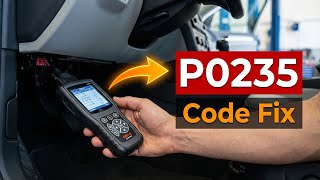
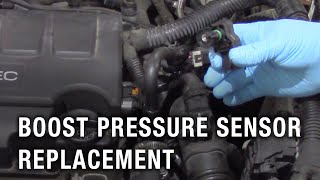
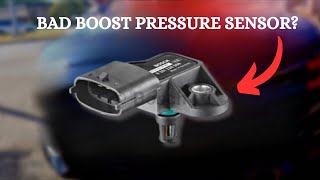
Shop the Parts Behind P0235
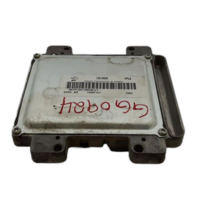
Below are the parts most often responsible for code P0235, ranked by how frequently each one is the actual culprit (per the diagnosis above). Tap any to see what we have for your vehicle.



The information in this article is provided for general reference and educational purposes only. Vehicle specifications, procedures, and part compatibility can vary by production date, trim level, and region. Always consult your vehicle's factory service manual and verify part numbers before purchasing or performing repairs. Safety-critical components such as airbags, seat belts, and braking systems should be installed by a qualified professional.
- 🧭 Diagnostic Flowchart
- 🎬 Helpful Videos
- 🛍️ Shop This Part
- What Does P0235 Mean?
- Can I Drive With P0235?
- Common Causes
- Symptoms
- Common Fixes & Costs
- DIY vs Professional
- Used vs. New Parts: Buying Guide
- What Happens If You Wait — Timeline
- Cost of Not Fixing It
- Diagnosis Steps
- When This Code Triggers (Freeze-Frame Conditions)
- Related Codes
- Climate & Environmental Factors
- How to Talk to a Mechanic About This Code
- Where to Take It: Dealer vs Independent vs Chain
- When to Walk Away From the Repair
- What Scan Tool You Need for This Code
- How to Clear the Code After You Fix It
- Will This Fail Emissions / State Inspection?
- Most Commonly Affected Vehicles
- Manufacturer-Specific Notes
- Real Owner Stories
- 2013 VW Jetta 1.8T at 115K miles
- 2015 Ford F-150 3.5L EcoBoost at 80K miles
- 2012 Chevy Cruze 1.4L at 95K miles
- How to Prevent This Code From Triggering
- Frequently Asked Questions
- What is the most common misdiagnosis for a P0235 code?
- Can I just clean the boost sensor to fix P0235?
- Will P0235 cause my car to fail an emissions test?
- How much does it cost to fix code P0235?
- What's the difference between boost sensor 'A' and 'B'?
- Why did the P0235 code come back after I replaced the sensor?
- Can a bad tune cause a P0235 code?
- Key Takeaways
- 🎟️ Get 5% Off