

P0236 on 2012-2018 Ford Focus 1.0L EcoBoost: Turbo Sensor Causes and Fixes
On a 1.0L EcoBoost Focus, P0236 is most often caused by a faulty Turbocharger Boost Pressure (TCBP) sensor located on the charge pipe before the throttle body. Expect to pay $40-$80 for a new sensor. Before replacing, check the wiring and look for any air leaks in the boost pipes.
- P0236 on your 1.0L EcoBoost almost always points to an issue with the boost pressure sensor on the charge pipe (before the throttle body), NOT the sensor on the intake manifold.
- Before buying parts, use a scan tool to compare sensor readings with the engine off. If the 'TCBP' or 'TIP' reading is off, the sensor is the likely culprit.
- Always inspect the sensor's wiring and connector for damage before replacing it, as this is a common secondary cause.
- If the sensor and wiring are good, check for boost leaks from cracked hoses or a loose intercooler connection using a smoke test.
What's Unique About the 2012-2018 Ford Focus
The 1.0L EcoBoost engine uses two separate pressure sensors that are often confused: the 'A' sensor for this code (P0236) is the Turbocharger Boost Pressure (TCBP) sensor located on the charge pipe before the throttle body. The second is the Manifold Absolute Pressure (MAP) sensor located on the intake manifold itself. Owners and mechanics frequently misdiagnose this code by replacing the wrong sensor. The TCBP sensor is also susceptible to contamination from oil vapors common in the PCV system of direct-injection turbo engines, which can degrade its performance over time.
Symptoms You May Notice
- Check Engine Light is on
- Vehicle enters 'limp mode' with a severe lack of power
- Poor or hesitant acceleration
- Symptom is often intermittent, sometimes occurring only on the first cold start of the day. The engine must be shut off and restarted to clear the limp mode temporarily.
- Replacing the Manifold Absolute Pressure (MAP) sensor on the intake manifold instead of the correct Turbocharger Boost Pressure (TCBP) sensor on the charge pipe.
Most Likely Causes
- Faulty Turbocharger Boost Pressure (TCBP) Sensor 'A' 🔴 High Probability → Shop Turbocharger This sensor is located on the charge piping, where it is exposed to heat and oil vapor from the PCV system, which can cause it to fail or respond slowly over time.
How to confirm: With the key on and engine off, use a scan tool to view live data. Compare the readings for the TCBP/TIP sensor, MAP sensor, and BARO sensor. All three should read nearly identical atmospheric pressure. A variance of more than 0.5 PSI on the TCBP sensor indicates it is likely faulty.
Typical fix: Replace the TCBP sensor on the charge air pipe. Be careful to order the correct sensor, as it is distinct from the MAP sensor on the intake manifold.
Est. part cost: $40-$80 - Damaged Wiring or Connector 🟡 Medium Probability Engine vibration and heat can cause wires to chafe or connector pins to corrode, leading to an intermittent or lost signal. The harness can sometimes make contact with moving parts like drive belts if not properly secured. NHTSA ODI #11035325 notes a case where grease was thrown onto a sensor, contributing to a P0236 and other electrical codes.
How to confirm: Visually inspect the wiring harness and connector going to the TCBP sensor for any signs of damage, fraying, or green corrosion. Wiggle the connector and harness with the engine running while observing live data on a scan tool to see if the reading fluctuates. Check for continuity and shorts between the sensor connector and the PCM.
Typical fix: Repair the damaged section of wire or replace the connector pigtail.
Est. part cost: $15-$30 - Vacuum or Boost Leak 🟡 Medium Probability Plastic and rubber components in the intake and vacuum system can become brittle and crack over time, causing unmetered air to enter or boost pressure to escape. The charge pipes and intercooler are common leak points.
How to confirm: Visually inspect all vacuum lines and the charge air piping from the turbo to the intercooler and to the throttle body for cracks or loose connections. A smoke test is the most effective way to find small, hard-to-see leaks.
Typical fix: Replace the cracked hose, tighten the loose clamp, or replace the leaking intercooler.
Est. part cost: $10-$300 - Faulty Turbocharger Wastegate Control Solenoid ⚪ Low Probability → Shop Turbocharger This solenoid controls the vacuum sent to the wastegate actuator. If it fails, it can cause the wastegate to behave incorrectly, leading to boost pressure that doesn't match the ECM's target. It can become sticky or fail electronically.
How to confirm: Test the solenoid's operation using a capable scan tool or apply power and ground to see if it clicks. A vacuum gauge can be used to verify it holds and releases vacuum correctly. A user on a Ford forum identified the part by its number (7.07402.00) as the boost solenoid.
Typical fix: Replace the wastegate control solenoid. The Pierburg part number is often 7.07402.00.
Est. part cost: $30-$60
Rare But Worth Checking
- Faulty VREF Circuit Splice: Ford has issued a Technical Service Bulletin (TSB 16-0161) for the 1.6L EcoBoost engine where a poorly crimped splice (S129) in the 5-volt reference (VREF) circuit causes P0236 and other sensor codes. While not specific to the 1.0L Focus, it's a known issue in the Ford family and worth considering if multiple sensors are acting up simultaneously, as the VREF circuit is often shared.
- Sticking Turbocharger Wastegate: → Shop Turbocharger The wastegate door inside the turbocharger housing can stick due to carbon buildup or mechanical failure, causing overboost or underboost conditions. This is less common than sensor or wiring issues but can be a root cause if all else is ruled out.
Diagnosis Steps
- Read the code with an OBD-II scanner and check for any other accompanying codes.
- With the Key On, Engine Off (KOEO), use the scanner to view live data for the TCBP (or TIP) sensor, MAP sensor, and BARO sensor. The pressure readings should be nearly identical (reflecting atmospheric pressure). If the TCBP reading is significantly different, the sensor or its circuit is the primary suspect.
- Thoroughly inspect the wiring harness and connector for the TCBP sensor. Look for chafed wires, loose pins, or corrosion. Wiggle the harness while monitoring the live data to check for intermittent connections.
- Inspect all accessible charge pipes and vacuum lines between the turbo, intercooler, and throttle body for obvious cracks, damage, or loose clamps.
- If no obvious issues are found, perform a smoke test on the intake and charge air system to locate any hard-to-find leaks.
- If no leaks or wiring issues are present, replace the TCBP sensor. Ensure you are replacing the sensor on the charge pipe, not the one on the intake manifold. Using a genuine Ford/Motorcraft part is often recommended over aftermarket to avoid compatibility issues.
- If the problem persists, investigate the turbocharger wastegate actuator and the control solenoid for proper operation.
- As a final, less likely step, investigate the VREF circuit for potential issues as described in related Ford TSBs, especially if other sensor codes are present.
Parts You'll Likely Need
- Turbocharger Boost Pressure Sensor (TCBP / MAPT Sensor)
(OEM #BV6Z-9F479-A)— This is the most common failure point for code P0236 on this engine due to its location and susceptibility to contamination. It is also referred to by Ford as a MAP sensor, causing confusion.
Trusted brands: Motorcraft, Bosch, NTK
OEM price range: $70-$90
Aftermarket price range: $40-$60
Related Codes That Often Appear With This One
- P0237 — This code indicates 'Boost Sensor A Circuit Low', which can occur if the wiring to the sensor is shorted to ground.
- P0238 — This code indicates 'Boost Sensor A Circuit High', which can occur if there is an open in the ground circuit or a short to power. A Ford TSB for F-150s (TSB-13-6-17) links P0236 and P0238 as related codes. NHTSA ODI #11620504 also documents P0236 and P0238 appearing together as a "charged air sensor A fault."
- P0299 — This code indicates 'Turbocharger Underboost'. A faulty boost sensor giving a low reading or a significant boost leak can trigger both P0236 and P0299.
Technical Service Bulletins (TSBs) & Recalls
- TSB 16-0161 (for 1.6L EcoBoost): Notes that P0236 can be caused by a faulty wiring splice in the 5V reference (VREF) circuit, providing a possible diagnostic path if the sensor and leaks are ruled out.
Platform-Specific Known Issues
- Intermittent Cold Start Failure: A very common complaint from owners is that the P0236 code and associated limp mode only appear on the first start of the day, especially in damp or cold weather. After restarting the engine once, the fault often clears and does not return for the rest of the day's driving. This pattern strongly suggests an intermittent electrical issue, such as a failing sensor that is sensitive to temperature/moisture or a borderline wiring/connector problem.
Mechanic-Grade Diagnostic Values
- Key On, Engine Off (KOEO) Pressure Correlation — expected: TCBP, MAP, and BARO sensor readings should all be nearly identical to atmospheric pressure.. Failure: A variance greater than 0.5 PSI on the TCBP sensor reading compared to the MAP and BARO sensors points to a faulty TCBP sensor or circuit.
Scan Tool Commands That Help
- FORScan / Ford IDS: Live Data / PID Monitoring — Essential for the initial KOEO (Key On, Engine Off) test. Monitor the PIDs for 'TCBP' (Turbocharger Boost Pressure), 'MAP' (Manifold Absolute Pressure), and 'BARO' (Barometric Pressure) to check for correlation. This is the primary method to confirm a sensor rationality fault.
Wiring & Ground Locations
- Main Engine Bay Grounds — Underneath the airbox assembly. There are typically two ground points on the chassis frame rail in this location.. The PCM and its sensors rely on clean ground connections. Corrosion or paint on these ground points can cause intermittent voltage drops and signal noise, leading to sensor rationality codes like P0236. Technicians often sand the paint under the ground lug to ensure a bare-metal connection.
- TCBP Sensor Connector — On the TCBP sensor, located on the charge pipe leading to the throttle body.. A wiring diagram shows the TCBP sensor has a signal return wire (SIGRTN), often Green-Blue, which is critical for the PCM to receive a correct signal. Checking for voltage and continuity at this connector is a key step if a new sensor doesn't fix the issue.
Real Owner Repair Stories
- Ford Owners Club user 'Rickychips' (Ford Focus 1.0L EcoBoost) — P0236 and limp mode, but only on the first cold start of the day. Restarting the engine clears the issue for the rest of the day.
❌ Tried (didn't work) Replacing the boost sensor twice.
✅ What actually fixed it The user was still diagnosing, but the confirmed next step from forum experts was to investigate the turbocharger wastegate control solenoid (part number 7.07402.00 was identified from a photo), as it was the next most likely cause for intermittent, temperature-dependent faults when the sensor itself was ruled out. - YouTube user 'Casual Car Talk' (Ford Focus ST (demonstrates a principle applicable to the 1.0L)) — Check Engine Light with code P0236.
❌ Tried (didn't work) Replacing the faulty MAP sensor with an aftermarket one from Autozone.
✅ What actually fixed it The issue was only resolved after replacing the sensor with a genuine Ford OEM part. The aftermarket sensor, despite being new, did not solve the problem, highlighting potential compatibility or quality issues. - NHTSA ODI #11620504 — An owner reported a "charged air sensor A fault" and "boost sensor range/performance fault" involving codes P0236 and P0238, noting the issue occurred upon cranking the car.
"I Checked Everything" — The Actual Cause
- In cases where the sensor has been replaced and a smoke test reveals no leaks, the most commonly cited 'next step' that leads to a fix is investigating the electronic components that control boost, specifically the turbocharger wastegate control solenoid. This part can become sticky or fail electronically, causing boost to deviate from the PCM's target, but it won't be found by a smoke test.
When the Usual Fixes Don't Work
- The most significant counter-evidence to the 'it's always the sensor' diagnosis is the well-documented scenario of the intermittent cold start fault. Multiple owners have replaced the TCBP sensor, even multiple times, without resolving the issue. In these threads, the focus invariably shifts to secondary causes that are not the sensor itself, such as a faulty wastegate control solenoid, a wiring harness issue that is sensitive to temperature and moisture, or a poor ground connection.
OEM Part Supersession History
BV6Z-9F479-A→BV6Z-9F479-A (current)— This is the primary OEM part number for the TCBP sensor.
Heads up: This sensor is also sold as Motorcraft part CX2391. Extreme caution is needed when ordering, as other Ford sensors share the base number '9F479' but have different prefixes (e.g., CV2A) and are not compatible. Using a sensor with the wrong prefix, even if it physically fits, will not fix the code.
Model Year Variations Within This Range
- 2018: Starting in 2018 for European models, Ford began rolling out a revised 1.0L EcoBoost engine. This new version features a timing chain (instead of a wet belt) and a reversed-flow cylinder head, which moves the turbocharger to the rear of the engine bay near the firewall. While the P0236 diagnostic logic remains the same, the physical location of the turbo, wastegate solenoid, and charge pipes will differ on these late-model vehicles.
Diagnostic Flowchart
Other Known Issues on This Vehicle
Issues unrelated to this code that are worth knowing about as an owner of this generation:
- Timing Belt-in-Oil ('Wet Belt') Degradation 🔴 High — A widely documented issue. Belt material can break down, especially if incorrect oil is used or oil change intervals are extended. Debris clogs the oil pump pickup, leading to oil starvation and catastrophic engine failure, often between 60,000-100,000 miles. (Ref: NHTSA investigation and a recall on automatic models for a related oil pump belt issue (December 2023).)
- Coolant System Vulnerabilities (Hoses & Head Gasket) 🔴 High — Early models (pre-2014) had a plastic coolant 'degas' hose prone to cracking from heat, causing rapid coolant loss and overheating. This overheating can lead to cracked cylinder heads or head gasket failure. (Ref: Ford issued a Field Service Action (FSA) in March 2015 to replace the original hose on affected vehicles.)
- Carbon Buildup on Intake Valves 🟠 Medium — Common to all direct-injection engines. Fuel is injected directly into the cylinder, so it does not wash over and clean the intake valves. Over many miles (50,000+), carbon deposits can restrict airflow, causing rough idle, hesitation, and reduced performance.
Used vs. New Parts: Buying Guide for This Vehicle
When a used part is the smart pick: For this repair, used parts are generally not recommended for the electronic components. However, if the cause is a cracked charge pipe or a damaged intercooler (found via smoke test), a used part from a reputable salvage yard is a very cost-effective and reliable option.
Donor-vehicle mileage cap: roughly under 80000 miles for the part to have meaningful remaining life.
What to inspect on the donor part:
- For charge pipes/intercooler: Check for any visible cracks, especially around seams and mounting points.
- Ensure all mounting tabs are intact.
- Look for signs of heavy oil residue inside the pipe, which could indicate excessive blow-by on the donor vehicle.
- Verify the part is from the same engine (1.0L EcoBoost) as locations and diameters can vary.
OEM-only on this vehicle (don't cheap out):
- Turbocharger Boost Pressure Sensor (TCBP)
Aftermarket brands forum-validated for this vehicle:
- For the TCBP sensor, Motorcraft (Ford's OEM parts brand) is the only consistently recommended choice.
- Bosch is a reputable OEM supplier for many European brands and may be a reliable alternative if a Motorcraft part is unavailable.
Brands owners have reported issues with on this vehicle:
- Unbranded or 'white-box' sensors from online marketplaces have a high reported failure rate or incompatibility for this specific code.
Real Owner Stories
Aggregated from forums and TSBs cited above. Mileages and costs reflect what owners reported in those sources.
2012-2018 Ford Focus 1.0L EcoBoost
Symptoms: The P0236 code and associated limp mode only appear on the first start of the day, especially in damp or cold weather. After restarting the engine once, the fault often clears.
What fixed it: The issue was identified as a persistent electrical fault, with suggestions pointing toward the wastegate solenoid (Pierburg part 7.07402.00) after sensor replacement failed to resolve it.
Source hint: Ford Owners Club (fordownersclub.com) thread titled 'Ford Focus P0236' involving user 'Rickychips'
2014-2019 Ford Fiesta 1.0L EcoBoost
Symptoms: P0236 code triggered after the wiring harness made contact with the drive belts.
What fixed it: Repairing the damaged wiring harness that had been frayed by moving engine parts.
Source hint: Fiesta ST Forum (fiestastforum.com) thread regarding P0236 wiring harness issues
2012-2018 Ford Focus
Symptoms: Multiple diagnostic trouble codes including P0106, P0236, and P06A7 appearing simultaneously.
What fixed it: NHTSA ODI #11035325 describes a situation where grease was thrown onto a sensor, causing the Check Engine Light and multiple DTCs.
Source hint: NHTSA ODI #11035325
Related OBD-II Codes
Frequently Asked Questions
My 2014 Ford Focus 1.0L EcoBoost only goes into limp mode on the first cold start of the day. Is this a known issue?
I'm looking for the boost solenoid for my 1.0L EcoBoost; do you have a specific part number?
Does TSB 16-0161 apply to my 1.0L Focus if I have a P0236 code?
Which sensor should I replace first for P0236, the one on the manifold or the pipe?
How can I tell if my TCBP sensor is actually bad before buying a new one?
Could my P0236 code be related to the 'wet belt' timing issue on my Focus?
Helpful Videos
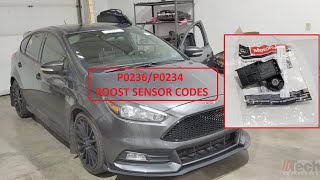
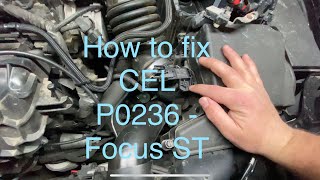
We Have This Part in Stock
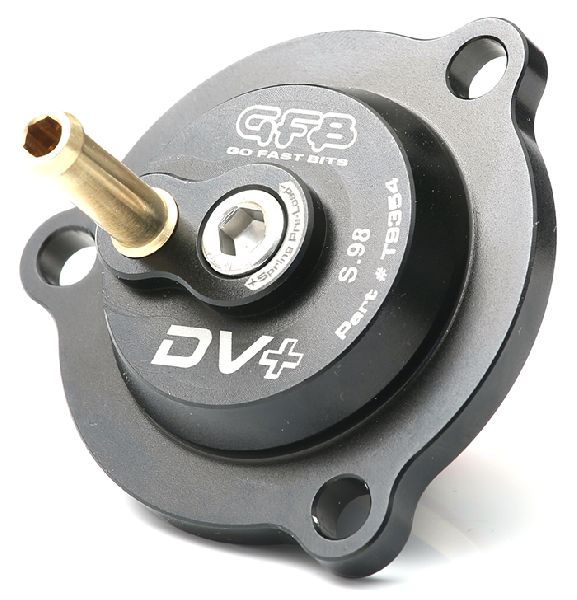

The information in this article is provided for general reference and educational purposes only. Vehicle specifications, procedures, and part compatibility can vary by production date, trim level, and region. Always consult your vehicle's factory service manual and verify part numbers before purchasing or performing repairs. Safety-critical components such as airbags, seat belts, and braking systems should be installed by a qualified professional.
- Ford Focus:
- 🧭 Diagnostic Flowchart
- 🎬 Helpful Videos
- 🛍️ Shop This Part
- What's Unique About the 2012-2018 Ford Focus
- Symptoms You May Notice
- Most Likely Causes
- Rare But Worth Checking
- Diagnosis Steps
- Parts You'll Likely Need
- Related Codes That Often Appear With This One
- Technical Service Bulletins (TSBs) & Recalls
- Platform-Specific Known Issues
- Mechanic-Grade Diagnostic Values
- Scan Tool Commands That Help
- Wiring & Ground Locations
- Real Owner Repair Stories
- "I Checked Everything" — The Actual Cause
- When the Usual Fixes Don't Work
- OEM Part Supersession History
- Model Year Variations Within This Range
- Other Known Issues on This Vehicle
- Used vs. New Parts: Buying Guide for This Vehicle
- Real Owner Stories
- 2012-2018 Ford Focus 1.0L EcoBoost
- 2014-2019 Ford Fiesta 1.0L EcoBoost
- 2012-2018 Ford Focus
- Related OBD-II Codes
- Frequently Asked Questions
- 🎟️ Get 5% Off