

P0237 on 2019-2021 Chevrolet Silverado 1500: Turbo Boost Sensor Circuit Low Causes & Fixes
On a 2019-2021 Silverado, P0237 is most often caused by a chafed engine wiring harness, a known issue covered by GM Technical Service Bulletin #21-NA-149. Before replacing the boost pressure sensor, thoroughly inspect the harness for damage at specified points, particularly where it passes the ECM bracket, upper control arm, and crosses the camshaft carrier cover (2.7L) or generator (3.0L).
- For a 2019-2021 Silverado, P0237 is more likely a wiring problem than a sensor problem.
- Before buying any parts, you must inspect the engine wiring harness for chafing, as detailed in GM TSB #21-NA-149.
- Common chafe points for the 2.7L engine are where the harness crosses the cam cover and passes the air filter housing.
- Common chafe points for the 3.0L engine are on top of the generator and near the PCV hose clamp.
- If multiple, seemingly unrelated codes are present with P0237, it is almost certainly the wiring harness.
What's Unique About the 2019-2021 Chevrolet SILVERADO 1500
The 2019-2021 Silverado 1500, along with its GMC Sierra counterpart, is uniquely prone to this code due to a well-documented manufacturing issue. GM has released several Technical Service Bulletins, most notably #21-NA-149, detailing how the engine wiring harness is susceptible to chafing at multiple points in the engine bay. TSBs explain that a harness clip was sometimes omitted during production for ergonomic reasons, leaving an 'uncontrolled branch' of the harness free to rub against sharp metal edges. This chafing can cause a short to ground in the boost sensor circuit, triggering P0237, often along with a host of other seemingly unrelated electrical codes.
Diagnostic Flowchart
Tap your situation to follow the diagnostic path that matches what you're seeing on this vehicle.
Symptoms You May Notice
- Check Engine Light illuminated
- Reduced engine power or 'limp mode'
- Sluggish or delayed acceleration
- Engine may run rough
- In cases of severe harness damage, a no-start or no-crank condition may occur
- Transmission shifting erratically
- Instrument panel cluster (IPC) gauges sweeping while driving
- Replacing the boost pressure sensor without first inspecting the wiring harness. Due to the known TSB, the harness is a more likely culprit than the sensor itself on this specific truck.
Most Likely Causes
- Engine Wiring Harness Chafing 🔴 High Probability → Shop Engine Wiring Harness A known issue documented in GM TSB #21-NA-149 (superseding PIT5677E). The harness routing can lead to contact with sharp edges on the engine and chassis, causing wires to rub through their insulation. The TSB notes this can affect the 2.7L L3B, 3.0L LM2, 4.3L LV3, 5.3L L84, and 6.2L L87 engines.
How to confirm: Perform a thorough visual inspection of the engine wiring harness. TSB #21-NA-149 recommends removing the driver-side front wheel and wheelhouse liner for better access. Key chafe points for all engines are the ECM/TCM bracket, the driver-side upper control arm, and the shock tower bolt area. For the 2.7L L3B, also inspect where the harness crosses the camshaft carrier cover, the lower air cleaner housing, and the generator bracket. For the 3.0L LM2, inspect the harness on top of the generator (approx. 18 inches from ECM) and where it may contact the PCV hose clamp.
Typical fix: If chafing is found, the damaged wires must be repaired following proper procedures (solder, seal). The harness should then be rerouted or protected with anti-abrasion tape, a Kevlar sleeve, or secured with zip ties to prevent recurrence. The TSB provides specific part numbers for protective sleeves and clips.
Est. part cost: $10-$30 - Faulty Turbocharger Boost Pressure Sensor (MAP Sensor) 🟡 Medium Probability → Shop Turbocharger
How to confirm: If the wiring harness is confirmed to be intact, the sensor is the next suspect. Using a scan tool, check the sensor's voltage with the key on, engine off. A reading near 0 volts points to an internally shorted sensor. The reading should be close to atmospheric pressure (approx. 14.7 PSI at sea level) and change with engine RPM.
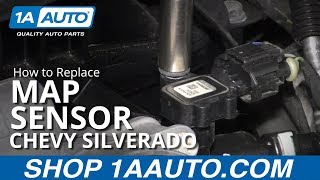
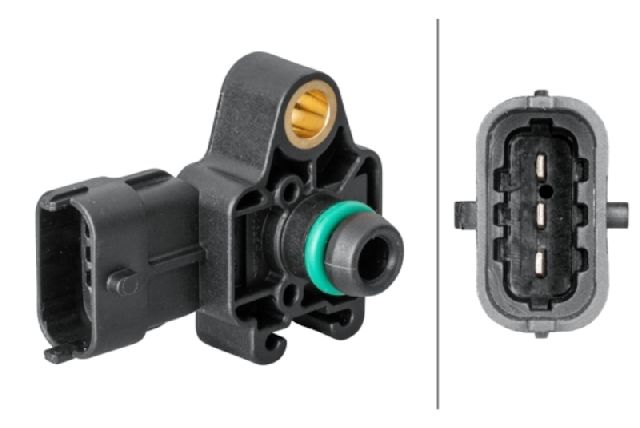
Typical fix: Replace the boost pressure sensor. It is typically located on the intake manifold or charge pipe. 🎬 Watch: See how to replace the MAP sensor on your Silverado.
Est. part cost: $40-$90 - Damaged Sensor Connector or Pigtail ⚪ Low Probability
How to confirm: Visually inspect the boost pressure sensor's electrical connector and the wires leading into it for corrosion, damage, or loose pins. Gently tug on the individual wires to ensure they are secure in the connector; they can sometimes break internally at the connector.
Typical fix: Repair the wiring or replace the connector pigtail if damage is found.
Est. part cost: $15-$40
Rare But Worth Checking
- Faulty Engine Control Module (ECM): This is very rare and should only be considered after all wiring and sensor issues have been definitively ruled out. TSB #21-NA-149 explicitly states that in many cases, the ECM has been unnecessarily replaced for these concerns. A faulty ECM was noted as the fix in one case alongside wiring repairs.
Diagnosis Steps
- Scan the ECM for all stored DTCs. Note if P0237 appears alone or with many other codes. A large number of codes strongly suggests a wiring harness issue.
- Perform a thorough visual inspection of the engine wiring harness, focusing on the chafe points identified in TSB #21-NA-149 for your specific engine. Access is improved by removing the driver's side front wheel and wheelhouse liner.
- If harness damage is found, repair the affected wires and protect the harness from future damage using anti-abrasion tape or sleeves. Clear codes and re-test.
- If the harness is in perfect condition, inspect the boost pressure sensor connector for damage, corrosion, or poor pin tension.
- Using a multimeter or scan tool, verify the sensor's operation. With the key on and engine off, check for the 5V reference and ground at the connector. The signal wire should read below the specified threshold (which triggers the code). A live data scan should show pressure near atmospheric pressure.
- If the wiring is good but the sensor signal is incorrect, replace the boost pressure sensor.
- If the problem persists after replacing the sensor and verifying all wiring, the ECM may be at fault, but this is extremely unlikely and should be the last resort.
Parts You'll Likely Need
- Engine Harness Repair Supplies — To fix the most common cause: chafed wiring. This includes Tesa tape, wire, solder, and heat shrink. The TSB also calls for specific Kevlar sleeves and zip ties.
Trusted brands: 3M, Tesa
OEM price range: $10-$30
Aftermarket price range: $5-$25 - Turbocharger Boost Pressure Sensor
(OEM #ACDelco 24000470 (for 3.0L LM2 Diesel, supersedes 55505514) / ACDelco 12711681 (for 2.7L L3B))— This is the part to replace if the wiring harness is confirmed to be in good condition.
Trusted brands: ACDelco, Bosch, Delphi
OEM price range: $60-$90
Aftermarket price range: $40-$70
Related Codes That Often Appear With This One
- Multiple Unrelated Codes — If the cause is a chafed wiring harness, multiple circuits can be shorted simultaneously, leading to a wide array of seemingly random DTCs for various engine sensors and systems, as listed in TSB #21-NA-149.
- P0238 - Turbocharger Boost Sensor 'A' Circuit High — If the wiring damage is intermittent, the circuit may experience both shorts to ground (P0237) and open circuits (P0238) as the engine vibrates.
- U0100, U0101, U0073 — These are communication codes that are frequently listed alongside P0237 in TSB #21-NA-149 as resulting from the harness chafing issue, indicating a loss of communication with the ECM or TCM. [Bulletin #PIT5677E, Bulletin #PIT5677]
Technical Service Bulletins (TSBs) & Recalls
- 21-NA-149: Details numerous engine wire harness chafe points for multiple engines, including the 2.7L L3B and 3.0L LM2, and lists P0237 as a potential resulting code. It supersedes several previous bulletins.
- PIT5677E: An earlier version of the TSB, also listing P0237 among many codes caused by harness chafing. Superseded by 21-NA-149. [Bulletin #PIT5677E]
- PIT5677: The original preliminary information bulletin highlighting the harness chafing issue on the 2019 2.7L L3B engine. [Bulletin #PIT5677]
Platform-Specific Known Issues
- This vehicle platform is subject to GM Technical Service Bulletin #21-NA-149 (and its predecessors #PIT5677E and #PIT5677), which explicitly details multiple engine wiring harness chafe points that can cause P0237 and numerous other DTCs.
- source — A user with a 2020 Silverado 3.0L Duramax reported a cluster of codes including P0237. The dealer found the wiring harness had chafed on the AC line near the firewall. The repair involved fixing the wires and wrapping the harness, which resolved the issue. This aligns perfectly with the TSB.
Mechanic-Grade Diagnostic Values
- Boost Sensor Signal Voltage — expected: 0.5V to 4.5V, changing with boost pressure.. Failure: Voltage is below 0.5V for more than a few seconds.
- Sensor 5V Reference Wire Voltage (at connector, Key On Engine Off) — expected: 4.8V - 5.2V.. Failure: No voltage or significantly low voltage points to an issue upstream (wiring or ECM).
- Sensor Signal and Ground Wire Continuity — expected: ≤ 20 Ω.. Failure: High resistance or an open circuit (OL) indicates a break in the wire.
- DTC Set Condition — expected: Boost pressure signal greater than the threshold.. Failure: The ECM sets P0237 when the boost pressure sensor signal is less than 38-40 kPa for 2 seconds.
Scan Tool Commands That Help
- Professional Scan Tool (e.g., iCarsoft, GDS2): Turbo Sensor Relearn / Reset Adaptations — After replacing the boost pressure sensor, this function resets the ECM's stored boost pressure memory for proper calibration and performance.
Wiring & Ground Locations
- G103 — Left rear of the engine compartment on the cowl, above the brake booster.. This is a major ground point for the BCM, Instrument Panel Cluster (IPC), and Data Link Connector (DLC). While not a direct engine ground, a poor connection here can cause widespread communication and electrical issues that could mimic or accompany harness damage.
- G110 / G114 — Frame rail area, specific location varies slightly by model/engine.. GM issued Engineering Information (EI) bulletin PIE0548 for loose ground connections at G110 (Body Harness) and G114 (Engine Harness) on 2019-2020 Silverado/Sierra 1500s, indicating these are known problem areas that can cause various electrical faults.
- ECM Connector X1 — This is one of the main connectors on the Engine Control Module.. The boost pressure sensor's 5V reference, signal, and low reference (ground) circuits all run through this connector to the ECM. Testing for voltage and continuity at the specific pins on this connector can isolate a problem between the sensor and the ECM.
Real Owner Repair Stories
- Article citing a repair on a platform-mate GMC Sierra (2019 GMC Sierra 1500 5.3L) — P0237 and P0106, reduced engine power.
❌ Tried (didn't work) Initial diagnosis pointed towards a faulty sensor.
✅ What actually fixed it The final repair involved replacing the fuel rail pressure sensor connector pigtail due to poor terminal tension and replacing the ECM because it was sending incorrect voltage. This highlights that even with a wiring-related code, the ECM itself can be the ultimate point of failure.
OEM Part Supersession History
55505514→24000470— Standard part update or revision by GM.
Helpful Videos
We Have This Part in Stock

The information in this article is provided for general reference and educational purposes only. Vehicle specifications, procedures, and part compatibility can vary by production date, trim level, and region. Always consult your vehicle's factory service manual and verify part numbers before purchasing or performing repairs. Safety-critical components such as airbags, seat belts, and braking systems should be installed by a qualified professional.
- Chevrolet SILVERADO 1500:
- 🧭 Diagnostic Flowchart
- 🎬 Helpful Videos
- 🛍️ Shop This Part
- What's Unique About the 2019-2021 Chevrolet SILVERADO 1500
- Symptoms You May Notice
- Most Likely Causes
- Rare But Worth Checking
- Diagnosis Steps
- Parts You'll Likely Need
- Related Codes That Often Appear With This One
- Technical Service Bulletins (TSBs) & Recalls
- Platform-Specific Known Issues
- Mechanic-Grade Diagnostic Values
- Scan Tool Commands That Help
- Wiring & Ground Locations
- Real Owner Repair Stories
- OEM Part Supersession History
- 🎟️ Get 5% Off