

OBD-II Code P0242: Turbo/Supercharger Boost Sensor 'B' Circuit High
What P0242 means, why it triggers, and how to fix it
- P0242 triggers when the engine computer detects a continuous voltage above 4.8V from the 'B' boost pressure sensor, forcing the vehicle into a low-power limp mode.
- Melted wiring shorting to a power source is the most common cause of P0242, particularly on Ford EcoBoost engines where harnesses route near hot exhaust components.
- A stuck wastegate or faulty boost control solenoid causes a genuine overboost condition, meaning the sensor is accurately reporting a mechanical failure rather than an electrical one.
- Driving more than 100 miles with an active P0242 risks fouling the catalytic converter due to a rich fuel mixture, potentially adding $800 to $2,500 in secondary repair costs.
- Never replace the boost sensor without first performing a live-data 'wiggle test' on the wiring harness to rule out an intermittent electrical short.
What Does P0242 Mean?
The engine's computer (ECU) detects that the voltage signal from the 'B' boost pressure sensor is higher than the normal operational range. This tells the computer that the turbo or supercharger is creating dangerously high pressure, even if it isn't. In response, the ECU cuts engine power and fuel to protect the engine from potential damage.
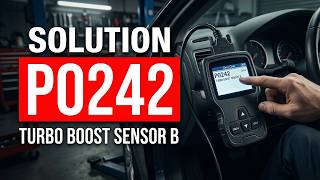
Technical definition: The official SAE/OBD-II definition is "Turbocharger/Supercharger Boost Sensor 'B' Circuit High". This indicates the Powertrain Control Module (PCM) registers a voltage from the 'B' boost pressure sensor that is above the specified range (typically over 4.8 volts for more than a few seconds 🎬 See this quick breakdown of what high voltage readings mean.), indicating a short to power or an open circuit.
Can I Drive With P0242?
Yes, But With Caution. Yes, but your engine will enter 'limp mode' with noticeably less power. Driving over 100 miles risks secondary damage, like a fouled catalytic converter ($800-$2500). A severe overboost condition also risks internal engine damage.
Common Causes
- Damaged or Corroded Wiring Harness (Very Common) — The wiring for the boost sensor routes near hot exhaust components. Heat melts the insulation, causing the signal wire to touch a power source (a short circuit) and send a constant high voltage signal. This also includes damaged connectors or poor ground circuits.
- Faulty Turbo/Supercharger Boost Sensor 'B' (Common) — The sensor fails internally, developing a short that causes it to send a continuous high voltage signal to the computer, regardless of the actual boost pressure.
- Mechanical Wastegate or Boost Control Solenoid Failure (Less Common) — A stuck-closed wastegate, faulty boost control (N75) solenoid, or cracked vacuum lines cause the turbo to generate excessive boost pressure. The P0242 code sets because the sensor accurately reports a real overboost condition.
- Aftermarket Modifications or Incorrect ECU Tune (Less Common) — Improperly installed aftermarket parts like manual boost controllers or an aggressive engine tune push boost pressure to levels the stock ECU software considers out of range, triggering a P0242 code.
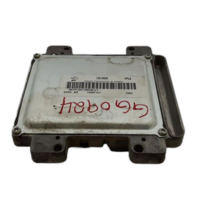
- Faulty Powertrain Control Module (PCM) (Rare) — The engine computer itself fails. An internal short in the PCM's driver circuit for the sensor causes it to misread the signal, even if the sensor and wiring are perfectly fine.
Symptoms
- Reduced Engine Power / Limp Mode — The car feels sluggish, hesitates, and won't accelerate quickly. The ECU puts the engine into a 'limp mode' to prevent damage from perceived excessive boost.
- Poor Fuel Economy — The engine runs less efficiently as the computer tries to compensate for the incorrect boost reading, running rich and using more fuel than normal.
- Excessive Black Smoke from Exhaust — If the ECU's response to the fault causes a rich fuel mixture, you see black smoke from the tailpipe during acceleration.
- Check Engine Light is on (also visible on scanner) — The ECU logs code P0242 and illuminates the malfunction indicator lamp (MIL) on your dashboard.
Diagnostic Flowchart
Tap your situation to follow the diagnostic path that matches what you're seeing on this code.
Common Fixes & Costs
- Repairing or replacing the wiring harness — Parts: $10-$50, Labor: $100-$300, ~2 hr book time (Intermediate)
- Replacing the Turbo/Supercharger Boost Sensor — Parts: $40-$150, Labor: $80-$160, ~1 hr book time (DIY)
- Replacing the Boost Control Solenoid/Wastegate Actuator — Parts: $50-$200, Labor: $100-$250, ~1 hr book time (Intermediate)
- Cleaning or replacing the sensor connector — Parts: $5-$25, Labor: $50-$150, ~0.8 hr book time (DIY)
- Replacing the Powertrain Control Module (PCM) — Parts: $600-$1000, Labor: $150-$300 (including programming), ~1.5 hr book time (Professional)
Used vs. New Parts: Buying Guide
When a used part is worth it: For electronic parts like a boost sensor or solenoid, buying used is rarely recommended as the cost savings are minimal compared to the risk of premature failure and repeat labor costs. A used part makes sense only if it's from a verified low-mileage donor vehicle and the budget is extremely tight.
Donor-vehicle mileage cap: roughly under 50000 miles for the part to have meaningful remaining life.
Donor quality checklist:
- Verify the donor vehicle was not scrapped for engine or emissions-related failures.
- Avoid parts from rust-belt donors, as connectors have hidden corrosion.
- Match the part number exactly. Superseded or different part numbers are not compatible with your vehicle's software.
Decision logic:
- If Part is electronic (sensor, solenoid) and new aftermarket version is < $100 → Always buy new. The warranty and reliability are worth the small extra cost over a used part.
- If Vehicle is > 150K miles AND budget is the primary concern → A used part from a reputable salvage yard with a short-term warranty is a viable, but risky, option.
- If Part is known to be a high-failure item with multiple revisions (e.g., some VW sensors) → Buy a new OEM part to ensure you get the latest, most reliable version.
Warranty tradeoff: Used parts typically come with a 30-90 day warranty that covers the part only, not labor. New aftermarket parts often have a 1-year to limited lifetime warranty. New OEM parts carry a 1-2 year warranty, especially if installed by a dealer.
Worst-case if a used part fails: $200-$500 if a used sensor or solenoid fails shortly after installation, requiring repeat labor and the purchase of another part.
What Happens If You Wait — Timeline
- 0-1 month: Code sets, Check Engine Light is on. Vehicle frequently enters 'limp mode' with drastically reduced power. Driver notices hesitation or sluggishness. (MPG impact: 5-10%% · Added cost: $0-$50 in wasted fuel)
- 1-3 months: The ECU's protective rich fuel mixture begins to stress the catalytic converter. Fuel economy remains poor. Soot becomes visible on the exhaust tip. (MPG impact: 10-15%% · Added cost: $50-$150 in wasted fuel)
- 3-6 months: Sustained exposure to the rich exhaust mixture overheats and permanently damages the catalytic converter's internal structure. A P0420 (Catalyst Efficiency) code appears. Damage is irreversible. (MPG impact: 10-20%% · Added cost: $800-$2500 (cost of catalytic converter replacement is now unavoidable))
- 6+ months: Complete catalytic converter meltdown creates an exhaust blockage, leading to severe power loss or a no-start condition. The prolonged rich condition fouls spark plugs and oxygen sensors. (MPG impact: 15-25%% · Added cost: $1500-$3500+ (includes catalytic converter, O2 sensors, and engine diagnosis for damage from exhaust blockage))
Cost of Not Fixing It
- 0-1 month: Persistent check engine light, significantly reduced engine power ('limp mode'), and a drop in fuel economy of 5-10%. (Added cost: Negligible, other than increased fuel consumption.)
- 1-6 months: The engine running in a default rich fuel condition overheats and fouls the catalytic converter, leading to irreversible damage and failure. (Added cost: $1200-$2800)
- 6+ months: If the code is caused by a true mechanical overboost, continued operation risks severe internal engine damage, including to pistons and head gaskets. If the cause is electrical, fouled spark plugs and oxygen sensors result from the prolonged rich condition. (Added cost: $300-$7000+)
Diagnosis Steps
- Scan for Codes and Review Freeze Frame Data
Use an OBD-II scanner to confirm P0242 is the active code. Examine the freeze frame data to see the engine conditions (RPM, load, temperature) when the code was set. Check for other related codes, like P0299 (Underboost) or P0240 (Range/Performance).
Tools: OBD-II Scanner (Beginner) - Visually Inspect Wiring and Connector
Thoroughly inspect the entire wiring harness going to the 'B' boost sensor. Look for melted insulation, cracks, or frayed wires, especially near the hot turbo or exhaust manifold. Check the connector for green/white corrosion, pushed-out pins, or moisture.
Tools: Flashlight (Beginner) - Perform a Wiggle Test
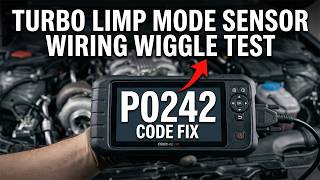
With the engine running and a scan tool graphing the boost sensor PID (or a multimeter connected), gently wiggle the wiring harness and connector for the boost sensor. If the voltage reading jumps erratically or spikes to 5 volts, it confirms an intermittent short or a broken wire inside the insulation.
Tools: Multimeter or OBD-II Scanner with Live Data (Intermediate) - Check for Reference Voltage and Ground at the Connector
With the key on but the engine off (KOEO), unplug the sensor. Use a multimeter to test the connector terminals. One pin must have a steady 5-volt reference signal from the PCM. Another pin must have a good ground (less than 0.1 volts or <10 ohms resistance to chassis ground). If either is missing, the problem is in the wiring or the PCM.
Tools: Multimeter (Intermediate) - Check Signal Voltage (KOEO, Sensor Disconnected)
With the sensor disconnected and KOEO, check the voltage on the signal wire at the harness connector. On many vehicles, you see 5 volts due to the PCM's internal pull-up resistor design. If you see 12 volts, you have a direct short to battery power in the harness.
Tools: Multimeter (Advanced) - Check Signal Voltage (KOEO, Sensor Connected)
Reconnect the sensor. With KOEO, backprobe the signal wire. The voltage corresponds to atmospheric pressure. At sea level, this is typically between 1.5V and 2.5V. A reading of 5.0V or higher indicates the sensor is internally shorted.
Tools: Multimeter (Advanced) - Verify Mechanical Operation
If all electrical tests pass, the sensor is correctly reporting a real overboost problem. Inspect the turbo wastegate actuator and linkage to ensure it moves freely. Apply vacuum or pressure with a hand pump to see if the actuator works. Check the boost control solenoid for proper function using a scan tool's active test feature.
Tools: Vacuum Pump, Scan Tool, Hand Tools (Advanced)
When This Code Triggers (Freeze-Frame Conditions)
- Engine Coolant Temp: 180-200°F (The engine is fully warmed up to normal operating temperature.)
- RPM: 1500-2500 RPM (The fault sets during steady-state cruising or light acceleration when the turbo is expected to be active.)
- Engine Load: 30-60% (The code triggers under moderate engine load, not necessarily full throttle, but when boost is being requested.)
- Vehicle Speed: 35-55 mph (Occurs during city or highway driving speeds, corresponding to the RPM and load conditions.)
Related Codes
- P0241 — This code means 'Turbocharger Boost Sensor B Circuit Low,' which is the opposite of P0242. A P0242 indicates a high voltage (short to power), while a P0241 indicates a low voltage (short to ground or an open signal wire). Diagnostic steps are similar, but you look for the opposite fault.
- P0240 — This code indicates a 'Range/Performance' issue with the same sensor circuit. It sets when the sensor's signal is not logical for the current engine state (e.g., not changing with RPM/load) but isn't stuck fully high or low. P0242 is specifically for a continuously high signal.
- P0299 — This code means 'Turbo Underboost.' It triggers as a direct consequence of P0242. When the ECU sees the false high-pressure signal from P0242, its protective response is to fully open the wastegate to lower boost. This action causes a real, measurable lack of boost, which logs a P0299 code. If P0242 and P0299 are logged together, P0242 is the root electrical cause.
- P0236 — This code is for 'Turbocharger Boost Sensor 'A' Circuit Range/Performance'. If your vehicle has two boost sensors ('A' and 'B'), a fault in one causes the computer to flag a related fault in the other as it compares their readings. Diagnosing both is necessary.
Climate & Environmental Factors
- Extreme Cold: In very cold temperatures (below freezing), moisture in the air freezes inside mechanical components. This causes the wastegate actuator arm to stick or move sluggishly, leading to an overboost or underboost condition. Additionally, wiring insulation becomes brittle and cracks, increasing the chance of a short circuit.
- High Humidity / Salt: Humid or salt-heavy environments (coastal areas, winter roads) accelerate corrosion on electrical connectors and ground points. Corrosion increases resistance in the circuit, which alters voltage readings and triggers a P0242 code.
- High Altitude: At high altitudes, atmospheric pressure is lower. The PCM uses the boost sensor (MAP sensor) reading at KOEO to determine this barometric pressure. While this doesn't directly cause a 'Circuit High' fault, it changes the baseline reading the PCM expects. A sensor that is failing and reading artificially high is pushed over the fault threshold more easily at altitude.
How to Talk to a Mechanic About This Code
Say this: "I have a P0242 code and I'd like to schedule a diagnostic. I want to make sure the technician tests the wiring harness for a short-to-power before recommending a new sensor, since I know harness damage is common for this code."
This signals to the shop that you are an informed customer. It directs them to perform a proper electrical diagnosis (which is the correct first step) rather than simply replacing the most obvious part (the sensor), which saves you money on a misdiagnosis.
Avoid saying:
- 'Just fix whatever's wrong'
- 'My check engine light is on, can you look at it?' (too vague — invites upsell)
- 'Whatever you recommend'
Questions to ask before authorizing the repair:
- What was the voltage on the signal wire when you tested it with the sensor unplugged?
- Did you perform a wiggle test on the harness to check for an intermittent short?
- If you are recommending a new sensor, how did you confirm the wiring harness is good?
- If the electrical tests passed, how did you test the mechanical parts like the wastegate actuator?
- What is the warranty on this specific repair, including both parts and labor?
Where to Take It: Dealer vs Independent vs Chain
- Dealer:
Recommended for warranty work or if an independent shop has already struggled to diagnose a complex mechanical or software-related cause.
Best for: Vehicles still under powertrain or emissions warranty, Complex manufacturer-specific quirks (e.g., BMW vacuum systems, VW N75 valves), Repairs that require a PCM software update (reflash)
Downsides: Higher labor rates, often $150-$250/hr., May prefer to replace an entire wiring harness ($$$) rather than repair a single wire ($). (Typical cost: +50% vs. baseline) - Independent Shop:
Best fit. P0242 is a common code that most competent independent shops diagnose and repair effectively, especially since the most common cause is wiring damage. They are often more willing than dealers to perform a targeted wiring repair instead of a more expensive full harness replacement.
Best for: Out-of-warranty vehicles where cost is a factor., Diagnosing and repairing common failures like wiring shorts or faulty sensors., Building a relationship with a technician you can talk to directly.
Downsides: Diagnostic capabilities vary; choose a shop that specializes in your vehicle's brand or has strong electrical diagnostic reviews., May not have access to the very latest manufacturer-only software updates. (Typical cost: +0% vs. baseline) - Chain Shop:
Use with caution. Acceptable for a straightforward boost sensor replacement if you have already confirmed the diagnosis yourself. Avoid for initial diagnosis, as the risk of an incorrect or incomplete assessment is high.
Best for: Simple, clear-cut part replacements when the diagnosis is already certain.
Downsides: Technician skill and diagnostic equipment vary dramatically., Business model incentivizes quick part replacement over thorough diagnosis, leading to misdiagnosis of a wiring or mechanical fault. (Typical cost: -10% vs. baseline)
When to Walk Away From the Repair
If the estimated repair cost exceeds 50% of the car's current private-party value (e.g., from Kelley Blue Book), you should pause and evaluate your options.
- Car worth $7000, fix is $450: Fix it. This is a standard repair cost and is a small fraction of the vehicle's value.
- Car worth $4000, fix is $1800: Walk away or get a second opinion. The repair cost is approaching 50% of the car's value. The high estimate indicates a recommendation for a major part (like a turbo or PCM) that may not be the true cause.
- Car worth $2500, fix is $1500: Walk away. The repair cost is over half the car's value. It is not economical to proceed unless the car has significant sentimental value.
What Scan Tool You Need for This Code
Minimum: OBD-II scanner with live data streaming and graphing. A basic code reader that only shows the code number is not sufficient for P0242.
To diagnose P0242, you must see the live voltage from the boost pressure sensor. A basic reader can't show you if the voltage is stuck high (indicating a short) or if it responds to a 'wiggle test' on the wiring. Without live data, you are just guessing.
Budget: BlueDriver Pro Scan Tool or Ancel BD310 (~$100) — These Bluetooth dongles connect to your smartphone and provide live data graphing. This is the minimum required to watch the boost sensor voltage in real-time to see if it's stuck high or if wiggling the harness causes it to spike.
Mid-range: Innova 5610 or Autel MaxiCOM MK808S (~$350) — Adds bidirectional control. This allows you to command components like the boost control solenoid to activate, helping you test mechanical parts directly from the scan tool after you've ruled out a simple wiring short. This is crucial for distinguishing between an electrical fault and a mechanical fault causing a real overboost.
Professional: Autel MaxiSys MS906 Pro / Launch X431 Series (~$1000-1500) — Provides full OEM-level diagnostics, including topology mapping to see how modules are communicating and advanced coding functions. For a P0242, its main advantage is the ability to easily perform PCM software updates (reflashes) if a manufacturer has issued a TSB to fix software-related false codes.
Rent vs buy: Most auto parts stores like AutoZone offer a free loaner tool program. However, these are often basic code readers that lack the essential live data function for this code. If you plan to diagnose the issue yourself, you need to buy a scanner with live data capability. If this is a one-time repair, it's more cost-effective to pay a shop's diagnostic fee ($120-$180) than to buy a mid-range scanner.
How to Clear the Code After You Fix It
- Use an OBD-II scan tool to clear the diagnostic trouble code.
- Perform a complete OBD-II drive cycle to allow the vehicle's readiness monitors to run.
- Reconnect the battery if it was disconnected for the repair, but be aware this resets all monitors.
Drive cycle (~30 minutes): A general drive cycle includes a cold start (engine sitting overnight), a 2-5 minute idle period, 10-15 minutes of mixed city/highway driving (including steady speeds between 45-65 mph), and a cool-down period.
Readiness monitors affected: Catalyst monitor, O2 sensor monitor, Heated O2 sensor monitor, EVAP system monitor
Before emissions retest: drive at least 100 miles to fully set monitors.
Watch out for:
- Simply clearing the code with a scanner will not fix the underlying problem; the code will return.
- Disconnecting the battery clears the code but also resets all readiness monitors, causing an immediate emissions test failure until a full drive cycle is completed.
- Not driving the vehicle through varied conditions (idle, city, highway) prevents some monitors from setting.
Will This Fail Emissions / State Inspection?
Yes — this code typically fails an OBD-II emissions inspection.
- California: An illuminated Check Engine Light from a P0242 code is an automatic test failure. After repair, all readiness monitors must be set to 'Ready', which requires driving over 100 miles in varied conditions before a retest is possible.
- New York: The NYS DMV vehicle inspection includes an OBD-II scan. An active P0242 trouble code results in an automatic failure of the emissions portion of the test.
- Texas: In the 17 counties requiring emissions testing, an active P0242 code and illuminated Check Engine Light is an automatic failure. You cannot renew your registration until the vehicle is repaired and passes the inspection.
Most Commonly Affected Vehicles
- Ford F-150 with EcoBoost (2011-2018) — Wiring harnesses route near hot components, leading to melted wires and shorts. The 2011-2012 models, in particular, had sensors prone to moisture intrusion.
- Chevrolet Cruze / Sonic / Trax 1.4L Turbo (2011-2016) — Known for boost sensor issues. A common misdiagnosis occurs when the boost sensor and upstream O2 sensor connectors are accidentally swapped after repairs, as they are physically similar. TSB 16-NA-019 also relates to intake system faults on these models.
- Volkswagen GTI / Golf R (2015-2019) — These models see cases of premature boost pressure sensor failure. The part number has been revised multiple times. Ensure you use the latest revision when replacing.
- Audi A4 / S4 (2013-2017) — Often related to harness damage near the sensor connector. Also, check the N75 boost control valve, as failures cause an actual overboost condition.
- BMW Various with N54/N55 Engines (e.g., 335i, 135i) (2007-2013) — Often related to faulty boost control solenoids or cracked/leaking vacuum lines causing actual overboost, which the sensor correctly reports. The solenoids are a very common failure item.
- Subaru WRX / STI (2008-2021) — Caused by a faulty wastegate control solenoid or issues with aftermarket tuning. The stock tune is sensitive to changes in boost pressure.
- Hyundai Sonata 2.0T / Veloster Turbo (2011-2016) — Wastegate and electronic boost solenoid issues are a known point of failure on these models, which relate to this code.
- Dodge Dart 1.4L Turbo (2013-2016) — Similar to the Chevy Cruze, these engines suffer from boost sensor failures and wiring issues. The sensor is located on the intake manifold and is relatively easy to access.
Manufacturer-Specific Notes
- Ford: On many EcoBoost engines, the wiring harness is notoriously prone to melting if it comes into contact with the exhaust manifold or turbocharger, making a wiring short a very common cause for this code. Always inspect the harness loom carefully.
- Volkswagen/Audi: For some VW and Audi models, a P0242 code is caused by a faulty boost control (N75) valve or a torn diverter valve, leading to incorrect boost pressure that the sensor accurately reports as high. Technicians check these mechanical components before replacing the sensor.
- General Motors (GM): On the 1.4L Ecotec engine (Cruze, Sonic), the upstream O2 sensor and boost pressure sensor connectors are identical and located near each other. They are accidentally swapped during maintenance, which immediately causes a P0242 and other codes. Always double-check connector placement after any service in that area.
- Chrysler/Dodge/Jeep: On some models, the PCM software is sensitive and sets a P0242 due to a momentary spike. Checking for a PCM software update (reflash) is a valid diagnostic step if no physical fault is found, as updated software includes a wider tolerance for sensor readings.
- General Motors (GM): For 2nd generation Chevy Cruze models in cold climates, GM issued TSB #22-NA-007 for codes like P0236, which relate to this issue. Ice forms in the charge air cooler and affects sensor readings. The fix involves inspecting for ice and updating PCM software.
Real Owner Stories
2013 Ford F-150 EcoBoost at 110K miles
Check engine light came on with sudden loss of power (limp mode) while towing a small trailer uphill.
What they tried:
- Initially replaced the boost pressure sensor ('B' sensor on the intake manifold) based on the code description. The code returned within 20 miles.
Outcome: A mechanic performed a wiggle test on the wiring harness near the turbo. The engine stumbled, confirming a wiring issue. A section of the harness had sagged and melted against the exhaust manifold, causing the signal wire to short to a power source. The mechanic repaired the melted wires and secured the harness away from the heat source using a high-temperature heat sleeve. The total repair cost was $250.
Lesson: On Ford EcoBoost engines, always inspect the wiring harness for heat damage before replacing the sensor itself. A short-to-power is a very common cause for P0242.
2012 Chevrolet Cruze 1.4T at 85K miles
After replacing the valve cover, the car immediately had a check engine light with P0242 and multiple other codes (P1101, P2227). The engine ran rough and had no power.
What they tried:
- The owner replaced the boost pressure sensor, but the codes instantly returned. They then suspected a faulty ECU.
Outcome: A forum suggested checking for swapped electrical connectors. The owner discovered they had accidentally swapped the boost pressure sensor connector with the nearby upstream O2 sensor connector, which are physically identical on this engine. After plugging the connectors into their correct components, all codes were cleared and did not return.
Lesson: On GM 1.4L Turbo engines, if P0242 appears immediately after a repair near the top of the engine, double-check that the boost sensor and O2 sensor connectors are not swapped.
2011 BMW 335i (N55 engine) at 95K miles
Intermittent P0242 code, usually appearing under hard acceleration, accompanied by a brief hesitation then limp mode.
What they tried:
- Electrical tests on the sensor and wiring (voltage checks, wiggle test) all passed, showing no signs of an electrical fault. The sensor was reading correctly.
Outcome: The owner inspected the turbocharger's mechanical components. Using a hand vacuum pump, they found the wastegate actuator was slow to respond. The vacuum line going to the actuator was old, brittle, and had a small crack that would open under pressure/heat, preventing the wastegate from opening correctly. This caused a real, momentary overboost condition that the sensor accurately reported. Replacing the $15 vacuum line fixed the issue.
Lesson: If electrical tests for the sensor and wiring are normal, the P0242 code indicates a real mechanical overboost problem. Inspect vacuum lines, the boost control solenoid, and wastegate actuator movement before assuming the sensor is bad.
How to Prevent This Code From Triggering
- Install a heat-resistant sleeve on the sensor wiring harness (Once, especially if harness is routed near the turbo or exhaust) — Melted wiring is a primary cause of P0242. A silicone or fiberglass heat sleeve provides a thermal barrier, preventing wire insulation from melting and causing a short-to-power.
- Periodically lubricate the wastegate actuator arm and linkage (Every 30,000 miles or during oil changes) — Carbon buildup and corrosion cause the wastegate to stick closed, leading to a real overboost condition that triggers P0242. Applying a high-temp penetrating lubricant keeps the mechanical parts moving freely.
- Use Top Tier rated gasoline (Every fill-up) — Higher quality fuels with advanced detergents prevent carbon buildup on internal engine components, including the wastegate valve seat, preventing it from sticking.
- Avoid excessive engine idling (Daily habit) — Long periods of idling contribute to faster carbon deposit accumulation in the exhaust and on turbo components, increasing the risk of a mechanically stuck wastegate.
Frequently Asked Questions
What is the most common misdiagnosis for P0242?
The most common mistake is replacing the boost pressure sensor without testing the wiring. Because the code points to a 'circuit high' fault, many assume the sensor failed. However, melted wiring causing a short-to-power is a much more frequent cause.
What does the 'B' mean in 'Boost Sensor B'?
In vehicles with multiple boost pressure sensors, 'B' designates the sensor located after the throttle body in the intake manifold. 'Sensor A' is typically located before the throttle body. The 'B' sensor's reading is critical for fuel and timing calculations under boost.
Can an aftermarket tune or mod cause a P0242 code?
Yes. If an engine tune requests boost levels exceeding the sensor's 4.8V factory limit, the PCM interprets the high pressure as a fault. This triggers P0242 as the system attempts to protect the engine.
Can a bad turbo cause a P0242 code?
While possible, this code specifically points to an electrical circuit problem or an overboost condition. It is more likely that a control component, like the wastegate or boost solenoid, failed and caused over-pressurization.
Will clearing the code fix the problem?
No. Clearing the code only turns the check engine light off temporarily. The code returns as soon as the ECU's self-test runs and detects the high voltage condition again.
How much does it cost to diagnose a P0242 code?
Most repair shops charge a diagnostic fee ranging from $120 to $180. This covers the initial scan tool analysis and preliminary circuit testing to find the root cause.
Can I replace the boost sensor myself?
Yes, the boost pressure sensor is relatively easy to access and replace on most vehicles. It mounts directly on the intake manifold or intercooler piping with one or two bolts. Always perform a proper diagnosis first to avoid replacing a functional part.
Where is the boost pressure sensor 'B' located?
The 'B' sensor is almost always located on the intake manifold after the throttle body. It functions as a Manifold Absolute Pressure (MAP) sensor in turbocharged applications. This location allows the ECU to measure the final pressure entering the engine cylinders.
Key Takeaways
- P0242 triggers when the engine computer detects a continuous voltage above 4.8V from the 'B' boost pressure sensor, forcing the vehicle into a low-power limp mode.
- Melted wiring shorting to a power source is the most common cause of P0242, particularly on Ford EcoBoost engines where harnesses route near hot exhaust components.
- A stuck wastegate or faulty boost control solenoid causes a genuine overboost condition, meaning the sensor is accurately reporting a mechanical failure rather than an electrical one.
- Driving more than 100 miles with an active P0242 risks fouling the catalytic converter due to a rich fuel mixture, potentially adding $800 to $2,500 in secondary repair costs.
- Never replace the boost sensor without first performing a live-data 'wiggle test' on the wiring harness to rule out an intermittent electrical short.
Helpful Videos
Shop the Parts Behind P0242
Below are the parts most often responsible for code P0242, ranked by how frequently each one is the actual culprit (per the diagnosis above). Tap any to see what we have for your vehicle.


The information in this article is provided for general reference and educational purposes only. Vehicle specifications, procedures, and part compatibility can vary by production date, trim level, and region. Always consult your vehicle's factory service manual and verify part numbers before purchasing or performing repairs. Safety-critical components such as airbags, seat belts, and braking systems should be installed by a qualified professional.
- 🧭 Diagnostic Flowchart
- 🎬 Helpful Videos
- 🛍️ Shop This Part
- What Does P0242 Mean?
- Can I Drive With P0242?
- Common Causes
- Symptoms
- Common Fixes & Costs
- Used vs. New Parts: Buying Guide
- What Happens If You Wait — Timeline
- Cost of Not Fixing It
- Diagnosis Steps
- When This Code Triggers (Freeze-Frame Conditions)
- Related Codes
- Climate & Environmental Factors
- How to Talk to a Mechanic About This Code
- Where to Take It: Dealer vs Independent vs Chain
- When to Walk Away From the Repair
- What Scan Tool You Need for This Code
- How to Clear the Code After You Fix It
- Will This Fail Emissions / State Inspection?
- Most Commonly Affected Vehicles
- Manufacturer-Specific Notes
- Real Owner Stories
- 2013 Ford F-150 EcoBoost at 110K miles
- 2012 Chevrolet Cruze 1.4T at 85K miles
- 2011 BMW 335i (N55 engine) at 95K miles
- How to Prevent This Code From Triggering
- Frequently Asked Questions
- What is the most common misdiagnosis for P0242?
- What does the 'B' mean in 'Boost Sensor B'?
- Can an aftermarket tune or mod cause a P0242 code?
- Can a bad turbo cause a P0242 code?
- Will clearing the code fix the problem?
- How much does it cost to diagnose a P0242 code?
- Can I replace the boost sensor myself?
- Where is the boost pressure sensor 'B' located?
- Key Takeaways
- 🎟️ Get 5% Off