

OBD-II Code P0243: Turbocharger/Supercharger Wastegate Solenoid 'A' Malfunction
The Ultimate Guide to Diagnosing and Fixing P0243 for Mechanics and DIYers
- P0243 is an electrical circuit code where over 80% of cases stem from a failed wastegate solenoid, damaged wiring, or a corroded connector.
- Driving with P0243 triggers a protective limp mode that cuts engine power and drops fuel economy by 10-20%.
- Inspect the solenoid's wiring harness and vacuum lines before buying parts, as a $10 broken vacuum hose or chafed wire frequently triggers this code.
- Ignoring this code risks a $2,500+ turbocharger replacement if a stuck wastegate causes chronic overboosting and internal engine damage.
What Does P0243 Mean?
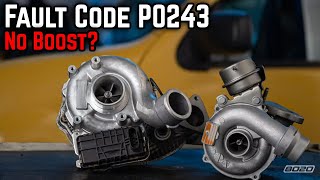
P0243 means your car's Powertrain Control Module (PCM) detects an electrical problem with the wastegate solenoid. This solenoid is a critical electronic valve controlling your turbocharger's boost pressure. 🎬 Watch: A quick breakdown of how this code affects your boost. It acts as a safety gate, bleeding off excess exhaust pressure to prevent the turbo from spinning too fast and destroying the engine.
Technical definition: The official SAE definition for P0243 is "Turbocharger/Supercharger Wastegate Solenoid 'A' Circuit Malfunction". This indicates the powertrain control module (PCM) detects an open circuit, short circuit, or other electrical fault in the control circuit for the wastegate solenoid.
Can I Drive With P0243?
Yes, But With Caution. You can drive for essential short trips (under 10 miles), but you must avoid heavy acceleration and high speeds. Your engine has noticeably less power and enters a protective 'limp mode'. Continuing to drive with an uncontrolled wastegate risks severe turbocharger damage from overspeeding or engine damage from an incorrect air-fuel ratio. Ignoring this turns a sub-$500 repair into a $4,000+ turbocharger and engine replacement bill.
Common Causes
- Faulty Wastegate Solenoid (Boost Control Solenoid) (Very Common) — The most frequent cause. The solenoid is an electromagnet that fails internally from heat cycles and age, causing an electrical short or open circuit that the PCM detects instantly. Internal contamination from oil vapor also causes the plunger to stick.
- Wiring or Connector Issues (Common) — The wiring harness lives in a high-heat environment. Wires become brittle and break, chafe against components causing a short, or connector pins corrode, blocking the signal.
- Leaking, Cracked, or Disconnected Vacuum Lines (Common) — Many solenoids use vacuum pressure to operate the wastegate actuator. If these small hoses crack or disconnect, the system cannot control boost, prompting the PCM to flag a control circuit fault.
- Blown Fuse (Less Common) — A short circuit in the wiring or the solenoid itself blows the dedicated circuit fuse, cutting off power and immediately triggering P0243.
- Stuck Mechanical Wastegate Actuator (Rare) — The solenoid and wiring are perfect, but the mechanical actuator arm seizes due to carbon buildup or rust. The PCM flags a fault because its electronic commands fail to change boost pressure.
- Aftermarket Modifications (Tune or Turbo) (Rare) — Aggressive aftermarket tunes set parameters the factory solenoid cannot meet. Alternatively, installing a mechanical aftermarket turbo without a 'wastegate fooler' resistor leaves the ECU searching for a missing factory solenoid.
- Faulty Powertrain Control Module (PCM) (Very Rare) — Highly uncommon. The internal driver circuit within the PCM that sends the signal to the solenoid fails. Suspect this only after exhaustively eliminating all other possibilities.
Symptoms
- Check Engine Light On — This is the most common and often the only symptom. The light illuminates as soon as the PCM logs the P0243 electrical fault.
- Decreased Fuel Economy — When the PCM cannot accurately control boost, it defaults to a richer fuel mixture to protect the engine, leading to a noticeable 10-20% drop in fuel efficiency.
- Unusual Noises from Engine Bay — A hissing or whistling sound indicates a vacuum or boost leak. A rattling noise points to a loose mechanical wastegate actuator linkage.
- Black Smoke from Exhaust — In diesel or gasoline direct injection engines, incorrect boost control creates a significantly imbalanced air-fuel mixture, resulting in visible black smoke under acceleration.
- Reduced Engine Power / Limp Mode (also visible on scanner) — To protect the engine from overboost damage, the PCM cuts turbo boost and limits RPM. The car feels flat, sluggish, and unresponsive, especially when merging or climbing hills.
Diagnostic Flowchart
Tap your situation to follow the diagnostic path that matches what you're seeing on this code.
Common Fixes & Costs
- Replace Wastegate Solenoid
— Parts: $50-$250, Labor: $100-$350, ~1.5 hr book time
(DIY)
: OEM
: OEM
: OEM - Repair Damaged Wiring or Connector
— Parts: $10-$50, Labor: $150-$300, ~2 hr book time
(Intermediate)
: OEM
: OEM - Replace Cracked or Leaking Vacuum Hoses — Parts: $10-$50, Labor: $50-$150, ~0.8 hr book time (DIY)
- Replace Turbocharger Assembly (if wastegate is integral and non-serviceable) — Parts: $900-$2,500+, Labor: $500-$1,200+, ~6.5 hr book time (Professional)
- PCM Software Update — Parts: $0, Labor: $100-$200, ~1 hr book time (Professional)
- Replace Powertrain Control Module (PCM) — Parts: $800-$1,500, Labor: $150-$300, ~1.5 hr book time (Professional)
DIY vs Professional
- Replace Wastegate Solenoid — Beginner:
- Repair Damaged Wiring or Connector — Beginner:
- Replace Cracked or Leaking Vacuum Hoses — Beginner:
- Replace Turbocharger Assembly — Beginner:
- PCM Software Update — Beginner:
- Replace Powertrain Control Module (PCM) — Beginner:
Used vs. New Parts: Buying Guide
When a used part is worth it: Buying a used wastegate solenoid is not recommended. It is an electronic wear-and-tear item, and the cost savings are minimal compared to the risk and repeated labor cost if the used part fails. A used part only makes sense if it's part of a complete, low-mileage turbocharger assembly being swapped.
Donor-vehicle mileage cap: roughly under 50000 miles for the part to have meaningful remaining life.
Donor quality checklist:
- Verify the exact OEM part number matches; aftermarket equivalents have different resistance values.
- Avoid parts from vehicles in rust-belt states due to a higher risk of connector corrosion.
- Ensure there is no physical damage to the plastic housing or electrical connector.
Decision logic:
- If The cost of a new OEM or reputable aftermarket solenoid is under $250. → Always buy new. The reliability and warranty are worth the cost.
- If The vehicle is over 20 years old and a new part is unavailable. → A tested, used part from a specialty recycler is an acceptable last resort.
- If The solenoid is integrated into the turbocharger assembly. → Favor a new or professionally remanufactured complete turbo unit over a used one to ensure all components are sound.
Warranty tradeoff: Used parts typically offer a 30-90 day warranty, often for the part only (not labor). New aftermarket parts usually carry a 1-year to limited lifetime warranty. New OEM parts have a 1-2 year warranty.
Worst-case if a used part fails: $250-$500 if a used solenoid fails shortly after installation, requiring a second repair (new part + repeat labor).
What Happens If You Wait — Timeline
- 0-2 weeks: Check Engine Light illuminates. In many cases, there are no other noticeable symptoms. The fault is logged, but the PCM may still have partial control or the failure mode does not yet impact performance. (MPG impact: 0-5%% · Added cost: $0)
- 2 weeks - 3 months: Vehicle enters 'limp mode' or reduced power mode. Acceleration becomes very sluggish as the PCM disables or limits turbo boost to protect the engine. A noticeable drop in fuel economy occurs. (MPG impact: 10-20%% · Added cost: $50-$150 in wasted fuel)
- 3-8 months: Secondary damage begins. If stuck open (underboost), the engine runs rich, leading to carbon fouling of spark plugs and overheating the catalytic converter. If stuck closed (overboost), the turbocharger experiences excessive wear from overspeeding. (MPG impact: 15-25%% · Added cost: $800-$2,500 (Risk of damaged catalytic converter or accelerated turbo wear))
- 8+ months: Catastrophic failure. A sustained overboost condition causes severe internal engine damage, such as a blown head gasket or damaged pistons. A destroyed catalytic converter sends debris downstream, damaging other exhaust components. (MPG impact: 20-30%+% · Added cost: $3,000-$7,000+ (Turbocharger replacement and/or engine repair))
Cost of Not Fixing It
- Immediate: Significant loss of engine power, poor acceleration, and a 10-20% drop in fuel economy. The vehicle automatically fails any emissions test. (Added cost: Negligible, other than increased fuel costs.)
- 1-6 Months: If the wastegate sticks closed, chronic overboosting causes catastrophic turbocharger failure. If stuck open, the engine runs consistently rich, overheating and destroying the catalytic converter. (Added cost: $1200-$4000 (Catalytic converter or turbocharger replacement).)
- 6+ Months: Severe, unaddressed overboost conditions lead to internal engine damage, such as blown head gaskets or damaged pistons. (Added cost: $3000-$7000+ (Engine repair or replacement).)
Diagnosis Steps
- Scan for Other Codes
Use an OBD-II scanner to read P0243 and document other codes. Codes like P0234 (Overboost) or P0299 (Underboost) provide clues about the performance result of the electrical fault. P0245 (Circuit Low) or P0246 (Circuit High) pinpoint the specific electrical issue.
Tools: OBD-II Scanner (Beginner) - Thorough Visual Inspection
Inspect the wastegate solenoid's wiring harness for melting, chafing, or broken wires. Check the connector for corrosion (green/white crust) or loose pins. Trace all vacuum lines from the solenoid to the turbo for cracks or disconnections. Verify the mechanical wastegate actuator rod is physically connected.
Tools: Flashlight, Inspection Mirror (Beginner) - Check for a Blown Fuse
Consult your owner's manual to locate the fuse for the boost control solenoid circuit. A blown fuse confirms a short circuit in the wiring or the solenoid itself that you must find before replacing the fuse.
Tools: Fuse puller or needle-nose pliers (Beginner) - Test the Solenoid's Resistance
Disconnect the solenoid's electrical connector. Use a multimeter set to Ohms (Ω) to measure the resistance between the two pins on the solenoid. Compare this to the manufacturer's specification (typically 10-40 Ohms). A reading of 'OL' (open circuit) or near zero (short circuit) means the solenoid is faulty and requires replacement.
Tools: Multimeter (Intermediate) - Test the Connector for Power and Ground
With the key 'On' (engine off), use a multimeter to check for voltage at the wiring harness connector. One pin must have battery voltage (12V) or a 5V reference, and the other is the control (ground) wire from the PCM. This confirms power reaches the solenoid.
Tools: Multimeter (Intermediate) - Pro Tip: Command the Solenoid with a Scan Tool
A bi-directional scan tool commands the wastegate solenoid on and off. With the engine off and key on, activate the solenoid and listen for a 'click'. No click proves a bad solenoid or wiring issue. A click confirms the electronics function, pointing toward a mechanical or intermittent issue.
Tools: Bi-Directional Scan Tool (Advanced) - Test the Wastegate Actuator and Vacuum System
If vacuum-operated, connect a hand-held vacuum pump to the wastegate actuator's port. Apply vacuum and watch the actuator arm move smoothly through its full range. If it fails to move or hold vacuum, the actuator diaphragm is ruptured or the wastegate is seized.
Tools: Hand-held vacuum pump/gauge (Intermediate) - Pro Tip: Check the Control Signal with a Multimeter (Duty Cycle)
Connect a multimeter set to Duty Cycle (%) or Frequency (Hz) to the control wire at the solenoid connector. With the engine running, the reading must change as you rev the engine. A static 0% or 100% reading proves a wiring short or a faulty PCM driver.
Tools: Multimeter with Duty Cycle/Frequency function (Advanced) - Advanced: Monitor Live Data PIDs
Monitor live data PIDs such as 'Commanded Boost Pressure' vs. 'Actual Boost Pressure'. A significant discrepancy between commanded and actual values while driving confirms the wastegate fails to respond correctly to PCM commands.
Tools: Advanced OBD-II Scan Tool (Advanced)
When This Code Triggers (Freeze-Frame Conditions)
- Engine Coolant Temp: 170-210°F (75-99°C) (The fault is often detected after the engine reaches full operating temperature.)
- RPM: 1800-3000 RPM (The code frequently sets during steady-state cruising or light to moderate acceleration, when the PCM actively commands the solenoid to manage boost.)
- Engine Load: 30-70% (This fault appears under moderate engine load, where the turbo produces boost and the PCM actively modulates the wastegate.)
- Vehicle Speed: 40-65 mph (64-105 km/h) (Highway or arterial road speeds are common conditions for this code to trigger, as the turbo system is most active.)
Related Codes
- P0234 — Means 'Engine Overboost Condition'. A common companion to P0243. P0243 is the electrical cause (a circuit fault), while P0234 is the performance effect (too much boost). A solenoid failing in a way that keeps the wastegate closed causes this.
- P0299 — Means 'Engine Underboost Condition'. P0243 is the electrical cause, while P0299 is the performance effect (not enough boost). A solenoid stuck open or failed wiring preventing it from commanding the wastegate closed causes this.
- P0245 / P0246 — More specific electrical fault codes for the same circuit. P0245 indicates 'Circuit Low' (short to ground), and P0246 indicates 'Circuit High' (short to power). P0243 is a general 'Circuit Malfunction'.
- P0045 / P0046 — These codes for 'Turbo/Supercharger Boost Control Solenoid 'A' Circuit/Open' are functionally identical to P0243. Some manufacturers use this code series instead of P0243 to describe the same electrical fault.
Climate & Environmental Factors
- High Engine Bay Heat: The primary environmental factor. Extreme heat cycles cause plastic wiring insulation and rubber vacuum lines to become brittle and crack. It also contributes to the internal breakdown of the solenoid's electromagnetic coil.
- Extreme Cold: In weather below 15°F (-10°C), moisture inside the solenoid or actuator freezes, causing it to stick. This triggers a P0243 code that disappears as the engine bay warms up.
- High Humidity and Salt: In coastal or rust-belt regions, moisture and salt accelerate corrosion on the electrical connector pins for the solenoid. This corrosion creates high resistance or an open circuit, directly causing P0243.
- High Altitude: High altitude reduces air density, forcing the turbocharger to work harder to produce the same boost. This exposes pre-existing weaknesses in the wastegate control system, making a fault more likely.
How to Talk to a Mechanic About This Code
Say this: "I have an active P0243 code and I'd like to schedule a diagnostic. My understanding is this is a circuit malfunction for the wastegate solenoid. Can you please start by testing the solenoid, its connector, wiring, and related vacuum lines before recommending a turbo replacement?"
This signals you've done your research and understand the code is electrical, not necessarily a mechanical turbo failure. It directs the technician to follow a logical diagnostic path, preventing them from jumping to the most expensive conclusion.
Avoid saying:
- 'My turbo is broken.'
- 'My check engine light is on, can you look at it?' (too vague, invites a broad and expensive diagnostic)
- 'Just fix whatever's wrong.'
Questions to ask before authorizing the repair:
- Did you test the solenoid's resistance? What was the reading compared to the spec?
- Did you check for voltage and ground at the solenoid's connector?
- Have you inspected the wiring harness and vacuum lines for visible damage, cracks, or leaks?
- What is the warranty on the proposed parts and labor?
Where to Take It: Dealer vs Independent vs Chain
- Dealer:
Best for: Vehicles still under powertrain or emissions warranty., Newer vehicles with known manufacturer TSBs (e.g., Ford EcoBoost e-clip issue)., Complex European brands (BMW, Mercedes) where specialized diagnostic tools are crucial.
Downsides: Highest labor rates, often 1.5-2x an independent shop., May recommend replacing a full turbo assembly when only an integrated actuator has failed. (Typical cost: +50% vs. baseline) - Independent Shop:
Best fit for most situations. A reputable independent shop with strong electrical diagnostic skills handles a P0243 code effectively and affordably.
Best for: Most out-of-warranty vehicles., Common failures on popular models (e.g., VW N75 valve, Cummins solenoid)., Cost-conscious owners who want a reliable diagnosis without dealer prices.
Downsides: Quality and diagnostic skill vary greatly. Vet shops by checking for ASE certifications and online reviews., May lack access to the very latest TSBs or manufacturer-specific software. (Typical cost: +0% vs. baseline) - Chain Shop:
AVOID for P0243 diagnosis. This code requires specific diagnostic skill that is not a strength of most chain shops. Risk of misdiagnosis and unnecessary parts replacement is high.
Best for: Simple, unrelated maintenance like oil changes or tire rotations.
Downsides: Technician skill is highly variable and often not specialized in complex electrical or turbo diagnostics., Business model pressures technicians to upsell, potentially leading to misdiagnosis (e.g., recommending a new turbo when only a wire is broken). (Typical cost: -10% vs. baseline)
When to Walk Away From the Repair
If the estimated repair cost exceeds 40-50% of the car's private-party value (check Kelley Blue Book), it's time to seriously consider selling the car as-is or trading it in.
- Car worth $5000, fix is $450: Fix it. The repair cost is only 9% of the vehicle's value, which is well below the threshold.
- Car worth $5000, fix is $2800: Walk away. A $2,800 repair (e.g., a full turbo replacement) is 56% of the car's value. This money is better put toward a replacement vehicle.
- Car worth $15000, fix is $2800: Fix it. While expensive, the repair is only ~19% of the car's value. It's economically sound to complete the repair.
What Scan Tool You Need for This Code
Minimum: A scanner that reads and clears codes, and critically, displays live data streams for boost-related PIDs (Parameter IDs).
A $20 code reader only gives you the 'P0243' code, forcing you to guess the cause. To diagnose properly, you need to see what the system is doing in real-time (e.g., comparing 'Commanded Boost' vs. 'Actual Boost'), which requires a scanner with live data capabilities.
Budget: BlueDriver Pro Scan Tool (~$100) — Connects to your smartphone via Bluetooth. It reads the code, provides freeze-frame data, and graphs live data, which is essential for monitoring boost pressure and solenoid command signals.
Mid-range: Foxwell NT510 Elite / KINGBOLEN Ediag Elite (~$150) — These scanners offer bi-directional control. This is a game-changer for P0243, as it allows you to directly command the wastegate solenoid to open and close, letting you hear if it 'clicks' and confirming if the solenoid and its wiring are functional in seconds.
Professional: Autel MaxiCOM MK808 / Launch X431 CRP919XBT (~$450-600) — Provides full bi-directional control, advanced live data graphing, and access to manufacturer-specific codes and data. These are professional-level tools that offer dealer-level diagnostic capabilities for all vehicle systems, making diagnosis faster and more accurate.
Rent vs buy: For a one-time fix, many AutoZone locations lend you a basic OBD-II scanner for free with a refundable deposit through their Loan-A-Tool program. However, these rental scanners typically lack live data or bi-directional features. If you plan to do your own diagnostics more than once, buying a budget pick like the BlueDriver is a worthwhile investment.
How to Clear the Code After You Fix It
- Use an OBD-II scan tool to clear the P0243 code.
- Reconnect the battery if it was disconnected for the repair.
- Perform a complete OBD-II drive cycle to allow readiness monitors to run.
Drive cycle (~30 minutes): Start the engine from a cold start (parked over 6-8 hours). Idle for 2-3 minutes with electrical loads on (A/C, defrost). Accelerate to 55 mph (88 km/h) at half-throttle and hold for 3-5 minutes. Decelerate to 20 mph (32 km/h) without using the brake. Accelerate again to 55-60 mph at three-quarters throttle. Hold steady speed for 5 minutes. Decelerate to a stop.
Readiness monitors affected: Catalyst Monitor, Oxygen (O2) Sensor Monitor, EGR System Monitor, Evaporative (EVAP) System Monitor
Before emissions retest: drive at least 100 miles to fully set monitors.
Watch out for:
- Clearing the code with a scanner or disconnecting the battery resets all readiness monitors to 'Not Ready', causing an immediate emissions test failure.
- The code returns immediately if the root electrical fault remains unrepaired.
- Skipping a true 'cold start' prevents certain monitors, like the O2 sensor heater, from running.
Will This Fail Emissions / State Inspection?
Yes — this code typically fails an OBD-II emissions inspection.
- California: An illuminated Check Engine Light is an automatic failure. After repair, a complete drive cycle must be performed to set all readiness monitors to 'Ready' before a smog retest passes.
- New York: The NYS DMV inspection includes an OBD-II scan. An active P0243 code results in an immediate test failure.
- Texas: In counties requiring emissions testing, an illuminated Check Engine Light is an automatic failure. After clearing the code, you can have at most one monitor 'Not Ready' (two for model years 1996-2000) to pass.
Most Commonly Affected Vehicles
- Dodge/Ram 2500/3500 with 5.9L Cummins (2004.5-2007) — Extremely common issue. The wiring pigtail right at the solenoid breaks internally from vibration and heat. Aftermarket turbos delete the electronic control and require a 'wastegate fooler' resistor (approx. 147 Ohms) to prevent this code.
- Ford F-150, Explorer, Mustang with EcoBoost (2011-2024) — On many 2.0L and 2.3L EcoBoost engines (2019+), this code is caused by a missing e-clip on the electronic wastegate actuator rod, not the solenoid itself. Ford issued TSBs like SSM 50485 and SSM 50171 for this issue.
- Subaru WRX, STI, Forester XT (2002-2024) — The electronic boost control solenoid (EBCS) is a frequent failure item. A resistance test must show 28-30 ohms at 20°C (68°F). Upgrading to a 3-port EBCS is common but requires an ECU tune.
- Volkswagen/Audi Golf, Jetta, A3, A4 with 1.8T/2.0T (2008-2019) — The part is called the 'N75 valve'. It is a very common failure point, along with the associated vacuum lines which become brittle. The OEM part number is 06F906283F.
- Chevrolet Cruze, Sonic with 1.4L Turbo (2011-2016) — A known issue pointing to a failed wastegate solenoid (boost pressure control valve) or a problem within the wiring harness near the turbo.
- Honda Civic, CR-V with 1.5L Turbo (2016-2024) — P0243 points to a faulty boost pressure control solenoid or issues with its electrical connector, such as corrosion on the pins. Check for factory software updates.
- BMW Models with N20, N26, B48 Engines (e.g., 328i, 528i) (2012-2019) — These use an electronic wastegate actuator. The issue is the actuator motor itself, its wiring, or a loose mechanical linkage rod between the actuator and the turbo. The retaining clip breaks, causing a control fault.
- Mercedes-Benz C-Class, E-Class, GLA, Sprinter (2010-2020) — Frequently appears on turbocharged Mercedes models, pointing to a fault in the electronic wastegate actuator circuit or the actuator itself, which is often integrated into the turbocharger.
Manufacturer-Specific Notes
- Dodge/Ram (Cummins): On 5.9L Cummins engines, the wires in the pigtail connector break right at the solenoid body due to vibration. The break is often internal, with insulation intact. Wiggle the wires at the connector; if the code changes, the pigtail is bad.
- Ford (EcoBoost): For 2019+ models with 2.0L/2.3L engines, visually inspect the electronic wastegate actuator rod for a missing e-clip before testing electrical components. Ford issued TSBs (e.g., SSM 50485) for this mechanical failure that logs an electrical code.
- Volkswagen / Audi: The wastegate solenoid is universally known as the 'N75 valve' in the VW/Audi community. Searching for parts or guides using this term yields much better results.
- BMW: On models with electronic wastegates, check the small mechanical linkage rod connecting the actuator motor to the turbo's wastegate arm. It disconnects or the retaining clip breaks, causing a control fault even if electronics are fine.
Real Owner Stories
2006 Dodge Ram 2500 5.9L Cummins
Check Engine Light appeared with code P0243. Owner replaced the entire turbocharger assembly about a year prior.
Outcome: The replacement turbo was a remanufactured unit using a dummy plug with a 10-ohm resistor instead of a real solenoid. This resistor failed. The owner wired in a 194 side marker lamp pigtail to 'fool' the ECM, clearing the code.
Lesson: On Cummins engines with aftermarket or reman turbos, the electronic wastegate control is often deleted. The P0243 code is frequently caused by the failure of the 'fooler' resistor, not a solenoid.
2021 Ford Bronco 2.3L EcoBoost at 23k miles
Check Engine Light and Wrench Light came on, with codes P0243 and P2AB9. The vehicle had a significant lack of power and a loud servo noise on startup/shutdown.
Outcome: Owner replaced the electronic wastegate actuator (Ford part LB5Z-9G488-B). The repair was straightforward, involving two bolts, a connector, and an e-clip. The code cleared, boost performance was restored, and the startup noise disappeared.
Lesson: On modern Ford EcoBoost engines, P0243 is commonly caused by a failed electronic actuator or a missing e-clip on the actuator rod. Always check for TSBs and inspect this component before assuming a wiring or turbo issue.
2011 VW Golf GTI (MK6)
Check Engine Light with P0243 appeared intermittently over 1,500 miles. No significant loss of power was felt. The code appeared shortly after a major service replacing the timing chain tensioner.
Outcome: The community advice pointed to a bad N75 valve or a vacuum leak. The fix is testing the N75 valve and inspecting all associated vacuum lines for cracks or disconnections, which are common failure points on VW/Audi models.
Lesson: If a code appears right after a repair, suspect a disturbed component first. On VW/Audi vehicles, P0243 almost always points to the 'N75' valve or its vacuum hoses, which become brittle and crack.
2013 Dodge Dart 1.4L Turbo
Owner was chasing multiple codes, including P0456 (EVAP leak) and P0299 (underboost). After fixing the P0299, a P0243 code appeared.
Outcome: The appearance of P0243 after replacing the solenoid suggests the issue is in the wiring or connector to the solenoid, or the replacement solenoid was faulty or incorrect for the application.
Lesson: When a new code appears immediately after a repair, it indicates a damaged connector, incompatible new part, or an overlooked circuit fault. Don't assume the new part is good; test its circuit and resistance.
How to Prevent This Code From Triggering
- Use high-quality full synthetic oil and follow strict change intervals (Every 5,000-7,500 miles) — High-quality synthetic oil is more resistant to thermal breakdown, preventing oil 'coking' (burning) that contaminates and seizes the wastegate actuator and turbo bearings.
- Allow a 30-60 second cool-down idle after hard driving (After any high-boost driving (highway pulls, towing)) — This allows circulating oil to carry heat away from the turbocharger assembly. Shutting down a hot engine immediately causes oil to cook inside the turbo, leading to carbon buildup that seizes the wastegate.
- Inspect and replace the engine air filter regularly (Inspect every 10,000 miles, replace as needed) — A clogged air filter restricts airflow, forcing the turbo to work harder and spin faster to make the same boost, increasing wear and heat on all turbo components, including the wastegate system.
- Periodically inspect vacuum lines and connectors (During every oil change) — The rubber and plastic components in the engine bay become brittle from heat cycles. Catching a cracked vacuum hose or a corroding connector early prevents a P0243 code and performance issues.
- Address engine oil leaks promptly (As needed) — Oil leaking from valve covers or other gaskets drips onto the wastegate solenoid's wiring harness, degrading the insulation and causing electrical shorts that trigger P0243.
Frequently Asked Questions
What is a wastegate solenoid?
It is an electronically controlled valve that manages the pressure your turbo produces. The PCM sends a signal to the solenoid, which controls a 'wastegate' flap in the turbocharger. This flap allows exhaust gas to bypass the turbo's turbine, regulating its speed and preventing excessive boost pressure.
How much does it cost to fix P0243?
The cost depends entirely on the cause. A simple vacuum hose replacement costs $100-$200, while replacing the solenoid typically runs $150-$600 at a shop. In rare cases involving turbo or PCM replacement, bills exceed $1,500.
Does P0243 mean I need a new turbo?
Almost never. P0243 is an electrical circuit code relating to the turbo's external control solenoid, wiring, or vacuum lines. While a failed wastegate eventually damages the turbo if ignored, the turbo itself is rarely the initial failure point.
What are the most common mistakes when diagnosing P0243?
The biggest mistake is immediately replacing the wastegate solenoid without performing basic checks. Always inspect related wiring and connectors for damage, check for blown fuses, and verify vacuum lines are intact first. Assuming the PCM is faulty without exhaustive testing is another expensive error.
Can I fix P0243 myself?
If the cause is a bad solenoid or a cracked vacuum hose on an accessible engine, it is a manageable DIY repair for someone with basic tools. Diagnosing electrical circuit faults requires a multimeter and some knowledge. Advanced steps like bi-directional testing or PCM replacement are best left to a professional.
Will my car fail an emissions test with a P0243 code?
Yes, absolutely. An active Check Engine Light is an automatic failure for an emissions or smog test in nearly all jurisdictions.
Will the P0243 code clear itself?
No. This code indicates a hard electrical fault. The Check Engine Light stays on until the underlying problem is repaired, after which the code must be manually cleared with an OBD-II scanner.
What is a 'wastegate fooler' for a Cummins engine?
It is a simple resistor (e.g., 147 Ohm, 1 Watt) housed in a connector that plugs into the factory wastegate solenoid harness. It 'fools' the ECU into thinking the original electronic solenoid is present when an aftermarket mechanical turbo is installed, preventing code P0243.
Key Takeaways
- P0243 is an electrical circuit code where over 80% of cases stem from a failed wastegate solenoid, damaged wiring, or a corroded connector.
- Driving with P0243 triggers a protective limp mode that cuts engine power and drops fuel economy by 10-20%.
- Inspect the solenoid's wiring harness and vacuum lines before buying parts, as a $10 broken vacuum hose or chafed wire frequently triggers this code.
- Ignoring this code risks a $2,500+ turbocharger replacement if a stuck wastegate causes chronic overboosting and internal engine damage.
Helpful Videos
Shop the Parts Behind P0243
Below are the parts most often responsible for code P0243, ranked by how frequently each one is the actual culprit (per the diagnosis above). Tap any to see what we have for your vehicle.



The information in this article is provided for general reference and educational purposes only. Vehicle specifications, procedures, and part compatibility can vary by production date, trim level, and region. Always consult your vehicle's factory service manual and verify part numbers before purchasing or performing repairs. Safety-critical components such as airbags, seat belts, and braking systems should be installed by a qualified professional.
- 🧭 Diagnostic Flowchart
- 🎬 Helpful Videos
- 🛍️ Shop This Part
- What Does P0243 Mean?
- Can I Drive With P0243?
- Common Causes
- Symptoms
- Common Fixes & Costs
- DIY vs Professional
- Used vs. New Parts: Buying Guide
- What Happens If You Wait — Timeline
- Cost of Not Fixing It
- Diagnosis Steps
- When This Code Triggers (Freeze-Frame Conditions)
- Related Codes
- Climate & Environmental Factors
- How to Talk to a Mechanic About This Code
- Where to Take It: Dealer vs Independent vs Chain
- When to Walk Away From the Repair
- What Scan Tool You Need for This Code
- How to Clear the Code After You Fix It
- Will This Fail Emissions / State Inspection?
- Most Commonly Affected Vehicles
- Manufacturer-Specific Notes
- Real Owner Stories
- 2006 Dodge Ram 2500 5.9L Cummins
- 2021 Ford Bronco 2.3L EcoBoost at 23k miles
- 2011 VW Golf GTI (MK6)
- 2013 Dodge Dart 1.4L Turbo
- How to Prevent This Code From Triggering
- Frequently Asked Questions
- What is a wastegate solenoid?
- How much does it cost to fix P0243?
- Does P0243 mean I need a new turbo?
- What are the most common mistakes when diagnosing P0243?
- Can I fix P0243 myself?
- Will my car fail an emissions test with a P0243 code?
- Will the P0243 code clear itself?
- What is a 'wastegate fooler' for a Cummins engine?
- Key Takeaways
- 🎟️ Get 5% Off