

P0244 on 2018-2022 Jeep Wrangler: Turbo Wastegate Causes and Fixes
On a 2018-2022 Jeep Wrangler with a turbo engine, code P0244 most often means the turbocharger wastegate actuator is stuck or has failed. This causes significant power loss. Replacing the actuator is the most common fix, costing around $250-$400 for the part.
- P0244 on a Jeep Wrangler JL indicates a problem with the turbo wastegate actuator's performance.
- The most common cause is a failed or mechanically stuck wastegate actuator, which is replaceable separately from the turbo.
- Before replacing parts, check for available PCM software updates with a dealer, especially if the turbocharger was recently replaced, as per TSB S2018000012.
- Symptoms are severe and include major power loss; driving should be limited until the issue is repaired.
- DIY repair is complex; professional diagnosis is recommended to avoid unnecessary costs.
What's Unique About the 2018-2022 Jeep WRANGLER

On the Wrangler JL platform, this code is particularly noteworthy. Manufacturer Technical Service Bulletins (TSBs) exist specifically for this issue, indicating it's a recognized problem. One critical issue, per TSB S2018000012, is that the code can appear after a turbocharger replacement, often requiring a full PCM replacement to resolve. Additionally, owner forums report that the electronic actuator can become mechanically stuck, a problem that can sometimes be temporarily resolved by simple lubrication but usually requires replacement. A common failure on the shared 2.0L engine in other Stellantis vehicles is the wearing of the actuator linkage arm, which also leads to this code.
Diagnostic Flowchart

Tap your situation to follow the diagnostic path that matches what you're seeing on this vehicle.
Generation note: The 2018 model year was a transition period. The previous generation (Wrangler JK) ended and the current generation (Wrangler JL) was introduced. This guide applies specifically to the 2018-2022 Jeep Wrangler JL models equipped with either the 2.0L Turbo or 3.0L EcoDiesel engine.
Symptoms You May Notice

- Check Engine Light is on
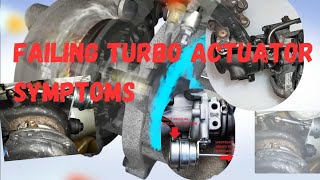
- Significant loss of engine power 🎬 Watch: Common symptoms of a failing turbocharger actuator
- Sluggish or delayed acceleration
- Vehicle may enter 'limp mode' with reduced performance
- Erratic or no boost from the turbocharger.
- Unusual whistling or 'air rushing' sound from the turbo area during acceleration.
- Replacing the turbocharger assembly when only the external electronic actuator has failed. For the JL Wrangler, the actuator is often available as a separate part.
- Replacing the wastegate actuator when the root cause is a software/hardware mismatch that requires a PCM update or replacement, as noted in TSBs.
Most Likely Causes

- Stuck or Failed Turbocharger Wastegate Actuator 🔴 High Probability → Shop Turbocharger The electronic actuator is subject to intense heat and vibration. It can fail in two main ways: 1) Internal electronic failure, such as broken solder joints on the circuit board. 2) Mechanical binding of the internal gears or the external linkage arm. Forum members have confirmed fixing P0244 by replacing a stuck actuator.
How to confirm: Use a scan tool to command the actuator to move while observing its linkage for physical movement. If it doesn't move or moves erratically, it's likely faulty. You can also manually try to move the wastegate linkage arm to check for binding (engine off and cool). A 'tap and WD40' has been reported as a very temporary fix for a stuck arm.
Typical fix: Replace the wastegate actuator. On the 2.0L engine, this is often sold as a kit.
Est. part cost: $250-$450 - Outdated or Mismatched Powertrain Control Module (PCM) Software/Hardware 🟡 Medium Probability Jeep has issued TSBs for this code. TSB S2218000017 addresses the code with a potential PCM software update. Crucially, TSB S2018000012 states that if P0244 appears *after* a turbocharger replacement, the PCM itself must be replaced, as the old module may not be compatible with the new hardware.
How to confirm: A Jeep dealership or a qualified shop with access to OEM software can check for available PCM updates against your VIN. If the turbo was recently replaced, reference TSB S2018000012.
Typical fix: Flash the PCM with the latest software, or replace the PCM entirely if required by the TSB.
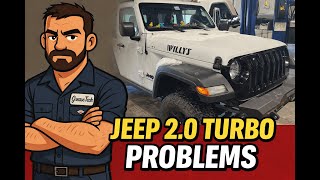
Est. part cost: $0-$200 for a flash, $600-$900+ for PCM replacement. - Worn Wastegate Actuator Linkage Arm 🟡 Medium Probability → Shop Turbocharger This is a well-documented failure on the platform-mate Alfa Romeo 2.0T engine. The hole on the linkage arm that connects to the turbo wears out, causing excessive 'slop'. This play prevents the actuator's movement from accurately controlling the wastegate, leading to a range/performance fault. 🎬 See this video on 2.0L turbo rattle and linkage issues
How to confirm: With the engine off, disconnect the linkage arm from the actuator. Wiggle the arm on its pivot point on the turbocharger. If there is significant play or the mounting hole is visibly oblong, it is worn.
Typical fix: Replace the linkage arm. Aftermarket companies produce upgraded, more durable arms for this specific issue.
Est. part cost: $50-$150 - Damaged Wiring or Corroded Connector ⚪ Low Probability The wiring harness to the actuator is in the hot, harsh environment of the engine bay, making it susceptible to heat damage, chafing, or corrosion at the connector.
How to confirm: Visually inspect the wiring harness and connector going to the wastegate actuator for any signs of melting, chafing, or corrosion. Perform a voltage drop test on the circuit; a difference greater than 0.2V between the ECU and actuator connector can indicate a problem.
Typical fix: Repair the damaged section of the wiring harness or clean/replace the connector.
Est. part cost: $10-$100 - Mechanical Binding of the Wastegate Valve ⚪ Low Probability Carbon buildup in the turbocharger housing can cause the internal wastegate valve to stick, preventing the actuator from moving it.
How to confirm: Disconnect the actuator linkage from the wastegate arm and attempt to move the arm by hand. It should move smoothly. If it's stuck, the issue is internal to the turbocharger.
Typical fix: This often requires replacing the entire turbocharger assembly, as servicing the internal valve is difficult.
Est. part cost: $800-$2000
Rare But Worth Checking
- Failed Powertrain Control Module (PCM): This is very rare, unless dictated by a TSB (like S2018000012). The PCM should only be suspected after all other possibilities, including wiring and the actuator itself, have been exhaustively tested and ruled out.
Diagnosis Steps
- Connect an OBD-II scanner and confirm P0244 is the primary code. Document any other codes and the freeze frame data.
- Clear the codes and perform a test drive to see if the code returns immediately.
- Visually inspect the wastegate actuator, its linkage, and the electrical connector for any obvious damage, melting, or corrosion.
- With the engine off and cool, disconnect the actuator from the linkage arm. Check the linkage arm for excessive play on its pivot; an oblong mounting hole indicates wear.
- Manually move the wastegate arm on the turbo itself. It should move smoothly without binding. If it sticks, the turbo housing is the problem.
- Use a high-level scan tool to monitor live data for the commanded vs. actual wastegate position. The PWM duty cycle should typically be between 0-100%.
- Use the scan tool's bidirectional controls to command the wastegate actuator through its range of motion. Observe if it moves smoothly and corresponds to the command.
- If the actuator fails to move correctly but the wiring is intact, the actuator is the likely culprit.
- If the actuator and wiring are good, contact a dealership to check if the PCM has the latest software calibration, referencing TSB S2218000017. If the turbo was recently replaced, reference TSB S2018000012, which recommends PCM replacement.
Parts You'll Likely Need
- Turbocharger Wastegate Actuator Kit (2.0L)
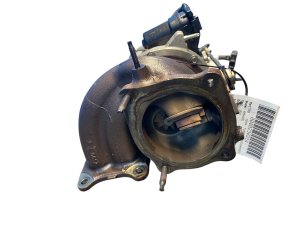
(OEM #68619868AA)— This is the most common failure point for code P0244 on the 2.0L engine (including eTorque and PHEV variants). It is an electronic component that fails due to heat and wear, or can become mechanically stuck.
Trusted brands: Mopar
OEM price range: $370-$490
Aftermarket price range: $250-$350 - Turbocharger Actuator (3.0L EcoDiesel)
(OEM #68486941AA, 68602174AA)— This is the corresponding actuator for the 3.0L EcoDiesel engine, which can also fail and trigger code P0244. These part numbers are associated with the Ram 1500 EcoDiesel platform mate.
Trusted brands: Mopar, Garrett
OEM price range: $700-$800
Aftermarket price range: $500-$650 - Upgraded Wastegate Actuator Linkage Arm (2.0L)
(OEM #N/A (Aftermarket Only))— A common failure on the shared 2.0L engine platform is the wearing of the factory linkage arm hole, causing play. Aftermarket solutions provide a more durable replacement to fix the resulting range/performance code.
Trusted brands: ModdedWear.com, Ron DIY Mods
OEM price range: N/A
Aftermarket price range: $50-$150
Technical Service Bulletins (TSBs) & Recalls
- S2218000017: Customer complaint may include a Mil-on condition and possible related driveability issues. Upon further inspection, a P0244-Turbo Wastegate Actuator "A" Range/Performance fault may be set in the PCM.
- S2018000012: Check engine lamp on. Fault code P0244- TURBOCHARGER/SUPERCHARGER WASTEGATE SOLENOID "A" RANGE/PERFORMANCE is set in the Powertrain Control Module (PCM a.k.a. ECM) after the turbocharger assembly has been replaced. Discussion: If P02
Platform-Specific Known Issues
- TSB #S2218000017: Notes that customers may experience a check engine light and driveability issues, with fault code P0244 being set. The solution may involve a PCM software update.
- TSB #S2018000012: Explicitly states that if code P0244 sets *after* a turbocharger assembly has been replaced, the fix is to *replace the Powertrain Control Module (PCM)*, not just re-flash it.
Mechanic-Grade Diagnostic Values
- Voltage Drop on Actuator Circuit — expected: Less than 0.2 Volts. Failure: A voltage difference greater than 0.2V between the ECU connector and the actuator harness connector indicates excessive resistance in the wiring.
- Wastegate Actuator Motor Coil Resistance (2.0L) — expected: Approximately 1.44 - 1.96 Ω at 69.8°F (21°C). Failure: A reading of infinity (open loop) or a value significantly outside the expected range indicates a failed motor inside the actuator. This test can be performed at the ECU connector pins.
Scan Tool Commands That Help
- wiTECH or equivalent professional scan tool: Wastegate Learn / Actuator Relearn / VGT Actuator Learning — This function is critical after replacing the turbocharger or the wastegate actuator. The PCM must cycle the new actuator to learn its full range of motion (minimum and maximum travel points) to ensure accurate boost control and prevent P0244 from setting.
- wiTECH or equivalent professional scan tool: Replace Relevant Component — Used after replacing the turbocharger assembly. The scan tool may prompt for the vehicle's current mileage to be entered as part of the programming process for the new component.
Wiring & Ground Locations
- Engine Ground Strap — On the 2.0L engine, a key ground cable is bolted to the right side of the engine block. A ground strap also connects the engine/body/hood.. A poor engine ground can cause a variety of electrical issues and fault codes, including performance codes for electronically controlled components like the wastegate actuator. Ensuring this connection is clean and tight is a fundamental step.
- PCM Connectors — The Powertrain Control Module (PCM) is located in the engine bay. The engine wiring harness connects to it.. The control signals for the wastegate actuator originate from the PCM. Testing for resistance and voltage should be done at these connectors to isolate a wiring fault from a component fault.
- Ground Location G903A — Located on the transmission, part of the transmission harness family.. Wiring diagrams for the JL Wrangler show multiple ground points. While not directly for the actuator, a fault in a major powertrain-related ground could potentially create electrical noise or voltage issues affecting sensor and actuator performance.
Real Owner Repair Stories
- JLwranglerforums.com user 'Inshan' (Jeep Wrangler JL (year not specified)) — P0244 error code appeared.
❌ Tried (didn't work) Initially, the user tried a temporary fix by removing the actuator, tapping it, and applying WD-40, which worked for a short time.
✅ What actually fixed it The actuator was mechanically stuck. Replacing the wastegate actuator resolved the P0244 code permanently.
Model Year Variations Within This Range
- 2018-2022: The 2.0L Turbo engine is available in standard, eTorque, and 4xe PHEV (Plug-in Hybrid Electric Vehicle) variants. The same wastegate actuator kit, part number 68619868AA, is specified for all three versions, indicating the failure mode and fix are common across them.
Helpful Videos
Used OEM Parts in Stock
New Aftermarket Parts Available


The information in this article is provided for general reference and educational purposes only. Vehicle specifications, procedures, and part compatibility can vary by production date, trim level, and region. Always consult your vehicle's factory service manual and verify part numbers before purchasing or performing repairs. Safety-critical components such as airbags, seat belts, and braking systems should be installed by a qualified professional.
- Jeep WRANGLER:
- 🧭 Diagnostic Flowchart
- 🎬 Helpful Videos
- 🛍️ Shop This Part
- What's Unique About the 2018-2022 Jeep WRANGLER
- Symptoms You May Notice
- Most Likely Causes
- Rare But Worth Checking
- Diagnosis Steps
- Parts You'll Likely Need
- Technical Service Bulletins (TSBs) & Recalls
- Platform-Specific Known Issues
- Mechanic-Grade Diagnostic Values
- Scan Tool Commands That Help
- Wiring & Ground Locations
- Real Owner Repair Stories
- Model Year Variations Within This Range
- 🎟️ Get 5% Off