

OBD-II Code P0262: Cylinder 1 Injector Circuit High
What P0262 means, why it triggers, and how to fix it like a pro
- P0262 indicates a high-voltage short in the cylinder 1 fuel injector circuit, requiring electrical diagnosis rather than fuel system repairs.
- Stop driving the vehicle immediately; continuous misfires dump unburned fuel into the exhaust, destroying a $1,200+ catalytic converter within 500 miles.
- Inspect the wiring harness for chafing before buying parts, as rubbed wires on engine brackets cause over 40% of P0262 codes on 2009-2014 GM vehicles.
- Swap the cylinder 1 injector with cylinder 2 to isolate the fault; if the code changes to P0265, replace the $150 injector, but if P0262 remains, repair the wiring.
- Test the Fuel Injection Control Module (FICM) voltage first on 2003-2007 Ford 6.0L diesels, as a module dropping below 45 volts triggers this code.
What Does P0262 Mean?
P0262 means the Powertrain Control Module (PCM) detects the electrical circuit for the cylinder 1 fuel injector is sending back abnormally high voltage. This is strictly an electrical problem, not a fuel pressure issue. The PCM triggers this code when current draw in the injector's control circuit exceeds the manufacturer's specified range. To protect the internal driver circuit, the computer shuts down the injector, causing an immediate engine misfire.
Technical definition: The SAE/OBD-II definition is "Cylinder 1 Injector Circuit High". The PCM operates the fuel injector by grounding its control circuit. A 'circuit high' fault means the voltage failed to drop to near zero when commanded on. This indicates a short to a power source in the wiring or an internal short within the injector coil.
Can I Drive With P0262?
Yes, But With Caution. You can drive for short distances, but it is highly discouraged. Continuous operation with a P0262 code forces the engine to run with a cylinder misfire, dumping unburned fuel into the exhaust. This rapidly overheats and destroys the catalytic converter, adding $1,200 to $2,800 to the final bill. Drive straight to a repair shop, but avoid daily commuting to prevent catastrophic secondary damage.
Common Causes
- Faulty Cylinder 1 Fuel Injector (Very Common) — An internal electrical short within the injector's coil windings lowers its resistance. This draws excessive current, which the PCM interprets as a high voltage condition.
- Damaged Fuel Injector Wiring Harness (Common) — Wires routing between the PCM and the injector chafe against engine brackets or the cylinder head, shorting to a voltage source. This is heavily documented on GM vehicles (TSB #PIP4924D) and often stems from incorrect routing during previous repairs.
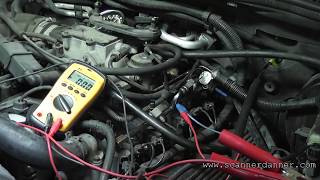
- Bad Injector Connector or Pigtail 🎬 See how to fix a faulty injector pigtail connector. (Common) — The plastic connector at the injector degrades from engine heat, vibration, or water intrusion. This creates corrosion and high resistance, mimicking a high circuit fault. 🎬 Watch this walkthrough for repairing a diesel injector control circuit.
- Faulty Fuel Injection Control Module (FICM) (Less Common) — Specific to diesel engines like the Ford 6.0L Powerstroke. An internal logic board or power supply failure causes the FICM to send high voltage to the injector circuit.
- Faulty Powertrain Control Module (PCM) (Rare) — The internal driver circuit controlling the injector fails. Exhaust all wiring and injector tests before condemning the PCM.
Symptoms
- Rough Idle and Misfire — The engine runs unevenly, shakes, and stumbles at idle because cylinder 1 is disabled and not receiving fuel.
- Reduced Engine Power and Acceleration — The vehicle feels sluggish and struggles to accelerate. The PCM often triggers a reduced power "limp mode" to prevent further damage.
- Poor Fuel Economy — Operating with a dead cylinder forces the engine to run inefficiently, consuming significantly more fuel to maintain speed.
- Fuel Smell from Exhaust — The injector fault creates an overly rich condition, emitting a distinct smell of raw fuel from the tailpipe.
- Check Engine Light is On (also visible on scanner) — The PCM illuminates the Check Engine Light (or Malfunction Indicator Lamp) on the dashboard. The light remains steady.
Diagnostic Flowchart
Tap your situation to follow the diagnostic path that matches what you're seeing on this code.
Common Fixes & Costs
- Replace Cylinder 1 Fuel Injector — Parts: $70-$350, Labor: $100-$325, ~1.5 hr book time (Intermediate)
- Repair or Replace Fuel Injector Wiring Harness/Connector — Parts: $25-$150, Labor: $150-$350, ~2.5 hr book time (Intermediate)
- Replace Fuel Injection Control Module (FICM) — Parts: $350-$700, Labor: $150-$300, ~1.5 hr book time (Professional)
- Replace Powertrain Control Module (PCM) — Parts: $600-$1050, Labor: $200-$300, ~2.5 hr book time (Professional)
Used vs. New Parts: Buying Guide
When a used part is worth it: For a common fix like a fuel injector, a used part from a low-mileage vehicle (<80,000 miles) is a cost-effective option for older cars where new OEM parts are cost-prohibitive.
Donor-vehicle mileage cap: roughly under 80000 miles for the part to have meaningful remaining life.
Donor quality checklist:
- Verify the donor vehicle was not scrapped for engine failure.
- Match the part number exactly; injectors are specific to engine codes and years.
- Demand at least a 30-day functional guarantee from the seller.
Decision logic:
- If Vehicle is newer or has low mileage (<80K miles) → Buy a new OEM or high-quality aftermarket injector. The longer warranty and reliability justify the cost.
- If Vehicle is older (>150K miles) and you are on a tight budget → A tested, used injector is an acceptable risk, but expect a shorter remaining lifespan.
- If The part is known for high failure rates (e.g., Ford 6.0L FICM) → Buy a new or professionally remanufactured unit with an updated design and a longer warranty.
Warranty tradeoff: Used parts typically include a 30-90 day functional warranty. New aftermarket parts offer a 1-year to limited lifetime warranty. New OEM parts carry a 1-2 year warranty.
Worst-case if a used part fails: $300-$600 if a used injector fails shortly after installation, requiring a second labor charge and another part.
What Happens If You Wait — Timeline
- 0-100 miles: Check Engine Light illuminates with code P0262. A noticeable rough idle and slight hesitation on acceleration begins. The PCM disables the cylinder 1 injector. (MPG impact: 10-15%% · Added cost: $0)
- 100-500 miles: Engine runs consistently rough, shaking at stops. A smell of raw fuel or rotten eggs becomes apparent from the exhaust as the catalytic converter floods with unburned fuel. The converter begins to overheat. (MPG impact: 15-25%% · Added cost: $50-$150 in wasted fuel.)
- 500-1,000 miles (or a few weeks of city driving): The catalytic converter's internal substrate melts and clogs from extreme heat. Acceleration becomes significantly weaker as exhaust backpressure builds. The converter glows red after driving. (MPG impact: 25-40%% · Added cost: $1,200-$2,800 for the now-necessary catalytic converter replacement.)
- 1,000+ miles (or 1-2 months of continued driving): The catalytic converter becomes completely blocked. The engine stalls frequently, refuses to start, or has almost no power. Severe backpressure damages exhaust valves, piston rings, or the head gasket. (MPG impact: 40-60%% · Added cost: $2,500-$5,000+ to cover the catalytic converter plus secondary engine damage.)
Cost of Not Fixing It
- Immediate: Rough idle, engine misfire, poor acceleration, and a 10-25% drop in fuel economy. The vehicle fails any emissions test. (Added cost: Negligible, other than increased fuel costs.)
- 1-3 months: Unburned fuel from the misfiring cylinder continuously enters the exhaust, overheating the catalytic converter and melting its internal structure. (Added cost: $1,200-$2,800 for catalytic converter replacement.)
- 6+ months: A completely clogged catalytic converter causes severe backpressure, leading to a major loss of power, engine overheating, and blown exhaust valves or head gaskets. (Added cost: $2,500-$5,000+ to cover the catalytic converter plus secondary engine repairs.)
Diagnosis Steps
- Read the Trouble Codes & Freeze Frame Data
Use an OBD-II scanner to confirm P0262 is present and check for related codes like P0301 (Cylinder 1 Misfire). Analyze the freeze frame data to see the engine conditions (RPM, temperature, load) when the fault triggered. Note any TSBs the scanner references.
Tools: OBD-II Scanner (Beginner) - Perform a Detailed Visual Inspection
Examine the wiring harness leading to the cylinder 1 fuel injector. Look for chafing, melting, exposed copper wire, or corrosion. Pay close attention to areas where harnesses rub against engine brackets or cylinder heads, especially on GM vehicles. Verify the connector is securely plugged in and pins are clean.
Tools: Flashlight, Inspection Mirror (Beginner) - Swap the Fuel Injector
Swap the cylinder 1 injector with an injector from an easily accessible cylinder (e.g., cylinder 2). Clear the codes and drive the vehicle. If the code changes to P0265 (Cylinder 2 Injector Circuit High), the injector is faulty. If P0262 returns, the problem is in the wiring or PCM.
Tools: Basic hand tools (socket set, wrenches) (Intermediate) - Use a Noid Light to Test the Circuit Signal
Disconnect the injector and plug a noid light into the harness connector. Start the engine. A rhythmic flashing light indicates the PCM and wiring are functioning, pointing to a bad injector. A solid, non-flashing light indicates a short to power in the control wire.
Tools: Noid Light Set (Beginner) - Test the Injector's Resistance
Disconnect the injector and use a multimeter set to Ohms (Ω). Measure the resistance between the two electrical pins on the injector. Compare the reading to the manufacturer's specification. A reading near 0 Ohms indicates an internal short circuit. All injectors should read within 0.5-1.0 Ohm of each other.
Tools: Multimeter, Basic hand tools (Intermediate) - Check the Wiring for a Short to Voltage
Disconnect the injector connector. Turn the ignition key to 'On' (engine off). Set the multimeter to DC Volts. Place the black lead on the battery's negative terminal and probe both terminals in the injector connector with the red lead. One wire shows battery voltage (12V). The control wire from the PCM must show 0 volts. Voltage on the control wire confirms a short to a power source in the harness.
Tools: Multimeter, Vehicle-specific wiring diagram (Advanced) - Perform a 'Wiggle Test'
With the engine idling, carefully wiggle the wiring harness at various points between the injector and the firewall, including the connector. If the engine's idle stumbles or smooths out as you move the wires, you found the location of an intermittent short in the harness.
Tools: Mechanic's Gloves (Intermediate) - Advanced: Quantitative Injector Resistance Test
Measure injector resistance precisely. High-impedance injectors (port-injected gasoline) measure 11-16 Ohms. Low-impedance injectors (TBI/performance) are 1.5-4.0 Ohms. Gasoline Direct Injection (GDI) injectors are 1-2 Ohms. Diesel common rail injectors are 0.2-0.5 Ohms. A reading of 0 Ohms confirms a dead short and a failed injector.
Tools: High-precision Multimeter, Service Manual (Advanced) - Advanced: Analyze the Injector Waveform with an Oscilloscope
Observe the voltage pattern on the injector's control circuit. A normal pattern shows a sharp drop to near zero volts when the PCM grounds the circuit, followed by a sharp inductive kick (voltage spike) when ground is removed. A P0262 fault shows a waveform that does not drop to zero, indicating the circuit is shorted to voltage and the PCM cannot ground it.
Tools: Oscilloscope, Back-probe pins (Professional)
When This Code Triggers (Freeze-Frame Conditions)
- Engine Coolant Temp: 175-210°F (The fault is most often detected once the engine reaches full operating temperature.)
- Engine RPM: 1200-3000 RPM (The code sets during steady-state cruising or light to moderate acceleration, rarely at idle.)
- Engine Load: 25-70% (The condition triggers when a moderate demand is placed on the engine.)
- Vehicle Speed: 30-65 mph (The fault occurs during city or highway driving conditions, consistent with the RPM and load values.)
Related Codes
- P0301 — P0301 means "Cylinder 1 Misfire Detected." P0262 is a direct cause for P0301. The injector circuit fault forces the PCM to stop firing the injector, guaranteeing a misfire. Fixing P0262 resolves P0301.
- P0201 — P0201 means "Injector Circuit/Open - Cylinder 1." P0262 specifically indicates a high voltage condition (short to power), while P0201 indicates an open circuit (break in the wire). Finding unexpected voltage on the control wire points to P0262.
- P0261 — P0261 is the opposite code: "Cylinder 1 Injector Circuit Low." P0262 points to a short to a voltage source. P0261 points to a short to ground or an open in the power supply side.
- P2146 — Means "Fuel Injector Group 'A' Supply Voltage Circuit/Open." On engines where injectors are controlled in banks, a problem setting P0262 on a single injector triggers a group fault code if the issue affects the shared power circuit.
Climate & Environmental Factors
- Cold Weather: Extremely cold temperatures cause wiring insulation to become brittle and crack, increasing susceptibility to vibration damage. On diesel engines, cold starts strain the FICM, exposing weak modules and triggering circuit codes.
- High Humidity / Heavy Rain: Moisture penetrates weathered connector seals or damaged wiring looms, leading to corrosion and short circuits that trigger a P0262 code.
- Road Salt (Winter Climates): Road salt sprays onto the undercarriage and engine bay. This highly corrosive saline solution accelerates the degradation of wiring harnesses and electrical connectors, leading to shorts.
How to Talk to a Mechanic About This Code
Say this: "I have a P0262 code for the cylinder 1 injector circuit and a noticeable misfire. I'd like to schedule a diagnostic appointment. Please test the circuit to determine if the fault is the injector itself, the wiring harness, or the connector before recommending a replacement part."
This signals you understand that P0262 is an electrical fault requiring diagnosis, not just part swapping. It prevents a shop from immediately selling you a new injector when the real problem is a less expensive wiring issue.
Avoid saying:
- 'My check engine light is on, can you look at it?'
- 'My car is running rough, just fix it.'
- 'I think I need a new fuel injector.'
Questions to ask before authorizing the repair:
- What diagnostic steps did you perform to isolate the cause?
- Did you check the injector's resistance and did it meet spec?
- Did you inspect the wiring harness for any shorts or chafing, especially near known problem areas?
- If you are recommending an injector replacement, what was the result of the 'swap test' or 'noid light' test?
- What is the warranty on the recommended parts and labor?
Where to Take It: Dealer vs Independent vs Chain
- Dealer:
A safe but expensive choice. Best if your vehicle is under warranty or has a specific known issue (like a FICM) they are equipped to handle efficiently.
Best for: Vehicles still under powertrain or emissions warranty., Complex, manufacturer-specific issues like a Ford Powerstroke FICM or known TSBs on newer cars.
Downsides: Significantly higher labor rates (up to 40% more) and parts costs., Defaults to replacing larger components (like a full harness) instead of repairing a single wire. (Typical cost: +40% vs. baseline) - Independent Shop:
The best fit for most situations involving a P0262 code. A reputable independent shop has the diagnostic tools and experience to trace the electrical fault accurately without the dealership price tag.
Best for: Most out-of-warranty vehicles., Diagnosing common electrical faults like P0262., Owners looking for better value and a direct relationship with the technician.
Downsides: Shop quality and diagnostic skill vary widely; look for ASE certifications and good reviews. (Typical cost: +0% vs. baseline) - Chain Shop:
Not recommended for diagnosing a P0262 code. While they offer a free initial code scan, their diagnostic process is not thorough enough to accurately pinpoint an electrical fault.
Best for: Simple, routine maintenance like oil changes or brake jobs.
Downsides: Technician skill is highly variable and often not specialized in diagnostics., Lacks the advanced tools or experience for electrical troubleshooting, leading to misdiagnosis. (Typical cost: -10% vs. baseline)
When to Walk Away From the Repair
If the estimated repair cost exceeds 40-50% of the car's private-party value (use Kelley Blue Book or Edmunds), seriously consider selling or trading it in.
- Car worth $4000, fix is $500: Fix it. The repair cost is well below the threshold and extends the life of the car.
- Car worth $4000, fix is $2200: Walk away. The repair cost is over 50% of the car's value. You are unlikely to recoup this cost.
- Car worth $15000, fix is $2500: Fix it. While a significant cost, it is well below the 50% threshold for a higher-value vehicle.
What Scan Tool You Need for This Code
Minimum: A code reader that displays Freeze Frame data and Live Data streams.
A $20 reader only gives the 'P0262' code. You need Freeze Frame data to see engine conditions when the fault occurred and Live Data to monitor the circuit's behavior, which is crucial for diagnosing an electrical issue.
Budget: BlueDriver Pro (~$99) — Connects to your smartphone and provides Freeze Frame data, live data graphing for injector circuits, and reads enhanced codes, offering excellent diagnostic value.
Mid-range: Autel MaxiCOM MK808S / Foxwell NT510 Elite (~$150-380) — Tablet-style scanners offering bidirectional controls. This allows you to actively test components, confirming if the injector driver in the PCM responds to commands.
Professional: Autel MaxiSys MS906 Pro / TOPDON Phoenix Lite 3 (~$700-1200) — Offers full bidirectional control, advanced diagnostic functions, and ECU coding capabilities. Necessary for tasks like programming a new PCM.
Rent vs buy: For a one-time diagnosis, auto parts stores like AutoZone offer a 'Loan-A-Tool' program to borrow a scanner for free after a refundable deposit. Buy a scanner only if you diagnose vehicles regularly.
How to Clear the Code After You Fix It
- Use an OBD-II scan tool to clear the diagnostic trouble codes.
- Ensure the fuel tank is between 35% and 85% full for the EVAP monitor to run.
- Perform a complete OBD-II drive cycle to allow all readiness monitors to run.
Drive cycle (~30 minutes): Start with a cold engine (off overnight). 1) Idle for 2-3 minutes with electrical loads on (A/C, rear defrost). 2) Accelerate to 55 mph and hold a steady speed for 3-5 minutes. 3) Decelerate to 20 mph without using the brakes and coast. 4) Accelerate again to 55-60 mph at 3/4 throttle and hold for 5 minutes. 5) Decelerate and come to a complete stop.
Readiness monitors affected: Catalyst Monitor, Evaporative (EVAP) System Monitor, Oxygen (O2) Sensor Monitor, Fuel System Monitor
Before emissions retest: drive at least 100 miles to fully set monitors.
Watch out for:
- Clearing the code resets all readiness monitors to 'Not Ready.' You must complete a drive cycle before an emissions test.
- The code returns immediately if the underlying electrical short remains unfixed.
- The catalyst monitor requires multiple drive cycles to complete if the component is marginal.
Will This Fail Emissions / State Inspection?
Yes — this code typically fails an OBD-II emissions inspection.
- California: An active Check Engine Light results in an automatic smog check failure. After repair, you must complete a drive cycle to set all readiness monitors (EVAP is allowed to be incomplete) and drive 100-200 miles before passing.
- New York: The NYS DMV vehicle inspection includes an OBD-II scan. An active P0262 code causes an automatic failure of the emissions portion.
- Texas: In the 17 counties requiring emissions testing, an illuminated Check Engine Light for P0262 automatically fails the inspection.
Most Commonly Affected Vehicles
- Chevrolet Equinox / GMC Terrain (2010-2014) — Extremely prone to wiring harness chafing on the back of the cylinder head or engine brackets, causing a short. Documented in GM TSB #PIP4924D. The 2.4L injector part number was superseded (12633784 to 12669384), indicating a design update.
- Chevrolet Traverse / GMC Acadia / Buick Enclave (2009-2014) — The 3.6L V6 experiences P0262 due to failed injectors or wiring harness issues. TSB #PIP4924D applies here, pointing to chafing against the intake plenum, valve cover bolts, and fuel lines.
- Ford F-250 / F-350 with 6.0L Powerstroke Diesel (2003-2007) — Frequently caused by a failing Fuel Injection Control Module (FICM). Low FICM voltage triggers a host of injector circuit codes. A rebuilt FICM is the standard repair.
- Chevrolet / GMC Silverado / Sierra with 6.6L LLY Duramax Diesel (2004.5-2005) — Injector harness connectors become loose or fail where they pass through the valve cover, particularly for cylinders #2 and #7. The community refers to the repair method as the 'ice pick fix'.
- Dodge / Ram 2500 / 3500 with 5.9L & 6.7L Cummins Diesel (2006-2018) — The main engine harness connector and the injector harness pass-through connector at the valve cover fail from vibration and heat, causing intermittent circuit faults.
- Hyundai Santa Fe / i10 (2002-2012) — The code points to an internal short in the injector control harness or a faulty injector. The ECM sets the code if it detects the control line is shorted to battery voltage.
- BMW 3 Series / 5 Series / X3 (N54/N55 Engines) (2006-2019) — Related to piezoelectric injectors failing internally or the failure of injector decoupler elements affecting the injector's connection.
- Volkswagen / Audi Jetta / Golf / A4 / TT (2005-2020) — VR6 or turbocharged engines experience P0262 due to internally shorted fuel injectors or wiring harness issues in the hot, tight engine bay.
Manufacturer-Specific Notes
- Ford (Powerstroke): On 6.0L Powerstroke diesel engines, P0262 is commonly caused by a failing Fuel Injection Control Module (FICM). The FICM's internal 48-volt power supply fails due to heat and vibration. Always test FICM voltage during diagnosis.
- General Motors (Duramax): On 2004.5-2005 LLY Duramax diesel engines, the injector wiring harness connections at the injector become loose and cause intermittent circuit faults. This is addressed by the 'ice pick fix'.
- General Motors (Gasoline): On 2009-2014 GM gasoline V6 and 4-cylinder engines, TSB #PIP4924D documents engine wiring harness chafing on engine brackets or the cylinder head, causing P0262.
- Dodge/Ram (Cummins): On 5.9L and 6.7L Cummins engines, the injector harness pass-through connector at the valve cover loses pin contact due to vibration, causing intermittent open and short circuits.
Real Owner Stories
2011 Chevy Equinox 2.4L at 135K miles
Check Engine Light came on with P0262 and P0301 (Cylinder 1 Misfire). The engine had a very rough idle and poor acceleration.
What they tried:
- Initially replaced the spark plug and ignition coil for cylinder 1, but the codes returned immediately.
- Swapped the cylinder 1 fuel injector with the cylinder 2 injector.
- After the swap, the code changed to P0265 (Cylinder 2 Injector Circuit High), confirming the injector was the faulty part.
Outcome: Replaced the single faulty fuel injector (part #12633784) for $90. Cleared the codes, and the engine ran smoothly again. The problem has not returned after 10,000 miles.
Lesson: The 'injector swap test' definitively proves whether the injector is the problem before spending money. Always check for known TSBs about wiring harness chafing on these vehicles before assuming it's the injector.
2006 Ford F-250 6.0L Powerstroke at 180K miles
Truck was hard to start when cold and ran very rough until warmed up. Eventually set P0262 along with several other injector circuit codes (P0261, P0270, P0273).
What they tried:
- Owner suspected bad injectors due to the multiple codes.
- Tested the Fuel Injection Control Module (FICM) output voltage during a cold start using a multimeter.
- The reading was only 34 volts, well below the required 46-48 volts.
Outcome: Sent the FICM to a specialist for a rebuild and upgrade for $400. After reinstalling the repaired FICM, all injector codes cleared, and the cold start issues were resolved.
Lesson: On a Ford 6.0L Powerstroke, multiple injector circuit codes indicate a failing FICM, not bad injectors. Always test the FICM voltage before condemning the injectors to save thousands in misdiagnosis.
2005 GMC Sierra 6.6L LLY Duramax at 210K miles
Owner experienced an intermittent P0262 code that appeared and disappeared, causing a noticeable engine stumble.
What they tried:
- Replaced the cylinder 1 injector, but the code returned a week later.
- Inspected the main wiring harness and found no visible damage.
- Researched online and found the 'ice pick fix' for LLY Duramax trucks addressing poor connections at the injector harness plugs.
Outcome: Performed the 'ice pick fix' by carefully cleaning and slightly bending the female pins in the injector harness connector to ensure a tighter fit, then applied dielectric grease. The P0262 code never returned.
Lesson: Intermittent electrical codes stem from poor connections, not failed parts. On LLY Duramax engines, the injector harness connectors are a known weak point. Research vehicle-specific forums for common fixes.
How to Prevent This Code From Triggering
- Periodically inspect the engine wiring harness for security and condition. (Every oil change (5,000-7,500 miles)) — Ensures wire looms are properly secured and not rubbing against sharp metal edges or hot engine components, preventing chafing and short circuits.
- Use a quality fuel system cleaner containing Polyetheramine (PEA). (Every 3,000-5,000 miles) — PEA-based cleaners (like Techron or BG44K) remove carbon deposits from injector tips. Clean injectors operate efficiently, reducing stress on electrical components.
- Apply dielectric grease to injector connectors when disconnected for service. (As needed during repairs) — Dielectric grease seals out moisture and oxygen, preventing corrosion on connector pins and ensuring a solid electrical connection.
Frequently Asked Questions
Can I fix P0262 myself?
Yes, if you have basic tools and a multimeter. Swapping injectors or replacing a pigtail connector are straightforward DIY tasks. Leave complex wiring harness repairs or PCM replacements to a professional.
What happens if I ignore the P0262 code?
Ignoring P0262 causes a constant rough idle, poor gas mileage, and failed emissions tests. The resulting misfire dumps unburned fuel into the exhaust, overheating and destroying the catalytic converter. This turns a minor electrical fix into a $1,200 to $2,800 repair.
Can bad gas cause a P0262 code?
No, bad gas does not cause a P0262 code. This is strictly an electrical circuit fault. Contaminated fuel causes misfire (P0301) or fuel trim (P0171) codes, not circuit high codes.
Should I replace all my fuel injectors if one is bad?
Replace all injectors if your vehicle has over 100,000 miles and the intake manifold requires removal for access. Injectors wear evenly, so if one fails, the others will likely follow soon. For easily accessible injectors, replacing just the faulty unit is acceptable.
How do I know for sure if it's the injector or the wiring?
Swap the cylinder 1 injector with cylinder 2, clear the codes, and run the engine. If the code changes to P0265 (Cylinder 2), the injector is bad. If P0262 returns, the wiring or PCM is at fault.
What is the most common misdiagnosis for P0262?
The most common mistake is replacing the fuel injector without inspecting the wiring harness. Chafed wires shorting to a power source or corroded connectors frequently cause this code. Always perform the injector swap test before buying parts.
Why did the P0262 code come back after replacing the injector?
This means the original injector was functioning properly. The actual fault lies in the wiring harness shorting to voltage or a failed PCM driver. You must now test the circuit with a multimeter to locate the short.
What does 'Circuit High' actually mean?
It means the PCM detected unexpected voltage on the injector's control wire. The computer fires the injector by grounding this wire to drop the voltage to zero. If the wire shorts to a power source, the voltage stays high, triggering the code.
Key Takeaways
- P0262 indicates a high-voltage short in the cylinder 1 fuel injector circuit, requiring electrical diagnosis rather than fuel system repairs.
- Stop driving the vehicle immediately; continuous misfires dump unburned fuel into the exhaust, destroying a $1,200+ catalytic converter within 500 miles.
- Inspect the wiring harness for chafing before buying parts, as rubbed wires on engine brackets cause over 40% of P0262 codes on 2009-2014 GM vehicles.
- Swap the cylinder 1 injector with cylinder 2 to isolate the fault; if the code changes to P0265, replace the $150 injector, but if P0262 remains, repair the wiring.
- Test the Fuel Injection Control Module (FICM) voltage first on 2003-2007 Ford 6.0L diesels, as a module dropping below 45 volts triggers this code.
Helpful Videos
Shop the Parts Behind P0262
Below are the parts most often responsible for code P0262, ranked by how frequently each one is the actual culprit (per the diagnosis above). Tap any to see what we have for your vehicle.






The information in this article is provided for general reference and educational purposes only. Vehicle specifications, procedures, and part compatibility can vary by production date, trim level, and region. Always consult your vehicle's factory service manual and verify part numbers before purchasing or performing repairs. Safety-critical components such as airbags, seat belts, and braking systems should be installed by a qualified professional.
- 🧭 Diagnostic Flowchart
- 🎬 Helpful Videos
- 🛍️ Shop This Part
- What Does P0262 Mean?
- Can I Drive With P0262?
- Common Causes
- Symptoms
- Common Fixes & Costs
- Used vs. New Parts: Buying Guide
- What Happens If You Wait — Timeline
- Cost of Not Fixing It
- Diagnosis Steps
- When This Code Triggers (Freeze-Frame Conditions)
- Related Codes
- Climate & Environmental Factors
- How to Talk to a Mechanic About This Code
- Where to Take It: Dealer vs Independent vs Chain
- When to Walk Away From the Repair
- What Scan Tool You Need for This Code
- How to Clear the Code After You Fix It
- Will This Fail Emissions / State Inspection?
- Most Commonly Affected Vehicles
- Manufacturer-Specific Notes
- Real Owner Stories
- 2011 Chevy Equinox 2.4L at 135K miles
- 2006 Ford F-250 6.0L Powerstroke at 180K miles
- 2005 GMC Sierra 6.6L LLY Duramax at 210K miles
- How to Prevent This Code From Triggering
- Frequently Asked Questions
- Can I fix P0262 myself?
- What happens if I ignore the P0262 code?
- Can bad gas cause a P0262 code?
- Should I replace all my fuel injectors if one is bad?
- How do I know for sure if it's the injector or the wiring?
- What is the most common misdiagnosis for P0262?
- Why did the P0262 code come back after replacing the injector?
- What does 'Circuit High' actually mean?
- Key Takeaways
- 🎟️ Get 5% Off