

P0265 on 2009-2016 GMC Acadia: Cylinder 2 Injector Circuit High Causes & Fixes
P0265 on a GMC Acadia indicates a high voltage condition in the cylinder 2 fuel injector circuit. The most common causes are a faulty fuel injector or a damaged wiring harness. A wiring issue is particularly noted in GM Technical Service Bulletin #PIP4924D, where the harness chafes against engine components, causing a short to voltage.
- P0265 on a 2009-2016 Acadia means there's a high voltage fault in the cylinder 2 fuel injector circuit.
- Before buying parts, thoroughly inspect the fuel injector wiring harness for damage, as this is a known issue documented by GM in TSB PIP4924D.
- If the wiring is intact, the most likely culprit is a failed fuel injector for cylinder 2.
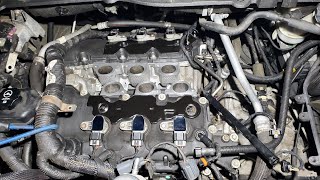
- Cylinder 2 is located on the front bank of the engine (closest to the radiator), on the passenger side.
- Repairing this code requires removing the intake manifold, so replacing the intake gaskets is mandatory for a successful repair.
What's Unique About the 2009-2016 Gmc ACADIA
The 2009-2016 GMC Acadia, equipped with the 3.6L direct-injection V6 engine (LLT or LFX), has a well-documented issue with wiring harness integrity. General Motors issued Technical Service Bulletin PIP4924D (and its revisions) that specifically calls out P0265 and other injector codes. It advises technicians to inspect the injector wiring harness for chafing against the intake plenum, valve cover bolts, fuel lines, and engine hoist brackets, which can cause a short to voltage. This makes a wiring fault a higher-than-usual probability on this specific vehicle platform and its Lambda-platform mates.
Diagnostic Flowchart
Tap your situation to follow the diagnostic path that matches what you're seeing on this vehicle.
Symptoms You May Notice
- Check Engine Light is on
- Engine misfire, which may feel like a shake or stumble, especially at idle
- Rough or uneven idle
- Hesitation or loss of power during acceleration
- Reduced fuel economy
- Strong fuel smell from the exhaust
- Replacing the spark plug or ignition coil for cylinder 2. While these parts can cause a misfire (P0302), they will not cause an injector circuit code like P0265.
Most Likely Causes
- Damaged Fuel Injector Wiring Harness 🔴 High Probability → Shop Engine Wiring Harness As noted in GM TSB #PIP4924D, the injector harness on the 3.6L engine is susceptible to chafing and rubbing against engine components like the intake manifold, valve covers, and engine lift brackets, leading to a short to voltage.
How to confirm: Visually inspect the entire length of the fuel injector harness for cylinder 2. Pay close attention to areas where it contacts other parts of the engine, especially near the back of the intake manifold. Use a multimeter to check for voltage on the control wire for the cylinder 2 injector with the key on; it should be 0V until the engine is cranking/running. A constant voltage indicates a short.
Typical fix: Repair the damaged section of the wire and protect it with loom or re-route it. In severe cases, the entire injector harness may need to be replaced.
Est. part cost: $5-$25 for wire repair, $150-$300 for a new harness - Failed Fuel Injector (Cylinder 2) 🟡 Medium Probability → Shop Fuel Injector Direct injection (GDI) injectors operate under high pressure and can fail internally. An internal short in the injector's solenoid coil can cause a high current draw, which the ECM interprets as a 'Circuit High' fault.
How to confirm: Swap the cylinder 2 fuel injector with an injector from another cylinder (e.g., cylinder 4). Clear the codes and run the engine. If the code changes to P0271 (Cylinder 4 Injector Circuit High), the injector is faulty. You can also test the injector's resistance with a multimeter; it should be within the manufacturer's specified range (approx. 1.5-1.6 Ohms for these GDI injectors). A reading significantly outside the spec indicates a bad injector.
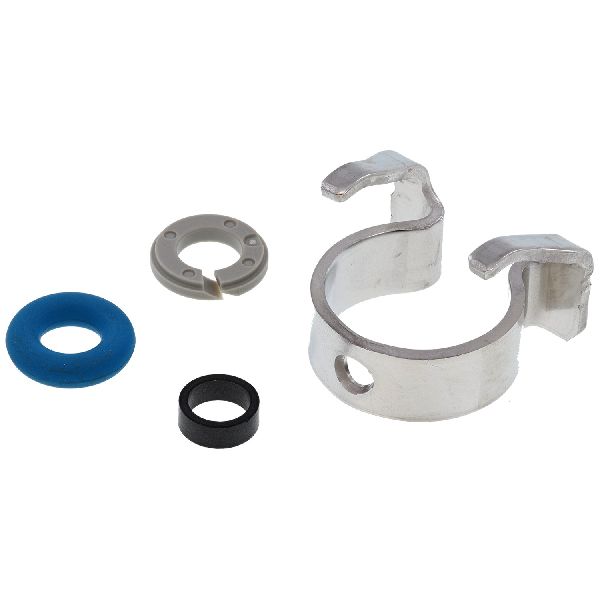
Typical fix: Replace the faulty fuel injector. Since the intake manifold must be removed, it is often recommended to replace all intake gaskets and the injector seals at the same time.
Est. part cost: $70-$150 - Faulty Engine Control Module (ECM) ⚪ Low Probability → Shop Engine Control Module (ECM)
How to confirm: This should be the last resort after confirming the injector and wiring are both in good condition. The internal driver transistor in the ECM can fail and get stuck 'on', causing a constant voltage supply to the injector. This is diagnosed by a professional after eliminating all other possibilities.
Typical fix: Replace and reprogram the ECM.
Est. part cost: $400-$800
Rare But Worth Checking
- Contaminated Fuel: The initial TSB from NHTSA (PIP4924D) mentions inspecting the fuel. Poor quality or contaminated fuel, especially with high water content, can cause injectors to corrode internally, stick, or short out, which may manifest as an electrical fault code.
Diagnosis Steps
- Scan for Codes: Read the codes with an OBD-II scanner and confirm P0265 is present. Note any other codes, especially P0302.
- Locate Cylinder 2: On the transverse 3.6L V6 in the Acadia, the cylinders closer to the radiator are the even-numbered cylinders (Bank 2): 2, 4, and 6 (from passenger to driver side). Cylinder 2 is the first one on the front bank, on the passenger side.
- Visual Inspection: Following GM's TSB (PIP4924D), carefully inspect the fuel injector wiring harness for any signs of chafing, melting, or corrosion, particularly where it runs near the intake manifold, engine hoist brackets, and valve covers.
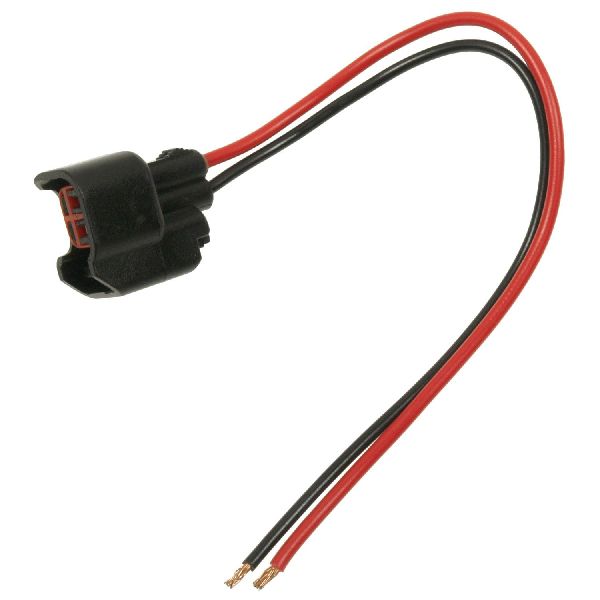
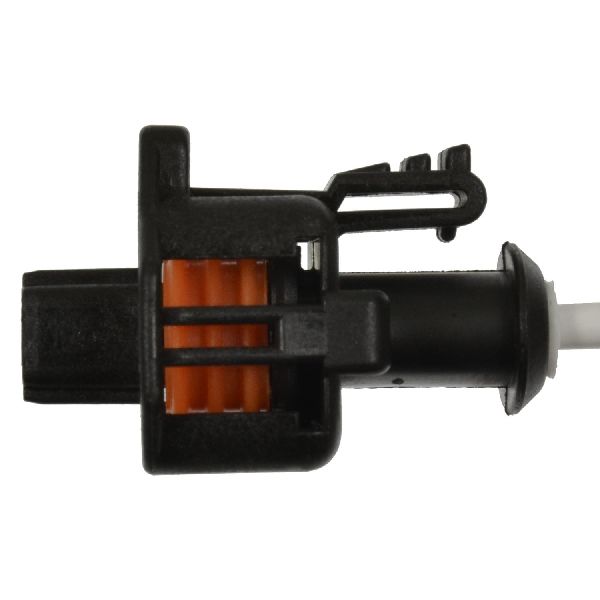
- Test the Circuit with a Noid Light: Disconnect the harness from the cylinder 2 injector and plug in a noid light. Start the engine. A correctly functioning circuit will cause the light to flash rapidly. If the light stays on continuously without flashing, it confirms a short to voltage (the 'Circuit High' condition) in the wiring or ECM.
- Swap Injectors: If the wiring looks good and the noid light test is inconclusive, swap the cylinder 2 injector with another one (e.g., cylinder 4). Clear the codes and drive the vehicle. If the fault moves to the new cylinder (now showing P0271), the injector is bad.
- Test Wiring with a Multimeter: If the fault code P0265 returns after the swap, the problem is in the wiring or ECM. Disconnect the harness from the injector and the ECM. Check for continuity on the control wire and check for a short to voltage by probing the control wire and a known good 12V source.
- Suspect ECM: If the injector and wiring have both been proven to be good, the fault likely lies within the ECM's internal injector driver.
Parts You'll Likely Need
- Fuel Injector
(OEM #LLT Engine (2009-2011): 12638530; LFX Engine (2012-2016): 12669384)— This is a common failure point that directly causes the P0265 code. Part number 12669384 supersedes 12638530, but it is critical to verify the correct part for your specific engine via VIN.
Trusted brands: ACDelco, Bosch
OEM price range: $90-$150
Aftermarket price range: $50-$100 - Upper and Lower Intake Manifold Gaskets
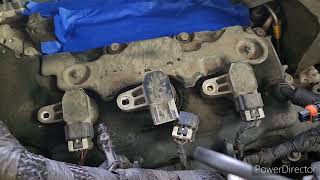
(OEM #Upper: 12673300 (LFX), Lower: 12607449 (LFX))— The intake manifold must be removed to access the fuel injectors on the 3.6L V6 engine. These gaskets are considered single-use and must be replaced to prevent vacuum leaks. 🎬 Watch this walkthrough for removing the intake and injectors. Aftermarket kits like Fel-Pro MS97240 are also available.
Trusted brands: ACDelco, Fel-Pro
OEM price range: $40-$70
Aftermarket price range: $20-$40
Related Codes That Often Appear With This One
- P0302 — This code means 'Cylinder 2 Misfire Detected'. Since P0265 indicates a problem with fueling cylinder 2, a misfire on that same cylinder is a direct and very common consequence.
- P0202 — This is a more generic 'Cylinder 2 Injector Circuit Malfunction' code and may appear alongside the more specific 'Circuit High' fault.
Technical Service Bulletins (TSBs) & Recalls
- PIP4924D: States that for a SES light and misfire with various injector codes (P0261, P0262, P0264, P0265, etc.), the technician should carefully inspect the fuel injector wiring harness for rub-through or internal opens, especially against engine hard points.
Platform-Specific Known Issues
- Technical Service Bulletin PIP4924D (and its revisions A, B, C) explicitly identifies a problem with the fuel injector wiring harness chafing on various engine components, leading to codes like P0265. Common chafe points are against the intake plenum, valve cover bolts, fuel lines, and engine hoist brackets.
Mechanic-Grade Diagnostic Values
- Fuel Injector Coil Resistance (Direct Injection) — expected: 1.5 - 1.6 Ohms. Failure: A reading near zero ohms indicates a shorted coil; an infinite (OL) reading indicates an open coil. This value is for GDI injectors and is much lower than traditional port injectors. 🎬 See how to perform active fuel injection testing and removal.
- High-Side Fuel Pressure (Scan Tool, at Idle) — expected: Approx. 500 - 580 PSI (3.4 - 4.0 MPa). Failure: Pressure that is significantly lower than the 'desired' fuel rail pressure PID on the scan tool, or pressure that does not increase substantially under load, points to a failing high-pressure fuel pump (HPFP).
- Low-Side Fuel Pressure (Scan Tool or Gauge) — expected: 36 - 72 PSI (250 - 500 kPa). Failure: Pressure outside this range indicates a problem with the in-tank fuel pump or the fuel pump control module. While not a direct cause of a circuit code, it's a key health check.
Scan Tool Commands That Help
- GDS2 (GM Dealer Software): Automated Injector Balance Test — This is a powerful non-invasive test to perform after checking wiring. The tool commands the high-pressure pump to a set pressure, pulses each injector individually, and measures the pressure drop. It can identify a mechanically sticking or partially clogged injector that might be causing an electrical fault code under load. A pressure drop variance of more than 20% between cylinders indicates a faulty injector.
Wiring & Ground Locations
- Cyl 2 Injector Control Wire — This is a Light Blue wire located at pin J2-16 in the ECM connector. The injector itself has two wires, a Dark Blue/White and a Dark Blue, for the high and low side drivers.. This is the specific wire that must be tested for a short to voltage between the ECM and the fuel injector. Knowing the pin number allows for definitive testing at the ECM connector, isolating the fault to the wiring or the ECM itself.
- G112 / G113 — G112 is located on the rear of the engine, mounted to the cylinder head. G113 is located on the left side of the engine, at an engine-to-transmission stud.. These are primary engine block grounds. The ECM's injector drivers rely on a clean and solid ground path. A loose or corroded connection at these points can cause erratic behavior in the injector circuits, potentially leading to high circuit codes.
- G110 — Located on the right front of the engine, mounted to the cylinder head.. Another critical engine ground point. All major engine grounds should be inspected, cleaned, and tightened when diagnosing any electrical fault, including injector circuit codes.
OEM Part Supersession History
12638530→12669384— Standard part revision and consolidation by the manufacturer.
Heads up: While physically similar, it is strongly recommended not to mix original and superseded injectors, or OEM and aftermarket injectors, on the same fuel rail due to potential differences in flow rates and spray patterns that can cause fuel trim imbalances.
Model Year Variations Within This Range
- 2009-2011 vs 2012-2016: The engine changed from the 3.6L LLT (2009-2011) to the 3.6L LFX (2012-2016). A key difference for electrical diagnosis is that the LLT engine typically used a Bosch ECM, while the LFX engine used a Delphi ECM. This can result in different ECM connector pinouts and harness details, making it critical to use the correct wiring diagram for the specific model year.
Helpful Videos
We Have This Part in Stock


The information in this article is provided for general reference and educational purposes only. Vehicle specifications, procedures, and part compatibility can vary by production date, trim level, and region. Always consult your vehicle's factory service manual and verify part numbers before purchasing or performing repairs. Safety-critical components such as airbags, seat belts, and braking systems should be installed by a qualified professional.
- Gmc ACADIA:
- 🧭 Diagnostic Flowchart
- 🎬 Helpful Videos
- 🛍️ Shop This Part
- What's Unique About the 2009-2016 Gmc ACADIA
- Symptoms You May Notice
- Most Likely Causes
- Rare But Worth Checking
- Diagnosis Steps
- Parts You'll Likely Need
- Related Codes That Often Appear With This One
- Technical Service Bulletins (TSBs) & Recalls
- Platform-Specific Known Issues
- Mechanic-Grade Diagnostic Values
- Scan Tool Commands That Help
- Wiring & Ground Locations
- OEM Part Supersession History
- Model Year Variations Within This Range
- 🎟️ Get 5% Off