

P0267 on 2009-2014 GMC Acadia: Cylinder 3 Injector Circuit Low Explained
P0267 on a GMC Acadia indicates a low voltage condition in the cylinder 3 fuel injector circuit. This is most often caused by a failed fuel injector or a wiring issue, such as chafing against the intake plenum or valve cover bolts. Expect to pay $150-$350 for a replacement injector and seals, with DIY difficulty being moderate due to the intake manifold removal required.
- P0267 on your Acadia means there's an electrical problem with the cylinder 3 fuel injector circuit, usually a short.
- The most likely culprit is the fuel injector itself having failed.
- A wiring problem is the second most likely cause, with a GM service bulletin (PIP4924D) highlighting common chafe points on the harness.
- To fix this, the intake manifold must be removed to access the injector on the rear cylinder bank.
- Driving with this code can cause damage to your catalytic converter and is not recommended for extended periods.
What's Unique About the 2009-2014 Gmc ACADIA
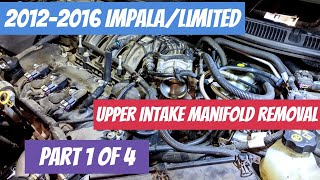
The 2009-2014 Acadia uses a 3.6L V6 with direct injection, which operates at very high fuel pressures and uses injectors that are more complex than traditional port injectors. On this engine, the high voltage supply circuits for injectors on cylinders 3 and 6 are paired within the ECM. This means a severe short on one circuit can sometimes cause the ECM to set a fault for the companion cylinder and disable the driver for both. Additionally, accessing the injectors on the rear bank (including cylinder 3) requires removing the upper intake manifold, 🎬 Watch: Step-by-step guide to removing the upper intake manifold. making the repair more involved than on some other vehicles.
Diagnostic Flowchart
Tap your situation to follow the diagnostic path that matches what you're seeing on this vehicle.
Symptoms You May Notice
- Check Engine Light is on
- Engine running rough or vibrating, especially at idle
- Noticeable engine misfire, which may feel like a stumble or hesitation
- Loss of power during acceleration
- Reduced fuel economy
- Engine may stall
- Replacing the spark plug or ignition coil for cylinder 3. While these can cause a misfire (P0303), they will not cause an injector circuit code like P0267.
Most Likely Causes
- Failed Cylinder 3 Fuel Injector 🔴 High Probability → Shop Fuel Injector Direct injectors operate under high stress and can fail internally, causing an electrical short. This is a well-documented failure on these engines.
How to confirm: The most reliable method is to swap the cylinder 3 injector with another cylinder (e.g., cylinder 1). Clear the codes and run the engine. If the trouble code moves to the new cylinder (e.g., P0261 for cylinder 1), the injector is faulty. A resistance test can also be performed; a reading outside of manufacturer specs indicates failure. There are different resistance specifications for the 2009-2011 LLT engine and the 2012-2014 LFX engine.
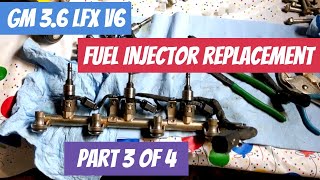
Typical fix: Replace the failed fuel injector and its Teflon seal. It is often recommended to replace all injectors on the same bank or all six at the same time, 🎬 See this walkthrough for replacing the fuel injectors. as they have all been subjected to the same conditions.
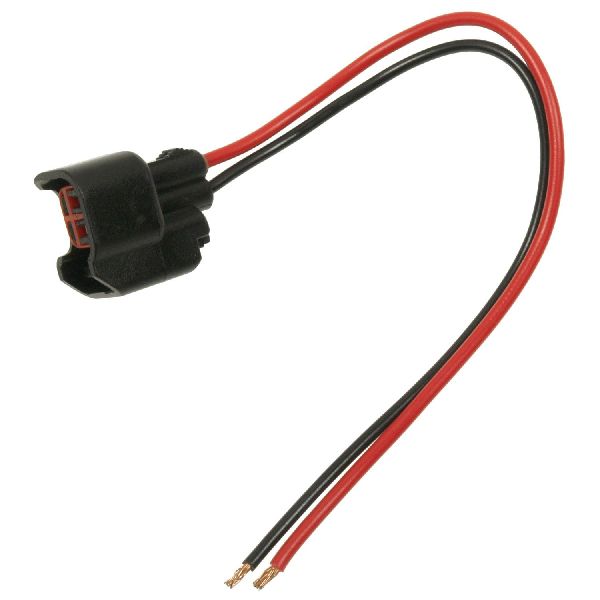
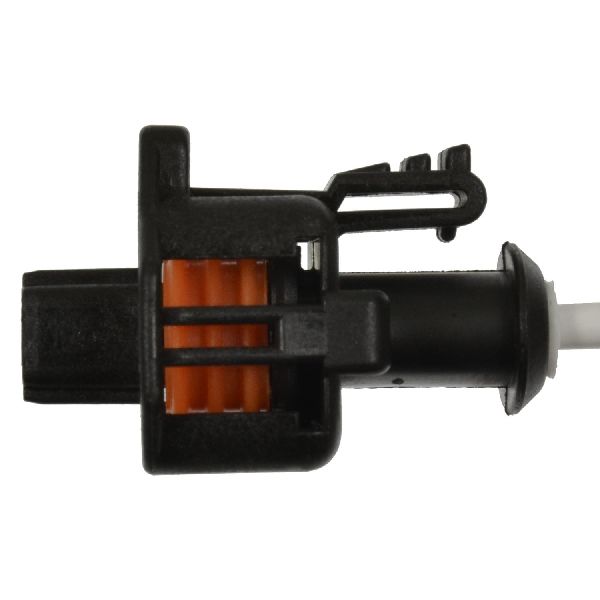
Est. part cost: $70-$150 per injector - Wiring Harness or Connector Issue 🟡 Medium Probability GM issued Technical Service Bulletin PIP4924D which specifically calls out wiring harness issues for a wide range of injector codes, including P0267. The harness is known to chafe against the intake plenum, valve cover bolts, fuel lines, and the side of the cylinder head, causing a short to ground.
How to confirm: Visually inspect the wiring going to the cylinder 3 injector for any signs of damage, particularly at the contact points mentioned in TSB PIP4924D. Use a multimeter to check for continuity and for a short to ground on the control wire between the ECM and the injector connector.
Typical fix: Repair the damaged section of the wiring harness with solder and heat-shrink tubing, then secure it away from the sharp edge that caused the damage. In severe cases, the injector pigtail connector or a section of the harness may need to be replaced.
Est. part cost: $15-$50 - Faulty Engine Control Module (ECM) ⚪ Low Probability → Shop Engine Control Module (ECM)
How to confirm: This should only be considered after the injector and wiring have been definitively ruled out. A professional diagnosis using advanced scan tools is needed to confirm an ECM driver failure. The ECM's internal driver transistor for the injector circuit can fail, but this is the least likely cause.
Typical fix: Replace and reprogram the Engine Control Module.
Est. part cost: $400-$800
Diagnosis Steps
- Verify the code P0267 is present using an OBD-II scanner. Note any other codes, especially P0303 or P0276.
- Locate cylinder 3. On the transverse 3.6L V6, the cylinders against the firewall (rear bank) are 1, 3, and 5, from passenger side to driver side. Cylinder 3 is the middle cylinder on the rear bank.
- Visually inspect the wiring harness and connector for the cylinder 3 fuel injector. Per TSB PIP4924D, pay close attention to areas where the harness may rub against the intake plenum, valve cover bolts, or fuel lines.
- If the wiring looks good, the next step is to access the fuel injectors, which requires removing the upper intake manifold. Before removing, use compressed air to blow away debris from around the injectors to prevent it from falling into the cylinders.
- Disconnect the injector connector. Use a multimeter to test the resistance of the fuel injector. Compare the reading to the manufacturer's specification, noting the difference between engine types: ~10-16 ohms for the 2009-2012 LLT and 1.2-2.5 ohms for the 2012-2014 LFX. An out-of-spec reading (open or shorted) indicates a bad injector.
- For a definitive diagnosis, swap the cylinder 3 injector with the cylinder 1 injector. Reassemble the intake manifold (using old gaskets for testing is acceptable for a short duration), clear the codes, and run the engine. If the code changes to P0261 (Cylinder 1 Injector Circuit Low), the injector is confirmed to be the problem.
- If the code P0267 returns after the swap, the issue is in the wiring or the ECM. Perform a continuity test on the control and voltage supply wires from the ECM connector to the injector connector to check for opens or shorts to ground. A noid light can also be used to verify a pulsing signal from the ECM at the injector connector.
Parts You'll Likely Need
- Fuel Injector
(OEM #12669384 (supersedes 12638530))— This is the most common cause of a P0267 code, due to internal electrical failure. The part number has been updated over time.
Trusted brands: ACDelco (GM Genuine), Bosch, Standard Motor Products
OEM price range: $100-$160
Aftermarket price range: $70-$120 - Fuel Injector Seal Kit
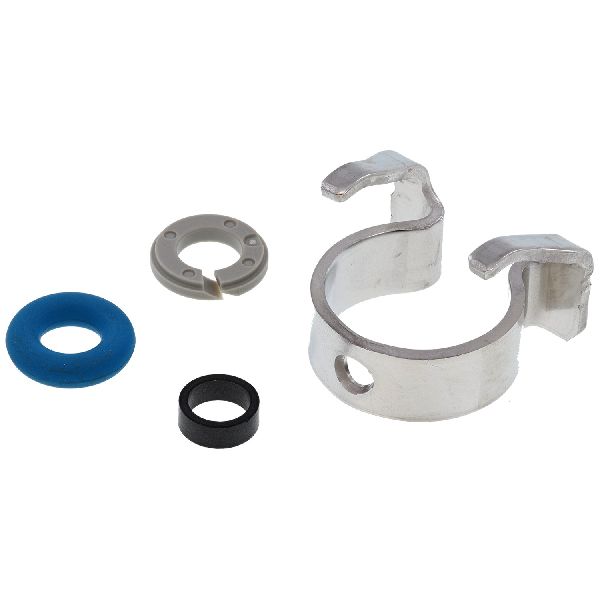
(OEM #12643761)— The Teflon seal at the tip of the direct injector is single-use and must be replaced anytime an injector is removed and reinstalled to prevent high-pressure fuel leaks.
Trusted brands: ACDelco
OEM price range: $10-$20
Aftermarket price range: $5-$15 - Upper Intake Manifold Gaskets
(OEM #12639995 (example, verify by VIN))— The upper intake manifold must be removed to access the fuel injectors, and its gaskets are considered single-use and should be replaced to prevent vacuum leaks.
Trusted brands: ACDelco, Fel-Pro
OEM price range: $30-$50
Aftermarket price range: $20-$40 - Fuel Injector Teflon Seal Installer Tool
(OEM #EN-49245)— A special tool is required to properly size and install the new Teflon seal onto the direct injector without damaging it. Attempting to install without this tool can lead to leaks.
Trusted brands: Lisle, OTC
OEM price range: $50-$100
Aftermarket price range: $20-$40
Related Codes That Often Appear With This One
- P0303 — P0303 means "Cylinder 3 Misfire Detected." Since a P0267 fault prevents the injector from delivering fuel, it will almost always cause a misfire in that cylinder.
- P0276 — P0276 is "Cylinder 6 Injector Circuit Low." On this engine, the high voltage supply circuits for injectors 3 and 6 are paired. A severe short on the cylinder 3 circuit can cause the ECM to set a fault for the companion cylinder and shut down the driver for both.
- P2152 — P2152 is "Cylinder 3 Injector High Control Circuit". This is another code related to the same injector circuit and can appear alongside P0267, often pointing towards a wiring or ECM issue.
Technical Service Bulletins (TSBs) & Recalls
- PIP4924D: Addresses a potential engine misfire and a host of fuel injector circuit codes (P0261, P0267, etc.). The primary recommendation is to inspect the wiring harness for chafing before replacing components.
Platform-Specific Known Issues
- A GM Technical Service Bulletin, #PIP4924D, addresses a potential engine misfire and the presence of numerous fuel injector circuit codes, including P0267. It specifically advises technicians to carefully inspect the fuel injector wiring harness for rubbing (chafing) against components like the intake plenum, valve cover bolts, and fuel lines. This strongly suggests a known design vulnerability.
- source — On the 'Camaro5' forum, a user with a 2011 V6 (same LLT engine family) experienced P0267 and P0303. After initial parts swaps didn't work, they physically moved the #3 injector to the #1 cylinder position. The codes followed the injector, changing to P0261 and P0301, definitively proving the fuel injector was the faulty component.
Mechanic-Grade Diagnostic Values
- Fuel Injector Resistance (2009-2011 LLT Engine) — expected: 10 - 16 Ohms. Failure: A reading of zero (short), infinity (open), or significantly outside this range indicates a failed injector.
- Fuel Injector Resistance (2012-2014 LFX Engine) — expected: 1.2 - 2.5 Ohms. Failure: A reading outside this narrow range indicates an internal injector fault. These are low-impedance injectors.
- Injector Circuit Voltage Spike (Oscilloscope) — expected: 60 - 80 Volts. Failure: The absence of this sharp 'inductive kick' when the injector driver grounds and then opens points to a problem with the injector's coil or the control circuit.
- Injector Control Circuit Voltage (Key On, Engine Off) — expected: Battery Voltage (approx. 12V). Failure: Voltage significantly lower than battery voltage points to a short to ground or excessive resistance in the power supply side of the circuit.
Scan Tool Commands That Help
- GDS2 (GM Global Diagnostic System 2): Injector Test / Active Fuel Injector Test (AFIT) — This bidirectional test commands each injector to fire individually while the tool monitors the corresponding drop in fuel rail pressure. If cylinder 3 shows a significantly different pressure drop than the others, it confirms a functional issue with the injector (clogged, weak, etc.), which is useful if electrical resistance tests are inconclusive.
Wiring & Ground Locations
- ECM Pins 26 & 27 (X1 Connector) — At the Engine Control Module (ECM) connector. Pin 26 is the Dark Green/White wire and Pin 27 is the Dark Green wire for cylinder 3.. These are the specific high and low side control circuit pins for the cylinder 3 injector. Testing for resistance and shorts here can isolate the entire circuit from the ECM to the injector, helping to differentiate a wiring fault from an internal ECM fault.
- Harness Connectors X160 / X161 — Multi-pin connectors located at the rear of the intake manifold.. These are intermediate connectors between the ECM and the fuel injectors. Disconnecting them allows a technician to isolate and test the engine-side harness separately from the main harness connected to the ECM.
- G110 — Right front of the engine, mounted to the cylinder head.. This is a primary engine ground. A poor connection here can introduce electrical noise and voltage irregularities that may affect the PCM's ability to properly control and monitor injector circuits.
- G113 — Left side of the engine, at an engine-to-transmission stud.. This is another critical engine block ground. A compromised G113 can cause a range of difficult-to-diagnose electrical issues, including problems with the PCM and its driver circuits for components like fuel injectors.
OEM Part Supersession History
12611545, 12632255, 12638530→12669384— GM updated the part design over time to improve reliability and performance.
Heads up: The listed original part numbers are all superseded by 12669384, which is the current service replacement.
Model Year Variations Within This Range
- 2009-2011 (LLT Engine): Uses higher resistance fuel injectors (~10-16 Ohms), an aluminum intake manifold, and a Bosch ECM.
- 2012-2014 (LFX Engine): Uses lower resistance fuel injectors (~1.2-2.5 Ohms), a composite intake manifold, integrated exhaust manifolds, and a Delphi ECM. Using the wrong injector or resistance spec for diagnosis will lead to misdiagnosis.
Helpful Videos

We Have This Part in Stock


The information in this article is provided for general reference and educational purposes only. Vehicle specifications, procedures, and part compatibility can vary by production date, trim level, and region. Always consult your vehicle's factory service manual and verify part numbers before purchasing or performing repairs. Safety-critical components such as airbags, seat belts, and braking systems should be installed by a qualified professional.
- Gmc ACADIA:
- 🧭 Diagnostic Flowchart
- 🎬 Helpful Videos
- 🛍️ Shop This Part
- What's Unique About the 2009-2014 Gmc ACADIA
- Symptoms You May Notice
- Most Likely Causes
- Diagnosis Steps
- Parts You'll Likely Need
- Related Codes That Often Appear With This One
- Technical Service Bulletins (TSBs) & Recalls
- Platform-Specific Known Issues
- Mechanic-Grade Diagnostic Values
- Scan Tool Commands That Help
- Wiring & Ground Locations
- OEM Part Supersession History
- Model Year Variations Within This Range
- 🎟️ Get 5% Off