

P0268 on 2009-2013 Chevrolet Malibu: Cylinder 3 Injector Circuit High Causes and Fixes
On a 2009-2013 Malibu, code P0268 is most often caused by a damaged fuel injector wiring harness, an issue highlighted in a GM Technical Service Bulletin. The next most likely cause is a failed fuel injector for cylinder 3. Expect to pay $60-$120 for a new injector.
- P0268 is an electrical fault, not a fuel delivery problem. Do not replace the fuel pump.
- Always inspect the wiring harness for chafing first, as per GM TSB PIP4924C. This is the most common cause on this specific vehicle.
- If the wiring is good, test the injector before replacing it. Swapping it with another cylinder is a good way to confirm failure.
- A PCM is a possible but unlikely cause; it should be the last component to be replaced.
What's Unique About the 2009-2013 Chevrolet MALIBU
General Motors released a Technical Service Bulletin (TSB #PIP4924C) that specifically addresses this code, along with many other injector circuit codes, on the 2009-2013 Malibu and its platform mates. The bulletin explicitly advises technicians to inspect the fuel injector wiring harness for chafing and shorts against components like the intake plenum, valve cover bolts, fuel lines, and the side of the cylinder head. This indicates that wiring problems are a recognized pattern on this platform and should be the first area of investigation, potentially saving you from replacing a perfectly good fuel injector.
Diagnostic Flowchart
Tap your situation to follow the diagnostic path that matches what you're seeing on this vehicle.
Generation note: This range covers two Malibu generations: the 7th generation (2009-2012) and the 8th generation (2013). The 7th gen primarily used a 2.4L 4-cylinder or 3.6L V6 engine. The 8th gen introduced a new 2.5L 4-cylinder as the base engine. While the code's cause is similar, the specific fuel injector part numbers differ between these engines. The underlying wiring harness vulnerability noted in TSB PIP4924C applies across these model years and engines.
Symptoms You May Notice
- Check Engine Light is illuminated
- Engine runs rough or idles poorly
- Noticeable engine misfire, which may feel like a bucking or jerking
- Loss of power and sluggish acceleration
- Engine may stall in some cases
- Strong fuel smell from the exhaust
- Replacing the spark plug or ignition coil for cylinder 3. While these parts can cause a misfire (P0303), they will not set a P0268 'Circuit High' code. This code is specific to the fuel injector's electrical circuit. A mechanic on YouTube noted a case where a cracked spark plug caused a misfire, but this would typically set a P0303, not P0268.
Most Likely Causes
- Damaged Fuel Injector Wiring or Connector 🔴 High Probability → Shop Fuel Injector As documented in GM TSB #PIP4924C, the fuel injector wiring harness is a known weak point. The plastic loom can become brittle, and wires can chafe against the intake plenum, valve cover bolts, fuel lines, or the side of the cylinder head, causing a short to voltage. Owners have reported finding wires rubbed raw in these exact locations.
How to confirm: Visually inspect the wiring harness leading to the cylinder 3 fuel injector. Look for any signs of chafing, melting, exposed wires, or damage to the connector plug. Wiggle the harness with the engine running to see if the misfire changes. Pay close attention to the specific chafe points mentioned in the TSB.
Typical fix: Repair the damaged section of wire or replace the injector connector pigtail. Use quality heat shrink and loom to protect the repair.
Est. part cost: $15-$40 - Failed Cylinder 3 Fuel Injector 🟡 Medium Probability → Shop Fuel Injector
How to confirm: After confirming the wiring is good, test the injector. Unplug the injector and measure its resistance with a multimeter; compare the reading to the vehicle's specifications (typically 10-16 ohms for high-impedance injectors). A reading that is very low or an open circuit indicates a failed injector. An alternative is to swap the cylinder 3 injector with another one (e.g., cylinder 1) and see if the trouble code follows the injector (e.g., changes to P0262 for cylinder 1).
Typical fix: Replace the failed fuel injector.
Est. part cost: $60-$120 - Faulty Powertrain Control Module (PCM) ⚪ Low Probability → Shop Engine Control Module (ECM)
How to confirm: This should only be considered after ruling out wiring and the injector itself. A professional technician would use advanced scan tools to monitor the injector driver command and output from the PCM to confirm the fault originates inside the module. An injector short can sometimes damage the PCM driver circuit, requiring replacement of both components.
Typical fix: Replace and reprogram the Powertrain Control Module.
Est. part cost: $300-$800
Diagnosis Steps
- Verify the Check Engine Light is on and code P0268 is present using an OBD-II scanner.
- Identify the location of Cylinder 3. On 2.4L and 2.5L 4-cylinder engines, it is the third cylinder from the front (passenger side). On the 3.6L V6, it is the middle cylinder on the bank closer to the firewall.
- Perform a thorough visual inspection of the wiring harness and connector for cylinder 3. Pay close attention to areas where the harness might rub against the engine block, intake plenum, or valve cover bolts, as noted in TSB #PIP4924C.
- If no visible damage is found, disconnect the injector and use a 'noid light' to test for a signal from the PCM. The light should flash steadily while the engine is cranking or running. A light that stays on constantly points to a short-to-voltage in the wiring or a faulty PCM driver.
- With the injector unplugged, use a multimeter to measure the resistance across the two pins on the injector itself. Compare the reading to the manufacturer's specification. If it's out of spec, the injector is bad.
- If the injector tests good, perform a continuity test on the two wires running from the PCM connector to the injector connector to check for breaks. Also, check for a short to voltage by testing for voltage on the signal wire with the key on.
- If wiring and the injector are confirmed to be good, the fault likely lies within the PCM, which may require professional diagnosis and replacement.
Parts You'll Likely Need
- Fuel Injector
(OEM #12613163)— This is the most likely component to have failed if the wiring is intact. This part number is for the 2.4L I4 (2009-2012). 🎬 See this walkthrough for replacing injectors on the 2.4L Ecotec engine.
Trusted brands: ACDelco, Bosch, Standard Motor Products
OEM price range: $80-$120
Aftermarket price range: $50-$90 - Fuel Injector
(OEM #12662564)— This is the most likely component to have failed if the wiring is intact. This part number is for the 2.5L I4 (2013).
Trusted brands: ACDelco, Bosch, Hitachi
OEM price range: $85-$130
Aftermarket price range: $60-$100 - Fuel Injector
(OEM #217-3158)— This is the most likely component to have failed if the wiring is intact. This part number is for the 3.6L V6 (2009-2012).
Trusted brands: ACDelco, Bosch, Delphi
OEM price range: $80-$120
Aftermarket price range: $30-$70 - Fuel Injector Connector Pigtail
(OEM #PT2160)— If the wiring is damaged at the connector, replacing the pigtail is the standard repair. ACDelco PT2160 is a common GM pigtail for this application.
Trusted brands: ACDelco, Dorman (e.g., 645-509)
OEM price range: $25-$40
Aftermarket price range: $15-$30
Related Codes That Often Appear With This One
- P0303 — P0303 indicates a 'Cylinder 3 Misfire'. Since P0268 causes the PCM to shut down the cylinder 3 injector, a misfire is the direct result.
- P0203 — P0203 indicates a general 'Injector Circuit/Open - Cylinder 3'. It can appear alongside P0268 depending on the exact nature of the electrical fault.
- P0267, P0273 — If multiple injector circuit low codes (e.g., P0261, P0267, P0273 for cylinders 1, 3, 5) appear together, it can point to a wiring harness short affecting an entire bank of injectors, as seen in a 2005 Buick LaCrosse with the 3.6L V6.
Technical Service Bulletins (TSBs) & Recalls
- PIP4924C: Malfunction Indicator Lamp on and a misfire
Platform-Specific Known Issues
- GM Technical Service Bulletin #PIP4924C directly applies to this code on 2009-2013 models, advising technicians to inspect the fuel injector wiring harness for chafing and shorts. Specific chafe points mentioned are against the intake plenum, valve cover bolts, fuel lines, and the side of the head under the plenum. This strongly suggests a known manufacturing or design issue with harness routing or protection.
Mechanic-Grade Diagnostic Values
- Fuel Injector Resistance (2.4L Port Injection) — expected: 11 - 14 Ohms (when engine is cold). Failure: A reading significantly outside this range, or an open (OL) or shorted (near 0 Ohms) circuit.
- Fuel Injector Resistance (3.6L Direct Injection) — expected: 1.2 - 2.3 Ohms (when engine is cold). Failure: A reading outside this range. Resistance changes with temperature, so compare to other injectors.
- Injector Control Wire Voltage (Key On, Engine Off) — expected: Near 0 Volts. Failure: A reading above 5 Volts suggests a short to power in the wiring harness.
- Injector Pulse Width (at idle, via scan tool) — expected: 2 - 4 milliseconds (ms). Failure: A value of 0 ms on cylinder 3 while others are pulsing indicates the PCM is not commanding the injector, or has disabled it due to the fault.
Scan Tool Commands That Help
- GDS2 / Tech2: Cylinder Power Balance Test / Injector Kill — To confirm that cylinder 3 is the one not contributing power, verifying the misfire location before physical inspection.
- GDS2 / Tech2: Injector Test — To command the PCM to pulse the injector driver. If the injector is known good and wiring is intact, a failure of this test points towards a faulty PCM driver circuit.
Wiring & Ground Locations
- G106 — On the 2.4L engine, it's at the left rear of the engine. On the 3.6L engine, it's at the right front.. This is a primary engine ground. A poor connection here can cause widespread electrical issues, including erratic sensor and actuator behavior like that seen with a P0268 code.
- G107 — On the 2.4L engine, it's at the lower left side of the engine. On the 3.6L, it's at the center rear.. Another critical engine ground point. Verifying it is clean and tight is a key step in diagnosing any electrical circuit fault on the engine.
- ECM (Engine Control Module) — Located in the left front of the engine compartment.. This is the source of the injector control signal. Knowing its location is necessary for testing continuity of the injector harness back to the module.
OEM Part Supersession History
12627093, 12633913, 12662570→12662564— Standard part evolution for improved reliability or manufacturing changes.
Heads up: These part numbers apply to the 2.5L engine found in the 2013 Malibu.
Model Year Variations Within This Range
- 2009-2012 (2.4L I4): Uses a high-impedance port fuel injector (PFI). Diagnostic resistance check should yield a value between 11-14 Ohms.
- 2009-2012 (3.6L V6) and 2013 (2.5L I4): Use low-impedance direct injection (DI) injectors. Diagnostic resistance check will yield a much lower value, typically between 1.2-2.3 Ohms. Using a PFI resistance value for diagnosis will lead to an incorrect conclusion.
Helpful Videos
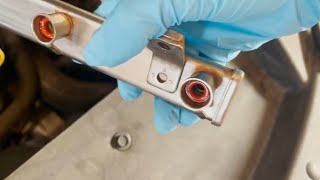
We Have This Part in Stock



The information in this article is provided for general reference and educational purposes only. Vehicle specifications, procedures, and part compatibility can vary by production date, trim level, and region. Always consult your vehicle's factory service manual and verify part numbers before purchasing or performing repairs. Safety-critical components such as airbags, seat belts, and braking systems should be installed by a qualified professional.
- Chevrolet MALIBU:
- 🧭 Diagnostic Flowchart
- 🎬 Helpful Videos
- 🛍️ Shop This Part
- What's Unique About the 2009-2013 Chevrolet MALIBU
- Symptoms You May Notice
- Most Likely Causes
- Diagnosis Steps
- Parts You'll Likely Need
- Related Codes That Often Appear With This One
- Technical Service Bulletins (TSBs) & Recalls
- Platform-Specific Known Issues
- Mechanic-Grade Diagnostic Values
- Scan Tool Commands That Help
- Wiring & Ground Locations
- OEM Part Supersession History
- Model Year Variations Within This Range
- 🎟️ Get 5% Off