

P0271 on 2009-2014 Buick LaCrosse (3.0L LF1, 3.6L LLT/LFX): Cylinder 4 Injector Circuit High Causes and Fixes
This code indicates a high voltage issue in the cylinder 4 fuel injector circuit. The most common cause on this vehicle is a chafed or damaged fuel injector wiring harness, as noted in GM Technical Service Bulletin #PIP4924D. The harness is known to rub against the intake plenum, valve cover bolts, or fuel lines. A faulty fuel injector is the second most likely culprit.
- P0271 on a 2009-2014 LaCrosse points specifically to an electrical problem with the cylinder 4 fuel injector, not the ignition system.
- Before replacing any parts, thoroughly inspect the fuel injector wiring harness for damage, as this is a known issue documented in a GM Technical Service Bulletin (PIP4924D).
- If the wiring is good, the next most likely cause is a failed fuel injector.
- Driving with this code can lead to a steady misfire, which can damage your catalytic converter over time.
What's Unique About the 2009-2014 Buick LACROSSE
For this generation of Buick LaCrosse and its platform mates with the 3.0L/3.6L V6 engines, General Motors has identified a common failure point with the fuel injector wiring harness. Technical Service Bulletin (TSB) #PIP4924D explicitly warns technicians that the harness can rub against engine components. Specific chafe points include the intake plenum, valve cover bolts, the fuel line, and the side of the cylinder head under the plenum. This makes a meticulous wiring inspection a critical first step, even before suspecting the injector itself.
Diagnostic Flowchart
Tap your situation to follow the diagnostic path that matches what you're seeing on this vehicle.
Generation note: The 2009-2014 range covers two LaCrosse generations. The 2009 model is the end of the first generation, while 2010-2014 models are the second generation. The key issue, a problematic fuel injector wiring harness cited in TSB PIP4924D, applies to V6 engines (3.0L LF1, 3.6L LLT/LFX) across this entire year range.
Symptoms You May Notice
- Check Engine Light is on
- Rough or shaking idle
- Engine misfire, which may be more noticeable under load
- Hesitation or stumbling during acceleration
- Reduced engine power and 'Engine Power is Reduced' message on DIC
- Poor fuel economy
- A raw fuel smell from the exhaust if the misfire is severe
- Replacing the spark plug or ignition coil for cylinder 4. While these parts can cause a misfire (P0304), they do not cause an injector circuit code like P0271. The code specifically points to an electrical problem in the fuel injector's circuit, not an ignition problem.
Most Likely Causes
- Chafed or Damaged Fuel Injector Wiring Harness 🔴 High Probability → Shop Engine Wiring Harness GM issued TSB #PIP4924D specifically identifying this as a widespread problem. The harness routing makes it susceptible to rubbing against sharp edges on the intake plenum, valve cover bolts, fuel lines, or the side of the cylinder head. This friction eventually wears through the insulation, causing a short to voltage and triggering the 'Circuit High' code.
How to confirm: Visually inspect the entire wiring harness leading to the fuel injectors, paying close attention to cylinder 4. Carefully check the specific chafe points mentioned in the TSB. Wiggle the harness with the engine running (if safe) to see if it induces a change in idle. Check for continuity and shorts on the two wires for the cylinder 4 injector.
Typical fix: Repair the damaged section of wire using solder and heat-shrink tubing. Protect the repaired area with high-quality anti-abrasion tape (like Tesa tape) or split-loom tubing. Re-route the harness slightly if possible to prevent future contact. If damage is extensive or at the connector, replace the injector wiring pigtail.
Est. part cost: $15-$150 - Faulty Fuel Injector 🟡 Medium Probability → Shop Fuel Injector Direct injection (DI) injectors operate under high pressure and can fail internally. While wiring is the primary suspect, injector failure is still a common cause.
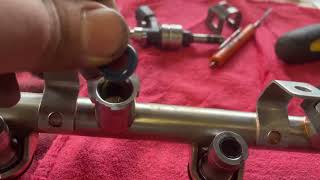
How to confirm: After confirming the wiring is intact, test the injector. Use a multimeter to check the resistance of the cylinder 4 injector. For the 3.6L V6 (LLT/LFX), a good injector should read between 1.2 and 1.8 Ohms. For the 3.0L V6 (LF1), the spec is closer to 12 Ohms. A reading far outside this range, especially an open circuit (OL), indicates a failed injector. 🎬 Watch: Professional diagnostic testing and removal of GM direct injectors. A noid light can also confirm the injector is receiving a pulse signal from the PCM.
Typical fix: Replace the cylinder 4 fuel injector. It is highly recommended to replace the Teflon injector seal and the O-ring at the same time. Many technicians advise replacing all injectors on the same bank (Bank 2: cylinders 2, 4, 6) if they are high mileage.
Est. part cost: $60-$120 - Corroded or Loose Injector Connector ⚪ Low Probability
How to confirm: Unplug the connector at the cylinder 4 injector and inspect the terminals for corrosion (green or white powder), moisture, or bent/damaged pins. Ensure the connector fits snugly and the locking tab is intact.
Typical fix: Clean the terminals with an electrical contact cleaner or replace the connector pigtail if it's damaged. Apply a small amount of dielectric grease to the seal to prevent future moisture intrusion.
Est. part cost: $15-$30
Rare But Worth Checking
- Faulty Powertrain Control Module (PCM): → Shop Engine Control Module (ECM) This is the least likely cause. The internal driver circuit for the injector can fail, but all other possibilities, especially wiring and the injector itself, should be exhaustively ruled out before condemning the PCM. A failure of the injector driver in the PCM is rare.
Diagnosis Steps
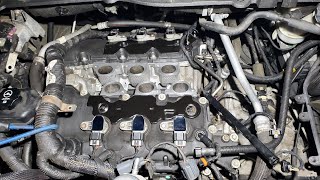
- Identify Cylinder 4: On the transverse-mounted 3.0L/3.6L V6, the engine banks are oriented with Bank 1 (odd cylinders 1, 3, 5) at the rear, near the firewall, and Bank 2 (even cylinders 2, 4, 6) at the front, near the radiator. Cylinder 4 is the middle cylinder of the front bank. 🎬 See how to remove the intake manifold to access the injectors.
- Read Codes: Read all stored fault codes with an OBD-II scanner. Note any other codes present, especially misfire codes (P0304) or injector group codes.
- Inspect Wiring Harness: Perform a careful visual inspection of the fuel injector wiring harness as recommended by TSB #PIP4924D. Check for chafing against the intake manifold, valve cover bolts, fuel lines, and the side of the cylinder head. Pay extra attention to the harness branch going to the front bank of injectors.
- Check Connector: Inspect the electrical connector at the cylinder 4 fuel injector for damage, corrosion, or loose pins.
- Test for Signal (Noid Light): If wiring appears okay, disconnect the connector and attach a noid light. Crank the engine. A flashing light indicates the PCM is commanding the injector to fire.
- Measure Injector Resistance: With the ignition off, disconnect the injector and measure its internal resistance with a multimeter. For the 3.6L V6, the reading should be between 1.2 and 1.8 Ohms. For the 3.0L, expect ~12 Ohms. Compare with an adjacent injector (e.g., cylinder 2 or 6). A reading of infinity (OL) or far outside the specification indicates a failed injector.
- Check for Shorts: If the resistance is good, check for a short to ground or voltage on the harness side of the connector. One wire should have continuity to ground (with key off), and the other should not.
- Isolate the Fault: If there is no signal at the connector with a noid light, and the wiring from the PCM to the injector is confirmed to be good (checking for continuity), the PCM itself may be faulty, but this is extremely rare.
Parts You'll Likely Need
- Fuel Injector
(OEM #12669384 (supersedes 12638530))— If the injector's internal coil has failed its resistance test, it must be replaced. This is a common failure point after wiring issues are ruled out.
Trusted brands: ACDelco (GM Genuine), Bosch, Standard Motor Products
OEM price range: $90-$150
Aftermarket price range: $50-$90 - Fuel Injector Wiring Harness Pigtail
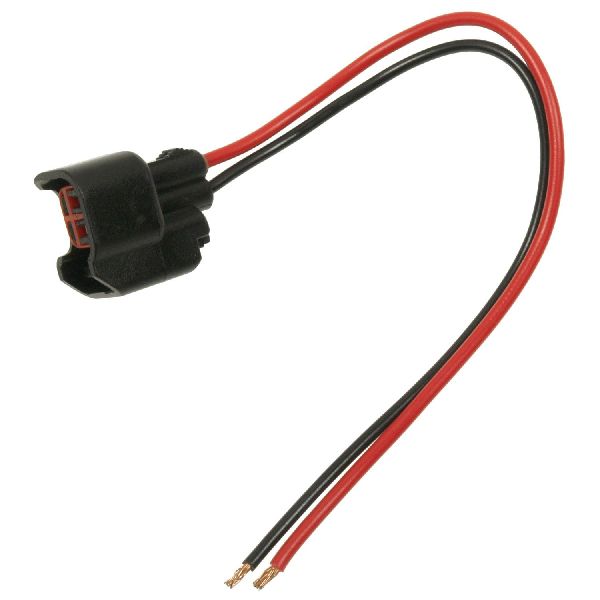
(OEM #ACDelco PT2160 (example))— If the wiring is damaged right at the connector, splicing in a new pigtail is the standard repair.
Trusted brands: ACDelco, Dorman, Standard Motor Products (e.g., S-1024)
OEM price range: $25-$45
Aftermarket price range: $15-$30 - Teflon Injector Seal Kit — The Teflon seal at the tip of the direct injector is a single-use item and must be replaced whenever an injector is removed and reinstalled to prevent compression and fuel leaks.
Trusted brands: ACDelco, Fel-Pro
OEM price range: $8-$15
Aftermarket price range: $5-$10
Related Codes That Often Appear With This One
- P0304 — This code means 'Cylinder 4 Misfire Detected'. It is a direct result of the P0271 fault, as the injector circuit problem prevents proper fueling, causing the cylinder to misfire.
- P0204 — This code for 'Injector Circuit/Open - Cylinder 4' is closely related and can sometimes appear with P0271, as both point to an electrical fault in the same circuit.
- P0171 / P0174 — These 'System Too Lean' codes for Bank 1 and Bank 2 can appear if the misfire is significant enough to throw off the engine's overall air-fuel ratio, causing the oxygen sensors to report a lean condition.
- P2152 / P2155 — These codes relate to Fuel Injector Group 'C' or 'D' Supply Voltage Circuit. Because injectors are often grouped in the PCM, a fault on one circuit can sometimes trigger group codes. TSB PIP4924D lists these as potential companion codes.
Technical Service Bulletins (TSBs) & Recalls
- PIP4924D: SES Light And Misfire With Injector Codes. This bulletin is the primary source for diagnosing P0271 on this vehicle, pointing directly to a chafing wiring harness as a probable cause and listing specific areas to inspect.
Platform-Specific Known Issues
- TSB #PIP4924D - Chafing Wiring Harness: This is the most critical vehicle-specific issue. It documents that the fuel injector wiring harness is prone to rubbing through against engine components (intake, valve covers, etc.), causing various injector circuit codes, including P0271. A thorough inspection of the harness is required.
- Cylinder 4 Location: Properly identifying cylinder 4 is key. On these transverse V6 engines, Bank 2 is the front bank, and the cylinders are numbered 2, 4, 6 from passenger side to driver side.
Mechanic-Grade Diagnostic Values
- Fuel Injector Coil Resistance (3.6L LLT/LFX V6) — expected: 1.2 - 1.8 Ohms. Failure: A reading significantly outside this range, an open circuit (OL), or a short (near 0 Ohms) indicates a failed injector coil.
- Fuel Injector Coil Resistance (3.0L LF1 V6) — expected: 11.8 - 12.6 Ohms. Failure: A significant deviation from this range indicates an internal fault in the high-impedance injector.
- Injector Pulse Width (at idle) — expected: 2 - 4 milliseconds (ms). Failure: A value of 0 ms on cylinder 4 while others are pulsing indicates the ECM is not commanding the injector to open.
- High Pressure Fuel System Pressure (at Idle) — expected: Approximately 508 psi (35 bar). Failure: While not a direct cause of a circuit code, pressure significantly lower than spec could indicate related fuel system issues.
Scan Tool Commands That Help
- GM GDS2 (Global Diagnostic System 2): Injector Control Circuit Test Status — While the engine is operating, this function allows a technician to observe the status of the injector circuits as reported by the ECM. A 'Not OK' or fault status for cylinder 4 would confirm an active electrical issue detected by the module.
- GM GDS2 (Global Diagnostic System 2): Automated Injector Balance Test — This bidirectional test commands the engine to turn over while it primes the high-pressure fuel pump, then pulses each injector individually and measures the corresponding pressure drop in the fuel rail. This can help identify a mechanically or electrically failed injector by comparing the pressure drop for cylinder 4 to the others.
Wiring & Ground Locations
- ECM Connector X1/J1 Pin 47 — On the main Engine Control Module (ECM) connector, typically designated X1 or J1. The ECM is located in the engine bay.. For a 2011 LaCrosse 3.6L, the control wire for the cylinder 4 injector is a Light Blue wire at Pin 47. The shared power feed for Bank 2 injectors (2, 4, 6) is a Pink/Black wire. Performing a continuity test from the injector connector directly to this pin is the definitive method to confirm the wiring harness is intact or has a fault.
- G101 / G107 — G101 is a primary engine ground, often located on the engine block near the starter motor, and may be strapped to G107 on the chassis frame.. A poor main engine ground can cause a variety of unpredictable electrical issues and voltage drops. While not a direct cause for a single injector circuit high code, verifying that main engine and chassis grounds are clean and tight is a foundational step in any electrical diagnosis.
Real Owner Repair Stories
- ScannerDanner Forum (2011 Buick LaCrosse 3.6L V6) — Misfire on cylinders 3, 4, and 6. No-start condition.
❌ Tried (didn't work) Cleaning all injectors, Resistance testing all injectors (all tested good), Verifying wiring harness continuity (tested good)
✅ What actually fixed it The diagnosis concluded that the ECM was not providing the ground signal to fire injectors 3, 4, and 6. After confirming the wiring and injectors were good, the root cause was determined to be a faulty ECM driver circuit for that bank of injectors. A replacement ECM was ordered to fix the issue.
OEM Part Supersession History
12638530→12669384— Part revision and consolidation by GM. This is a common progression for many GM parts.
Heads up: Part number 12638530 is primarily associated with the 2009-2011 3.6L LLT engine. The 3.6L LFX engine (2012-2014) may use a different injector. While some vendors list them as interchangeable, LLT and LFX injectors are not directly swappable due to differences in the engine and ECM control. Always verify the correct part number by VIN.
Model Year Variations Within This Range
- 2009-2011: These models primarily used the 3.6L LLT V6 engine. This engine has conventional cast exhaust manifolds and uses a Bosch ECM. The fuel injector part number is typically 12638530 or its direct predecessors/successors.
- 2012-2014: These models use the updated 3.6L LFX V6 engine. Key changes include cylinder heads with integrated exhaust manifolds, a lighter composite intake manifold, and a different (Delphi) ECM. These changes mean some parts, like injectors and intake components, are not interchangeable with the earlier LLT engine.
- 2010: The 2010 model year also offered a 3.0L LF1 V6. This engine uses different, high-impedance (~12 Ohm) fuel injectors compared to the low-impedance (~1.5 Ohm) injectors of the 3.6L engines. Diagnosis of the circuit is similar, but the component specifications are different.
Helpful Videos
We Have This Part in Stock


The information in this article is provided for general reference and educational purposes only. Vehicle specifications, procedures, and part compatibility can vary by production date, trim level, and region. Always consult your vehicle's factory service manual and verify part numbers before purchasing or performing repairs. Safety-critical components such as airbags, seat belts, and braking systems should be installed by a qualified professional.
- Buick LACROSSE:
- 🧭 Diagnostic Flowchart
- 🎬 Helpful Videos
- 🛍️ Shop This Part
- What's Unique About the 2009-2014 Buick LACROSSE
- Symptoms You May Notice
- Most Likely Causes
- Rare But Worth Checking
- Diagnosis Steps
- Parts You'll Likely Need
- Related Codes That Often Appear With This One
- Technical Service Bulletins (TSBs) & Recalls
- Platform-Specific Known Issues
- Mechanic-Grade Diagnostic Values
- Scan Tool Commands That Help
- Wiring & Ground Locations
- Real Owner Repair Stories
- OEM Part Supersession History
- Model Year Variations Within This Range
- 🎟️ Get 5% Off