

P0271 on 2009-2014 GMC Acadia: Cylinder 4 Injector Circuit High Causes and Fixes
On a 2009-2014 GMC Acadia, code P0271 is most often caused by a chafed or damaged fuel injector wiring harness, a known issue cited in GM Technical Service Bulletin PIP4924D. Inspect the harness for damage, particularly where it may rub against the intake plenum or cylinder head, before replacing the cylinder 4 fuel injector.
- P0271 on a 2009-2014 Acadia points to a high voltage condition in the cylinder 4 injector circuit.
- The most probable cause is a damaged wiring harness, as noted in a GM Technical Service Bulletin.
- Always inspect the wiring harness for chafing before spending money on a new fuel injector.
- Cylinder 4 is the middle cylinder on the front bank (near the radiator), which is easier to access than the rear cylinders.
- Driving with this code can lead to catalytic converter damage, so prompt diagnosis is recommended.
What's Unique About the 2009-2014 Gmc ACADIA
The first-generation GMC Acadia and its platform mates (Buick Enclave, Chevy Traverse, Saturn Outlook) with the 3.6L V6 are specifically noted for having issues with the fuel injector wiring harness. A General Motors Technical Service Bulletin (TSB #PIP4924D) directly links P0271 and other injector codes to a harness that is prone to rubbing against components like the intake plenum, valve cover bolts, and the side of the cylinder head. This makes a thorough wiring inspection the most critical first step, as it's a more common and well-documented failure point on this vehicle than the injector itself.
Diagnostic Flowchart
Tap your situation to follow the diagnostic path that matches what you're seeing on this vehicle.
Symptoms You May Notice
- Check Engine Light is on (may be flashing if misfire is severe)
- Rough or unstable idle
- Engine misfires, which may be felt as a shudder or stumble.
- Hesitation or loss of power during acceleration.
- Reduced engine power message on the driver information center 🎬 See how to diagnose reduced engine power and fuel pump codes
- Decreased fuel economy
- Excessive black or white smoke from the exhaust due to improper combustion
- Replacing the fuel injector without first inspecting the wiring harness. Given the known TSB, the wiring is the most likely culprit and should always be checked first to avoid unnecessary expense and labor.
Most Likely Causes
- Chafed or Damaged Fuel Injector Wiring Harness 🔴 High Probability → Shop Engine Wiring Harness As documented in GM TSB #PIP4924D, the engine wiring harness is known to rub against various components, causing wires to short to voltage or break. Common chafe points include contact with the intake plenum, valve cover bolts, fuel lines, and the side of the cylinder head under the plenum. Engine vibration exacerbates this issue over time.
How to confirm: Visually inspect the entire length of the fuel injector harness, especially in the areas mentioned in the TSB. Pay close attention to the main connectors (X160/X161) at the rear of the intake manifold. Look for rubbed-through insulation, exposed copper wires, or signs of melting. Use a multimeter to check for a short to voltage on the control wire for the cylinder 4 injector.
Typical fix: Repair the damaged section of wire using solder and heat-shrink tubing or by splicing in a new pigtail connector. Secure the repaired harness away from any sharp edges or contact points with zip ties or protective conduit to prevent future damage.
Est. part cost: $15-$30 for a pigtail connector or wire repair materials, $150-$250 for a new harness section. - Faulty Cylinder 4 Fuel Injector 🟡 Medium Probability → Shop Fuel Injector Injectors can fail electrically over time due to internal coil windings shorting out. While not as common as the wiring issue on this platform, it is still a significant possibility.
How to confirm: Check the injector's internal resistance with a multimeter; it should be within the manufacturer's specification (typically 11-14 ohms for 2009-2011 LLT engines, 1.5-2.5 ohms for 2012-2014 LFX engines). The most definitive test is to swap the cylinder 4 injector with another cylinder (e.g., cylinder 2). Clear the codes and drive the vehicle. If the code returns as P0265 (Cylinder 2 Injector Circuit High), the injector is confirmed to be faulty.
Typical fix: Replace the cylinder 4 fuel injector. On the 3.6L V6, cylinder 4 is the middle cylinder on the front bank (closest to the radiator), making it accessible without removing the intake manifold. It is often recommended to replace all injectors on a high-mileage engine 🎬 Watch: Step-by-step guide to replacing the fuel injectors if one fails.
Est. part cost: $70-$150 for a single OEM-quality injector. - Faulty Engine Control Module (ECM) ⚪ Low Probability → Shop Engine Control Module (ECM)
How to confirm: This should only be considered after the wiring and injector have been exhaustively tested and ruled out. A specialized scan tool is needed to monitor the injector driver circuit status within the ECM. If the wiring and injector are good, but the fault persists on cylinder 4, the ECM's internal driver for that circuit may have failed.
Typical fix: Replace and program the Engine Control Module. This requires programming specific to the vehicle's VIN.
Est. part cost: $400-$800 for a new or remanufactured ECM.
Rare But Worth Checking
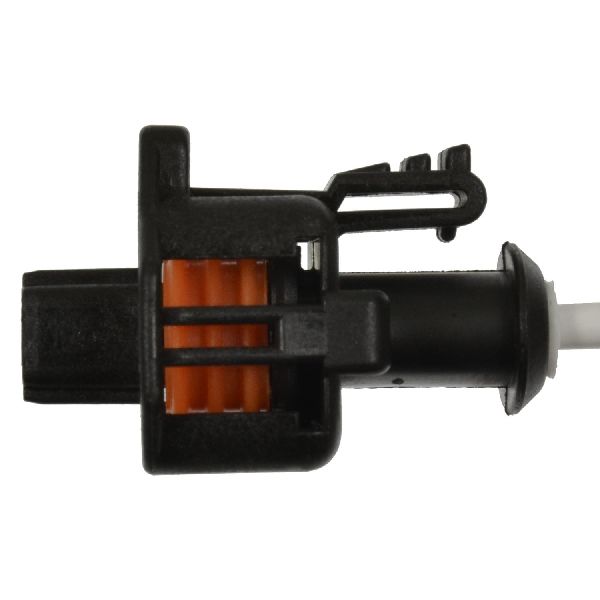
- Corroded or Loose Connector: The electrical connector at the fuel injector itself or at the main engine harness can become loose or filled with corrosion, causing a high-resistance or intermittent connection that the ECM interprets as a circuit high fault. Always check for bent pins or corrosion inside the connectors when diagnosing.
Diagnosis Steps
- Read the trouble codes with an OBD-II scanner and note any other codes present, such as P0304 or P0204.
- TSB Inspection: Carefully inspect the fuel injector wiring harness for any signs of chafing, melting, or corrosion. Per TSB PIP4924D, focus on areas where it contacts the intake plenum, valve cover bolts, and the side of the cylinder head.
- Connector Check: Disconnect the harness at the cylinder 4 injector. Inspect the connector pins for corrosion, moisture, or damage.
- Noid Light Test: A quick way to check for a signal is to use a noid light. Plug it into the injector connector and start the engine. A rhythmic flashing light indicates the ECM is trying to fire the injector. A constantly lit or unlit noid light points to a wiring or ECM issue.
- Voltage Check: With the key on, engine off, use a multimeter to verify that one pin at the connector has battery voltage (power feed). The other wire is the control wire, which the ECM grounds to activate the injector.
- Injector Resistance Test: With the injector disconnected, measure its internal resistance using a multimeter. Compare the reading to the other injectors; a significant deviation or an open/shorted reading indicates a bad injector. A typical reading is between 11-15 ohms.
- Injector Swap Test: If wiring looks good and resistance is normal, swap the cylinder 4 injector with cylinder 2. Clear the codes and run the engine. If the code changes to P0265 (Cylinder 2), the injector is bad and needs replacement.
- Wiring Continuity Test: If the code remains P0271 after the swap, the problem is in the wiring or ECM. Perform a continuity and short-circuit test on the control wire between the ECM connector and the injector connector to find any breaks or shorts to voltage/ground.
- ECM Driver Test: If the wiring is confirmed to be 100% intact, the fault likely lies with the ECM's internal injector driver circuit.
Parts You'll Likely Need
- Fuel Injector Wiring Harness (Passenger Side/Front Bank)
(OEM #12621096)— This is the most common failure point for this code on this vehicle, as documented by a manufacturer TSB. Damage often requires replacement of the harness section for the front bank of cylinders.
Trusted brands: ACDelco, GM Genuine
OEM price range: $90-$160
Aftermarket price range: $70-$120 - Fuel Injector
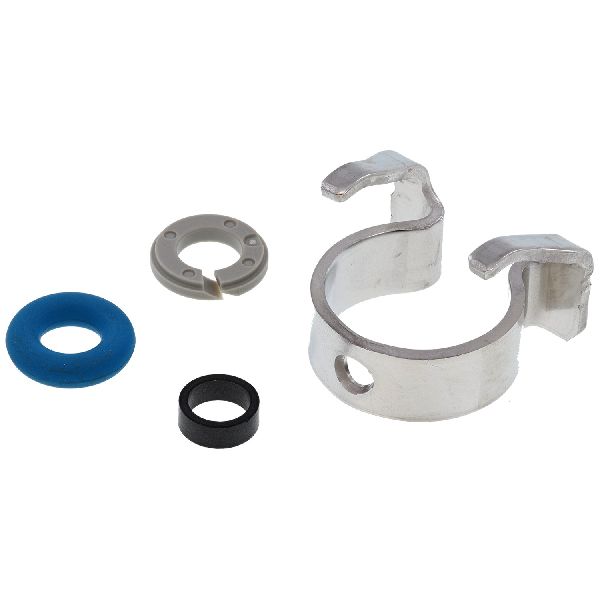
(OEM #12638530)— If the injector itself has an internal short, it will need to be replaced. This is the second most likely cause after wiring issues. This part number corresponds to the injector used in the 3.6L LLT engine.
Trusted brands: ACDelco (217-3445), Bosch, GM Genuine
OEM price range: $90-$150
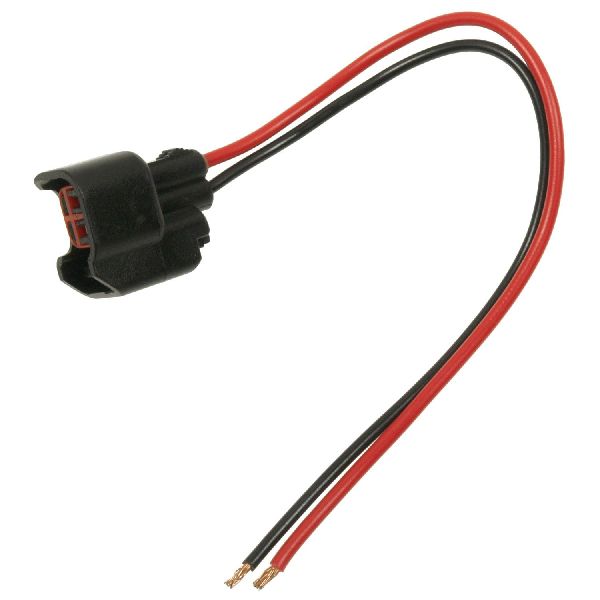
Aftermarket price range: $50-$100 - Fuel Injector Connector Pigtail — If only the connector end of the harness is damaged, splicing in a new pigtail is a cost-effective repair instead of replacing the entire harness section.
Trusted brands: Dorman, ACDelco, Standard Motor Products
OEM price range: $25-$40
Aftermarket price range: $15-$25
Related Codes That Often Appear With This One
- P0304 — P0304 means "Cylinder 4 Misfire Detected." Since a faulty injector circuit prevents proper fueling for cylinder 4, it will directly cause a misfire on that same cylinder.
- P0204 — P0204 means "Injector Circuit/Open - Cylinder 4." This is a related injector circuit code. Depending on the exact nature of the wiring failure (a short to voltage, a short to ground, or a complete break), P0271, P0270, or P0204 could be set.
- P0174 — P0174 indicates "System Too Lean (Bank 2)." Cylinder 4 is on Bank 2 (the front bank). A non-functioning injector will cause that entire bank to run lean, as the oxygen sensor detects excess oxygen from the misfiring cylinder.
Technical Service Bulletins (TSBs) & Recalls
- PIP4924D: Mentions that various fuel injector codes (P0270, P0271, etc.) can be caused by a chafed wiring harness and instructs technicians to inspect it at common rub points like the intake plenum, valve cover bolts, and fuel lines.
Platform-Specific Known Issues
- A known issue documented in TSB #PIP4924D involves the fuel injector wiring harness chafing against engine components, leading to various injector circuit codes, including P0271.
- Forum users on acadiaforum.net frequently report this issue, with many finding the harness chafed near the rear of the cylinder head or against the EVAP purge solenoid bracket.
Mechanic-Grade Diagnostic Values
- Fuel Injector Coil Resistance (2009-2011 LLT Engine) — expected: 11 - 14 ohms. Failure: A reading significantly outside this range, OL (open), or near 0 (short) indicates a failed injector. Measurement is most accurate when engine coolant temp is 50-90°F (10-32°C).
- Fuel Injector Coil Resistance (2012-2014 LFX Engine) — expected: 1.5 - 2.5 ohms. Failure: A reading outside this range indicates a failed injector. This lower resistance is specific to the LFX direct injection engine.
- Injector Control Voltage (Boost Phase) — expected: ~65 Volts (brief peak). Failure: This is a very brief, high-voltage pulse from an internal ECM capacitor used to open the direct injector. Absence of this peak, viewable on an oscilloscope, can point to an ECM driver issue.
- Injector Control Circuit Voltage (Key On, Engine Off) — expected: ~0.15 Volts on a good cylinder's control wire. Failure: A significantly higher voltage, such as 0.65V or more, on the suspect cylinder's control wire can indicate a short to voltage within the ECM driver circuit.
- Injector Pulse Width (at idle) — expected: ~2.5 milliseconds. Failure: While not a direct test for a circuit high code, comparing the commanded pulse width on a scan tool between cylinders can reveal if the ECM is attempting to compensate for a fault.
Hidden / Shadow Codes Worth Checking
- Mode $06 Data (OBDMID $35): While not a hidden code, Mode $06 provides access to non-continuous monitor test results. For misfires, you can view the raw misfire counters for each cylinder (e.g., TIDs $9A, $9B) before they are high enough to set a P030x code. This can be used to confirm that cylinder 4 is the source of the misfire counts. (see via A professional scan tool with Mode $06 capability is required.)
Scan Tool Commands That Help
- GM GDS2 / Tech2: Injector Balance Test — This function is used to identify a mechanically or electrically failing injector. The tool commands the high-pressure fuel pump to build pressure, then fires a single injector and measures the pressure drop. An inconsistent drop on cylinder 4 compared to others indicates a problem with that injector.
- GM GDS2 / Tech2: Injector Circuit Status — When viewing live data, this parameter should display 'OK' for all cylinders. If it shows a fault for cylinder 4, it confirms the ECM is detecting an electrical issue on that circuit.
- GM GDS2 / Tech2: Crankshaft Position System Variation Learn — This procedure is required after the ECM has been replaced or reprogrammed to allow the new module to learn the variations in the crankshaft position sensor reluctor wheel, ensuring accurate misfire detection.
Wiring & Ground Locations
- G103 / G104 — These are primary engine grounds, typically located on the cylinder heads (e.g., G104 on the rear of the left cylinder head).. A loose or corroded engine ground can create a floating ground reference for the ECM and its sensors, potentially causing incorrect voltage readings and false circuit codes.
- ECM (Engine Control Module) — Located in the engine compartment, at the front of the engine, left side.. This is the source of the control signal for the fuel injector. The control wire for the cylinder 4 injector runs from a specific pin on the ECM connector to the injector.
- X160 / X161 Connectors — These are main engine harness connectors, often located near the rear of the intake manifold.. These connectors are intermediate points for the injector wiring. Corrosion or a loose pin in these connectors can cause the same symptoms as a damaged harness or faulty injector.
- Cylinder 4 Injector Wires — Runs from the ECM, through the engine harness, to the fuel injector on the front bank (Bank 2), middle cylinder.. One wire is the power feed (typically pink), and the other is the control wire that the ECM pulses to ground. A 'Circuit High' code is often caused by this control wire shorting to a power source.
Real Owner Repair Stories
- Reddit user in r/MechanicAdvice (GMC Acadia (year not specified, but with Direct Injection)) — P0201 (Cylinder 1 Injector Circuit) and a corresponding misfire.
❌ Tried (didn't work) Checked for injector pulse with a noid light; pulse was missing on the bad cylinder., Checked wiring continuity from the injector connector to the ECM; wiring was confirmed to be good with no shorts between the two wires.
✅ What actually fixed it The user measured the voltage at the injector connector with the key on. Good cylinders read ~0.15V, while the faulty cylinder read 0.65V. This abnormal voltage with good wiring strongly indicated a failed injector driver inside the ECM, requiring ECM replacement.
OEM Part Supersession History
12638530→12669384— Standard part update/revision by the manufacturer.
Heads up: This part is for the 2009-2011 LLT engine and is not compatible with the 2012-2014 LFX engine, which uses a different injector with lower resistance.N/A→N/A— N/A
Heads up: It is highly recommended to replace all injectors on one bank, or the entire set, rather than mixing a single new injector (especially aftermarket) with old OEM ones. Differences in fuel flow and atomization can cause subtle performance issues.
Model Year Variations Within This Range
- 2009-2011 (LLT Engine): Uses fuel injector P/N 12638530 (or its successor 12669384) with a coil resistance of 11-14 ohms. These models are typically equipped with a Bosch ECM and an aluminum intake manifold.
- 2012-2014 (LFX Engine): Uses a different fuel injector with a much lower coil resistance of 1.5-2.5 ohms. These models are equipped with a Delphi ECM and a composite intake manifold. Using an LLT injector in an LFX engine (or vice-versa) will cause immediate circuit faults and potential ECM damage.
Helpful Videos

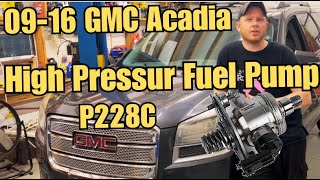
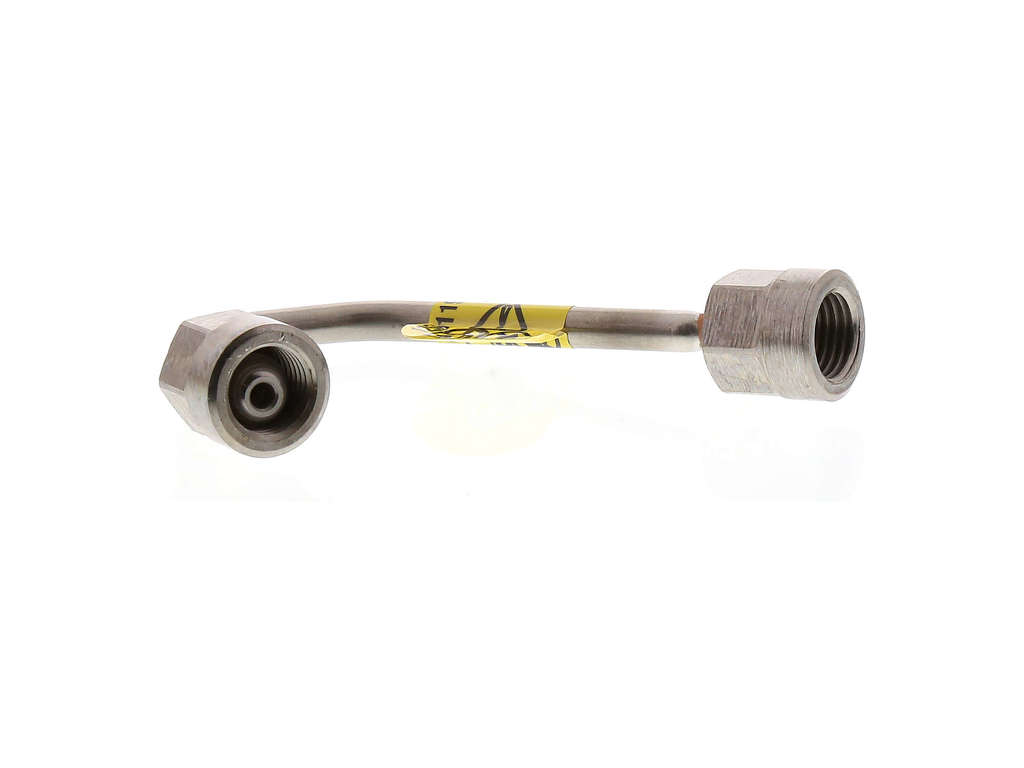
We Have This Part in Stock


The information in this article is provided for general reference and educational purposes only. Vehicle specifications, procedures, and part compatibility can vary by production date, trim level, and region. Always consult your vehicle's factory service manual and verify part numbers before purchasing or performing repairs. Safety-critical components such as airbags, seat belts, and braking systems should be installed by a qualified professional.
- Gmc ACADIA:
- 🧭 Diagnostic Flowchart
- 🎬 Helpful Videos
- 🛍️ Shop This Part
- What's Unique About the 2009-2014 Gmc ACADIA
- Symptoms You May Notice
- Most Likely Causes
- Rare But Worth Checking
- Diagnosis Steps
- Parts You'll Likely Need
- Related Codes That Often Appear With This One
- Technical Service Bulletins (TSBs) & Recalls
- Platform-Specific Known Issues
- Mechanic-Grade Diagnostic Values
- Hidden / Shadow Codes Worth Checking
- Scan Tool Commands That Help
- Wiring & Ground Locations
- Real Owner Repair Stories
- OEM Part Supersession History
- Model Year Variations Within This Range
- 🎟️ Get 5% Off