

P0299 on 2017-2020 Alfa Romeo Giulia: Turbo Underboost Causes and Fixes
On the 2.0T Giulia, P0299 is most often caused by a worn turbo wastegate actuator arm, which is a known weak point that causes a rattling noise and loss of power. Before replacing parts, check for software updates, as TSBs indicate this code can be falsely triggered after a PCM update. An upgraded, stainless steel actuator arm is a common, permanent fix that avoids a costly full turbo replacement.
- Before starting any repairs for P0299, contact an Alfa Romeo dealer to check if your vehicle needs a PCM software update, as this can be the root cause.
- The most common mechanical failure for this code is a worn wastegate actuator arm on the turbocharger. This can be diagnosed by checking for excessive play.
- Replacing the wastegate arm with an upgraded aftermarket part is a common and cost-effective DIY repair that can save thousands compared to a full turbo replacement.
- A failed diverter valve is another likely culprit that can cause a boost leak and trigger the P0299 code.
What's Unique About the 2017-2020 Alfa Romeo GIULIA

While P0299 is a generic code, the Alfa Romeo Giulia has two very distinct and common reasons for it. First, official Technical Service Bulletins (TSBs) confirm that software glitches in the engine computer can erroneously trigger this code after a software update. Second, the 2.0L GME-T4 engine is known for premature wear on the turbocharger's wastegate actuator arm. The pivot holes on the soft factory arm elongate, causing excessive play and preventing the wastegate from closing properly to build boost. This is so common that multiple aftermarket companies produce upgraded, more durable replacement arms from 316 stainless steel to permanently solve the issue, as Alfa Romeo only sells the complete turbo assembly.
Diagnostic Flowchart

Tap your situation to follow the diagnostic path that matches what you're seeing on this vehicle.
Symptoms You May Notice
- Check Engine Light illuminated.
- Significant loss of engine power and sluggish acceleration, especially under high load in Dynamic mode.
- Vehicle may enter 'limp mode', limiting RPM and speed.
- Message on dash such as 'Service Electronic Throttle Control'.
- Audible rattling noise from the engine bay, especially at idle or when letting off the throttle, caused by a loose wastegate arm.
- Hissing or whistling noises from the engine bay, indicating a boost leak from a hose or the diverter valve.
- Replacing the entire turbocharger assembly when only the inexpensive wastegate actuator arm is worn. This is the dealer-prescribed fix but is often unnecessary.
- Replacing the boost pressure (MAP) sensor. The sensor is usually just accurately reporting the low boost caused by a mechanical (leak) or software issue.
Most Likely Causes

- Worn Turbocharger Wastegate Actuator Arm 🔴 High Probability → Shop Turbocharger The original factory arm is made of a soft metal that is prone to the pivot holes wearing out and elongating, causing excessive 'play'. This prevents the wastegate from fully closing, leading to a constant boost leak and the P0299 code. This issue is widely documented by owners.
How to confirm: With the engine off and cool, locate the actuator arm on the turbocharger. Physically wiggle the arm; if there is significant side-to-side or up-and-down play at the connection points, it is worn. A rattling sound from this area when the engine is running is another strong indicator.
Typical fix: Replace the worn factory arm with an upgraded, more durable aftermarket version made from stainless steel. Alfa Romeo does not sell the arm separately and their official procedure is to replace the entire turbo assembly at a cost of thousands of dollars. The arm-only replacement is a well-known DIY fix that takes under an hour.
Est. part cost: $100-$200 - Powertrain Control Module (PCM) Software Issue 🟡 Medium Probability → Shop Engine Control Module (ECM) Manufacturer TSBs #S2018000008 and #S2018000011 specifically state that P0299 can be set incorrectly after certain PCM software updates have been performed, sometimes in conjunction with misfire codes.
How to confirm: A dealer or qualified shop with access to Alfa Romeo's service network can check the vehicle's service history and current software calibration version to see if it is affected by the TSBs.
Typical fix: Update the Powertrain Control Module (PCM) with the latest software calibration available from the manufacturer. This is typically performed by a dealership.
Est. part cost: $0-$200 - Failed Diverter Valve (Blow-Off Valve) 🟡 Medium Probability → Shop Turbocharger The factory diverter valve is a plastic component with a rubber diaphragm that can tear or degrade over time, causing a constant leak of boost pressure that the ECU detects as an underboost condition.
How to confirm: Inspect the valve for physical damage. However, the failure is often an internal diaphragm tear that is not visible without removal. A smoke test may reveal the leak. Many owners replace it as a preventative measure or when chasing a P0299 code.
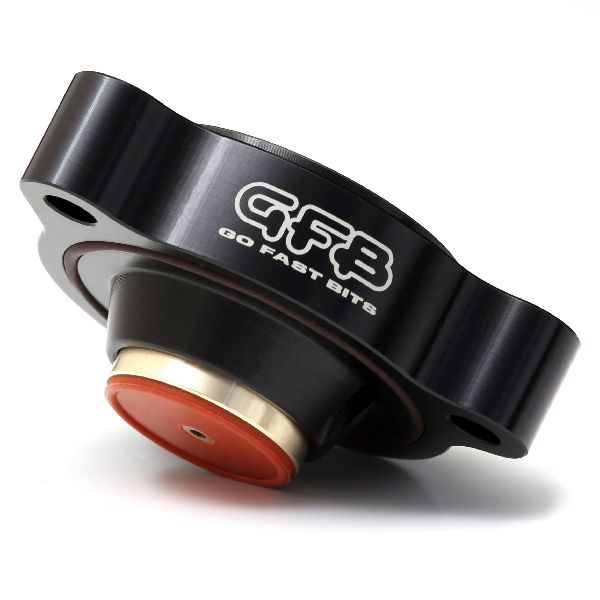
Typical fix: Replace the diverter valve assembly. A popular and robust upgrade is the Go Fast Bits (GFB) DV+ (part T9366), which replaces the failure-prone plastic valve parts with metal components for improved reliability and throttle response.
Est. part cost: $150-$250 - Boost Leak (Cracked Hoses or Loose Clamps) ⚪ Low Probability Plastic and rubber components in the intake and charge pipe system can become brittle and crack with age and heat cycles. A known weak spot is the rear PCV hose that runs under the intake manifold, which can develop cracks in its bend near the turbo.
How to confirm: Perform a smoke test on the intake and charge air system. Smoke will escape from any cracks or loose connections, pinpointing the leak. Some leaks only appear when the engine is hot and components expand.
Typical fix: Replace the cracked hose or tighten the loose clamp. The rear PCV hose was updated for 2018+ models to be more durable.
Est. part cost: $20-$300
Rare But Worth Checking
- Worn Turbocharger Wastegate Flap or Post: → Shop Turbocharger In some cases, especially if an aftermarket arm still has play, the issue is not the arm but the posts it connects to on the turbo housing and actuator rod. Additionally, the internal wastegate flap itself can wear, causing a leak that a new arm cannot fix. This requires turbocharger removal and repair or replacement.
- Complete Turbocharger Failure: → Shop Turbocharger While less common than the actuator arm, the turbocharger itself can fail due to worn bearings or damaged turbine wheels. This is usually accompanied by loud whining, grinding noises, or blue smoke from the exhaust.
Diagnosis Steps
- Check with an Alfa Romeo dealer for any open recalls or applicable TSBs, specifically #S2018000008 and #S2018000011, related to PCM software.
- Scan for any other accompanying fault codes, such as misfire (P030x) or lean (P0171) codes, which can provide clues.
- With the engine cool, perform a physical inspection of the turbo wastegate actuator arm. Check for a rattling sound and physically confirm excessive play.
- Visually inspect all accessible charge pipes and vacuum hoses between the turbo, intercooler, and intake manifold for cracks, loose connections, or damage. Pay attention to the rear PCV hose.
- If no obvious issues are found, perform a smoke test on the entire intake system to check for hidden leaks from hoses, gaskets, or the intercooler itself.
- Inspect the electronic diverter valve for damage or leaks. Consider replacing it with an upgraded unit if it's original and the vehicle has higher mileage.
- If a new actuator arm is installed and play is still present, the pivot posts on the turbo may be worn, or the issue could be internal to the turbocharger itself.
Parts You'll Likely Need
- Turbocharger Wastegate Actuator Arm — This is the most common failure point on the 2.0T engine leading to a P0299 code. The factory part is not sold separately, requiring an aftermarket solution.
Trusted brands: Centerline, Archertuned, Endurolite
OEM price range: N/A (Full Turbo Assembly is ~50057629 or 871794-0008, costing $1000+).
Aftermarket price range: $100-$200 - Diverter Valve
(OEM #4893902AB)— The diaphragm in this valve can fail, causing a boost leak. It is a common cure for P0299, and many owners upgrade it preventatively.
Trusted brands: Mopar (OE), GFB (Go Fast Bits) DV+ T9366
OEM price range: $100-$150.
Aftermarket price range: $150-$250.
Related Codes That Often Appear With This One
- P0300 — Random/Multiple Cylinder Misfire Detected. TSB #S2018000011 notes that underboost conditions can occur alongside misfire codes after a specific PCM software update.
- P0301, P0302, P0303, P0304 — Cylinder-specific misfire codes. These can be triggered for the same reason as P0300, as noted in TSB #S2018000011.
- P0171 — System Too Lean (Bank 1). This code often accompanies P0299 if the root cause is a significant vacuum or boost leak, as unmetered air is entering the system.
Technical Service Bulletins (TSBs) & Recalls

- S2018000008: Engine Surge Feel and/or Diagnostic Trouble Code P0299 ? Turbo Underboost Condition After Updating The Powertrain Control Module (PCM) Software.
- S2018000011: Issue includes a fault code(s) set in the Powertrain Control Module (PCM) for P0299, P0300, P0301, P0302, P0303, and/or P0304 after performing the PCM software update process for Customer Satisfaction Notification (CSN) W05.
Platform-Specific Known Issues
- TSB #S2018000008 notes that P0299 can appear after a PCM software update on models with ETL, ETM, or ETN engines (2.0L Turbo variants).
- TSB #S2018000011 links P0299 and misfire codes (P0300-P0304) to a PCM software update related to Customer Satisfaction Notification W05.
- A safety recall (NHTSA 18V-828) was issued for some 2017-2018 models for a coolant hose clamp potentially contacting a brake line, highlighting the tight packaging in the engine bay.
Mechanic-Grade Diagnostic Values
- Wastegate Solenoid Coil Resistance — expected: 12-18 Ohms. Failure: A reading significantly outside this range (open circuit or short) indicates a faulty solenoid coil.
- Boost Pressure Sensor (MAP) Voltage — expected: Approx. 0.5V at low boost to 4.5V at full boost (with a 5V reference). Failure: Voltage is stuck, erratic, or does not change with engine load.
- Boost Pressure Sensor (MAP) Plausibility — expected: Sensor should read approximately 1.6 PSI to 44.5 PSI (11,000 Pa to 307,000 Pa).. Failure: Readings do not correlate with actual boost measured by a mechanical gauge, or are pegged at min/max value.
Scan Tool Commands That Help
- MultiECUScan / wiTECH: Actuator Test: Wastegate Solenoid — To electronically cycle the wastegate solenoid. An audible click should be heard, confirming the solenoid's electrical circuit is functioning. This helps isolate a dead solenoid from a mechanical problem like a stuck arm.
- MultiECUScan / wiTECH: Self-adaptation parameters reset — This should be performed after replacing a component in the air/fuel system, such as a MAP sensor or diverter valve. It forces the ECU to clear its learned long-term values and relearn the operating parameters of the new part.
- wiTECH (Dealer Tool): Proxy Alignment Procedure — This is a mandatory procedure after replacing the PCM or certain other electronic modules. It synchronizes all modules on the CAN bus. Failure to perform this can result in a flashing odometer and various system faults.
- wiTECH (Dealer Tool): BCM Secret Key Transfer to ECM — This security function is required only when a new Powertrain Control Module (PCM/ECM) is installed. It authorizes the new module to work with the rest of the vehicle's security system.
Wiring & Ground Locations
- Main Engine Ground Strap — A heavy gauge flexible cable located between the transmission and the chassis, on the driver's side near the rear of the transmission.. This is a critical failure point. The original uncoated strap corrodes, causing high resistance. This can lead to the engine wiring harness overheating and melting as it seeks a ground path, causing widespread, catastrophic electrical issues that can be misdiagnosed as sensor or module failures.
- Boost Pressure Sensor Connector — Near the back of the engine bay, closer to the firewall. It is a 3-pin connector.. This sensor provides the primary reading for boost pressure. Damage to its wiring or connector can cause incorrect signals to the PCM, triggering P0299.
- Manifold Absolute Pressure (MAP) Sensor Connector — Located more towards the center of the engine, on the intake manifold itself. It is a 4-pin connector.. The PCM uses this sensor's reading to verify the boost pressure sensor's plausibility. A fault in this sensor's circuit can contribute to boost-related codes.
Real Owner Repair Stories
- YouTube user 'alfatechlxv' (2017 Alfa Romeo Giulia, 150,000 km) — P0299 error code, loss of power, 'Service electronic throttle control' message.
❌ Tried (didn't work) Initial diagnosis often points to the wastegate actuator arm, but that was not the root cause here.
✅ What actually fixed it The internal wastegate flap itself was worn, causing excessive play even with a good actuator arm. The fix required removing the turbocharger, grinding off the old flap link, and welding a new flap assembly onto the housing. - Reddit user experience summary (2017-2020 Giulia/Stelvio 2.0T) — P0299 code returned shortly after replacing the common wastegate actuator arm.
❌ Tried (didn't work) Replacing the wastegate actuator arm with a new aftermarket part.
✅ What actually fixed it The pivot post on the turbocharger housing, which the actuator arm connects to, was worn down. This caused excessive play even with a new arm. The ultimate fix required either repairing the post (welding) or replacing the entire turbocharger assembly. - Reddit user on r/AlfaRomeo (2018 Alfa Romeo Stelvio TI Sport (same 2.0L platform)) — Car would not start, acted like a dead battery. After a few start attempts, white smoke came from the driver's side wheel well.
❌ Tried (didn't work) Initially misdiagnosed as a battery or starting system issue.
✅ What actually fixed it The main engine ground strap between the transmission and chassis had corroded. This forced the starting current through a smaller ground wire in the wheel well, which melted the main engine wiring harness. The fix required replacing the entire engine wiring harness and installing the updated, coated ground strap.
"I Checked Everything" — The Actual Cause
- In cases where a smoke test reveals no boost leaks, the cause is often mechanical play that doesn't present as a typical leak. The most common examples are a worn internal wastegate flap or a worn pivot post on the turbo housing. Neither of these issues would be found with a smoke test, but can be confirmed by physically checking for excessive 'wiggle' at the wastegate assembly with the heat shield removed.
When the Usual Fixes Don't Work
- While upgrading the diverter valve to an aftermarket unit like the GFB DV+ is a very common recommendation for P0299, it is not a guaranteed fix and can, in rare cases, be the cause. A case study on a Ford vehicle showed that an aftermarket DV+ was leaking under specific load conditions, and the P0299 code was only resolved by reinstalling a new OEM diverter valve. This suggests that unless the OEM valve is confirmed to have failed (e.g., torn diaphragm), replacing it with an aftermarket part may introduce a new variable.
OEM Part Supersession History
Unknown (uncoated braided steel)→68648999AA— The original main engine ground strap was uncoated and prone to severe corrosion, leading to high resistance and potential for catastrophic wiring harness failure. The new part is coated for corrosion protection.
Model Year Variations Within This Range
- 2017: Early 2017 models may be more susceptible to software-related issues that require a PCM replacement when a new turbocharger assembly is installed, as documented in TSBs for related fault codes like P0244.
Helpful Videos
We Have This Part in Stock

The information in this article is provided for general reference and educational purposes only. Vehicle specifications, procedures, and part compatibility can vary by production date, trim level, and region. Always consult your vehicle's factory service manual and verify part numbers before purchasing or performing repairs. Safety-critical components such as airbags, seat belts, and braking systems should be installed by a qualified professional.
- Alfa Romeo GIULIA:
- 🧭 Diagnostic Flowchart
- 🎬 Helpful Videos
- 🛍️ Shop This Part
- What's Unique About the 2017-2020 Alfa Romeo GIULIA
- Symptoms You May Notice
- Most Likely Causes
- Rare But Worth Checking
- Diagnosis Steps
- Parts You'll Likely Need
- Related Codes That Often Appear With This One
- Technical Service Bulletins (TSBs) & Recalls
- Platform-Specific Known Issues
- Mechanic-Grade Diagnostic Values
- Scan Tool Commands That Help
- Wiring & Ground Locations
- Real Owner Repair Stories
- "I Checked Everything" — The Actual Cause
- When the Usual Fixes Don't Work
- OEM Part Supersession History
- Model Year Variations Within This Range
- 🎟️ Get 5% Off