

P0299 on 2009-2013 Audi A5 Cabriolet: Underboost Causes and Fixes
On the 2.0T TFSI engine in your Audi A5, code P0299 is most often caused by a failed diverter valve (Rev 'D', Part #06H145710D) or a worn turbocharger wastegate. Replacing the diverter valve is a common DIY fix for around $50-$150. A wastegate issue can sometimes be fixed with a simple clip (Part #06J145220A) but may require turbo replacement if wear is severe.
- P0299 on your A5 almost always points to a loss of boost pressure, not a sensor failure.
- Before considering an expensive turbo replacement, thoroughly inspect the diverter valve for tears; this is a very common and inexpensive fix.
- Check for excessive play or rattling at the turbo's wastegate actuator rod, as this is another known failure point cited by Audi.
- A failed PCV valve can also trigger this code and is often indicated by a loud squealing noise from the engine.
- If you have the original diaphragm-style diverter valve, upgrading to the revised piston-style part is recommended for reliability.
What's Unique About the 2009-2013 Audi A5 CABRIOLET
The 2.0T TFSI (EA888) engine used in this generation of Audi A5 is known for a few specific failure points that lead to P0299. The original diaphragm-style diverter valve is a very common culprit, as the rubber can tear, causing a boost leak. Audi later released an updated, more durable piston-style valve (Revision D) to solve this. Additionally, as noted in official Technical Service Bulletins like TSB 2031245/5, the wastegate actuator and flap on the IHI K03 turbocharger can wear out, causing a rattle and allowing boost to escape, triggering this code.
Diagnostic Flowchart
Tap your situation to follow the diagnostic path that matches what you're seeing on this vehicle.
Symptoms You May Notice
- Noticeable loss of engine power and acceleration.
- Check Engine Light is on.
- Engine may feel sluggish or enter a reduced-power "limp mode".
- Hissing or whistling sounds from the engine bay, especially under acceleration, can indicate a boost leak.
- A metallic rattling noise from the turbo area, especially when letting off the throttle or coasting between 1800-3000 RPM, is a strong indicator of a loose wastegate.
- Replacing the entire turbocharger when the actual fault is a simple, inexpensive diverter valve or a boost leak.
- Replacing the boost pressure sensor when it is correctly detecting a loss of pressure from a mechanical fault.
- Assuming a turbo replacement is needed when only the wastegate actuator clip is required to fix the issue.
Most Likely Causes
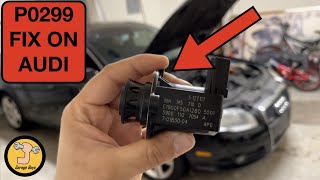
- Failed Diverter Valve (DV) 🔴 High Probability → Shop Turbocharger The original factory DV (Revision 'C' or earlier) uses a rubber diaphragm that is notorious for tearing, creating a significant boost leak. Audi released an updated piston-style valve (Revision 'D', Part #06H145710D) that is far more durable and is the standard replacement.
How to confirm: Remove the diverter valve from the turbocharger (located underneath the engine, held by three T30 bolts) and visually inspect the rubber diaphragm for rips or tears. A failed valve may fall apart upon removal.
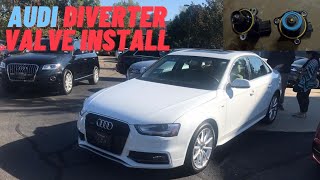
Typical fix: Replace the old diaphragm-style valve with the updated OEM piston-style valve (06H145710D) or a quality aftermarket equivalent like the GFB DV+. This is a very common DIY repair. 🎬 Watch: Step-by-step guide to installing the updated diverter valve.
Est. part cost: $50-$150 - Worn Turbocharger Wastegate Flap/Actuator 🔴 High Probability → Shop Turbocharger As cited in TSB 2031245/5, the wastegate actuation mechanism on the IHI turbo can develop excessive wear. This causes play at the wastegate flap, allowing boost pressure to escape. A rattling noise is the key symptom.
How to confirm: With the engine cool, physically check the wastegate actuator rod for excessive looseness or play. If you can wiggle it easily by hand, it's worn. A boroscope can be used to inspect the internal flap for a proper seal after removing the catalytic converter.
Typical fix: For minor rattle and play, an inexpensive OEM repair clip (Part #06J145220A or 06J145220B) can be installed to add tension and fix the issue. If wear is on the internal flap bushing, the turbo must be replaced as the housing is not considered serviceable by Audi.
Est. part cost: $15-$30 (clip), $800-$2000 (new turbocharger) - PCV Valve Failure 🟡 Medium Probability → Shop PCV Valve The Positive Crankcase Ventilation (PCV) valve, or oil separator, is a known failure point on the EA888 engine. It can fail and cause incorrect pressure within the crankcase, which can affect the turbo system and lead to various pressure-related codes, including P0299.
How to confirm: A common sign is a loud squealing or howling noise from the engine at idle. Another test is to try removing the oil cap while the engine is running; if the cap is held on by extreme suction, the PCV has failed. A hissing sound from the PCV area can also indicate a leak.
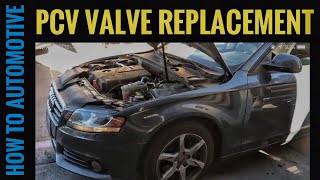
Typical fix: Replace the PCV valve assembly. It is located on top of the valve cover and is relatively accessible. The latest revision of the part should be used. 🎬 Watch: How to replace the PCV valve on your 2.0T.
Est. part cost: $40-$150 - Boost/Vacuum Leak 🟡 Medium Probability Over time, rubber and plastic hoses in the intake and vacuum systems can become brittle and crack, causing air leaks. This is especially common in the charge pipes or intercooler connections.
How to confirm: Visually inspect all hoses connected to the intake manifold, turbocharger, and intercooler. A smoke test is the most effective way to find small, hard-to-see leaks.
Typical fix: Replace the cracked or disconnected hose(s).
Est. part cost: $20-$200 depending on the specific hose - Failed N75 Valve (Wastegate Solenoid) ⚪ Low Probability This electronic solenoid controls the vacuum sent to the wastegate actuator. If it fails, it can't properly command the wastegate to open or close, leading to underboost or overboost.
How to confirm: Testing involves checking for proper electrical signal and ensuring the valve holds vacuum when commanded by a scan tool. It can be tested with a vacuum pump. The electrical resistance across the two pins should be between 25-35 ohms when cold.
Typical fix: Replace the N75 valve.
Est. part cost: $40-$100
Rare But Worth Checking
- Clogged Catalytic Converter: → Shop Catalytic Converter A restriction in the exhaust system can prevent the turbo from spooling up effectively. This may be accompanied by other exhaust-related codes and a noticeable lack of top-end power.
- Failed Boost Pressure Sensor (MAP Sensor): It is possible for the sensor itself to fail, but it's more common for it to be accurately reporting a mechanical problem. Owners often replace this first without success. It should not be replaced without first ruling out physical leaks or component failures.
Diagnosis Steps
- Read the fault codes with an OBD-II scanner (like VCDS/VAG-COM for VW/Audi) to confirm P0299 and check for any other related codes.
- Log requested vs. actual boost pressure while driving (Measuring Block 115 in VCDS). A large, consistent discrepancy confirms the underboost condition.
- Perform a visual inspection of the engine bay. Look for any disconnected, cracked, or collapsed hoses in the intake and vacuum system.
- Inspect the diverter valve. This is the most common failure. Remove the three T30 bolts holding it to the turbo and check for a torn rubber diaphragm. The part is located on the bottom of the turbo.
- Inspect the turbocharger wastegate actuator rod. With the engine cool, reach down and try to wiggle the rod connected to the wastegate arm. If there is significant play or a rattle, the wastegate is loose.
- Check for a failed PCV valve. Listen for a high-pitched squealing noise at idle or check for strong vacuum at the oil cap with the engine running.
- If leaks are suspected but not visible, perform a smoke test on the entire intake and boost pipe system to pinpoint the source of the leak.
- For a definitive wastegate inspection, remove the catalytic converter to gain visual access to the wastegate flap inside the turbo housing. Check for a loose seal or cracks.
Parts You'll Likely Need
- Turbocharger Diverter Valve (Piston-Style Update)
(OEM #06H145710D)— The original diaphragm version is a very common failure point. The updated 'Revision D' piston-style valve is a permanent fix for this specific issue.
Trusted brands: Pierburg (OEM), Bosch, Genuine VW/Audi
OEM price range: $120-$160
Aftermarket price range: $50-$100 - Turbocharger Wastegate Actuator Rod Clip
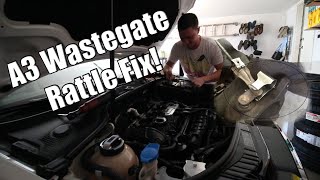
(OEM #06J145220A)— This inexpensive OEM clip was designed by VW/Audi specifically to fix the common wastegate rattle and subsequent boost loss that triggers P0299. It adds tension to the actuator rod. 🎬 See how to install the wastegate rattle clip yourself.
Trusted brands: Genuine VW/Audi
OEM price range: $15-$30
Aftermarket price range: $10-$30 - PCV Valve / Oil Separator
(OEM #06H103495AK (or latest revision))— A common failure item on the 2.0T engine that can cause a variety of pressure-related fault codes, including P0299.
Trusted brands: Genuine VW/Audi, Vaico, Febi
OEM price range: $130-$160
Aftermarket price range: $40-$80 - Turbocharger Assembly
(OEM #06H145702L (or equivalent))— This is the most expensive fix, required when the internal wastegate flap or its pivot bushing is excessively worn and cannot be repaired by the clip, or if the turbo has other internal damage.
Trusted brands: IHI (OEM manufacturer), BorgWarner
OEM price range: $1200-$2000
Aftermarket price range: $600-$1000
Related Codes That Often Appear With This One
- P2279 - Intake Air System Leak
- P0033 - Turbocharger Bypass Valve Control Circuit
Technical Service Bulletins (TSBs) & Recalls
- Mil on - P0299 Negative pressure deviation, turbocharger excessive wastegate play: → Shop Turbocharger This TSB, updated June 7, 2013, applies to 2009-2012 A4, A5, and Q5 models. It identifies excessive wear and play in the turbocharger wastegate flap as a cause for P0299. The service solution involves installing a specific clip (06J 145 220 A) on the wastegate actuator rod to reduce play and prevent boost loss. It warns not to install the clip on a pre-damaged turbo.
Platform-Specific Known Issues
- TSB for Wastegate Play: A manufacturer Technical Service Bulletin (TSB 2031245/5, which supersedes 21-13-14) specifically notes that excessive
Mechanic-Grade Diagnostic Values
- N75 Valve (Wastegate Solenoid) Resistance — expected: 25-35 Ohms (when cold). Failure: A reading significantly outside this range, or a reading that climbs above 35 Ohms when the valve is heated (e.g., with hot water), indicates a failing coil.
- MAP (Boost Pressure) Sensor Voltage, Key On Engine Off (KOEO) — expected: ~5V on the reference wire, and a signal voltage that reflects atmospheric pressure.. Failure: Reference voltage not at 5V indicates a wiring or ECU issue. Signal voltage not changing with pressure indicates a bad sensor.
- MAP (Boost Pressure) Sensor Voltage, Engine Idling — expected: 1.0V to 2.0V. Failure: An immediate drop from the KOEO voltage is expected upon starting. If the voltage is stuck high or does not fluctuate when the throttle is applied, the sensor may be faulty.
- VCDS Boost Pressure Log (Requested vs. Actual) — expected: Actual boost pressure should closely track the requested boost pressure under acceleration.. Failure: If the actual boost (green line in VCDS graphs) consistently lags far behind the requested boost (red line), it confirms a mechanical underboost condition.
- N75 Valve Duty Cycle (VCDS Log) — expected: The duty cycle should modulate rapidly during boost changes.. Failure: A duty cycle that maxes out (e.g., 96.5%) while actual boost still fails to meet requested boost points towards a mechanical limit being reached (e.g., a leak or worn wastegate) rather than an electronic control issue.
Scan Tool Commands That Help
- VCDS (VAG-COM): Selective Output Test: Solenoid Valve for Boost Pressure Control (N75) — In the [01-Engine] module, use this test to manually cycle the N75 valve. You should hear an audible clicking from the valve, which helps confirm the solenoid is mechanically actuating and can be commanded by the ECU. This helps differentiate a bad valve from a wiring problem.
- VCDS (VAG-COM): Data Logging: Measuring Blocks (e.g., Group 115) — Log 'Engine Speed', 'Boost Pressure (Specified)', and 'Boost Pressure (Actual)' during a drive, especially during a 3rd gear pull from low RPM to redline. This is the definitive way to visualize the gap between requested and actual boost, confirming the P0299 condition.
Real Owner Repair Stories
- HumbleMechanic YouTube Commenter (VW MK6 GTI (with similar 2.0T TSI engine)) — P0299 code and lack of performance.
❌ Tried (didn't work) Checked for boost leaks., Checked wastegate rod., Replaced the entire turbocharger with a new one.
✅ What actually fixed it The P0299 code persisted after a new turbo install. Using a borescope through the O2 sensor port, the owner discovered the catalytic converter was clogged and looked like a 'solid black chunk'. Replacing the downpipe (which contains the primary catalytic converter) finally resolved the P0299 code. - Reddit user BitterHousing25 (2012 Audi A4 2.0T, 108k miles) — P0299 code appeared, no major performance loss but 'something sounds off'.
❌ Tried (didn't work) Replaced the pressure sensor.
✅ What actually fixed it The final fix was not explicitly stated by the original poster, but the thread consensus and follow-up comments strongly pointed to a loose turbo wastegate, with another user on a 2011 A5 2.0T reporting the same code and a noise when letting off the throttle. The recommended fix was either adjusting the wastegate rod or installing the anti-rattle clip. - YouTube user Bluudy's Garage (VW Transporter with similar TDI engine and vacuum control system.) — P0299 underboost code, vehicle entering limp mode.
❌ Tried (didn't work) A cheap, non-OEM N75 valve had been previously installed and failed.
✅ What actually fixed it After confirming good vacuum from the pump and that the turbo actuator diaphragm held vacuum, the N75 valve was identified as the culprit. Replacing a cheap aftermarket N75 valve with a quality OEM (Pierburg) part for £43 restored proper turbo function and fixed the underboost code.
"I Checked Everything" — The Actual Cause
- A common scenario for P0299 is a smoke test that reveals no leaks in the charge pipes, yet the underboost condition persists. The actual cause is often a component not fully tested by a standard intake smoke test, such as a torn diaphragm in the PCV valve (which acts as an internal vacuum leak) or a worn wastegate flap on the turbo's exhaust housing, which leaks exhaust pressure before it can spin the turbine.
OEM Part Supersession History
06J145220A→06J145220B— The clip was updated by VW/Audi to better address the wastegate rattle and associated boost loss. Both are designed to add tension to the wastegate actuator rod.
Heads up: The 'B' revision is the latest version, but the 'A' revision is also effective. It is critical to use a genuine OEM part, as cheap aftermarket copies are known to be ineffective. The TSB warns not to install the clip on a turbo that is already damaged or has excessive wear, as it is a preventative/minor repair part, not a fix for a failed turbo.
Model Year Variations Within This Range
- 2009-2012: Vehicles in this range with the CAEB engine code are specifically called out in TPI 2031245 for issues related to excessive turbocharger wastegate play, which is a primary cause of P0299.
- 2013 (B8.5 Facelift): The 2013 model year marked the 'B8.5' facelift for the A5. While it still uses the 2.0T EA888 engine, some ancillary parts and software calibrations may differ slightly from the earlier B8 models. However, the primary causes for P0299 (Diverter Valve, Wastegate, PCV) remain consistent across the 2009-2013 range for this engine.
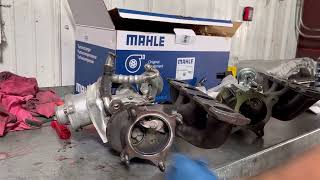
Helpful Videos


The information in this article is provided for general reference and educational purposes only. Vehicle specifications, procedures, and part compatibility can vary by production date, trim level, and region. Always consult your vehicle's factory service manual and verify part numbers before purchasing or performing repairs. Safety-critical components such as airbags, seat belts, and braking systems should be installed by a qualified professional.
- Audi A5 CABRIOLET:
- 🧭 Diagnostic Flowchart
- 🎬 Helpful Videos
- What's Unique About the 2009-2013 Audi A5 CABRIOLET
- Symptoms You May Notice
- Most Likely Causes
- Rare But Worth Checking
- Diagnosis Steps
- Parts You'll Likely Need
- Related Codes That Often Appear With This One
- Technical Service Bulletins (TSBs) & Recalls
- Platform-Specific Known Issues
- Mechanic-Grade Diagnostic Values
- Scan Tool Commands That Help
- Real Owner Repair Stories
- "I Checked Everything" — The Actual Cause
- OEM Part Supersession History
- Model Year Variations Within This Range
- 🎟️ Get 5% Off