

P0299 on 2019-2021 Audi A8 4.0T: Turbo Underboost Causes and Fixes
On the 2019-2021 Audi A8 with the 4.0L V8 TFSI (EA825) engine, code P0299 is most often caused by a boost leak, a faulty diverter valve, or a specific and well-documented issue where the switchable coolant pump fails and contaminates the turbocharger's vacuum control system with coolant. This contamination is a primary suspect if P0299 appears alongside engine overheating warnings. Check for a 'Drive system: warning!' message and a significant loss of power.
- P0299 on a 2019-2021 Audi A8 4.0T means the turbochargers are not making enough pressure.
- Common causes are boost leaks from hoses or a bad diverter valve.
- A critical, vehicle-specific cause is coolant leaking into the turbo's vacuum control lines from a faulty coolant pump circuit.
- Do not immediately assume the turbochargers have failed; a thorough diagnosis of the boost and vacuum systems is required.
- Due to the complexity and specific known issues, professional diagnosis is highly recommended.
What's Unique About the 2019-2021 Audi A8

For the Audi A8 (D5) with the 4.0L V8 TFSI (EA825) engine, P0299 can be more complex than a simple boost leak. A widely known issue, detailed in Audi Technical Service Bulletin 2074303/6, involves the switchable mechanical coolant pump and its control valve (N649). A failure in this system can leak coolant directly into the vacuum lines that control the turbocharger's wastegates. This contamination damages the vacuum actuators, causing them to malfunction and trigger an underboost code, sometimes accompanied by overheating. Additionally, the broader 4.0T engine family has a well-documented history of a small oil strainer getting clogged, which can starve the turbos of oil and lead to their failure—a catastrophic cause of underboost.
Diagnostic Flowchart

Tap your situation to follow the diagnostic path that matches what you're seeing on this vehicle.
Symptoms You May Notice
- Significant loss of engine power and sluggish acceleration.
- Check Engine Light or Exhaust Emissions Warning Lamp is on.
- A 'Drive system: warning! Limited performance' message may appear in the instrument cluster.
- Hissing or whistling sounds from the engine bay during acceleration, indicating a boost leak.
- Engine overheating warnings or temperature gauge in the red, if the cause is coolant system related.
- Irregular boost delivery (e.g., 5 PSI then suddenly 20 PSI) as vacuum actuators struggle with contamination.
- Replacing the turbocharger without first performing a thorough boost leak test and checking the vacuum system for coolant. A simple cracked hose or contaminated valve is a much more common and cheaper fix than a new turbo.
- Replacing boost pressure sensors without verifying their readings with a mechanical gauge. The sensor is often reporting a real problem, not failing itself.
- Only replacing one component of the vacuum system after coolant contamination. If coolant is found, the pump, N649 valve, vacuum reservoir, and all affected lines and actuators must be replaced to prevent a repeat failure.
Most Likely Causes

- Coolant Contamination of Vacuum System via N649 Valve/Coolant Pump 🔴 High Probability A specific, well-documented issue noted in TSB 2074303/6 for the EA825 engine involves a faulty coolant pump or its electric changeover valve (N649). The valve or pump fails, allowing coolant into the vacuum system. This coolant then travels through the lines, contaminating and damaging the vacuum-operated components that control the turbochargers' wastegates, leading to P0299. This is a widely discussed problem in owner forums.
How to confirm: A technician must inspect the vacuum hoses connected to the turbo actuators and the N649 valve for any traces of pink/red coolant. TSB 2074303/6 provides a detailed diagnostic procedure. Often, P0299 will be logged alongside overheating symptoms.
Typical fix: Replace the faulty coolant pump and/or changeover valve (N649), and replace all contaminated vacuum lines, the vacuum reservoir, and any damaged vacuum actuators (V465, V546). This is a labor-intensive job with repair quotes often exceeding several thousand dollars.
Est. part cost: $400-$1200 - Leaking Turbocharger Diverter Valve 🟡 Medium Probability → Shop Turbocharger The diverter valve (also called a blow-off or bypass valve) releases boost pressure. The factory diaphragm-style valves are a common failure point on many VAG vehicles, leading to pressure leaks. The diaphragm can tear, causing a loss of boost.
How to confirm: Inspect the valve for physical damage or a torn diaphragm. A technician can also apply vacuum to the valve to see if it holds pressure. A smoke test on the charge pipe system may also reveal a leak at the valve.
Typical fix: Replace the faulty diverter valve. Many owners opt for upgraded piston-style valves for better durability. The OEM part is often a Pierburg or Bosch unit.
Est. part cost: $80-$200 - Boost Leak in Hoses or Intercooler 🟡 Medium Probability → Shop Intercooler The charge air system uses multiple hoses and clamps that can loosen, crack, or split over time due to heat and pressure cycles.
How to confirm: A visual inspection may reveal an obvious split hose or loose clamp. The most effective method is a 'smoke test,' where a machine fills the intake and charge pipes with pressurized smoke to reveal the source of any leaks.
Typical fix: Tighten the loose clamp or replace the damaged hose or intercooler.
Est. part cost: $50-$800 - Failed Wastegate Actuator or Linkage ⚪ Low Probability → Shop Turbocharger The vacuum-operated actuators that control the turbo wastegates can fail due to internal diaphragm rupture or, more commonly on this platform, due to coolant contamination. The linkage can also become stuck or loose. If the wastegate is stuck open, the turbo cannot build sufficient boost.
How to confirm: A diagnostic scan tool can be used to command the actuator to move while visually inspecting its operation. A vacuum pump can be used to test if the actuator holds vacuum. The linkage should move freely without binding.
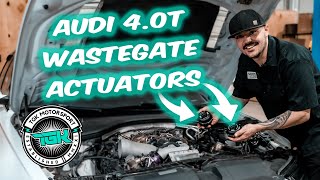
Typical fix: Replace the faulty wastegate actuator. In some cases, aftermarket upgraded actuators are available. 🎬 Watch: Step-by-step instructions for installing new wastegate actuators. If the cause is coolant contamination, the entire vacuum system must be addressed.
Est. part cost: $250-$600
Rare But Worth Checking
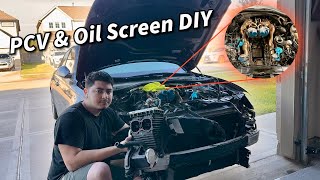
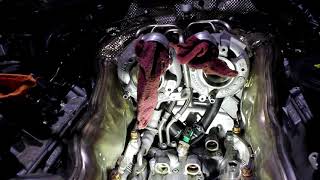
- Clogged Turbocharger Oil Strainer: → Shop Engine Oil Pump This is a critical failure point for the 4.0T engine family. A small mesh screen in the engine valley clogs with oil/carbon deposits, starving the turbos of oil and causing complete failure. While a recall (21H7) existed for earlier C7/D4 generation models (2013-2017), the design principle remains a known weakness. 🎬 Watch: A DIY guide to the 4.0T oil screen service. P0299 is a direct symptom as the turbos begin to fail from oil starvation. The repair is extremely labor-intensive and requires replacing the turbos, oil lines, and the strainer itself, often with an updated part or an aftermarket relocation kit. 🎬 See how to install a serviceable oil screen and line kit.
- Failed Turbocharger: → Shop Turbocharger While often misdiagnosed, the turbocharger itself can fail mechanically, usually as a result of the oil starvation mentioned above. Symptoms include loud whining or grinding noises, excessive blue or gray smoke from the exhaust, and a sudden, major loss of power.
Diagnosis Steps
- Read all stored fault codes in the ECM to check for any other related issues, particularly any cooling system codes.
- Perform a visual inspection of the entire air intake and charge air system, looking for disconnected hoses, loose clamps, or obvious cracks.
- Using a diagnostic tool, monitor the requested boost pressure versus the actual boost pressure while driving to confirm the underboost condition.
- Crucially, inspect the vacuum system for coolant contamination per TSB 2074303/6. Check the vacuum line running from the N649 valve to the mechanical coolant pump and to the turbo actuators for any pink/red G12/G13 coolant residue.
- If coolant is found, the source (likely the coolant pump or N649 valve) must be identified and all contaminated components replaced.
- If no coolant is found, perform a smoke test on the charge air system to accurately locate any leaks in hoses, gaskets, or the intercooler.
- Inspect the turbocharger diverter valve(s) for damage or leaks.
- Test the function of the wastegate actuators using a scan tool and vacuum pump to ensure they move freely and hold vacuum.
- If no leaks are found and actuators function, inspect the turbocharger for shaft play or signs of oil starvation, which could point to a clogged oil strainer.
Parts You'll Likely Need
- Coolant Changeover Valve
(OEM #N649)— A known issue on this engine where this valve fails and allows coolant to enter the turbo's vacuum control system, causing P0299. It is often replaced alongside the coolant pump.
Trusted brands: Genuine Audi
OEM price range: $100-$200 - Switchable Mechanical Coolant Pump — The primary source of coolant leaks into the vacuum system on the EA825 engine, leading to P0299. It is often replaced as a preventative measure or when the N649 valve is found to be contaminated.
Trusted brands: Genuine Audi
OEM price range: $300-$600
Aftermarket price range: $200-$400 - Turbocharger Diverter Valve
(OEM #06M145710G)— A common failure point on VAG engines. The diaphragm tears, causing a direct loss of boost pressure. It's a relatively inexpensive and easy part to replace as a first step.
Trusted brands: Genuine Audi/VW, Pierburg
OEM price range: $80-$150
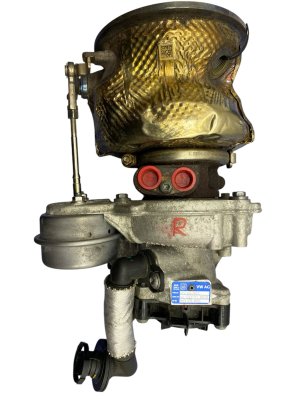
Aftermarket price range: $60-$120 - Turbocharger Wastegate Actuator — Can fail due to a ruptured internal diaphragm or from coolant contamination from the N649/water pump issue. This prevents the wastegate from closing properly to build boost.
Trusted brands: Genuine Audi, MaXpeedingRods
OEM price range: $250-$400
Aftermarket price range: $100-$200
Related Codes That Often Appear With This One
- P2181 — This code for 'Cooling System Performance' can appear alongside P0299 if the root cause is the coolant pump/N649 valve failure, which affects both systems.
- P2262 — This code indicates a mechanical turbocharger problem and can appear with P0299 if the issue is related to a stuck wastegate or internal turbo damage.
Technical Service Bulletins (TSBs) & Recalls

- TSB 2074303/6: Details the diagnosis and repair for engine overheating and/or P0299 caused by coolant contamination of the turbo vacuum control system from a faulty N649 valve or coolant pump.
- TSB 2065040/2: Instructs technicians to inspect the vacuum control line and switch valve (N649) for coolant contamination whenever the mechanical coolant pump is replaced for a leak.
- Recall 21H7 (NHTSA 21V198000): Addresses the clogged turbo oil strainer issue on the previous generation (2013-2017) 4.0T engines, highlighting a known design weakness that can lead to turbo failure and P0299.
- TSB_2079209_2: Confirms P0299 is associated with the exhaust emissions warning lamp.
Platform-Specific Known Issues
- A Technical Service Bulletin (TSB #2074303/6) explicitly states that P0299 can be caused by a faulty switchable mechanical coolant pump system, leading to coolant contaminating the vacuum lines that control the turbochargers. This is the most unique and critical issue for this platform.
- The 4.0T engine family is known for a critical issue where a small oil strainer becomes clogged, starving the turbochargers of oil and causing them to fail, which results in a P0299 code.
Mechanic-Grade Diagnostic Values
- Wastegate Lever Clearance — expected: Approximately 3mm. Failure: If there is no gap, it indicates excessive wear on the wastegate flap or linkage inside the turbo, often requiring turbo replacement.
- Live Data: Specified vs. Actual Boost Pressure — expected: Actual value should closely track the specified value during acceleration.. Failure: If the actual pressure is significantly lower than the specified pressure for more than a few seconds (e.g., >2 PSI for 6 seconds), it confirms an underboost condition.
Hidden / Shadow Codes Worth Checking
- P029900: This is the VAG-specific format of the P0299 code that will appear in diagnostic tools like VCDS or ODIS. (see via VCDS, ODIS, or other advanced VAG-specific scan tools.)
Scan Tool Commands That Help
- VCDS / ODIS: Advanced Measuring Values / Live Data — Log 'Charge air pressure: specified value' vs. 'Charge air pressure: actual value' during a test drive to quantify the boost deviation and confirm the P0299 fault condition.
- VCDS / ODIS: Output Test (DTM) - Wastegate Bypass Regulator Valve (N75) / Turbocharger Recirculation Valve (N249) — To individually cycle the electronic valves. A technician should listen for an audible click, which confirms the solenoid is receiving a signal and is electrically functional. No click points to a wiring or component failure.
- VCDS / ODIS: Basic Settings: 'First Adaptation of charge pressure actuator' — This is a mandatory procedure after replacing a turbocharger or wastegate actuator. It allows the ECU to learn the mechanical end-stops and operating range of the new component to ensure accurate boost control.
Wiring & Ground Locations
- Main Engine Ground — A primary ground cable connects the battery negative terminal directly to the engine block. Secondary ground straps connect the engine to the chassis/firewall.. A poor engine ground can cause erratic behavior from all engine sensors and actuators, including the boost pressure sensor, wastegate actuators, and N649 valve, potentially leading to incorrect readings and fault codes.
- G12 / G13 — Main chassis ground connections in the engine compartment, typically on the left (G12) and right (G13) chassis members, forward of the front axle.. These are the primary grounding points for many electronic modules and components in the engine bay. Corrosion or looseness here can cause a wide range of difficult-to-diagnose electrical faults.
- Jump Start Terminal / Terminal 30 Distributor — Located in the engine compartment on the right-hand side, near the coolant reservoir. This post distributes positive battery voltage (Terminal 30) to various components.. While a power distribution point, not a ground, corrosion or loose connections here can affect the power supply to the ECU and related turbo control solenoids, mimicking sensor or actuator failures.
Real Owner Repair Stories
- Reddit user on r/Audi (2021 Audi A8 4.0T) — 'Drive system: warning! Limited performance' message, P0299 code triggered immediately under hard acceleration.
❌ Tried (didn't work) Dealer first replaced a boost valve (Part # 7PP-906-283-P), but the error returned immediately., Dealer then replaced the water pump and associated seals, but the error still returned.
✅ What actually fixed it The final diagnosis was that coolant had contaminated the vacuum system. The fix was to replace another blocked valve and a portion of the vacuum lines. - AudiWorld Forums user (2021 Audi Q8 (4.0T EA825 engine family)) — Check Engine Light, noticeable drop in power, higher RPMs before shifting.
❌ Tried (didn't work) N/A - Diagnosed correctly the first time.
✅ What actually fixed it The dealer diagnosed an internal water pump leak causing coolant to migrate into the vacuum system. The final repair involved replacing the water pump, solenoid valves, the vacuum pump, and the vacuum reservoir to clear the P0299 code.
"I Checked Everything" — The Actual Cause
- On the 4.0T engine, a standard low-pressure smoke test may not reveal a boost leak. A proper test requires pressurizing the charge system to 15-20 PSI with compressed air to find leaks in hoses or the intercooler that only open up under real-world boost levels.
- If all pressure and vacuum tests pass, the issue can be a mechanical failure that isn't a leak, such as a worn wastegate linkage causing the flap to not seal properly, or a failing turbo due to oil starvation from the clogged screen.
When the Usual Fixes Don't Work
- In one documented case for a 2021 A8 4.0T, the dealer first replaced a boost valve and then the water pump, neither of which solved the P0299 code. The ultimate cause was found to be coolant contamination that had migrated through the vacuum system and blocked a different valve, requiring replacement of that valve and the affected vacuum lines to finally resolve the issue. This highlights the systemic nature of the coolant contamination problem—fixing the source leak (water pump) is not enough if the contamination has already spread and damaged other components.
OEM Part Supersession History
Unknown early revisions→Revised 'G' revision oil screen— The original turbo oil screen was prone to clogging with carbon and sludge, leading to oil starvation and catastrophic turbo failure. The revised part is reportedly more resistant to clogging.
Heads up: While the part was revised for earlier 4.0T engines, the underlying design weakness remains a concern. Aftermarket oil line relocation kits are a more robust solution as they make the screen easily serviceable.
Helpful Videos
Used OEM Parts in Stock
New Aftermarket Parts Available

The information in this article is provided for general reference and educational purposes only. Vehicle specifications, procedures, and part compatibility can vary by production date, trim level, and region. Always consult your vehicle's factory service manual and verify part numbers before purchasing or performing repairs. Safety-critical components such as airbags, seat belts, and braking systems should be installed by a qualified professional.
- Audi A8:
- 🧭 Diagnostic Flowchart
- 🎬 Helpful Videos
- 🛍️ Shop This Part
- What's Unique About the 2019-2021 Audi A8
- Symptoms You May Notice
- Most Likely Causes
- Rare But Worth Checking
- Diagnosis Steps
- Parts You'll Likely Need
- Related Codes That Often Appear With This One
- Technical Service Bulletins (TSBs) & Recalls
- Platform-Specific Known Issues
- Mechanic-Grade Diagnostic Values
- Hidden / Shadow Codes Worth Checking
- Scan Tool Commands That Help
- Wiring & Ground Locations
- Real Owner Repair Stories
- "I Checked Everything" — The Actual Cause
- When the Usual Fixes Don't Work
- OEM Part Supersession History
- 🎟️ Get 5% Off