

P0299 on 2013-2020 Ford Escape: EcoBoost Underboost Causes and Fixes
On a 2013-2020 Ford Escape with an EcoBoost engine, code P0299 is most often caused by a faulty wastegate regulating valve solenoid, a cracked charge pipe, or a disconnected/faulty wastegate actuator. Expect to pay $150-$800 for repairs, which can range from a simple solenoid swap to a more involved turbocharger replacement.
- P0299 on an EcoBoost Escape means the turbo isn't making enough pressure, causing power loss.
- Before replacing the expensive turbocharger, thoroughly inspect for boost leaks from cracked or loose charge pipes.
- The wastegate actuator and its control solenoid are known weak points covered by Ford TSBs and should be checked early in the diagnosis.
- Cleaning or replacing the boost pressure (MAP) sensor is a simple, low-cost diagnostic step that can sometimes resolve the issue.
- Always check for TSBs related to your specific engine, as Ford has provided clear diagnostic paths for this code.
What's Unique About the 2013-2020 Ford ESCAPE

The Ford Escape's EcoBoost engines rely heavily on the turbocharger system for both power and efficiency. This constant use puts stress on all components. Ford has issued multiple Technical Service Bulletins (TSBs) for this exact code, pointing to specific failure points like the wastegate actuator and its control solenoid, which are known weak spots on these engines. Owner complaints frequently mention this code, sometimes leading to a full turbo replacement when a simpler component, like a cracked hose, faulty solenoid, or even a missing e-clip on the actuator rod was the actual culprit.
Diagnostic Flowchart

Tap your situation to follow the diagnostic path that matches what you're seeing on this vehicle.
Generation note: This guide covers the third generation (2013-2019) and the first year of the fourth generation (2020) Ford Escape. The P0299 code is a common issue on the 1.5L, 1.6L, and 2.0L EcoBoost engines 🎬 Watch: A step-by-step fix for the P0299 code on 1.6L engines used across these years. While the engine designs evolved, the fundamental turbocharging system and its potential failure points remain similar. TSBs have been issued that cover multiple engine types and model years within this range.
Symptoms You May Notice
- Significant loss of engine power and acceleration
- Check Engine Light is on
- Whistling, hissing, or whining noises from the engine bay, especially under acceleration
- Vehicle may enter 'limp mode' with severely restricted power
- Hissing sounds indicating a boost leak
- Metallic rattle on startup near the turbo area
- Black smoke from the exhaust in some cases
- Shuddering or surging under load
- Replacing the entire turbocharger assembly when only a less expensive component like a charge pipe, solenoid, bypass valve, or wastegate actuator has failed.
Most Likely Causes

- Faulty Turbocharger Wastegate Regulating Valve Solenoid 🔴 High Probability → Shop Turbocharger This is a well-documented failure. Ford TSB 15-0162 directly addresses P0299 on the 1.6L engine by calling for the replacement of this solenoid. It's an inexpensive part and a very common first step in diagnosis for many owners, often solving the problem. The solenoid controls the vacuum sent to the wastegate actuator, and when it fails, it can't regulate boost properly.
How to confirm: The solenoid can be tested for electrical integrity. The resistance should be approximately 12.4 Ω ±0.5Ω at room temperature for the 1.6L engine's solenoid. A DIY-friendly approach is to replace it as a primary diagnostic step due to its high failure rate and low cost.
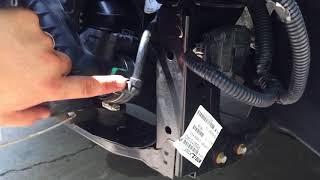
Typical fix: Replace the wastegate regulating valve solenoid. Ensure all three vacuum hoses are securely re-attached 🎬 See this walkthrough on replacing the turbo wastegate solenoid to the new solenoid.
Est. part cost: $40-$90 - Leaking, Cracked, or Disconnected Charge Air Cooler (Intercooler) Pipes 🔴 High Probability → Shop Intercooler The plastic and rubber components of the charge pipes are exposed to constant heat, oil vapor, and pressure changes, causing them to become brittle and crack, split, or swell over time. A loose clamp can also cause a pipe to blow off the turbo outlet or intercooler inlet/outlet under boost.
How to confirm: Visually inspect all piping between the turbo, intercooler, and throttle body for cracks, splits, oil residue (indicating a leak), or loose connections. A smoke test is the most effective method to pressurize the system and reveal hard-to-see leaks.
Typical fix: Replace the damaged section of pipe and any associated clamps.
Est. part cost: $50-$250 - Faulty or Disconnected Wastegate Actuator 🟡 Medium Probability → Shop Turbocharger TSB SSM 50485 points to an inoperative wastegate actuator, a missing e-clip on the actuator rod, or non-visible damage to the rod itself on 2.0L and 2.3L EcoBoost engines, including the 2020 Escape. If the clip is missing, the rod disconnects from the wastegate arm, leaving the wastegate stuck open and preventing boost from building.
How to confirm: Visually inspect the turbocharger's wastegate actuator rod to ensure it is connected to the wastegate arm and that the retaining e-clip is present. Apply vacuum with a hand pump to the actuator; it should hold vacuum (e.g., 20 inHg) and move the arm smoothly through its full range of motion.
Typical fix: If the e-clip is missing, reinstall the rod and secure it with a new clip. If the actuator itself is faulty, Ford has released a service kit to replace the actuator, rod, and clips without replacing the entire turbocharger.
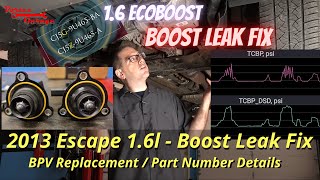
Est. part cost: $50-$150 for the actuator kit; <$5 for a clip - Faulty Turbocharger Bypass/Diverter Valve (BPV) 🟡 Medium Probability → Shop Turbocharger The bypass valve releases boost pressure when the throttle is closed. The diaphragm inside can tear or the valve can get stuck open, creating a constant boost leak. On the 1.6L engine, Ford does not sell this part separately from the turbo, but owners have found that the BPV from the 2.0L (Part No. CJ5Z-9U465-A) is a physical match 🎬 Watch: How to find boost leaks and replace the bypass valve and works as a replacement.
How to confirm: Remove the valve (typically held by three bolts) and inspect the diaphragm for tears or damage. Datalogging may show desired boost and actual boost tracking well until high load, when the actual boost falls off sharply as the weak BPV is forced open.
Typical fix: Replace the bypass valve assembly.
Est. part cost: $50-$120 - Dirty or Faulty Boost Pressure Sensor (MAP Sensor) ⚪ Low Probability Over time, oil vapor from the PCV system can coat the sensor, causing it to read boost pressure inaccurately. It may report lower-than-actual pressure, triggering the P0299 code even if the turbo system is mechanically sound. This is a common issue on high-mileage vehicles.
How to confirm: Remove the sensor and inspect it for oil contamination. On the 1.5L 3-cylinder (2020+), the sensor is easily accessible on top of the intake manifold. It can be carefully cleaned with dedicated MAF or electronics cleaner. Do not use brake cleaner. If cleaning doesn't work, monitor its readings with a scan tool to see if they are erratic or incorrect.
Typical fix: Clean the sensor. If the problem persists, replace the sensor.
Est. part cost: $40-$100
Rare But Worth Checking
- Failed Turbocharger: → Shop Turbocharger While often suspected first, complete turbo failure is less common than its supporting components. Failure is usually caused by oil starvation, contamination, or excessive wear on the internal wastegate bushing causing it to not seal properly. Symptoms include loud whining or grinding noises, excessive shaft play, and sometimes a rattle from a worn internal wastegate flapper.
- Clogged Catalytic Converter: → Shop Catalytic Converter A restriction in the exhaust system downstream of the turbo can prevent it from spooling up effectively, creating backpressure that leads to an underboost condition. This is more likely on higher-mileage vehicles. One owner on a forum noted the P0299 code began appearing 2-3 months after a catalytic converter replacement, suggesting a potential link to exhaust flow issues.
Diagnosis Steps
- Read all fault codes with an OBD-II scanner to check for any other related codes.
- Perform a thorough visual inspection of the entire air intake system. Look for cracked, disconnected, swollen, or collapsed hoses, especially the large charge air cooler pipes. Check for oil residue which indicates a leak.
- Inspect the turbocharger wastegate actuator rod. Ensure it is physically connected to the wastegate arm and that the e-clip is present, as noted in TSB SSM 50485.
- Test the wastegate actuator itself using a vacuum pump. Apply vacuum and confirm it holds pressure and smoothly moves the wastegate arm through its full range of motion.
- If no visible leaks are found, perform a smoke test on the intake and boost system to identify hidden leaks from gaskets, seals, or hard-to-see cracks in pipes.
- Test the wastegate control solenoid. On the 1.6L, this is a known failure point (TSB 15-0162) and is often replaced as a primary diagnostic step.
- Inspect and test the turbocharger bypass valve (diverter valve). Remove it and check for a torn diaphragm.
- Inspect and clean the boost pressure (MAP) sensor. It can get coated in oil, causing false readings. Use only MAF or electronics cleaner.
- If all other components check out, inspect the turbocharger for signs of failure, such as excessive shaft play (in/out and side-to-side), damaged fins, or a worn/rattling internal wastegate flapper.
Parts You'll Likely Need
- Turbocharger Wastegate Regulating Valve Solenoid
(OEM #CJ5Z-9K378-B (replaces CJ5Z-9K378-A))— This is a known high-failure part identified in Ford TSB 15-0162 for the 1.6L engine and is a very common cause of improper boost control. Many owners and technicians replace this first.
Trusted brands: Motorcraft, Dorman
OEM price range: $60-$90
Aftermarket price range: $30-$60 - Charge Air Cooler Pipe / Hose — These pipes are prone to cracking, splitting, or blowing off under pressure, causing a significant boost leak which is a primary cause of P0299.
Trusted brands: Motorcraft, Mishimoto
OEM price range: $100-$200
Aftermarket price range: $50-$150 - Turbocharger Bypass Valve (Diverter Valve)
(OEM #CJ5Z-9U465-A (for 2.0L, but reported to fit 1.6L))— The diaphragm in this valve is known to tear, causing a persistent boost leak. While not officially sold for the 1.6L, a YouTube repair shows the 2.0L part is a direct fit and solves the issue.
Trusted brands: Motorcraft, Pierburg
OEM price range: $60-$100
Aftermarket price range: $40-$80 - Turbocharger Wastegate Actuator Service Kit
(OEM #K2GZ-9G488-B (for specific 2.0L/2.3L applications))— For issues where the actuator fails or the connecting rod e-clip is lost, TSB SSM 50485 indicates this kit can be used to avoid replacing the entire turbocharger on some later models.
Trusted brands: Motorcraft
OEM price range: $100-$150
Aftermarket price range: N/A
Related Codes That Often Appear With This One
- P0234 — This is an 'Overboost Condition' code. Seeing it with P0299 often points to a faulty wastegate control solenoid that is working erratically, causing both underboost and overboost situations at different times. TSB 15-0162 lists P0234 and P0299 together as being caused by the same faulty solenoid.
- P0365 / P0369 — These are camshaft position sensor codes. They appeared alongside P0299 in an owner complaint (NHTSA ODI #11633558), suggesting a more complex engine problem or multiple simultaneous failures, not necessarily a direct causal link.
Technical Service Bulletins (TSBs) & Recalls

- SSM 50485: Addresses an inoperative wastegate actuator or missing e-clip causing P0299 and other codes on 1.5L, 1.6L, 2.0L, and 2.3L EcoBoost engines. [⭐ MANUFACTURER TSB — highest authority]
- TSB 15-0162: Pertains to 2013-2016 Escapes with the 1.6L engine, identifying the wastegate regulating valve solenoid as the cause for P0299.
Platform-Specific Known Issues
- 1.6L Wastegate Solenoid Failure: The wastegate regulating valve solenoid is a very common failure point on the 1.6L EcoBoost engine, as documented in Ford's own TSB 15-0162. It's an inexpensive and relatively easy part to replace, making it a top suspect for P0299.
- 1.6L Non-Serviceable Bypass Valve: Ford does not list the turbo bypass valve (BPV) as a separate, serviceable part for the 1.6L engine, instead including it with the entire turbo assembly. However, owner experience has shown that the BPV from the 2.0L engine (CJ5Z-9U465-A) is a direct physical replacement and works correctly.
- 2.0L/2.3L Wastegate Actuator E-Clip: → Shop Turbocharger On later model 2.0L and 2.3L EcoBoost engines, TSB SSM 50485 highlights that the P0299 code can be caused by something as simple as a missing e-clip that holds the wastegate actuator rod to the wastegate arm, causing a total loss of boost control.
Mechanic-Grade Diagnostic Values
- Turbocharger Wastegate Regulating Valve Solenoid Resistance (1.6L Engine) — expected: 12.4 Ω ± 0.5 Ω at 25°C (77°F). Failure: A reading significantly outside this range, or an open/short circuit, indicates a faulty solenoid.
- Wastegate Actuator Vacuum Test — expected: The actuator should hold a steady vacuum (e.g., 20 inHg) without bleeding down for at least 30 seconds.. Failure: If the actuator cannot hold vacuum, the internal diaphragm is likely torn, requiring replacement of the actuator.
- Wastegate Solenoid Control Wire Voltage (Key On, Engine Off) — expected: 0 Volts. Failure: Receiving any constant voltage (e.g., 3.44V as seen in one case) directly from the PCM pin for this wire indicates a short to voltage within the PCM itself.
Scan Tool Commands That Help
- Ford IDS (Integrated Diagnostic System): VGT/Turbocharger System Test — This is a guided test that allows a technician to command the wastegate actuator through its range of motion and monitor sensor responses. It is used to verify if the electronic control side (solenoid, wiring, PCM) and mechanical side (actuator, wastegate arm) are functioning correctly without having to physically access all components.
- High-End Bidirectional Scanner (e.g., Autel, ANCEL): VGT Turbo Calibration / Active Test — After replacing a component like the actuator or turbo, this function may be used to recalibrate or run an active test to command the component, verifying its operation and ensuring the PCM recognizes the new part's parameters.
Wiring & Ground Locations
- G105 / G108 / G109 / G111 / G112 — Various locations on the left rear of the engine compartment and transmission.. These are primary engine and powertrain control module (PCM) ground points. Corrosion or a loose connection at these locations can cause erratic behavior from sensors and solenoids involved in the turbo system, leading to false codes or intermittent issues.
- Battery Junction Box (Engine Bay Fuse Box) Relay R14 — In the main fuse box in the engine compartment.. This is the main Engine Control Relay (Powertrain Control Relay). A faulty or intermittent relay can cause a loss of power to the PCM, which controls the entire turbocharging system, potentially leading to underboost conditions or other codes.
- Wastegate Solenoid Connector — Connected to the wastegate solenoid, which is on the passenger side of the engine for the 1.6L, accessible from the wheel well.. The two-wire connector and its harness are a critical failure point. A user diagnosed a short-to-voltage issue by testing the control wire at this connector and tracing it back to the PCM, ultimately finding a bad PCM driver.
Real Owner Repair Stories
- Reddit user on r/fordescape (2014 Escape SE 1.6L) — P0299 code, oil leaking from turbo, acceleration issues, engine maxing RPMs uphill.
❌ Tried (didn't work) Multiple shops quoted a full turbo replacement based on symptoms.
✅ What actually fixed it A final diagnosis at a Ford dealership determined the cause was the wastegate solenoid. Replacing the solenoid ($70 part) resolved the issue completely. - DRiVParts Forum user (2017 Ford Escape 2.0L EcoBoost with 39k miles) — P0299 code, lack of power.
❌ Tried (didn't work) Initial under-hood visual inspection showed no problems.
✅ What actually fixed it Upon raising the vehicle, the technician found the turbo output hose had blown completely off the turbocharger outlet. Re-fastening the hose restored power. The tech noted the hose was oily and swollen, suggesting a slow oil leak from the turbo may have caused the hose to soften and fail. - YouTube video by 'Fixit channel' (2014 Ford Escape 1.6L) — P0299 code, check engine light.
❌ Tried (didn't work) Inspecting other hoses.
✅ What actually fixed it The large charge air cooler hose on the front passenger side had a 2-inch tear. Replacing the hose with a $27 part from O'Reilly's fixed the underboost condition.
"I Checked Everything" — The Actual Cause
- A system can pass a smoke test (indicating no leaks) but still set a P0299 code if the wastegate actuator e-clip is missing. This is documented in Ford TSBs SSM 50485, 50171, and 49427. The actuator rod physically detaches from the wastegate arm, leaving it open and preventing boost from building, even though the system is perfectly sealed.
- A faulty wastegate regulating valve solenoid can also be the cause when no leaks are present. The solenoid may fail electrically or mechanically, preventing it from correctly commanding the wastegate actuator, leading to an underboost condition as documented in TSB 15-0162.
When the Usual Fixes Don't Work
- While many immediately suspect a major turbocharger failure or a significant boost leak when P0299 appears, owner-reported data and TSBs show the root cause is frequently a much cheaper component. In one documented case, a 2014 Escape owner was quoted for a full turbo replacement due to oil leaks and underboost, but the actual fix was simply a faulty $70 wastegate solenoid. Another owner fixed the code by tightening a single loose hose clamp. This highlights the importance of thorough diagnosis of the control system (solenoids, actuators) and a meticulous inspection for minor leaks before condemning the entire turbocharger assembly.
OEM Part Supersession History
Not sold separately by Ford for 1.6L→CJ5Z-9U465-A— The Turbocharger Bypass Valve (BPV/Diverter Valve) on the 1.6L EcoBoost is not offered as a separate service part by Ford; they only sell the complete turbo assembly. However, owners and technicians have discovered that the BPV for the 2.0L engine (part number CJ5Z-9U465-A) is physically and functionally identical and can be used as a direct replacement to fix a torn diaphragm.CJ5Z-6K682-D→CJ5Z-6K682-L— Part update/revision for the 1.6L EcoBoost turbocharger assembly.
Model Year Variations Within This Range
- 2013-2016: These years used the 1.6L EcoBoost engine. TSB 15-0162, which points to the wastegate regulating valve solenoid as a primary cause for P0299, is specific to this engine.
- 2017-2019: The 1.6L engine was replaced by a 1.5L EcoBoost engine. The 2.0L EcoBoost was also updated. Some 1.5L models feature a liquid-to-air intercooler integrated into the intake manifold, unlike the 2.0L's traditional air-to-air front mount intercooler. A failure of this integrated cooler could cause coolant ingestion.
- 2020: This is the first year of the 4th generation Escape, which introduced a new 1.5L 3-cylinder EcoBoost engine and a revised 2.0L EcoBoost. TSBs like SSM 50485 regarding a missing wastegate actuator e-clip apply to the 2.0L engine in this new generation.
Helpful Videos
Used OEM Parts in Stock
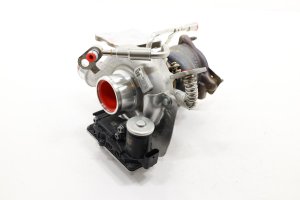
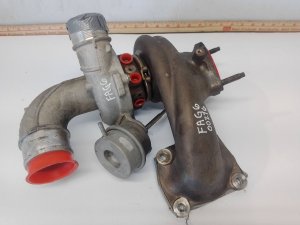
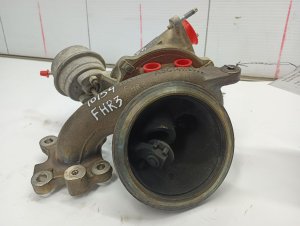
New Aftermarket Parts Available


The information in this article is provided for general reference and educational purposes only. Vehicle specifications, procedures, and part compatibility can vary by production date, trim level, and region. Always consult your vehicle's factory service manual and verify part numbers before purchasing or performing repairs. Safety-critical components such as airbags, seat belts, and braking systems should be installed by a qualified professional.
- Ford ESCAPE:
- 🧭 Diagnostic Flowchart
- 🎬 Helpful Videos
- 🛍️ Shop This Part
- What's Unique About the 2013-2020 Ford ESCAPE
- Symptoms You May Notice
- Most Likely Causes
- Rare But Worth Checking
- Diagnosis Steps
- Parts You'll Likely Need
- Related Codes That Often Appear With This One
- Technical Service Bulletins (TSBs) & Recalls
- Platform-Specific Known Issues
- Mechanic-Grade Diagnostic Values
- Scan Tool Commands That Help
- Wiring & Ground Locations
- Real Owner Repair Stories
- "I Checked Everything" — The Actual Cause
- When the Usual Fixes Don't Work
- OEM Part Supersession History
- Model Year Variations Within This Range
- 🎟️ Get 5% Off