

P0299 on 2016 Volkswagen Passat: Turbo Underboost Causes and Fixes
On a 2016 VW Passat with the 1.8T engine, code P0299 is most often caused by a failed turbocharger wastegate actuator or a torn diverter valve. A faulty wastegate, a well-known issue on the IHI IS12 turbo, can be fixed with an actuator repair kit or may require a full turbo replacement. A new diverter valve is a less expensive and common fix.
- P0299 on your 2016 Passat means the turbo is not making enough boost, resulting in a serious loss of power.
- The most likely causes are a faulty turbo wastegate actuator or a torn diverter valve.
- Always start diagnosis with the cheapest and easiest parts: check for boost leaks and inspect the diverter valve before assuming the entire turbocharger needs replacement.
- A physical check of the wastegate actuator arm for excessive play is a key diagnostic step for this specific engine.
- Driving with this code is possible but not recommended; you will have poor performance and could cause further damage.
What's Unique About the 2016-2016 Volkswagen PASSAT

The 2016 Passat uses the Gen 3 EA888 1.8T engine, typically paired with an IHI IS12 turbocharger. A very common failure point on this specific turbo is the electronic wastegate actuator. The linkage arm can develop excessive play or the pivot point in the exhaust housing can corrode and seize, preventing the wastegate from closing properly to build boost. This excessive play at the wastegate pivot point is a well-documented weakness on this engine platform, often leading to a P0299 code. While boost leaks are a possible cause, this specific wastegate issue is a primary suspect.
Diagnostic Flowchart

Tap your situation to follow the diagnostic path that matches what you're seeing on this vehicle.
Symptoms You May Notice
- Significant loss of engine power and sluggish acceleration.
- Check Engine Light and/or a flashing EPC (Electronic Power Control) light on the dashboard.
- Unusual whistling, hissing, or rattling noises from the engine bay during acceleration.
- The vehicle may enter 'limp mode,' which severely restricts engine power.
- Poor fuel economy.
- A rattling sound from the turbo area when the engine is turned off, indicating a loose wastegate flapper.
- Replacing the entire turbocharger when the actual problem is a much cheaper diverter valve, a simple boost leak, or a 🎬 See why you shouldn't replace the turbo without checking these. repairable wastegate actuator.
Most Likely Causes

- Faulty Turbocharger Wastegate Actuator 🔴 High Probability → Shop Turbocharger The IHI IS12 turbo used on the 1.8T Gen 3 engine is known for wastegate actuator linkage wear, pivot point seizure from corrosion, and motor failure, causing the wastegate flap to not seal properly. This is the most common cause of P0299 on this platform.
How to confirm: With the engine off and cool, physically inspect the wastegate actuator arm connected to the turbo. If there is significant play (more than ~3mm) or rattling, the actuator or linkage is worn. A diagnostic tool like VCDS can perform an actuator function test; failure to adapt or out-of-spec voltage points to a fault. 🎬 Watch: How to perform a wastegate actuator bench calibration.
Typical fix: If the internal wastegate flap is not excessively worn, a wastegate actuator repair kit (Part No. 06L145612K) can be installed. In cases of severe wear or a seized pivot, the entire turbocharger assembly must be replaced. Some specialists have developed methods to free a seized arm or bend the actuator rod to increase preload as a temporary fix.
Est. part cost: $100-$250 for an actuator kit, $900-$1500 for a new turbocharger. - Failed Diverter Valve (or Turbo Recirculation Valve) 🟡 Medium Probability → Shop Turbocharger The original diverter valves often use a rubber diaphragm that can tear under heat and pressure, creating a direct boost leak. Newer revisions use a more robust piston design but can still fail.
How to confirm: Remove the three T30 bolts holding the diverter valve to the turbocharger and inspect it for a torn diaphragm or other damage. Oil leaking from the electrical connector is also a sign of failure. The valve is located on the passenger side, connected to the turbo, and is typically accessed from underneath the vehicle.
Typical fix: Replace the diverter valve with a new unit. It is highly recommended to use the latest OEM revision part, known as 'Revision D' (Part No. 06H145710D), which uses a more durable piston design.
Est. part cost: $70-$150 - Boost/Vacuum Leak 🟡 Medium Probability Plastic and rubber hoses in the charge pipe system, as well as the PCV system, can become brittle and crack over time. Clamps can loosen, allowing pressurized air to escape. The PCV valve itself is a common leak point.
How to confirm: Perform a visual inspection of all hoses from the turbo to the intercooler and to the throttle body for cracks or loose connections. A smoke test is the most effective way to pressurize the system and pinpoint the exact location of a leak. Common leak points include charge pipe connections and the PCV hose assembly.
Typical fix: Replace the cracked hose, faulty clamp, or failed PCV valve.
Est. part cost: $50-$300 depending on the specific hose that failed. - Faulty N75 Valve (Boost Pressure Control Solenoid) ⚪ Low Probability This electronic solenoid controls the vacuum or pressure sent to the wastegate actuator. It can fail electronically or become clogged, leading to improper wastegate control. While a possible cause, it is less frequent than actuator or diverter valve failure on this engine.
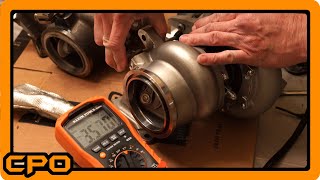
How to confirm: Test the valve's operation using a handheld vacuum pump and a multimeter, or by monitoring its duty cycle with an advanced scan tool. Check for proper vacuum supply to the valve and test the actuator diaphragm for leaks separately. The resistance between the two pins on the electrical connector should be between 25-35 ohms.
Typical fix: Replace the N75 valve.
Est. part cost: $40-$100
Rare But Worth Checking
- Clogged Catalytic Converter: → Shop Catalytic Converter An exhaust restriction can prevent the turbo from spooling up effectively, as it relies on exhaust gas flow. This should be suspected if power loss is severe and consistent across all RPMs, and other boost-related components check out.
- Faulty Boost Pressure Sensor (MAP Sensor): The sensor itself can fail and send incorrect pressure readings to the ECU, causing the computer to think there is an underboost condition when there isn't one.
- Internal Turbocharger Failure: → Shop Turbocharger While less common than actuator failure, the turbo's internal bearings can fail or the turbine/compressor wheels can be damaged by foreign objects, preventing it from building boost. This is a last resort after all other external causes are ruled out.
Diagnosis Steps
- Scan the ECU for any other fault codes that may provide more context. Use a tool like VCDS or OBDeleven to log requested vs. actual boost pressure during a drive to confirm the underboost.
- Perform a thorough visual inspection of the engine bay. Look for any disconnected, cracked, or collapsed vacuum lines or charge pipes, especially around the intercooler, throttle body, and PCV system.
- With the engine cool, locate the turbocharger wastegate actuator arm. Attempt to move it by hand. Excessive rattling or play (more than ~3mm) indicates a worn linkage, a very common issue. Check if the arm moves freely or is seized.
- Remove and inspect the turbocharger diverter valve (3x T30 bolts). Look for any tears in the diaphragm or signs of oil inside the electrical connector. This is a very common and relatively easy check. 🎬 Watch: How a torn diverter valve causes the P0299 code.
- If no obvious issues are found, perform a boost leak test using a smoke machine. This will pressurize the intake system from the turbo inlet to the engine and reveal hard-to-see leaks.
- Test the N75 boost control solenoid using a vacuum gauge to ensure it is correctly modulating vacuum/pressure to the wastegate actuator.
- If all other components check out, the issue is likely with the turbocharger itself, either the internal wastegate flap being worn or an internal bearing/turbine failure.
Parts You'll Likely Need

- Turbocharger Diverter Valve
(OEM #06H145710D)— This is a very common failure point. The original diaphragm tears, causing a boost leak directly at the turbo. It's a relatively inexpensive and easy part to replace. The 'D' revision is the updated, more durable piston-style part.
Trusted brands: Pierburg (OEM), Bosch, Go Fast Bits (GFB DV+)
OEM price range: $100-$150
Aftermarket price range: $70-$100 - Turbocharger Assembly
(OEM #06K145722H)— Required if the wastegate actuator linkage or internal wastegate flap is excessively worn or seized, which is a very common cause of P0299 on this engine. This part number corresponds to the IHI IS38 turbo but is often cross-referenced for the IS12-equipped cars as a direct (though upgraded) replacement. The original IS12 part number may vary.
Trusted brands: IHI (OEM), Mahle
OEM price range: $1200-$1800
Aftermarket price range: $700-$1100 - Turbocharger Wastegate Actuator Repair Kit
(OEM #06L145612K)— A cost-effective alternative to a full turbo replacement when only the electronic actuator has failed or the linkage has excessive play. This kit replaces the actuator motor and arm.
Trusted brands: Genuine VW/Audi, Aftermarket equivalents
OEM price range: $200-$300
Aftermarket price range: $100-$180
Related Codes That Often Appear With This One
- P0101 — Mass Air Flow (MAF) Sensor Circuit Range/Performance. A large boost leak downstream of the MAF sensor can cause unmetered air issues, leading to erratic readings from the MAF sensor.
- P0234 — Turbocharger Overboost Condition. A failing or sticking wastegate actuator or N75 valve can sometimes cause both underboost and overboost conditions intermittently as it fails to regulate pressure correctly.
- P2563 — Turbocharger Boost Control Position Sensor 'A' Circuit. This code is a strong indicator that the electronic wastegate actuator is faulty, requires adjustment, or the linkage is binding. It often appears with P0299.
Technical Service Bulletins (TSBs) & Recalls
- VIN-4-A-PIN AUGU (2016 FUEL SYSTEM, OTHER, dated 2016-08-30): Mentions MIL-ON P0299 as a known issue, but provides no diagnostic details. This confirms manufacturer awareness.
- Volkswagen Tech Tip 21-10-02: While for an earlier engine, this TSB describes a similar issue where the wastegate valve lever drops or seizes, causing P0299. It suggests checking for proper clearance (~3.0mm) between the turbo housing and lever, a principle that applies to the 2016 model's issue.
Platform-Specific Known Issues
- Ross-Tech Forum: 2016 Passat 1.8 no boost: A user on the Ross-Tech forums with a 2016 Passat reported a P0299 code. After trying a new actuator and checking wiring, the ultimate cause was discovered to be a damaged impeller inside the turbocharger, requiring a replacement turbo. This highlights that while less common, internal turbo damage can occur even if the more common external components seem fine.
Mechanic-Grade Diagnostic Values
- Wastegate Actuator Position Sensor Voltage (Lower Stop) — expected: 3.4V to 3.9V (Key On, Engine Off). Failure: A voltage outside this range after running the basic setting adaptation indicates a fault or improper mechanical adjustment.
- N75 Valve (Boost Pressure Control Solenoid) Resistance — expected: 25-35 Ohms. Failure: A resistance reading outside this range indicates an internal electrical fault in the solenoid.
- MAP Sensor (G71) Voltage (Key On, Engine Off) — expected: ~2.0-3.0V at atmospheric pressure on the signal wire (Pin 4), with 5V on the reference wire (Pin 3).. Failure: Voltage that doesn't change with pressure or a missing 5V reference voltage points to a bad sensor or wiring issue.
Hidden / Shadow Codes Worth Checking
- P2563: Turbocharger Boost Control Position Sensor 'A' Circuit Implausible Signal. This is not a true 'shadow' code but is a critical companion code that almost always points directly to a problem with the electronic wastegate actuator's adjustment, linkage, or motor, rather than a simple boost leak. (see via Standard OBD-II scan tool or VW-specific tools like VCDS/OBDeleven.)
Scan Tool Commands That Help
- VCDS or OBDeleven: Basic Settings: 'First Adaptation of Charge Pressure Actuator' — This is a mandatory procedure after replacing the wastegate actuator or the entire turbocharger. It teaches the ECU the new voltage for the wastegate's fully closed position, which is critical for accurate boost control. Failure to run this can result in persistent P0299 or P0234 codes.
- VCDS or OBDeleven: Output Tests: 'Test for charge pressure actuator' — This command cycles the actuator through its full range of motion. It is used to visually and audibly check if the actuator motor is working and if the linkage arm is moving freely without binding or getting stuck.
- VCDS or OBDeleven: Adv. Meas. Values: 'Charge air pressure control valve uncond voltage sensor' — This allows you to monitor the real-time voltage from the wastegate actuator's position sensor. It is essential for manually adjusting the actuator rod to the correct starting voltage (typically ~3.7V) before running the adaptation.
Wiring & Ground Locations
- Engine Sensor Ground — On the left side of the cylinder head.. A poor ground connection at this point can cause erratic readings from various engine sensors, including the MAP sensor or N75 valve, potentially leading to an incorrect P0299 diagnosis.
Real Owner Repair Stories
- golfmk7.com forum user (VW Golf with 1.8T Gen 3 engine (similar to Passat)) — P0299 underboost code, significant power loss.
❌ Tried (didn't work) Replaced diverter valve, Replaced N75 valve, Performed a smoke test which came back clean (no leaks found)
✅ What actually fixed it The pivot point for the wastegate flapper arm inside the turbo's exhaust housing had seized due to corrosion. This prevented the wastegate from closing fully, causing a constant exhaust leak that bled off boost. The entire turbocharger had to be replaced. - Reddit user r/jetta (MK6 Jetta (similar EA888 engine)) — Car went into limp mode, EPC light on.
❌ Tried (didn't work) Initially just replacing the broken wastegate actuator arm.
✅ What actually fixed it After replacing the broken wastegate actuator, the car worked but the fix was incomplete. The final solution required using OBDeleven to adjust the wastegate rod until the live data for 'Acknowledgement of charge pressure actuator' read the correct voltage, and then running the 'First Adaptation of Charge Pressure Actuator' basic setting.
"I Checked Everything" — The Actual Cause
- A common scenario for the P0299 code on this engine is a passed smoke test, but the underboost problem persists. This is because the most frequent cause is a leak on the *exhaust* side of the turbocharger at the wastegate flapper, not a leak in the pressurized intake tract. A smoke test only pressurizes the intake system from the turbo's compressor outlet to the engine and cannot detect exhaust gas bypassing a poorly sealed wastegate.
OEM Part Supersession History
Various older revisions (e.g., 06H145710C)→06H145710D— The original diverter valves used a rubber diaphragm prone to tearing. The 'D' revision is an updated piston-style design that is significantly more durable.06L145612E, F, G, H, J→06L145612K— Progressive updates to the electronic wastegate actuator for improved reliability and performance. The 'K' revision is the most current replacement kit.
Heads up: While physically interchangeable, it is critical to perform the 'First Adaptation' procedure with a scan tool after installing any new actuator to ensure the ECU recognizes its electronic end-stops.
Helpful Videos
We Have This Part in Stock


The information in this article is provided for general reference and educational purposes only. Vehicle specifications, procedures, and part compatibility can vary by production date, trim level, and region. Always consult your vehicle's factory service manual and verify part numbers before purchasing or performing repairs. Safety-critical components such as airbags, seat belts, and braking systems should be installed by a qualified professional.
- Volkswagen PASSAT:
- 🧭 Diagnostic Flowchart
- 🎬 Helpful Videos
- 🛍️ Shop This Part
- What's Unique About the 2016-2016 Volkswagen PASSAT
- Symptoms You May Notice
- Most Likely Causes
- Rare But Worth Checking
- Diagnosis Steps
- Parts You'll Likely Need
- Related Codes That Often Appear With This One
- Technical Service Bulletins (TSBs) & Recalls
- Platform-Specific Known Issues
- Mechanic-Grade Diagnostic Values
- Hidden / Shadow Codes Worth Checking
- Scan Tool Commands That Help
- Wiring & Ground Locations
- Real Owner Repair Stories
- "I Checked Everything" — The Actual Cause
- OEM Part Supersession History
- 🎟️ Get 5% Off