

P0300 on 2021-2022 Buick Encore: Random Misfire Causes and Fixes
P0300 on a 2021-2022 Buick Encore indicates a random engine misfire. The most common causes are a faulty spark plug with a broken internal insulator (per GM TSB #21-NA-255), a failed ignition coil pack, or a faulty PCV system integrated into the valve cover. Several Technical Service Bulletins also point to potential issues with fuel injector wiring.
- P0300 means your engine is misfiring on multiple cylinders, and you should address it promptly to avoid damaging the catalytic converter.
- Start your diagnosis with the most common and affordable fixes: inspect and likely replace the iridium spark plugs and inspect the ignition coil pack.
- Be aware of vehicle-specific issues. On the 2021-2022 Encore, this includes known problems with the PCV system (potentially requiring a new valve cover) and fuel injector wiring, as documented in GM Technical Service Bulletins.
- A flashing check engine light is a critical warning. Pull over and shut off the engine as soon as it is safe to do so.
What's Unique About the 2021-2022 Buick ENCORE
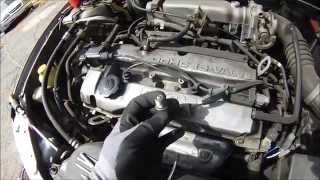
The 2021-2022 Encore uses the 1.4L LE2 direct-injection turbo engine. While spark plugs and coils are common culprits for misfires on any engine, this platform has specific issues documented by GM. Technical Service Bulletin #21-NA-255 directly addresses P0300 on this vehicle, pointing to broken spark plug insulators as a specific cause. Additionally, TSBs for the wider engine family highlight potential problems with fuel injector wiring (PIP5353F) 🎬 See how to troubleshoot injector control circuit and wiring faults. and plugged PCV orifices in the camshaft cover (20-NA-047), which can cause high crankcase pressure and lead to misfires. These known issues mean diagnosis should go beyond a simple tune-up if the problem persists.
Diagnostic Flowchart
Tap your situation to follow the diagnostic path that matches what you're seeing on this vehicle.
Symptoms You May Notice
- Rough or shaky idle, especially on a cold start.
- Hesitation, stumbling, or jerking during acceleration.
- Flashing Check Engine Light (in severe cases, often under load or on hills).
- Solid (non-flashing) Check Engine Light.
- Reduced engine power and sluggish performance.
- Poor fuel economy.
- Engine coughing or sputtering sounds.
- "Service StabiliTrak" message may appear along with the misfire.
- Replacing only one spark plug when the whole set is due or faulty per TSB.
- Replacing oxygen sensors, as they might report issues (like a lean condition) due to the misfire but are not the root cause.
- Assuming a catalytic converter is bad when it's actually being damaged by unburned fuel from the misfire.
- Replacing the ignition coil pack when the actual issue is a broken spark plug insulator as described in TSB #21-NA-255.
Most Likely Causes
- Faulty Spark Plugs (Broken Insulator) 🔴 High Probability → Shop Spark Plug GM issued TSB #21-NA-255 specifically for the 2021-2022 Encore with the LE2 engine for this exact issue. The bulletin states that a broken internal spark plug insulator can cause a P0300 misfire. This is a known manufacturing or design flaw, not just standard wear.
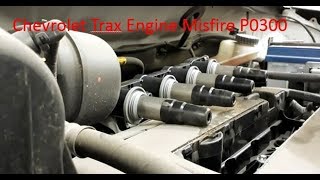
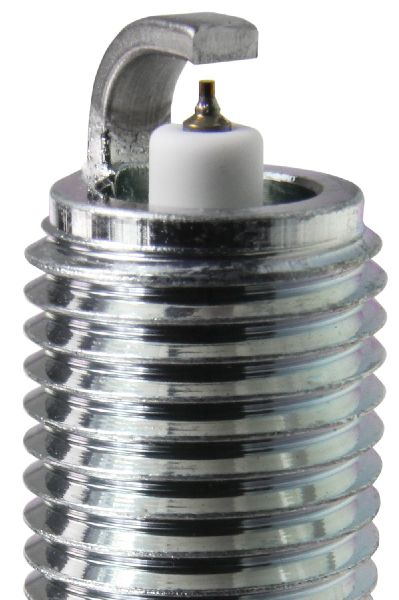
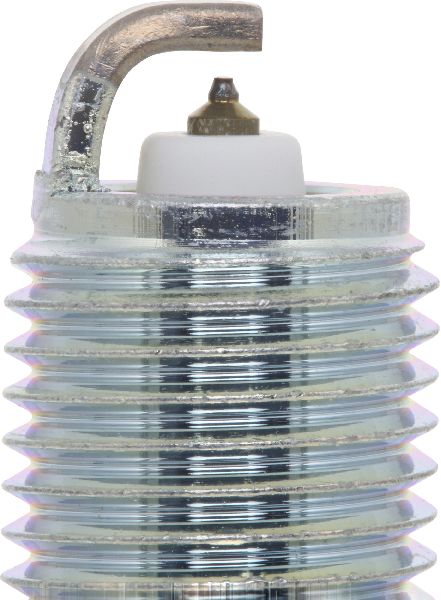
How to confirm: Per TSB #21-NA-255, remove the spark plugs and invert them. The broken center insulator may slide down the center electrode, which is a definitive sign of failure. Even if not visibly broken, worn electrodes or carbon fouling are also grounds for replacement.
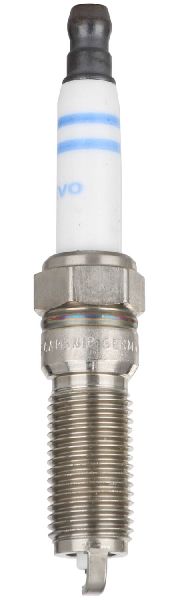
Typical fix: Replace all four spark plugs with the correct OEM-spec iridium plugs (ACDelco 41-121). It is critical to use the specified part.
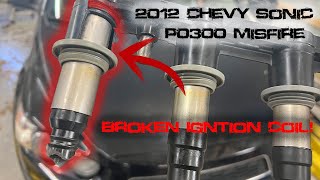
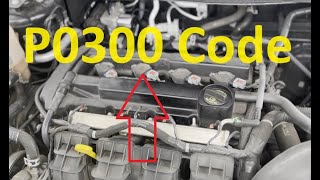
Est. part cost: $40-$80 - Faulty Ignition Coil Pack 🔴 High Probability → Shop Ignition Coil The engine uses a single coil-on-plug assembly that houses all four coils. Heat cycles and vibration can cause this unit to fail, leading to weak or no spark on one or more cylinders. Oil leaking from a faulty valve cover gasket can also saturate the coil boots and cause failure.
How to confirm: Inspect the coil pack for cracks and check the boots for corrosion, swelling, or white/black carbon tracking. A diagnostic scanner can monitor misfire counts per cylinder. Swapping the coil pack with a known good part is a definitive test.
Typical fix: Replace the entire ignition coil pack assembly. It is highly recommended to replace spark plugs at the same time.
Est. part cost: $100-$250 - PCV System Failure / Clogged Orifice 🟡 Medium Probability The LE2 engine family is known for issues with the PCV system integrated into the camshaft cover (valve cover). GM TSB #20-NA-047 notes that a plugged PCV orifice can cause high crankcase pressure, leading to various issues including a P0300 code. This failure effectively creates a large, unmetered vacuum leak.
How to confirm: With the engine running, listen for a loud hissing or whistling sound from the valve cover. A strong vacuum at the oil fill cap (making it hard to remove) is a classic sign of a failed PCV diaphragm.
Typical fix: The official fix involves replacing the entire camshaft cover (valve cover) assembly, which contains the non-serviceable PCV system. Ensure the new cover is the correct, updated part number.
Est. part cost: $150-$300 - Faulty Fuel Injectors or Wiring 🟡 Medium Probability → Shop Fuel Injector TSB #PIP5353F (and its revisions) specifically mentions that a rough idle or misfire (P0300) can be caused by issues with the Fuel Injector Control Circuit wiring. The bulletin advises technicians to verify wire colors at the ECM and injectors against schematics, as crossed wires from the factory or previous repairs can cause this issue.
How to confirm: A technician would need to perform a visual inspection of the fuel injector wiring harness for damage or incorrect connections as per the TSB. A scan tool can perform a fuel injector balance test to check for a clogged or failing injector.
Typical fix: Repairing the wiring harness or replacing a faulty fuel injector.
Est. part cost: $100-$400 per injector - Vacuum Leak ⚪ Low Probability Beyond the common PCV failure, leaks can occur at the intake manifold gasket, throttle body, or various vacuum hoses, introducing unmetered air and causing a lean condition that leads to misfires.
How to confirm: Perform a visual inspection of all vacuum lines. A smoke test is the most effective way to locate hard-to-see leaks. Long Term Fuel Trims (LTFT) significantly positive (e.g., >10%) at idle can also indicate a vacuum leak.
Typical fix: Replace the leaking gasket or hose.
Est. part cost: $10-$150
Rare But Worth Checking
- Low Engine Compression: Internal engine issues like a damaged piston can cause persistent misfires. TSB #PIP5490E mentions that a P0300 with low compression may be caused by a damaged piston on the 1.4L LE2 engine, requiring a compression and cylinder leakage test to diagnose.
- Low Fuel Pressure: A weak high-pressure or low-pressure fuel pump or a clogged fuel filter can starve the direct-injection engine for fuel, causing random misfires, especially under load.
- Faulty Mass Airflow (MAF) Sensor: → Shop Fuel Injection Air Flow Meter A dirty or failing MAF sensor can send incorrect airflow data to the ECM, upsetting the air/fuel mixture and causing misfires. This often sets a P0171 or P1101 code as well.
- Software Calibration Issue: In some cases for other GM engines, a P0300 could be falsely set due to software sensitivity. TSB #PIP5809 mentions a calibration update for a different engine to correct a false P0300. While not specific to the Encore, it's a possibility if all mechanical causes are ruled out.
Diagnosis Steps
- Read all stored fault codes with an OBD-II scanner. Note any other codes that accompany P0300, such as P0171 or P1101, as they provide critical clues.
- If the Check Engine Light is flashing, stop the engine as soon as safely possible to prevent catalytic converter damage.
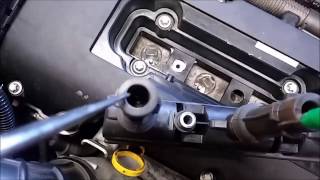
- Begin with TSB #21-NA-255. Remove the ignition coil pack and all four spark plugs. Invert each spark plug and check if the center insulator has broken loose and slides along the electrode. Replace all four plugs with OEM part ACDelco 41-121 if any are faulty or if they are due for service.
- While the coil is out, inspect the ignition coil pack for cracks, carbon tracking, or corrosion inside the boots. Check the spark plug wells for oil, which indicates a leaking valve cover gasket.
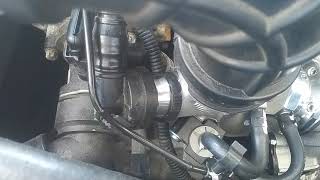
- Check for vacuum leaks, specifically the common PCV failure. With the engine running, listen for a loud hissing from the valve cover. Check for strong suction at the PCV orifice on the cover or at the oil fill cap.
- If ignition and vacuum issues are ruled out, investigate the fuel system. This may involve a fuel pressure test and inspecting the fuel injector wiring harness for crossed wires, referencing TSB #PIP5353F.
- If the problem persists, advanced diagnostics are needed. Perform an engine compression test and a cylinder leakage test to check for mechanical engine problems like a damaged piston, as noted in TSB #PIP5490E.
Parts You'll Likely Need
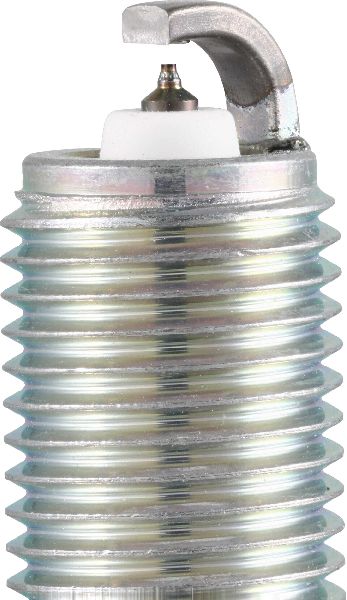
- Iridium Spark Plugs (Set of 4)
(OEM #41-121 (GM Part #12681656))— A primary cause of P0300 on this specific vehicle, as identified in GM TSB #21-NA-255.
Related Codes That Often Appear With This One
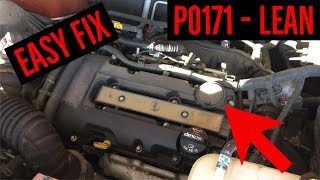
- P0171 — System Too Lean. This code is a classic companion to P0300 when the cause is a major vacuum leak, such as a failed PCV system in the valve cover, which allows a large amount of unmetered air into the engine.
- P1101 — Intake Air Flow System Performance. This code is also strongly associated with vacuum leaks and is mentioned in TSBs related to PCV issues on this engine family. It indicates a mismatch between expected and measured airflow.
- P0301, P0302, P0303, P0304 — Cylinder-Specific Misfires. A random misfire (P0300) may eventually be isolated by the ECM to a specific cylinder, triggering one of these codes and helping to pinpoint the faulty component (e.g., a single bad coil, injector, or broken plug).
- P050D — Cold Start Rough Idle. This code can appear alongside P0300 as it specifically indicates a misfire condition during a cold start, which could be caused by carbon buildup on valves or a failing injector.
Technical Service Bulletins (TSBs) & Recalls
- Specifically for 2021-2022 Encore/Trax with LE2 engine, identifies P0300 cause as a broken spark plug insulator and provides inspection procedure.
- Advises technicians to check for crossed or incorrect fuel injector control circuit wiring when diagnosing P0300 or rough idle.
- Notes that a plugged PCV orifice in the camshaft cover on the LE2 engine can cause high crankcase pressure and set codes like P0300.
- A general preliminary information bulletin for technicians to gather specific data when diagnosing misfire codes P0300-P0308 for GM's Technical Assistance Center.
- Notes that for the LE2 engine, a P0300 code accompanied by low compression may be caused by a damaged piston.
Platform-Specific Known Issues
- TSB #PIP5628G: Acknowledges P0300-P0308 codes and indicates that specific diagnostic information may be required by the GM Technical Assistance Center (TAC), suggesting potentially complex misfire scenarios.
- TSB #21NA255: A service bulletin specifically providing a repair procedure to correct customer concerns of engine misfire and an illuminated MIL with DTC P0300 set.
- TSB #PIP5353F: Points technicians to investigate the Fuel Injector Control Circuit wiring on vehicles with a rough idle or P0300, indicating a known potential for wiring-related issues.
- TSB #20-NA-047: While primarily for code P1101 or oil leaks, it notes that cracked pistons (which cause P0300) or a plugged PCV orifice can cause excessive crankcase pressure, linking PCV system health directly to misfire conditions on the LE2 engine.
Mechanic-Grade Diagnostic Values
- High-Pressure Fuel System Pressure (Direct Injection) — expected: 2,000 - 2,800 PSI. Failure: Pressure that fails to reach or maintain this range under load suggests a failing High Pressure Fuel Pump (HPFP).
- Low-Side Fuel Pressure (Key On, Engine Off) — expected: 50 - 94 PSI. Failure: Pressure below 50 PSI points to a weak in-tank fuel pump, clogged filter, or line issue.
- Spark Plug Torque — expected: 18 ft-lbs. Failure: Improper torque can lead to poor heat transfer or loose plugs.
- Spark Plug Gap (OEM Iridium) — expected: 0.028 inches (0.7mm). Failure: These plugs are pre-gapped and should not be adjusted; an incorrect gap can cause misfires under boost.
Scan Tool Commands That Help
- GDS2 / Professional Scan Tool: Crankshaft Position System Variation Learn Procedure — Required after replacing the ECM, crankshaft, crank sensor, or harmonic balancer. Failure to perform this relearn can cause the ECM to misinterpret crankshaft speed variations and falsely trigger a P0300 code.
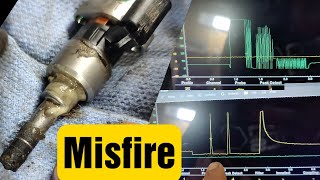
- GDS2 / Professional Scan Tool: Misfire Counters — To monitor live misfire data for each cylinder. This can help identify a cylinder that is misfiring intermittently before it's frequent enough to set a cylinder-specific code (P0301-P0304), helping to narrow down the random P0300.
- GDS2 / Professional Scan Tool: Fuel Injector Balance Test — To command each injector to fire for a set duration and measure the corresponding pressure drop. This test can identify a clogged or weak injector that may be contributing to a random misfire.
Wiring & Ground Locations
- G102 — Typically located at the rear of the engine.. This ground is often responsible for the ignition coils. A poor connection here can cause weak or intermittent spark across all cylinders, leading to a P0300.
- G103 — Typically located on the cowl in the engine compartment, above the brake booster.. Grounds the Engine Control Module (ECM) and the Data Link Connector (DLC). A faulty ground here can cause erratic ECM behavior and communication issues, potentially leading to false codes.
- K20 Engine Control Module Connector — The main electrical connector(s) at the ECM.. Per TSB #PIP5353F, the fuel injector control circuit wires should be inspected at this connector for proper pinout and integrity when diagnosing a P0300, as factory wiring errors have been found.
Real Owner Repair Stories
- BobIsTheOilGuy forum user '92saturnsl2' (2019-ish Buick Encore 1.4T) — Intermittent sharp crack of high voltage, misfire code.
❌ Tried (didn't work) A previous replacement of the spark plugs and ignition coil module had been performed 10,000 miles prior for the same issue.
✅ What actually fixed it The immediate cause was corrosion found in the spark plug well and inside the coil boot and spring for one cylinder, indicating electrical arcing. The short-term fix was to clean the well and replace the corroded boot/spring with a good one from the old coil pack. This suggests the root cause may be moisture intrusion into the spark plug well.
OEM Part Supersession History
N/A→N/A— No supersession found for the 2021-2022 LE2 engine's specific camshaft cover or spark plugs during the search. The ACDelco 41-121 spark plug remains the correct specified part.
Model Year Variations Within This Range
- 2021-2022: Unlike previous model years which offered two different 1.4L engines (LUV and LE2), the 2021-2022 Encore sold in North America exclusively uses the 1.4L LE2 direct-injection engine. This simplifies diagnosis, as only LE2-specific TSBs and failure patterns are relevant.
Helpful Videos
We Have This Part in Stock


The information in this article is provided for general reference and educational purposes only. Vehicle specifications, procedures, and part compatibility can vary by production date, trim level, and region. Always consult your vehicle's factory service manual and verify part numbers before purchasing or performing repairs. Safety-critical components such as airbags, seat belts, and braking systems should be installed by a qualified professional.
- Buick ENCORE:
- 🧭 Diagnostic Flowchart
- 🎬 Helpful Videos
- 🛍️ Shop This Part
- What's Unique About the 2021-2022 Buick ENCORE
- Symptoms You May Notice
- Most Likely Causes
- Rare But Worth Checking
- Diagnosis Steps
- Parts You'll Likely Need
- Related Codes That Often Appear With This One
- Technical Service Bulletins (TSBs) & Recalls
- Platform-Specific Known Issues
- Mechanic-Grade Diagnostic Values
- Scan Tool Commands That Help
- Wiring & Ground Locations
- Real Owner Repair Stories
- OEM Part Supersession History
- Model Year Variations Within This Range
- 🎟️ Get 5% Off