

P0300 on 2018-2020 Mitsubishi Eclipse Cross: Random Misfire Causes and Fixes
For a P0300 on a 2018-2020 Eclipse Cross, the most common causes are worn spark plugs or a vacuum leak from a cracked PCV breather hose. Start by inspecting these two items. If the issue persists, suspect faulty ignition coils or carbon buildup on the intake valves, a known issue for this direct-injection engine. An ECU software update may also be available to correct false misfire detection.
- Start your diagnosis with the simple and common fixes: inspect for cracked vacuum hoses and check the condition of your spark plugs.
- This is a direct-injection (GDI) engine, making it prone to carbon buildup on intake valves. If simple fixes don't work, this is a likely culprit requiring professional cleaning.
- Do not drive if the check engine light is flashing, as this signals a severe misfire that can quickly damage your expensive catalytic converter.
- Use only the OEM-specified spark plugs (NGK Iridium) for this engine to ensure proper performance and avoid introducing new problems.
What's Unique About the 2018-2020 Mitsubishi Eclipse Cross
The 4B40 is a gasoline direct injection (GDI) engine, which is the only engine offered in the Eclipse Cross in the American market. This technology makes it susceptible to specific issues that can cause a P0300 code. Carbon buildup on the intake valves is a documented problem for this engine type, as fuel is injected directly into the cylinder and doesn't wash over the valves to keep them clean. Additionally, specific vacuum hoses, like the PCV breather pipe, have been known to crack and cause lean conditions that lead to misfires. Mitsubishi has also issued TSBs for other models with different engines to reprogram the ECM for false P0300 detection under certain conditions, like high RPM with low load, suggesting the ECU logic can be sensitive. Manufacturer service bulletin TSB-13-13-001 notes that certain powertrain vibrations can be similar to misfire conditions, causing false MIL illumination, and provides software to revise misfire monitoring threshold values. A TSB for the 2019-2022 Eclipse Cross specifically addresses MIL illumination with P030X codes due to poor contact of the ignition coil terminal, recommending replacement with countermeasure parts.
Symptoms You May Notice
- Rough or shaky idle
- Hesitation or stumbling during acceleration
- Flashing Check Engine Light (indicates a severe misfire)
- Solid Check Engine Light
- Reduced engine power
- Poor fuel economy
- Smell of raw fuel from the exhaust
- Replacing oxygen (O2) sensors. While a faulty O2 sensor can affect the air/fuel mixture, it is not a primary cause of a P0300 code on this vehicle and would typically set its own specific code.
- Replacing the Mass Airflow (MAF) sensor. A dirty MAF sensor is a possible but less likely cause. It should be cleaned before considering replacement.
Most Likely Causes
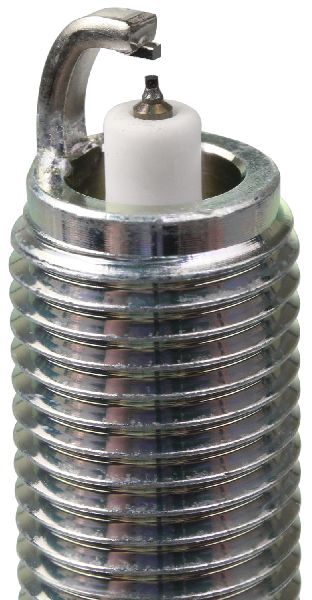
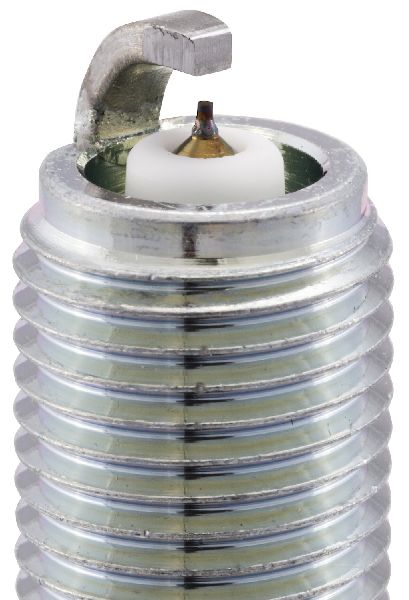
- Worn or Incorrect Spark Plugs 🔴 High Probability → Shop Spark Plug This engine is sensitive to the type and condition of its spark plugs. Using the correct OEM-spec (NGK Iridium) plugs is crucial for proper performance. Fouled or worn plugs are a primary and simple-to-fix cause for P0300.
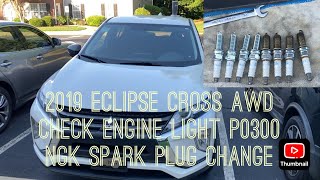
How to confirm: Remove the spark plugs and inspect them for wear, fouling, or an incorrect gap. The electrodes should be sharp and the ceramic insulator clean. A worn plug will have a rounded center electrode. A video for a 2019 Eclipse Cross showed worn, blackened plugs causing a P0300. 🎬 Watch: How new NGK Iridium plugs solved a P0300 misfire.
Typical fix: Replace all four spark plugs with the correct OEM-spec parts. The specified part is NGK Laser Iridium, model 92154. Do not overtighten them during installation.
Est. part cost: $60-$100 - Vacuum Leak (Cracked PCV Breather Hose) 🔴 High Probability The rubber breather hose running from the valve cover (rocker cover) to the intake area can become brittle and crack, creating a significant vacuum leak. This is a common failure point on many turbocharged vehicles due to heat and oil vapor exposure.
How to confirm: With the engine running, listen for a hissing sound around the top of the engine. Visually inspect the rubber hoses connected to the intake manifold and valve cover for obvious splits or cracks. A smoke test is the most definitive way to find a hidden leak. 🎬 See this guide on finding vacuum leaks and PCV repair.
Typical fix: Replace the cracked rubber hose. The specific part number is not widely published, but it is a standard pre-formed hose available from the dealer.
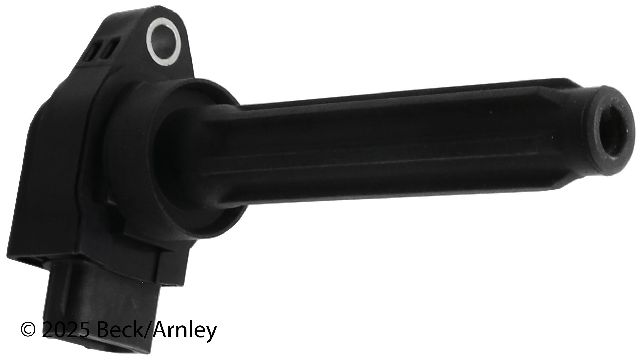
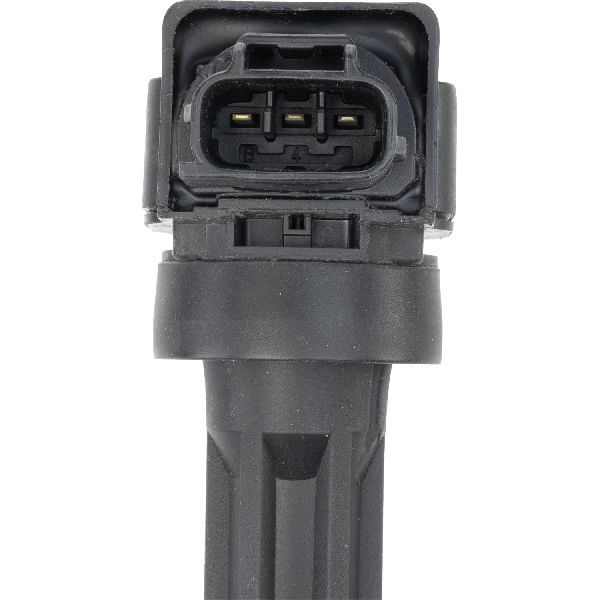
Est. part cost: $20-$50 - Faulty Ignition Coil(s) 🟡 Medium Probability → Shop Ignition Coil Coil-on-plug ignition systems are common failure points on many modern engines. Heat and vibration can cause the coils to fail over time, leading to insufficient spark. A TSB was issued for 2019-2022 models for unstable idle and P030X codes due to poor contact of the ignition coil terminal, advising replacement of all coils with updated parts.
How to confirm: If you have a scan tool that can show live misfire data, you may be able to see which cylinder is misfiring most often. Swap the ignition coil from a misfiring cylinder with one from a known good cylinder. Clear codes and see if the misfire code changes to the new cylinder (e.g., P0302 becomes P0304), the coil is bad. A multimeter can be used to check the secondary coil resistance, which should be between 8.5 - 11.5 kΩ.
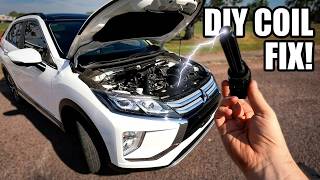
Typical fix: Replace the faulty ignition coil. The OEM part number is 1832A080. It is often recommended to replace them as a set if they are original and high-mileage, especially given the TSB. 🎬 Watch: Walkthrough for replacing both coil packs and spark plugs.
Est. part cost: $50-$90 per coil - Intake Valve Carbon Buildup 🟡 Medium Probability As a GDI engine, fuel is injected directly into the cylinder, so it never washes over the intake valves. Oil vapor from the PCV system can bake onto the hot valves, forming hard carbon deposits that disrupt airflow and cause misfires, especially on a cold start. The 4B40 engine in the US-market Eclipse Cross uniquely features both direct and port injection to help mitigate this issue, but it can still occur.
How to confirm: This is difficult to confirm without disassembly. A borescope can be inserted into the intake runners to visually inspect the valves. Symptoms like a rough cold start that improves as the engine warms are a strong indicator.
Typical fix: Requires professional cleaning, typically through walnut blasting, where crushed walnut shells are used to safely blast the carbon off the valves. An upper engine cleaning using a product like Sea Foam sprayed into the throttle body can sometimes be effective for minor buildup.
Est. part cost: $0 (service cost is labor) - Dirty or Faulty High-Pressure Fuel Injectors ⚪ Low Probability → Shop Fuel Injector The high-pressure GDI fuel injectors can become clogged or fail electronically, causing a misfire under load.
How to confirm: This is a more advanced diagnosis. A mechanic can perform a fuel injector balance test. A DIY method involves swapping an injector between cylinders to see if the misfire code follows the injector, but this is a labor-intensive job on this engine.
Typical fix: Replace the faulty fuel injector. It's recommended to replace all injector seals at the same time.
Est. part cost: $100-$200+ per injector
Rare But Worth Checking
- Low Fuel Pressure: While less common than a single bad injector, a weak high-pressure fuel pump (HPFP) can cause random misfires under high load. This would likely be accompanied by other codes like P0087.
- Low Engine Compression: Internal engine damage (e.g., piston rings, valves) can cause low compression and misfires. This is a worst-case scenario and should be investigated after all other possibilities are ruled out via a compression test.
- Incorrect ECU Software: Mitsubishi has released TSBs for other vehicles to fix 'false' P0300 codes caused by sensitive misfire detection logic during events like CVT downshifts or cold starts. While no specific TSB for the Eclipse Cross is widely cited for this exact issue, it's possible a dealer may have an updated calibration. A TSB does exist for P030X codes caused by faulty ignition coils.
Diagnosis Steps
- Read the codes with an OBD-II scanner and check for any other pending or stored codes, especially P0301-P0304 or P0171. Note any freeze frame data.
- Visually inspect the engine bay for obvious issues, paying close attention to the PCV breather hoses for cracks or breaks.
- Inspect the spark plugs. Remove them and check for wear, damage, or heavy fouling. Ensure they are the correct type for the engine (OEM Part #1822A104).
- Test the ignition coils (OEM Part #1832A080). Swap a coil from a cylinder that is suspected of misfiring (if identifiable via live data) with a coil from a good cylinder. Clear codes and see if the misfire follows the coil. Alternatively, test the secondary resistance of the coils; the standard value is 8.5 - 11.5 kΩ.
- Check for ECU software updates. Contact a Mitsubishi dealer with your VIN to see if any technical service bulletins (TSBs) related to false misfire detection or ignition coil issues (TSB-22-13-001) apply to your vehicle.
- If no issues are found, consider the possibility of carbon buildup, especially if the vehicle has over 60,000 miles or is used for frequent short trips. This may require professional diagnosis with a borescope.
- If the misfire happens primarily under heavy acceleration, investigate the fuel system, including the high-pressure fuel injectors and fuel pressure.
- As a final step, perform an engine compression test to rule out mechanical issues.
Parts You'll Likely Need
- Spark Plugs
(OEM #1822A104)— Worn spark plugs are a very common cause of misfires on most engines, and have been specifically identified as a fix for P0300 on the Eclipse Cross.
Trusted brands: NGK (Laser Iridium 92154)
OEM price range: $80-$120
Aftermarket price range: $60-$100 - Ignition Coil
(OEM #1832A080)— Ignition coils are a common failure item that directly cause misfires. A TSB was issued for the 2019-2022 Eclipse Cross for P030X codes related to poor ignition coil terminal contact.
Trusted brands: Denso, NGK, Bosch
OEM price range: $90-$150
Aftermarket price range: $50-$90 - PCV Breather Hose — A specific hose on this platform is known to crack, causing a vacuum leak that triggers lean and misfire codes.
Trusted brands: Mitsubishi (OEM)
OEM price range: $30-$60
Aftermarket price range: $20-$40
Related Codes That Often Appear With This One
- P0301, P0302, P0303, P0304 — If the random misfire begins to occur more frequently on one specific cylinder, the ECM will log one of these codes to identify it.
- P0171 (System Too Lean) — This code commonly appears with P0300 if the root cause is a vacuum leak, such as a cracked breather hose, which allows unmetered air into the engine. NHTSA ODI #10679585 describes an instance where P0300 appeared alongside P0171 and other electrical system codes.
Technical Service Bulletins (TSBs) & Recalls
- TSB-19-13-002: While for a different issue (engine stalling), this TSB for the 2019-2020 Eclipse Cross shows that Mitsubishi addresses engine control issues via ECU reprogramming, which could be a potential fix for false P0300 codes.
- TSB-13-13-001REV: Though for older models (Lancer/Outlander Sport), this TSB directly addresses false P0300 codes caused by sensitive ECU logic during CVT downshifts or cold starts, indicating a history of this type of issue in Mitsubishi vehicles.
- TSB-13-13-001: This bulletin notes that certain powertrain vibrations may cause vibration similar to misfire conditions, leading to false MIL illumination for P0300.
Platform-Specific Known Issues
- A known issue for the 4B40 1.5L Turbo engine is carbon accumulation on the intake valves, though this is partially mitigated by the dual port/direct injection system on US models.
- The PCV breather hose is susceptible to cracking from engine heat and oil vapor, causing vacuum leaks that trigger P0300 and P0171 codes.
- Some owners on forums like eclipsecrossforums.com have reported P0300 codes that were resolved simply by replacing the spark plugs with the correct OEM NGK Iridium plugs.
- NHTSA ODI #10453742 reports a random P0300 error accompanied by vibration between 2800 to 3500 RPM, noting it as a known issue with an associated TSB for similar Mitsubishi platforms.
Mechanic-Grade Diagnostic Values
- Ignition Coil Secondary Resistance — expected: 8.5 - 11.5 kΩ. Failure: A reading outside this range indicates a faulty coil.
Scan Tool Commands That Help
- Mitsubishi MUT-III or equivalent professional scanner: Live Data Misfire Counter — To monitor misfire counts per cylinder in real-time. This helps identify if a random P0300 is actually weighted towards a specific cylinder, which can guide diagnosis (e.g., swapping a coil from a high-count cylinder).
- Mitsubishi MUT-III: ECU Reprogramming — To apply updated software from Mitsubishi. TSBs have been issued for other models to correct false P0300 detection logic, making this a valid diagnostic step if a dealer confirms an update is available for the VIN.
Wiring & Ground Locations
- Engine Block to Chassis Ground — Typically a braided strap running from the engine block or transmission housing to the vehicle's chassis/firewall. One key ground strap is often located near a motor mount.. A poor engine ground can cause erratic behavior in the ignition system and sensors, leading to phantom electrical issues and misfire codes. Ensuring this connection is clean and tight is a crucial, often overlooked, basic step.
- Battery Negative to Chassis Ground — A primary cable running from the battery's negative terminal directly to a point on the vehicle's body or frame, usually nearby.. This is the main ground for the entire electrical system. Corrosion or a loose connection here can cause widespread issues, including insufficient voltage for the ignition coils to fire properly, resulting in misfires.
Real Owner Repair Stories
- YouTube channel 'Over Revv' (2019 Mitsubishi Eclipse Cross) — Check Engine Light with code P0300.
❌ Tried (didn't work) The video directly proceeds to the fix, implying initial diagnosis pointed towards the ignition system.
✅ What actually fixed it The problem was solved by replacing all four spark plugs. The old plugs were visibly worn and blackened. The video emphasizes that this engine is very sensitive to the specific plug type and that only the OEM-recommended NGK Laser Iridium plugs should be used. - NHTSA ODI #10106279 — An owner reported that the P0300 code would happen infrequently at first (5-6 times a month), but eventually became an occurrence almost by the minute.
OEM Part Supersession History
1832A080 (Ignition Coil)→1832A080 (Countermeasure Part)— A TSB (TSB-22-13-001) was issued for 2019-2022 models due to unstable idling and P030X codes caused by poor terminal contact in the original coils. The part number did not change, but countermeasure parts were introduced.
Heads up: The old and new parts are physically identical. Countermeasure parts produced until March 2022 were marked with a 'T' on the label. After April 2022, the 'T' was removed. Identification requires checking the lot number on the coil itself or the genuine part label. It is critical to replace with the updated version to resolve the TSB-related issue.
Model Year Variations Within This Range
- 2019-2020: These model years are included in TSB-22-13-001, which addresses faulty ignition coils causing misfires. While the 2018 model is not explicitly listed in this specific TSB, it shares the same engine and ignition coil part number, making the issue potentially relevant.
Diagnostic Flowchart
Other Known Issues on This Vehicle
Issues unrelated to this code that are worth knowing about as an owner of this generation:
- Forward Collision Mitigation (FCM) System Malfunction 🔴 High — Common enough to trigger two separate recalls in 2018 for the 2018-2019 model years. (Ref: NHTSA Recall 18V621000, 18V620000)
- General Electrical System Faults 🟠 Medium — The most common category of owner complaints filed with the NHTSA for the 2018 model year, though not tied to a specific single component.
- Engine Stalling in Cold Conditions 🟠 Medium — A specific issue affecting 2019-2020 models where the engine could stall after a restart in cold weather due to incorrect fuel correction data. (Ref: TSB-19-13-002)
- Premature Brake Wear / Pulsation 🟡 Low — Some owners report brake pedal pulsation or faster-than-expected wear, a common complaint on many modern vehicles.
Used vs. New Parts: Buying Guide for This Vehicle
When a used part is the smart pick: For this specific repair, using used parts is generally not recommended. The primary causes are wear items (spark plugs) or parts with known defects (ignition coils). A used PCV hose is likely to be as brittle as the one being replaced. Structural components like the engine cover or brackets could be sourced used, but not the core diagnostic parts.
Donor-vehicle mileage cap: roughly under 40000 miles for the part to have meaningful remaining life.
What to inspect on the donor part:
- For ignition coils, avoid if possible. If necessary, check for any signs of cracking on the housing or corrosion on the electrical connector.
- For hoses, squeeze the rubber to check for pliability. If it feels hard or makes crackling sounds, it is not a good donor part.
OEM-only on this vehicle (don't cheap out):
- Ignition Coils: Due to the TSB regarding faulty original coils, it is critical to use new, OEM countermeasure parts to ensure the problem is resolved permanently.
- Spark Plugs: The engine is noted to be very sensitive to the correct spark plug. While quality aftermarket brands like NGK are the OEM supplier, cheap alternatives should be avoided. Stick to the specified NGK Laser Iridium plug.
Aftermarket brands forum-validated for this vehicle:
- NGK (Spark Plugs, Ignition Coils)
- Denso (Ignition Coils)
Brands owners have reported issues with on this vehicle:
- Unbranded or 'white-box' ignition coils and spark plugs from online marketplaces. These often have a high failure rate and may not meet the specific requirements of this GDI turbo engine.
Real Owner Stories
Aggregated from forums and TSBs cited above. Mileages and costs reflect what owners reported in those sources.
2019 Mitsubishi Eclipse Cross 1.5L Turbo
Symptoms: Check engine light on with code P0300; inspection showed worn and blackened spark plugs.
What fixed it: Replacement of all four spark plugs with NGK Iridium Laser units.
Source hint: 2019 Mitsubishi EclipseCross Check Engine Code P0300 Misfire Solved by NGK Iridium Laser Spark Plugs - YouTube
2018-2020 Mitsubishi Eclipse Cross 1.5L Turbo
Symptoms: P0300 misfire code and rough running.
What fixed it: Replacing the spark plugs with the correct OEM NGK Iridium plugs.
Source hint: eclipsecrossforums.com - Multiple threads discuss P0300 being resolved by spark plug changes
2018-2020 Mitsubishi Eclipse Cross 1.5L Turbo
Symptoms: P0300 code accompanied by a vacuum leak.
What fixed it: Addressing vacuum leaks, specifically checking the PCV breather hoses for cracks.
Source hint: eclipsecrossforums.com - Multiple threads discuss P0300 being resolved by addressing vacuum leaks
Related OBD-II Codes
Frequently Asked Questions
Which specific spark plugs should I use for my 2018-2020 Mitsubishi Eclipse Cross 1.5L Turbo to fix a P0300?
Is there a Technical Service Bulletin for ignition coil issues on the 2019 Eclipse Cross?
Can a vacuum leak cause a P0300 on this vehicle?
Does the 1.5L Turbo engine suffer from carbon buildup like other GDI engines?
What is the correct resistance for testing the ignition coils on a 2018 Eclipse Cross?
Could my P0300 code be a 'false' code caused by the ECU?
Helpful Videos
We Have This Part in Stock


The information in this article is provided for general reference and educational purposes only. Vehicle specifications, procedures, and part compatibility can vary by production date, trim level, and region. Always consult your vehicle's factory service manual and verify part numbers before purchasing or performing repairs. Safety-critical components such as airbags, seat belts, and braking systems should be installed by a qualified professional.
- Mitsubishi Eclipse Cross:
- 🧭 Diagnostic Flowchart
- 🎬 Helpful Videos
- 🛍️ Shop This Part
- What's Unique About the 2018-2020 Mitsubishi Eclipse Cross
- Symptoms You May Notice
- Most Likely Causes
- Rare But Worth Checking
- Diagnosis Steps
- Parts You'll Likely Need
- Related Codes That Often Appear With This One
- Technical Service Bulletins (TSBs) & Recalls
- Platform-Specific Known Issues
- Mechanic-Grade Diagnostic Values
- Scan Tool Commands That Help
- Wiring & Ground Locations
- Real Owner Repair Stories
- OEM Part Supersession History
- Model Year Variations Within This Range
- Other Known Issues on This Vehicle
- Used vs. New Parts: Buying Guide for This Vehicle
- Real Owner Stories
- 2019 Mitsubishi Eclipse Cross 1.5L Turbo
- 2018-2020 Mitsubishi Eclipse Cross 1.5L Turbo
- 2018-2020 Mitsubishi Eclipse Cross 1.5L Turbo
- Related OBD-II Codes
- Frequently Asked Questions
- 🎟️ Get 5% Off