

P0301 on 2016-2022 Honda Accord: Cylinder 1 Misfire Causes and Fixes
On 2018-2022 Accords with the 1.5L Turbo engine, P0301 is most often caused by a faulty fuel injector, a known issue that may be covered by a warranty extension (up to 10 years/150,000 miles). For 2.0L Turbo models, TSB A23-026 indicates a simple software update often resolves the issue. For 2016-2017 models, the cause is typically a worn spark plug, a bad ignition coil, or a needed valve adjustment.
- For a 2018-2022 Accord, the first step is to identify your engine. The cause of P0301 is highly dependent on whether you have the 1.5T or 2.0T.
- If you have the 1.5T engine, a faulty fuel injector is the most probable cause. Check for warranty extensions before paying for repairs.
- If you have the 2.0T engine, a software update (TSB A23-026) is the most likely fix, especially if the issue occurs in cold weather.
- For older 2016-2017 models, P0301 is usually a simpler fix related to standard maintenance, like spark plugs or an ignition coil.
- Do not ignore a flashing check engine light, as it signals a severe misfire that can quickly destroy your expensive catalytic converter.
What's Unique About the 2016-2022 Honda ACCORD

The 2016-2022 Accord spans two generations with very different engines, leading to distinct reasons for a P0301 code. The 10th generation (2018-2022) is particularly notable. Its 1.5L Turbo (L15B7) engine is widely known for premature fuel injector failure, which is the most common cause of misfires on that powertrain. This issue is sometimes linked to a broader problem of fuel diluting the engine oil, especially in colder climates. Conversely, the available 2.0L Turbo (K20C4) engine can set the same code due to a software glitch that requires an update per TSB A23-026, not a part replacement. This is a sharp contrast to the 9th generation (2016-2017) models, where P0301 is usually caused by traditional ignition system wear or a need for a valve lash adjustment.
Diagnostic Flowchart

Tap your situation to follow the diagnostic path that matches what you're seeing on this vehicle.
Generation note: This range covers the end of the 9th generation (2016-2017) and the full 10th generation (2018-2022). * 9th Gen (2016-2017): Used naturally aspirated 2.4L 4-cylinder (K24W1) and 3.5L V6 (J35Y) engines. Misfire causes are typically standard ignition components or overdue valve adjustments. * 10th Gen (2018-2022): Used turbocharged 1.5L 4-cylinder (L15B7) and 2.0L 4-cylinder (K20C4) engines. These engines have specific, well-documented issues (fuel injectors on the 1.5T, software on the 2.0T) that commonly cause P0301.
Symptoms You May Notice

- Flashing or solid Check Engine Light
- Rough or shaking idle, sometimes described as feeling like a 'horseback ride' on a cold start.
- Engine hesitation or stumbling during acceleration
- Noticeable loss of power
- Smell of raw fuel from the exhaust
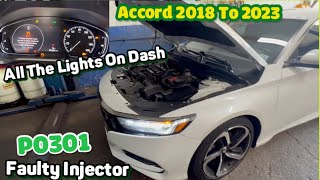
- A 'Christmas tree' effect on the dashboard, where multiple warning lights (Collision Mitigation, Brake System, etc.) appear simultaneously with the Check Engine Light. 🎬 Watch: Why all your dashboard warning lights are coming on.
- Replacing only ignition coils or spark plugs on a 2018+ 1.5L Turbo model without considering the extremely high likelihood of a fuel injector failure. Many owners replace ignition components only to have the P0301 code return.
Most Likely Causes

- Faulty Fuel Injector(s) 🔴 High Probability → Shop Fuel Injector This is the leading cause for 10th Gen (2018-2022) Accords with the 1.5L Turbo engine. These injectors are known to fail prematurely, often leaking fuel into the cylinder overnight, causing a rich misfire on cold starts. Honda has acknowledged the issue with warranty extensions for similar engines and issues, sometimes covering injectors up to 10 years or 150,000 miles. Numerous owner complaints and forum discussions confirm this is the most common fix.
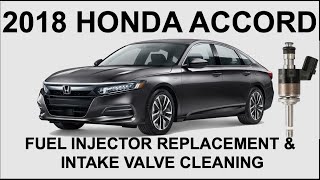
How to confirm: After ruling out spark plugs and coils by swapping them to other cylinders, the fuel injector is the prime suspect. A professional can perform a fuel injector balance test, but given the high failure rate, many owners and shops proceed with replacement if the misfire stays on cylinder 1. 🎬 See this walkthrough on replacing 1.5T fuel injectors. A leaking injector may also cause a fuel smell on the oil dipstick.
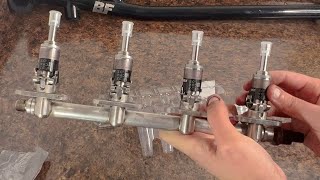
Typical fix: Replace the faulty fuel injector. It is highly recommended to replace all four injectors as a set with the updated part number, as the original-style injectors are prone to the same failure. Before paying for the repair, contact a Honda dealer with your VIN to check for any applicable warranty extensions or recalls.
Est. part cost: $350-$500 for a set of four OEM injectors. - PGM-FI Software Error 🔴 High Probability Specific to 10th Gen (2018-2022) Accords with the 2.0L Turbo engine. TSB A23-026 states that a software miscalculation, especially during cold starts, can cause the air-fuel ratio to go rich, triggering misfire codes (P300-P0304) and a rich condition code (P0172).
How to confirm: A Honda dealership or a qualified shop with access to Honda's i-HDS software can check the current PGM-FI software version against the latest version referenced in the TSB.
Typical fix: Update the PGM-FI software. The TSB also specifies performing an oil change (without filter replacement) as part of the procedure.
Est. part cost: $0 if covered under warranty, otherwise typically one hour of labor for the update at a dealership. - Worn Spark Plugs 🟡 Medium Probability → Shop Spark Plug A standard maintenance item. On the 9th Gen (2016-2017) models, this is a very common cause. On 10th Gen models, while still possible, they should be inspected but be aware that injectors (1.5T) or software (2.0T) are more likely culprits for a primary failure.
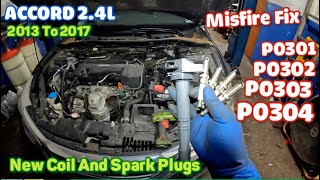
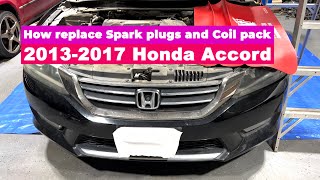
How to confirm: Visually inspect the spark plug from cylinder 1. Look for a worn electrode, fouling (black, sooty deposits), or oil. A simple test is to swap the cylinder 1 spark plug with another cylinder's plug (e.g., cylinder 2). If the code changes to P0302, the spark plug is the culprit. 🎬 Watch: How to swap coils and plugs on 9th Gen models.
Typical fix: Replace all spark plugs as a set. Use high-quality NGK or Denso plugs specified for your engine.
Est. part cost: $40-$100 for a set of four. - Failed Ignition Coil 🟡 Medium Probability → Shop Ignition Coil A common failure point on most modern engines. While less common than injectors on the 1.5T, a coil can still fail and cause a P0301 code.
How to confirm: Swap the ignition coil from cylinder 1 with another cylinder (e.g., cylinder 2). Clear the codes and drive the vehicle. If the misfire code moves to P0302, the ignition coil is faulty.
Typical fix: Replace the failed ignition coil. It's wise to use a reputable brand like Denso or Hitachi.
Est. part cost: $50-$100 for one coil.
Rare But Worth Checking
- Leaking Head Gasket: On 1.5L Turbo engines, there have been reports of head gasket failures allowing coolant into the combustion chamber, causing a misfire. This is a major, expensive repair. Check for symptoms like unexplained coolant loss in the reservoir, white exhaust smoke, or a milky appearance to the engine oil. Honda has internally investigated this issue.
- Intake Valve Carbon Buildup: As direct-injection engines, the 1.5T, 2.0T, and 2.4L are susceptible to carbon buildup on the intake valves over time, which can restrict airflow and cause misfires. This typically occurs at higher mileage (80,000+ miles) and may require a manual cleaning service (walnut blasting).
- Valve Clearance Out of Adjustment: Primarily for the 9th Gen 2.4L K24W1 engine, but applicable to all engines at high mileage (100,000+ miles). Honda engines do not have hydraulic lifters and require periodic manual valve adjustments. Tight valve clearances can cause a loss of compression and lead to misfires, especially when the engine is cold.
Diagnosis Steps
- Identify your engine. The diagnostic path is very different for the 1.5T, 2.0T, and the 9th Gen engines.
- Check for Warranty/TSBs. Before any repair, contact a Honda dealer with your VIN. Inquire about warranty extensions for fuel injectors (1.5T) and the applicability of TSB A23-026 (2.0T).
- Scan for other codes. Note if P0172 or other cylinder misfire codes are present, as this provides valuable diagnostic clues.
- (For 2.0T Engines): If TSB A23-026 is open for your vehicle, performing the software update is the first and most likely final step.
- Perform Ignition System Swap. For all engines, swap the ignition coil from cylinder 1 to cylinder 2. Clear codes and see if the misfire moves to P0302. If it does, the coil is bad. If not, swap the spark plug from cylinder 1 to cylinder 3. If the code moves to P0303, the spark plug is bad.
- (For 1.5T Engines): If the misfire remains on cylinder 1 after the ignition swap, a faulty fuel injector is the most probable cause.
- (For 9th Gen Engines): If ignition components are good, check maintenance records. If a valve adjustment has not been performed in over 100,000 miles, it is a likely cause.
- Check for Mechanical Issues. If other steps fail, check for signs of a blown head gasket (coolant loss, white smoke). A mechanical compression test can confirm the health of the cylinder.
Parts You'll Likely Need
- Fuel Injector Set (1.5T)
(OEM #06160-5PA-305 (Kit))— The most common cause of P0301 on 2018-2022 Accords with the 1.5L Turbo engine due to a known design flaw. Replacing as a full set is recommended.
Trusted brands: Honda (OEM)
OEM price range: $100-$150 per injector, or ~$400 for the kit
Aftermarket price range: $70-$120 per inject
Related Codes That Often Appear With This One
- P0300 — Indicates a random misfire across multiple cylinders. It often appears with specific cylinder misfire codes like P0301 when the underlying issue (like bad injectors or a software bug) begins to affect other cylinders.
- P0302, P0303, P0304 — These codes indicate misfires in other cylinders. Seeing them alongside P0301 points to a systemic issue like a failing set of fuel injectors, a software problem, or a bad batch of fuel.
- P0172 — Indicates the engine is running 'too rich'. This is commonly seen with P0301 on both 1.5T and 2.0T models. On the 1.5T, it's caused by a faulty fuel injector leaking excess fuel. On the 2.0T, it's a direct symptom of the software bug described in TSB A23-026.
Technical Service Bulletins (TSBs) & Recalls
- A23-026: Software Update for DTC P0300-P0304 or P0172 on 2.0L engines.
- 22-002: Warranty Extension for fuel injectors on certain 2015-2016 Fit models, but the issue of injector failure is analogous to the Accord 1.5T problem.
- 18-137 / 19-053: Warranty Extension for 2016-2018 Civic 1.5T for similar misfire/oil dilution issues, providing context for the Accord's problems.
- Honda Internal Search Request: AHM requested dealers to collect parts from 2018-2019 Accords with P030X and confirmed head gasket leaks to investigate the root cause.
Platform-Specific Known Issues
- 1.5L Turbo Fuel Injector Failures: 2018-2022 Accords with the 1.5T engine have a widely documented issue with fuel injectors failing, leading to misfires and rich conditions. Honda has issued warranty extensions for this on some vehicles. NHTSA ODI #11704229 and #11659144 both document this exact failure mode on Accords.
- 2.0L Turbo Software Update: TSB A23-026 was issued for 2018-2022 Accords with the 2.0L engine to correct a software flaw that causes misfire and rich condition codes (P030x, P0172) in cold weather. The fix is a software update, not a hardware replacement.
Mechanic-Grade Diagnostic Values
- Ignition Coil Primary Winding Resistance — expected: 0.5 to 2.5 Ohms. Failure: A reading significantly outside this range, or an open loop (OL) reading, indicates a faulty coil.
- Ignition Coil Secondary Winding Resistance — expected: 5,000 to 15,000 Ohms (5kΩ - 15kΩ). Failure: A reading outside this range suggests the secondary coil winding is compromised.
- Mode $06 Misfire Count per Cylinder — expected: Close to zero for each cylinder.. Failure: A significantly higher count for cylinder 1 compared to others, even without a pending or stored P0301 code, indicates an intermittent misfire that the ECU is tracking.
Hidden / Shadow Codes Worth Checking
- Mode $06, TID $53 (Ford example, Honda similar): This is not a code but a diagnostic monitor for cylinder-specific misfire counts. Advanced scan tools can read this data to show how many misfire events the ECU has counted for each cylinder in the current and previous drive cycles. This can reveal a problem with cylinder 1 before the count is high enough to trigger the P0301 check engine light. (see via An OBD-II scan tool that supports Mode $06 data display.)
Scan Tool Commands That Help
- Honda i-HDS (Honda Diagnostic System): PGM-FI Software Update — This is the required fix for 2.0T models experiencing P0301 as per TSB A23-026. The function updates the engine control module's software to correct a miscalculation that causes a rich condition and misfires on cold starts.
- Honda i-HDS: PCM Idle Learn Procedure / Throttle Position Learned Values Reset — This must be performed after the PGM-FI software update on 2.0T models as specified in TSB A23-026 to ensure the engine idles correctly with the new software logic.
- Honda HDS: CRANK PATTERN Learn Procedure — While not a primary fix for this specific P0301 issue, this procedure is sometimes required after major engine work or software updates to help the ECU relearn the crankshaft position sensor's signal pattern, which is essential for accurate misfire detection.
Wiring & Ground Locations
- Engine Harness Ground (G101) — Typically located on the driver's side of the intake manifold, sometimes on a vacuum T-fitting. Other key grounds are on the valve cover and transmission housing.. A poor ground connection at G101 can affect the entire engine management system, including the ECU, injectors, and ignition coils. This can cause erratic behavior and phantom codes, including misfires. Ensuring this ground is clean and tight is a crucial, often overlooked, diagnostic step.
- Under-hood Fuse Box — Located near the battery in the engine compartment.. This box contains fuses and relays critical for the PGM-FI (fuel injection) system and ignition system. A fault here, while rare, could cut power to the fuel injectors or ignition coils.
Real Owner Repair Stories
- Reddit user in r/accord (2018 Honda Accord 1.5T, 75k miles) — Multiple dashboard warning lights, rough idle, and a ticking noise from the back of the motor. Initially got a P0172 (Bank 1 too rich) code, which later changed to P0301.
❌ Tried (didn't work) Replacing spark plugs, Replacing ignition coils
✅ What actually fixed it The user was advised by their mechanic and online forums that the issue was the known fuel injector problem. The final fix was replacing the fuel injectors, which resolved the codes and symptoms. The user noted the high cost of the repair (~$2000 for injectors, plugs, and coils). - Reddit user in r/accord (2018 Honda Accord 1.5T) — Check engine light with codes P0172 (too rich) and P0300-P0304 (random and specific misfires).
❌ Tried (didn't work) Initial diagnosis was uncertain.
✅ What actually fixed it The user took the car to a dealer and Honda agreed to cover the cost of replacing the fuel injectors, even though the vehicle was likely out of the standard warranty period. The parts were on backorder, suggesting a widespread issue.
OEM Part Supersession History
16010-5PA-305 (Fuel Injector Set)→06160-5PA-305 (Fuel Injector Kit)— The original fuel injectors for the 1.5T engine were prone to premature failure. The new part number represents an updated kit designed to resolve the issue. The kit includes all four injectors, O-rings, and the fuel feed pipe.
Heads up: Users have reported that the original part number (16010-5PA-305) was discontinued and became difficult to order, with the new kit (06160-5PA-305) being the official replacement.
Model Year Variations Within This Range
- 2018-2022 (10th Gen): The primary cause of P0301 is highly dependent on the engine. For the 1.5L Turbo (L15B7), the cause is overwhelmingly faulty fuel injectors. For the 2.0L Turbo (K20C4), the cause is often a software glitch requiring a PGM-FI update per TSB A23-026.
- 2016-2017 (9th Gen): These models use naturally aspirated engines (K24W1, J35Y) where P0301 is typically caused by traditional wear items like spark plugs, ignition coils, or the need for a valve clearance adjustment at higher mileage.
Helpful Videos

The information in this article is provided for general reference and educational purposes only. Vehicle specifications, procedures, and part compatibility can vary by production date, trim level, and region. Always consult your vehicle's factory service manual and verify part numbers before purchasing or performing repairs. Safety-critical components such as airbags, seat belts, and braking systems should be installed by a qualified professional.
- Honda ACCORD:
- 🧭 Diagnostic Flowchart
- 🎬 Helpful Videos
- What's Unique About the 2016-2022 Honda ACCORD
- Symptoms You May Notice
- Most Likely Causes
- Rare But Worth Checking
- Diagnosis Steps
- Parts You'll Likely Need
- Related Codes That Often Appear With This One
- Technical Service Bulletins (TSBs) & Recalls
- Platform-Specific Known Issues
- Mechanic-Grade Diagnostic Values
- Hidden / Shadow Codes Worth Checking
- Scan Tool Commands That Help
- Wiring & Ground Locations
- Real Owner Repair Stories
- OEM Part Supersession History
- Model Year Variations Within This Range
- 🎟️ Get 5% Off