

P0302 on 2021-2025 Ford Bronco: Cylinder 2 Misfire Causes and Fixes
On a 2021-2025 Ford Bronco, especially with the 2.3L EcoBoost engine, a P0302 code is most often caused by a faulty ignition coil or spark plug in cylinder 2. This is a common DIY fix, with parts costing between $40 and $120. Cylinder 2 is the second from the front on the 2.3L I4 and the middle cylinder on the passenger side on the 2.7L V6.
- P0302 on a Ford Bronco indicates a misfire in cylinder 2.
- For the 2.3L EcoBoost engine, the most likely cause is a bad ignition coil or a worn spark plug, as confirmed by Ford TSBs.
- A simple diagnostic step is to swap the ignition coil from cylinder 2 to another cylinder to see if the misfire code follows it.
- Do not drive if the check engine light is flashing, as this can cause rapid and expensive damage to the catalytic converter.
- Check with a Ford dealer for any open recalls or available PCM software updates, especially TSB 21-2262, which addresses misfires caused by fuel injector software.
What's Unique About the 2021-2025 Ford BRONCO
For the 2021-2025 Bronco, particularly those with the 2.3L EcoBoost engine, Ford has issued several Technical Service Bulletins (TSBs) that directly address the causes of misfires like P0302. These bulletins point specifically to issues with spark plugs, ignition coils, and even the PCM's software configuration for the fuel injectors. This means that unlike a generic misfire, there are known, documented patterns of failure on this specific platform. Furthermore, the closely related Ford Ranger platform with the same 2.3L engine has a documented issue with water leaking onto the engine and pooling in spark plug wells, a potential contributing factor.
Diagnostic Flowchart
Tap your situation to follow the diagnostic path that matches what you're seeing on this vehicle.
Symptoms You May Notice
- Rough or shaky idle
- Hesitation or stumbling during acceleration
- Noticeable loss of engine power
- Flashing or solid check engine light
- Bucking or jerking sensation while driving at highway speeds (35-55 mph), particularly in gears 7-10 on models with the 10R60 automatic transmission. [SSM 53869]
- Reduced fuel economy
- Engine running rougher than normal
- Replacing oxygen sensors. While a misfire can affect O2 sensor readings, the sensor itself is rarely the cause of a single-cylinder misfire code.
- Replacing the catalytic converter. A misfire can damage a catalytic converter, but a bad converter will not cause a P0302 code. The converter is the victim, not the cause.
Most Likely Causes
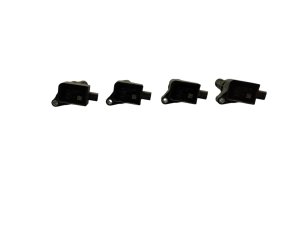
- Faulty Ignition Coil 🔴 High Probability → Shop Ignition Coil Ford TSB #SSM 53971 specifically identifies ignition coils as a primary cause for misfires (P0301-P0304) on 2.3L EcoBoost engines in this vehicle range. This is a very common failure point across all EcoBoost engine families.
How to confirm: Swap the ignition coil from cylinder 2 with another cylinder (e.g., cylinder 1). Clear the codes and drive. If the code changes to P0301, the ignition coil is faulty. This is the most definitive DIY diagnostic step.
Typical fix: Replace the faulty ignition coil. It is often recommended to replace all coils at the same time for preventative maintenance, especially if they are original and have high mileage.
Est. part cost: $50-$90 per coil - Worn or Fouled Spark Plug 🔴 High Probability → Shop Spark Plug TSB #SSM 53971 also lists spark plugs as a key cause of misfires on the 2.3L EcoBoost engine. Turbocharged, direct-injection engines like the EcoBoost are harder on spark plugs, requiring more frequent changes than naturally aspirated engines. The recommended service interval is up to 100,000 miles, but issues can arise sooner.
How to confirm: After confirming the coil is good, remove the spark plug from cylinder 2. Inspect it for wear (worn electrode), carbon fouling, oil, or damage to the ceramic insulator. Compare it to a plug from a working cylinder. Check the spark plug gap with a feeler gauge; for the 2.3L and 2.7L, it should be around 0.027 - 0.031 inches.
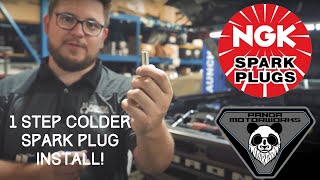
Typical fix: Replace the spark plug in cylinder 2. It is best practice to replace all spark plugs as a set 🎬 Watch this step-by-step guide to installing new spark plugs. to ensure consistent performance.
Est. part cost: $15-$25 per plug - PCM Software/Configuration 🟡 Medium Probability TSB 21-2262 states that on some 2021 2.3L engines, misfire codes can be falsely triggered by the PCM configuration related to fuel injector operation. Newer TSBs for 2025 models also indicate software fixes are in development for false misfire detection after a cold soak.
How to confirm: This can only be confirmed by a Ford dealership or a qualified shop with access to Ford's diagnostic software (FDRS). They can check the current PCM software calibration against available updates.
Typical fix: A Ford dealer needs to reprogram the Powertrain Control Module (PCM) with the latest software calibration. This is a non-mechanical fix.
Est. part cost: $0 (if under warranty), otherwise labor costs for reprogramming apply (typically 0.5-1.0 hours). - Faulty Fuel Injector ⚪ Low Probability → Shop Fuel Injector While less common than ignition issues, a clogged or failing fuel injector can cause a lean misfire on a single cylinder. On the 2.7L engine, some owners on Bronco6G forums have reported needing injector replacements to solve persistent misfires after coils and plugs were replaced.
How to confirm: After ruling out all spark-related issues, you can swap the fuel injector from cylinder 2 with another cylinder. This is a more involved job than swapping a coil and may require new seals.
Typical fix: Replace the faulty fuel injector. It's sometimes recommended to have all injectors professionally cleaned and tested at the same time.
Est. part cost: $50-$100 per injector
Rare But Worth Checking
- Internal Engine Mechanical Failure: A recall was issued for some 2021-2022 Broncos with the 2.7L engines for defective intake valves that could fracture, leading to loss of compression and catastrophic engine failure. While this would cause a misfire, it is a much more severe issue than a simple ignition component failure. A compression test is required for diagnosis.
- Low Compression: If spark and fuel systems are confirmed to be working, a compression test should be performed to check for mechanical issues like a bad valve, worn piston rings, or head gasket failure. This is a necessary step before considering major engine repairs.
- Wiring/Connector Issue: The wiring harness or connector to the ignition coil or fuel injector can become damaged, loose, or corroded. This can cause an intermittent connection and a misfire on that cylinder. A visual inspection of the harness for chafing or damage is a good diagnostic step.
Diagnosis Steps
- Read the code with an OBD-II scanner and check for any other pending or stored codes. Note the freeze frame data to see the engine conditions when the misfire was first detected.
- Locate cylinder 2. On the 2.3L I4 engine, it is the second cylinder from the front of the engine (radiator side). On the 2.7L V6, it is the middle cylinder on the passenger side (right side) bank.
- Visually inspect the wiring harness and connector for the ignition coil and fuel injector on cylinder 2. Look for any signs of damage, corrosion, or loose connections.
- Swap the ignition coil from cylinder 2 with the coil from cylinder 1. Clear the codes and test drive the vehicle. An 8mm socket is typically needed to unbolt the coil.
- If the code returns as P0301, the ignition coil is bad and needs to be replaced.
- If the code remains P0302, the coil is likely good. Put the coils back in their original positions. Now, swap the spark plug from cylinder 2 with the plug from cylinder 1. Clear codes and re-test.
- If the code returns as P0301, the spark plug is bad. It is highly recommended to replace all plugs as a set.
- If the code remains P0302, the issue is likely not a simple spark component. The problem could be the fuel injector, wiring, or a mechanical engine issue.
- If comfortable, you can perform a fuel injector swap, but this is more advanced. Otherwise, consult a professional.
- If all else fails, consult a professional for a compression test or to check for relevant PCM updates as per TSB 21-2262.
Parts You'll Likely Need
- Ignition Coil (2.3L)
(OEM #JX6Z-12029-B (supercedes JX6Z-12029-A), Motorcraft DG-576)— Identified as a primary cause of misfires in Ford TSB #SSM 53971 for the 2.3L engine.
Trusted brands: Motorcraft
OEM price range: $80-$95
Aftermarket price range: $45-$70 - Iridium Spark Plug (2.3L & 2.7L)
(OEM #Motorcraft SP-594 (replaces SP-542, SP-578))— Also identified as a primary cause of misfires in Ford TSB #SSM 53971. Worn plugs are a common maintenance item that can cause misfires. This part fits both engines.
Trusted brands: Motorcraft, NGK, Bosch
OEM price range: $16-$25
Aftermarket price range: $12-$20 - Ignition Coil (2.7L)
(OEM #ML3Z-12029-C (Motorcraft DG-594))— The 2.7L engine uses a different coil than the 2.3L. It is also a common failure point
Related Codes That Often Appear With This One
- P0300 — If multiple cylinders are misfiring randomly, P0300 (Random/Multiple Cylinder Misfire Detected) may appear alongside P0302. This could point to a systemic issue like a vacuum leak or fuel delivery problem.
- P0301, P0303, P0304, P0305, P0306 — These codes indicate misfires in other cylinders. Seeing them together with P0302 points towards a common problem affecting all cylinders, like a vacuum leak, low fuel pressure, or the PCM software issue mentioned in TSB 21-2262.
- P0316 — Misfire Detected on Startup (First 1000 Revolutions). This code often accompanies a specific cylinder misfire code and helps pinpoint when the misfire is occurring.
Technical Service Bulletins (TSBs) & Recalls
- SSM 53971: Misfire codes P0301-P0304 on 2.3L engines may be due to spark plugs or ignition coils.
- SSM 53869: Misfire codes P0300-P0304 on 2.3L engines may be accompanied by a buck/jerk sensation.
- TSB 21-2262: Misfire codes P0300-P0304 on some 2021 2.3L engines may be caused by PCM configuration for fuel injectors, fix is a re-program.
Platform-Specific Known Issues
- TSB #SSM 53971: Notes that 2.3L EcoBoost engines may exhibit P0301-P0304 codes due to spark plugs and/or ignition coils.
- TSB #SSM 53869: Connects P0300-P0304 codes on 2.3L models with the 10R60 transmission to a buck/jerk sensation at highway speeds.
- TSB 21-2262: Points to a PCM configuration issue related to fuel injector operation on 2021 2.3L engines as a cause for P0300-P0304 codes, requiring a software update.
- 2.7L Engine Valve Failure Recall (NHTSA Campaign 22V-346): Some 2021-2022 Broncos with the 2.7L engine were recalled for intake valves that could fracture, causing compression loss and engine failure. A misfire code would be an early symptom.
Mechanic-Grade Diagnostic Values
- High-Pressure Fuel Rail Pressure (Live Data) — expected: Should closely match the 'desired' fuel rail pressure value on a scan tool. OEM pressure is around 150 bar (2150 psi) under load.. Failure: If the actual pressure is significantly lower than the desired pressure, especially during acceleration, it can indicate a failing high-pressure fuel pump (HPFP).
- Ignition Coil Primary Resistance — expected: Generally between 0.3 and 1.0 ohms for the primary winding on similar Ford coil-on-plug systems.. Failure: A reading of infinite resistance (open loop) or zero resistance (short) indicates a failed coil.
- Ignition Coil Secondary Resistance — expected: Typically between 6,500 and 11,500 ohms (6.5k-11.5k ohms) on similar Ford coil packs.. Failure: A reading significantly outside this range suggests the coil's secondary winding is faulty.
- Ignition Coil Connector Voltage (Key On, Engine Off) — expected: One pin should show 12V+ (battery voltage). Another pin should have continuity to ground. The third pin is the signal from the PCM.. Failure: Absence of 12V power or a bad ground points to a wiring issue, not a faulty coil.
Hidden / Shadow Codes Worth Checking
- Mode $06, TID $53: This is not a DTC, but a diagnostic monitor within the OBD-II system. It tracks misfire counts per cylinder during the current and last ten driving cycles. Accessing this data can show if cylinder 2 has a higher misfire count than others, even before the count is high enough to trigger a P0302 code. (see via A professional scan tool or advanced DIY tool like FORScan that can access OBD-II Mode $06 data.)
Scan Tool Commands That Help
- Ford IDS / FORScan: Power Balance Test (or Cylinder Contribution Test) — This is a crucial diagnostic step after basic checks. The test disables one cylinder at a time and graphs the RPM drop. If disabling cylinder 2 causes little or no RPM drop compared to other cylinders, it confirms that cylinder 2 is not contributing power. This helps isolate the problem definitively to that cylinder.
Wiring & Ground Locations
- Engine Block to Body Ground — There are typically braided ground straps connecting the engine block to the firewall/body. On the Bronco, body grounds are located in the engine compartment along the seam between the cowl and the firewall on both the driver and passenger sides.. A poor or corroded engine ground can cause a weak spark across all cylinders, but can sometimes manifest as an intermittent misfire on a single cylinder due to electrical noise or resistance issues. Ensuring these grounds are clean and tight is a critical, often overlooked, step.
- Main Battery Ground — The main negative battery cable typically grounds to the engine block, often near the starter motor.. This is the primary ground for the entire engine electrical system, including the PCM and ignition coils. A loose or corroded connection here can cause a host of electrical issues, including misfires.
Real Owner Repair Stories
- Bronco6G Forum User (2021 Ford Bronco 2.7L EcoBoost) — Check engine light with misfire codes, leading to catastrophic engine failure.
❌ Tried (didn't work) Initial diagnosis pointed towards common misfire causes.
✅ What actually fixed it The root cause was a dropped intake valve, a known issue on some early 2.7L engines that led to a recall. The valve fractured and fell into the cylinder, causing complete engine failure that required a full engine replacement.
OEM Part Supersession History
JX6Z-12029-A→JX6Z-12029-B— Standard part revision by the manufacturer. The new part number is the current replacement for the 2.3L EcoBoost ignition coil.
Heads up: The parts are interchangeable, with JX6Z-12029-B being the updated version.
Model Year Variations Within This Range
- 2021-2022: Early production 2.7L EcoBoost engines were subject to a recall for defective intake valves made from an alloy called "Silchrome lite". These valves could become brittle and fracture, leading to catastrophic engine failure that would present as a severe misfire. Engines built after October 2021 are said to have resolved this issue.
Helpful Videos
We Have This Part in Stock

The information in this article is provided for general reference and educational purposes only. Vehicle specifications, procedures, and part compatibility can vary by production date, trim level, and region. Always consult your vehicle's factory service manual and verify part numbers before purchasing or performing repairs. Safety-critical components such as airbags, seat belts, and braking systems should be installed by a qualified professional.
- Ford BRONCO:
- 🧭 Diagnostic Flowchart
- 🎬 Helpful Videos
- 🛍️ Shop This Part
- What's Unique About the 2021-2025 Ford BRONCO
- Symptoms You May Notice
- Most Likely Causes
- Rare But Worth Checking
- Diagnosis Steps
- Parts You'll Likely Need
- Related Codes That Often Appear With This One
- Technical Service Bulletins (TSBs) & Recalls
- Platform-Specific Known Issues
- Mechanic-Grade Diagnostic Values
- Hidden / Shadow Codes Worth Checking
- Scan Tool Commands That Help
- Wiring & Ground Locations
- Real Owner Repair Stories
- OEM Part Supersession History
- Model Year Variations Within This Range
- 🎟️ Get 5% Off