

P0302 on 2012-2013 Mazda MAZDA3: Cylinder 2 Misfire Causes and Fixes
On a 2012-2013 Mazda3, P0302 most often points to a failed ignition coil on cylinder 2, a known issue highlighted in manufacturer TSB #01-014-16-3208. A new coil costs around $30-$75 for an aftermarket part or $80-$120 for OEM and is a simple DIY fix. For Skyactiv engines, carbon buildup on intake valves is another significant possibility if ignition parts are good.
- P0302 means cylinder 2 is misfiring.
- The most likely cause on a 2012-2013 Mazda3 is a bad ignition coil, as per TSB #01-014-16-3208.
- For Skyactiv engines, carbon buildup on intake valves is a very common secondary cause if ignition parts are good.
- A simple coil swap between cylinders is the definitive test for a bad coil.
- Do not drive with a flashing check engine light, as this can quickly destroy the expensive catalytic converter.
What's Unique About the 2012-2013 Mazda MAZDA3
Unlike generic misfire causes, the 2012-2013 Mazda3 with the Skyactiv engine is subject to two primary vehicle-specific issues. First, a Technical Service Bulletin (TSB #01-014-16-3208) from Mazda acknowledges that certain ignition coils from vendor YUMEBISHI can fail internally due to large temperature swings, making them a primary suspect. Second, as these are direct-injection (DI) engines, they are prone to carbon buildup on the intake valves, which doesn't get washed off by fuel. Another TSB (#01-012/19) specifically addresses this carbon buildup issue causing misfires. This makes checking coils and considering carbon cleaning key platform-specific steps.
Diagnostic Flowchart
Tap your situation to follow the diagnostic path that matches what you're seeing on this vehicle.
Symptoms You May Notice
- Rough idling or shaking engine.
- Lack of engine power and poor acceleration.
- Solid or flashing Check Engine Light.
- Engine hesitation or stalling.
- Reduced fuel economy.
- Unusual odor of unburnt fuel from the exhaust.
- Replacing spark plugs when the root cause is the ignition coil, which is a known TSB issue for this specific vehicle.
- On Skyactiv engines, repeatedly replacing ignition components when the underlying cause is heavy carbon buildup on the intake valves.
Most Likely Causes
- Failed Ignition Coil 🔴 High Probability → Shop Ignition Coil Mazda TSB #01-014-16-3208 specifically identifies internal failure of ignition coils from vendor YUMEBISHI due to large temperature fluctuations. These faulty coils can be identified by a 4-digit lot number, whereas the good MITSUBISHI-produced coils have a 5-digit lot number.
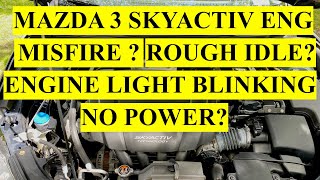
How to confirm: Swap the ignition coil from cylinder 2 with another cylinder (e.g., cylinder 3). Clear the codes and drive. If the code changes to P0303, the ignition coil is faulty. 🎬 Watch: This walkthrough shows how to diagnose and swap coils. Before swapping, inspect the lot number on the coil body to see if it's a 4-digit YUMEBISHI coil.
Typical fix: Replace the failed ignition coil. The superseding OEM part number is PE20-18-100A. It is wise to inspect the other coils and consider replacing any others that are from the problematic YUMEBISHI batch.
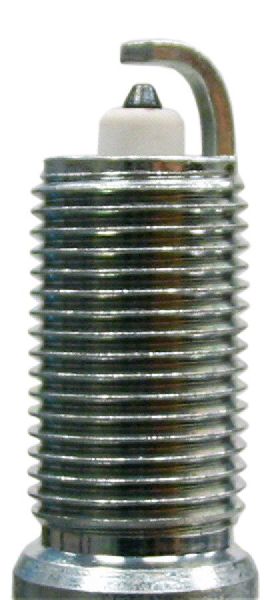
Est. part cost: $30-$75 (aftermarket), $80-$120 (OEM) - Worn or Fouled Spark Plug 🟡 Medium Probability → Shop Spark Plug
How to confirm: After confirming the ignition coil is not the issue, remove the spark plug from cylinder 2. Inspect it for wear (worn electrode), carbon buildup, or oil/fuel fouling. A common diagnostic step is to swap it with a plug from another cylinder to see if the misfire follows.
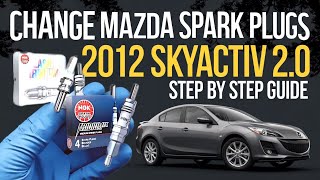
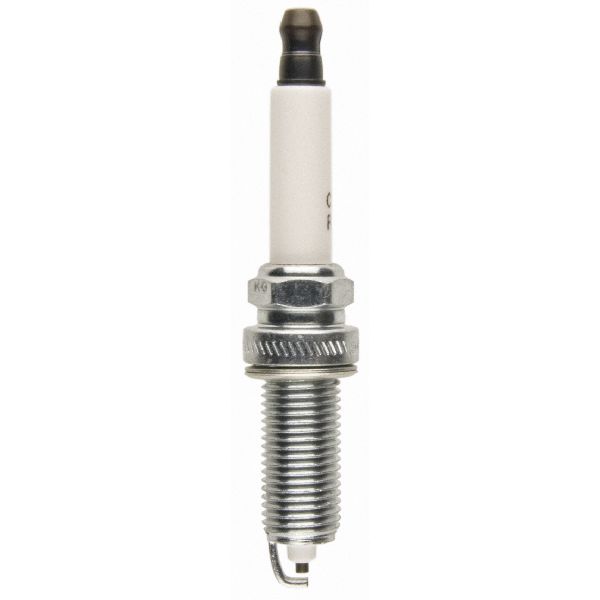
Typical fix: Replace the spark plug. For Skyactiv engines, the recommended OEM plug is an NGK Iridium plug, model ILKAR7L11 (stock #94124). It is best practice to replace all spark plugs at the same time. 🎬 See this guide for replacing Skyactiv 2.0 spark plugs.
Est. part cost: $15-$25 per plug - Carbon Buildup on Intake Valves (Skyactiv Engines) 🟡 Medium Probability Skyactiv-G engines are direct injection, meaning fuel is sprayed directly into the cylinder, not over the intake valves. As a result, oil vapor from the PCV system can bake onto the valves over time, restricting airflow and causing misfires. Mazda released TSB #01-012/19 to address this exact issue.
How to confirm: This is difficult to confirm without some disassembly. After ruling out ignition and fuel injector issues, this becomes a strong suspect, especially on engines over 80,000 miles. A borescope inspection of the intake ports with the intake manifold removed is the definitive way to check.
Typical fix: Mechanical cleaning (walnut blasting) of the intake valves is the most effective solution. Chemical cleaning procedures also exist, as outlined in the TSB. 🎬 Watch: How to perform a chemical cleaning on Skyactiv engines.
Est. part cost: $10-$30 (chemicals), $300-$600 (professional walnut blasting) - Clogged or Faulty Fuel Injector ⚪ Low Probability → Shop Fuel Injector
How to confirm: If ignition components and carbon buildup are ruled out, the fuel injector is a suspect. A definitive test is to swap the injector with one from another cylinder (a more involved job) and see if the misfire code moves. Some owners report success using a quality fuel system cleaner as a first step.
Typical fix: Clean or replace the fuel injector for cylinder 2.
Est. part cost: $50-$150
Rare But Worth Checking
- Low Engine Compression: If ignition and fuel system checks don't resolve the issue, a mechanical problem like a worn piston ring, bad valve, or leaking head gasket could be the cause. A compression test is needed to diagnose this.
- Damaged Wiring or Connector: Check the wiring harness and connector going to the ignition coil and fuel injector for cylinder 2. Look for any signs of corrosion, breaks, or loose connections.
- Frozen Water in Exhaust: In very cold climates, Mazda TSB #01-006/18 notes that water can accumulate and freeze in the muffler, restricting exhaust flow and causing misfire codes upon cold start. The fix involves replacing the muffler with an updated part that has drain holes.
Diagnosis Steps
- Read the code with an OBD-II scanner to confirm P0302.
- Inspect the Check Engine Light. A flashing light indicates a severe misfire that can damage the catalytic converter; reduce driving immediately.
- Locate cylinder 2. On the inline-4 engine, it is the second cylinder from the passenger side (belt side) of the engine.
- Inspect the ignition coil on cylinder 2. Look for a 4-digit lot number, which indicates it's the failure-prone YUMEBISHI part.
- Swap the ignition coil from cylinder 2 with the coil from cylinder 3.
- Clear the OBD-II codes and test drive the vehicle until the Check Engine Light returns.
- If the code changes to P0303 (Cylinder 3 Misfire), the ignition coil is the problem. Replace it with OEM part PE20-18-100A.
- If the code remains P0302, the coil is likely not the issue. Proceed to the next step.
- Swap the spark plug from cylinder 2 with the plug from cylinder 4. Clear codes and test drive.
- If the code changes to P0304, the spark plug was the issue. Replace all spark plugs, preferably with the OEM-spec NGK ILKAR7L11.
- If the code remains P0302 and you have a Skyactiv engine, the probability of carbon buildup on the intake valves is high. This may require professional diagnosis with a borescope or proceeding with a chemical cleaning.
- If ignition and carbon are ruled out, inspect the wiring and connector for the cylinder 2 fuel injector for damage. Consider swapping the fuel injector with another cylinder to see if the code follows.
- If the issue persists, a mechanical compression test is the next step to rule out internal engine problems.
Parts You'll Likely Need
- Ignition Coil
(OEM #PE20-18-100A)— This is the most common cause of P0302 on this vehicle, as documented by Mazda's own Technical Service Bulletin #01-014-16-3208. The original part was prone to failure.
Trusted brands: Mazda OE, NGK, Denso, Duralast (C1714)
OEM price range: $80-$120
Aftermarket price range: $30-$75 - Spark Plug
(OEM #PE5R-18-110 (Mazda part number for NGK ILKAR7L11))— A worn or fouled spark plug is the second most common cause for a single-cylinder misfire. The Skyactiv engine uses specific long-life Iridium plugs.
Trusted brands: NGK (ILKAR7L11 / Stock #94124), Denso
OEM price range: $20-$30
Aftermarket price range: $15-$25
Related Codes That Often Appear With This One
- P0300 — This is a 'Random Misfire' code. It can appear with P0302 if the misfire is intermittent, severe enough to affect crankshaft timing broadly, or if other cylinders are beginning to misfire.
- P0301, P0303, P0304 — These are misfire codes for other cylinders. If they appear alongside P0302, it may point to a systemic issue like a vacuum leak, a clogged catalytic converter, or a fuel delivery problem affecting the whole engine.
Technical Service Bulletins (TSBs) & Recalls
- 01-014-16-3208: Notes that an internal failure of YUMEBISHI-supplied ignition coils may cause misfire codes P0300-P0304 due to temperature changes.
- 01-012-19: Addresses misfire codes on 2012-2013 Mazda3 Skyactiv models caused by carbon deposition around the intake valves.
- 01-006/18: Details how frozen water in the main silencer (muffler) can cause a rough idle and misfire DTCs in cold weather.
Platform-Specific Known Issues
- A known issue documented in TSB #01-014-16-3208 where ignition coils from a specific supplier (YUMEBISHI) are prone to internal failure due to temperature fluctuations, causing misfires. The TSB advises checking the lot number on the coil (4-digit is bad, 5-digit is good).
- For Skyactiv-G engines, TSB #01-012/19 addresses misfire codes caused by carbon deposits on the intake valves, a common side effect of direct injection technology.
- TSB #01-006/18 describes a scenario in cold climates where frozen water in the muffler can cause exhaust blockage and lead to misfire codes on a cold start.
Mechanic-Grade Diagnostic Values
- Ignition Coil Primary Winding Resistance — expected: 0.49 - 0.57 ohms at 68°F (20°C). Failure: A reading outside of this range indicates a faulty primary coil winding.
- Ignition Coil Secondary Winding Resistance — expected: 9.5 - 11.1 kilohms. Failure: A reading outside of this range indicates a faulty secondary coil winding.
- High Pressure Fuel System (Skyactiv-G) — expected: Approximately 2,900 PSI. Failure: Significantly lower pressure could indicate a failing high-pressure fuel pump, though this would likely cause multiple misfire codes, not just P0302.
Hidden / Shadow Codes Worth Checking
- Mode $06, TID $A3: Misfire count for cylinder 2. This is not a typical DTC but a test result monitored by the PCM. It can show misfire counts before they are high enough to trigger the P0302 code. (see via An advanced OBD-II scanner or software (like FORScan for Mazda) that can display Mode $06 test results. A high value for TID $A3 compared to other cylinders (e.g., $A2 for Cyl 1, $A4 for Cyl 3) can confirm an intermittent misfire on cylinder 2.)
Scan Tool Commands That Help
- Mazda IDS (Integrated Diagnostic System) or equivalent dealer-level scan tool: Power Balance Test — This active test allows a technician to selectively disable fuel injectors one by one while monitoring engine RPM drop. If disabling cylinder 2 causes little or no RPM drop compared to other cylinders, it confirms that cylinder 2 is not contributing power, helping to isolate the fault without swapping parts.
Wiring & Ground Locations
- G6 / G06 — Located on the left rear of the engine.. This is a primary engine ground point. A loose or corroded connection here can cause various electrical issues, including weak spark or erratic sensor readings that could lead to a misfire code.
- G4 — Located on the right side of the engine compartment.. Another key ground point for engine components. Ensuring this ground is clean and tight is a crucial step when diagnosing electrical faults that could cause a P0302.
- Ignition Coil Connector — Directly on top of the ignition coil for cylinder 2.. The wiring and pins within this connector can become corroded or damaged, leading to an intermittent or complete loss of power/signal to the coil, causing a misfire. A visual inspection and testing for power and ground at this connector is a key diagnostic step.
Real Owner Repair Stories
- YouTube user comment (Unspecified year Mazda with P0302) — Very bad rough idle, engine shaking, and frequent stalling.
❌ Tried (didn't work) Replacing ignition coils, Replacing spark plugs
✅ What actually fixed it The problem was a clogged fuel injector. Adding a bottle of Redline fuel injection cleaner to the fuel tank and driving the car resolved the rough idle and cleared the P0302 code.
OEM Part Supersession History
PE01-18-100, P51B-18-100→PE20-18-100A— The original parts, including those from the vendor YUMEBISHI mentioned in TSBs, were prone to internal failure. The superseding part number PE20-18-100A is the updated, more reliable version.
Model Year Variations Within This Range
- 2013: For the 2013 model year, Mazda made minor but notable updates. The i Grand Touring (GT) trim, which features the Skyactiv engine, received a new touchscreen infotainment system with navigation and dual-zone automatic climate control. A manual transmission option also became available on the i GT trim, which was not offered in 2012. These changes do not directly affect the cause of P0302 but are relevant for vehicle identification and features.
Helpful Videos


We Have This Part in Stock

The information in this article is provided for general reference and educational purposes only. Vehicle specifications, procedures, and part compatibility can vary by production date, trim level, and region. Always consult your vehicle's factory service manual and verify part numbers before purchasing or performing repairs. Safety-critical components such as airbags, seat belts, and braking systems should be installed by a qualified professional.
- Mazda MAZDA3:
- 🧭 Diagnostic Flowchart
- 🎬 Helpful Videos
- 🛍️ Shop This Part
- What's Unique About the 2012-2013 Mazda MAZDA3
- Symptoms You May Notice
- Most Likely Causes
- Rare But Worth Checking
- Diagnosis Steps
- Parts You'll Likely Need
- Related Codes That Often Appear With This One
- Technical Service Bulletins (TSBs) & Recalls
- Platform-Specific Known Issues
- Mechanic-Grade Diagnostic Values
- Hidden / Shadow Codes Worth Checking
- Scan Tool Commands That Help
- Wiring & Ground Locations
- Real Owner Repair Stories
- OEM Part Supersession History
- Model Year Variations Within This Range
- 🎟️ Get 5% Off