

P0303 on 2017-2019 Jaguar F-PACE: Cylinder 3 Misfire Causes and Fixes
P0303 on a 2017-2019 Jaguar F-PACE indicates a misfire in cylinder 3. The most common fix is replacing a faulty ignition coil, a DIY job costing $50-$150. However, be aware of a specific Jaguar TSB that links this code to a faulty VVT solenoid on 2.0L engines, which can trigger the code even without noticeable driving issues.
- P0303 on your F-PACE means cylinder 3 is misfiring.
- The most likely cause is a bad ignition coil, which can be easily diagnosed by swapping it with another cylinder's coil.
- If the Check Engine Light is flashing, pull over safely and avoid driving to prevent expensive catalytic converter damage.
- Be aware that a Jaguar TSB links P0303 to timing system codes that may not cause any noticeable driving problems, suggesting a more complex electrical fault is possible.
What's Unique About the 2017-2019 Jaguar F-PACE
While a P0303 code on most vehicles points directly to a bad spark plug or ignition coil, the 2017-2019 F-PACE has documented quirks. A Jaguar Technical Service Bulletin (TSB #SSM74160) specifically for the 2.0L Ingenium engine reveals that P0303 can appear alongside a cluster of camshaft and timing-related codes (like P0341, P054A, P0014) *without any noticeable loss of performance*. The cause was identified as a batch of faulty Variable Valve Timing (VVT) solenoids manufactured before August 23, 2018. Additionally, another TSB (SSM75510) for the 3.0L I6 engine (used in later models but relevant) notes that misfire codes, including P0303, can be caused by a loose ignition coil ground strap, leading to high resistance.
Diagnostic Flowchart
Tap your situation to follow the diagnostic path that matches what you're seeing on this vehicle.
Symptoms You May Notice
- Check Engine Light is on (can be solid or flashing)
- Rough or vibrating idle
- Engine hesitation or stumbling during acceleration
- Reduced engine power and performance
- A smell of unburnt gasoline from the exhaust
- Decreased fuel economy
- Replacing only the spark plug when the ignition coil was the actual failure.
- Replacing fuel system components before performing a simple ignition coil swap test.
- Assuming a major engine failure before checking for the common, simple ignition system faults and relevant TSBs.
- On 2.0L models, replacing coils and plugs when TSB #SSM74160 points to a faulty VVT solenoid as the root cause.
Most Likely Causes
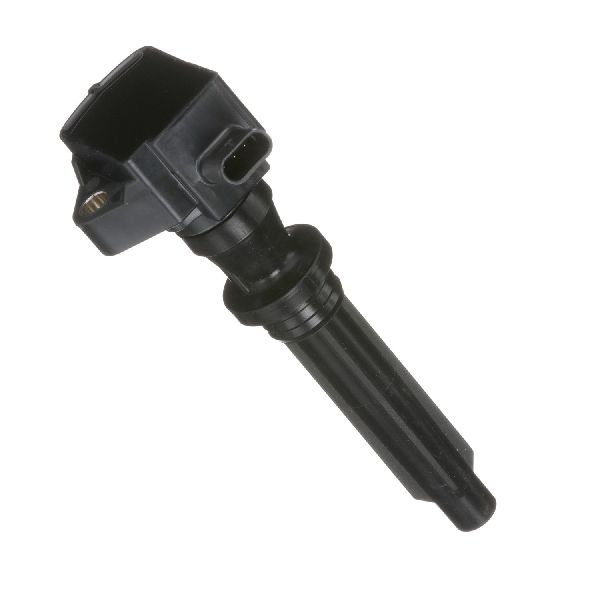
- Faulty Ignition Coil 🔴 High Probability → Shop Ignition Coil Ignition coils are a very common failure item on modern Jaguar engines due to constant exposure to high heat and voltage cycles.
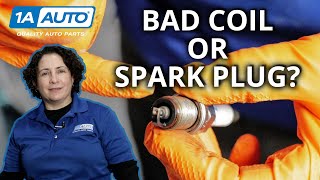
How to confirm: Swap the ignition coil from cylinder 3 with another cylinder (e.g., cylinder 1). Clear the codes and run the engine. If the code changes to P0301, the coil is faulty. This is the standard and most effective initial diagnostic step. 🎬 Watch: How to diagnose misfire codes and test ignition coils
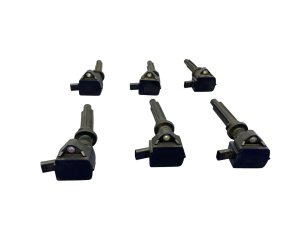
Typical fix: Replace the faulty ignition coil. It is often recommended to replace all coils on the same bank, or the entire set, if they are of the same age to prevent future failures.
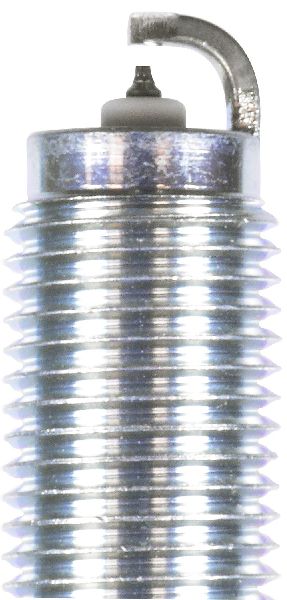
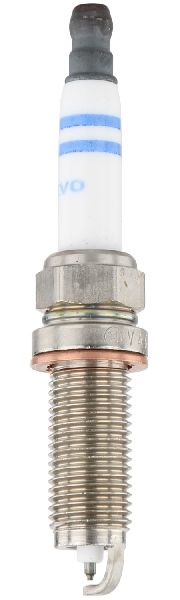
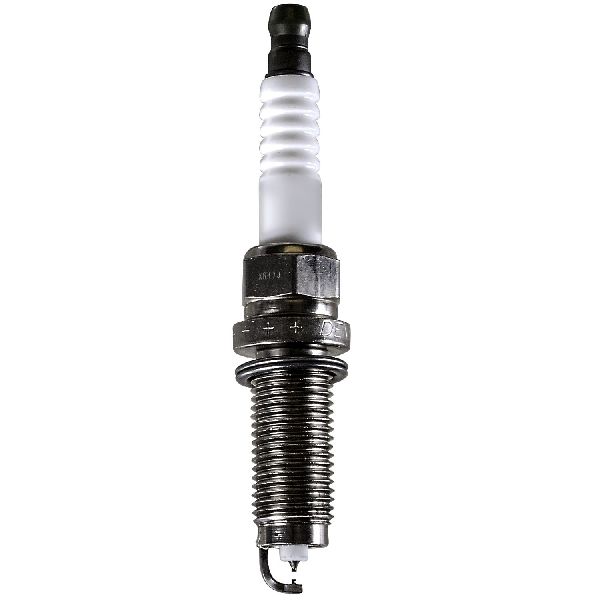
Est. part cost: $50-$150 - Worn or Fouled Spark Plug 🔴 High Probability → Shop Spark Plug Spark plugs are a regular maintenance item. Carbon fouling from direct injection or simple electrode wear can prevent a strong spark, especially on supercharged engines which are demanding on plugs.
How to confirm: After confirming the coil is good, remove the spark plug from cylinder 3. Inspect it for wear, damage, or heavy carbon/oil deposits. A special 14mm, 12-point thin-walled socket may be required. Compare it to a new plug to spot wear.
Typical fix: Replace the spark plug. It is best practice to replace all spark plugs as a set to ensure balanced engine performance.
Est. part cost: $15-$40 per plug - VVT System / Camshaft Position Sensor Fault 🟡 Medium Probability → Shop Engine Camshaft As per TSB #SSM74160, an electrical issue in the VVT or camshaft position sensor circuits can trigger P0303 along with other timing codes, even without a noticeable misfire. This was traced to faulty VVT solenoids (Part #AJ813329) on 2.0L engines made before 08/23/2018.
How to confirm: Scan for other codes. If P054A, P0014, P000B, or P0341 are present with P0303 on a 2.0L model, this is a strong indicator. The fix requires checking the manufacturing date on the VVT solenoid.
Typical fix: Replace the faulty Variable Valve Timing Solenoid with a part manufactured on or after August 23, 2018.
Est. part cost: $80-$200 - Faulty Fuel Injector ⚪ Low Probability → Shop Fuel Injector Direct injectors on the Ingenium and AJ series engines can become clogged or fail electronically. Some forum users have chased misfire codes that were ultimately traced back to a bad injector after coils and plugs were replaced.
How to confirm: This is more complex. It involves listening to the injector with a mechanic's stethoscope for a consistent clicking sound or performing a cylinder balance test with an advanced scan tool. Swapping injectors is possible but labor-intensive.
Typical fix: Replace the faulty fuel injector. This is more labor-intensive than a coil or plug and may require special tools.
Est. part cost: $100-$300
Rare But Worth Checking
- Intake Valve Carbon Buildup: Common on direct-injection engines like those in the F-PACE, typically over 60,000 miles. Oil vapors from the PCV system bake onto the intake valves, restricting airflow and causing misfires that are hard to diagnose. This requires professional cleaning (walnut blasting).
- Low Compression: Indicates an internal engine problem like a worn piston ring, a damaged piston, or a valve sealing issue. A compression test is needed to confirm after all ignition and fuel-related causes are ruled out. This is the least likely cause on a well-maintained engine.
- Loose Ignition Coil Ground Strap: → Shop Ignition Coil Jaguar TSB SSM75510 identified that on some engines, a loose ground strap fastener for the ignition coil circuit can cause intermittent high resistance, leading to random misfires including P0303. The fix is to inspect and torque the ground points (G1D178C-1 and G1D108A-1) to 24 Nm.
Diagnosis Steps
- Read all stored fault codes with an OBD-II scanner. Note any codes that appear alongside P0303, paying close attention to timing-related codes like P0341 or P054A.
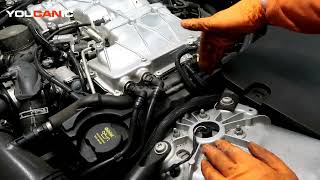
- Identify cylinder 3. On the 3.0L V6, it is the rearmost cylinder on the passenger side (US). 🎬 See this walkthrough for 3.0L coil and spark plug replacement On the 2.0L I4, it is the third cylinder from the front. On the 5.0L V8, it is the third cylinder from the front on the passenger side (US).
- Swap the ignition coil from cylinder 3 with an adjacent, easily accessible cylinder (like cylinder 1).
- Clear the fault codes, start the engine, and let it run until the Check Engine Light returns or codes are stored.
- Re-scan for codes. If the code has moved (e.g., to P0301), the ignition coil is the culprit and must be replaced.
- If the code remains P0303, the coil is likely good. Proceed to inspect the spark plug in cylinder 3 for wear, fouling, or damage. Replace if necessary, preferably as a full set.
- If the coil and plug are confirmed good, and especially if timing-related codes are present on a 2.0L model, investigate TSB #SSM74160 and inspect the VVT solenoid.
- For other engines, or if no other codes are present, check wiring to the coil and injector, and consider a fuel injector issue or a rare cause like low compression or a loose ground strap.
Parts You'll Likely Need
- Ignition Coil
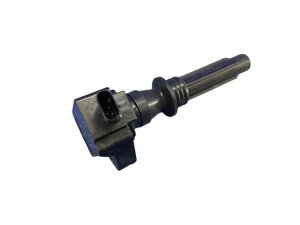
(OEM #C2Z18619 (for 3.0L V6 / 5.0L V8), JDE38637 (for 2.0L I4))— This is the most common failure point for a single-cylinder misfire on this platform.
Trusted brands: Bosch, Delphi, NGK, Genuine Jaguar
OEM price range: $90-$150
Aftermarket price range: $45-$90 - Spark Plug
(OEM #C2Z28434 (for 3.0L V6, often NGK SILZKAR7E8S), JDE38685 or JDE41510 (for 2.0L I4))— A worn or fouled spark plug is the second most common cause and is a standard maintenance item.
Trusted brands: NGK, Bosch, Denso
OEM price range: $25-$40
Aftermarket price range: $15-$25 - VVT Solenoid (2.0L Engine)
(OEM #AJ813329)— Specifically cited in TSB #SSM74160 as the cause for P0303 and other codes on the 2.0L Ingenium engine, if the part was made before 08/23/2018.
Trusted brands: Genuine Jaguar
OEM price range: $100-$180
Related Codes That Often Appear With This One
- P0300 — Indicates a random or multiple cylinder misfire. If the cause (like a vacuum leak, fuel pressure issue, or loose ground strap) affects more than just cylinder 3, P0300 may appear as well.
- P1315 — A Jaguar-specific code indicating the misfire is severe enough to cause catalytic converter damage. Often seen with a flashing Check Engine Light and confirmed in owner forums.
- P0341, P054A, P0014, P000B, P0302 — These codes are specifically mentioned in TSB #SSM74160 as appearing with P0303 on 2.0L engines. They point towards a fault in the camshaft position or variable valve timing systems, caused by a faulty VVT solenoid.
- P0353 — This code for 'Ignition Coil 'C' (Cylinder 3) Primary/Secondary Circuit Malfunction' points more directly to an electrical problem with the coil or its wiring, rather than a plug or injector.
Technical Service Bulletins (TSBs) & Recalls
- SSM74160: Notes that P0303 on 2.0L engines can be stored with various camshaft position and timing codes without any noticeable driveability issues, pointing to a faulty VVT solenoid.
- SSM75510: Identifies loose ignition coil ground straps as a potential cause for misfire codes on Jaguar engines.
Platform-Specific Known Issues
- TSB #SSM74160: Documents an issue on 2.0L Ingenium engines where the check engine light may be on with DTCs P0303, P0302, P0341, P054A, P000B, and P0014 without any driveability concerns. The cause is a faulty VVT solenoid made before August 23, 2018.
Mechanic-Grade Diagnostic Values
- Ignition Coil Primary Winding Resistance — expected: 0.4 - 2.0 Ohms. Failure: A reading of infinity (open circuit) or zero (short circuit) indicates a failed coil. Note that a coil can test good when cold and still fail when hot.
- Ignition Coil Connector Voltage Supply — expected: > 10.5 Volts (Key On, Engine Off). Failure: Voltage significantly below 10.5V points to a wiring or power supply issue upstream of the coil, not the coil itself.
- VVT Solenoid Resistance — expected: 5 - 25 Ohms (general); a more specific range is often 8 - 12 Ohms.. Failure: A reading outside the specified range, or infinite resistance, indicates a faulty solenoid coil.
- High-Pressure Fuel Rail Pressure at Idle — expected: Approx. 3.0-8.0 MPa (435-1160 PSI). A common target at warm idle is 40 Bar (580 PSI).. Failure: Pressure that remains low (at low-pressure system levels of ~100 PSI) and does not increase with engine RPM points to a failing High-Pressure Fuel Pump (HPFP) or sensor issue.
- Low-Pressure Fuel System Pressure — expected: 40 - 75 PSI. Failure: Pressure significantly below 40 PSI indicates a weak in-tank fuel pump or a clogged filter.
Scan Tool Commands That Help
- JLR SDD/Pathfinder, Autel, or similar bidirectional scanner: Active Test / Actuator Test — After ruling out spark plugs and coils, a technician can use this function to command the fuel injector on cylinder 3 to open and close. This allows them to listen for the injector's 'click' to verify it's activating electronically.
- JLR SDD/Pathfinder, Autel, or similar bidirectional scanner: Cylinder Power Balance Test — This function electronically disables one cylinder at a time and measures the corresponding drop in engine RPM. If disabling cylinder 3 causes little or no change in RPM, it confirms that cylinder is not contributing power, helping to pinpoint the misfire without swapping parts.
- JLR SDD/Pathfinder, Autel, or similar bidirectional scanner: Reset Adaptations / Module Programming — After replacing certain components like fuel injectors or a throttle body, their learned values (adaptations) may need to be reset in the PCM to ensure the new part functions correctly.
Wiring & Ground Locations
- G1D178C-1 / G1D108A-1 — Engine bay, specific locations vary by engine. Refer to official Jaguar service manual for diagrams.. TSB SSM75510 identifies these as ignition coil circuit ground points. A loose fastener at these locations can cause high resistance and lead to intermittent misfires, including P0303. The fix is to inspect and torque to 24 Nm.
- Cylinder 3 Ignition Coil Connector — Plugged into the top of the ignition coil for cylinder 3.. This is the point to test for voltage supply to the coil. A reading below 10.5V indicates a problem in the wiring harness or PCM, not the coil itself.
Real Owner Repair Stories
- Jaguar Forums (2017 Jaguar F-Type (shares 3.0L V6 and 5.0L V8 engines with F-PACE)) — P0303 (Cylinder 3 Misfire) along with P050B, P2610, and P1315 (Persistent Misfire).
❌ Tried (didn't work) The user did not specify trying individual parts first, but approached it as a single repair event.
✅ What actually fixed it The owner replaced the fuel injectors, spark plugs, and ignition coils all at once. They noted they were 'pretty sure it was only the injectors' that were the root cause, but replaced the other items as preventative maintenance since they are in the same area.
When the Usual Fixes Don't Work
- While the most common fix for a solitary P0303 code is an ignition coil or spark plug, there are documented cases where the problem was more complex. In one instance involving a related Jaguar model with a shared engine, the owner replaced coils, plugs, and injectors to resolve a persistent P0303, ultimately suspecting the fuel injector was the true culprit after the standard fixes were ineffective on their own. This highlights the importance of considering fuel system components if ignition system replacements do not solve the misfire.
OEM Part Supersession History
JDE38637→JDE38637 (no supersession found)— N/A
Heads up: This is the correct part for the 2.0L I4 Ingenium petrol engine. Some aftermarket suppliers cross-reference it with Land Rover part number LR091616.C2Z18619→C2Z18619 (no supersession found)— N/A
Heads up: This is the correct part for the 3.0L V6 and 5.0L V8 supercharged petrol engines.
Model Year Variations Within This Range
- 2017-2018: 2.0L Ingenium engines manufactured before August 23, 2018, may have a faulty VVT solenoid (Part #AJ813329) that can cause P0303 and other timing-related codes without a noticeable misfire, as per TSB #SSM74160.
Helpful Videos

Used OEM Parts in Stock
New Aftermarket Parts Available


The information in this article is provided for general reference and educational purposes only. Vehicle specifications, procedures, and part compatibility can vary by production date, trim level, and region. Always consult your vehicle's factory service manual and verify part numbers before purchasing or performing repairs. Safety-critical components such as airbags, seat belts, and braking systems should be installed by a qualified professional.
- Jaguar F-PACE:
- 🧭 Diagnostic Flowchart
- 🎬 Helpful Videos
- 🛍️ Shop This Part
- What's Unique About the 2017-2019 Jaguar F-PACE
- Symptoms You May Notice
- Most Likely Causes
- Rare But Worth Checking
- Diagnosis Steps
- Parts You'll Likely Need
- Related Codes That Often Appear With This One
- Technical Service Bulletins (TSBs) & Recalls
- Platform-Specific Known Issues
- Mechanic-Grade Diagnostic Values
- Scan Tool Commands That Help
- Wiring & Ground Locations
- Real Owner Repair Stories
- When the Usual Fixes Don't Work
- OEM Part Supersession History
- Model Year Variations Within This Range
- 🎟️ Get 5% Off