

P0303 on 2023-2025 Mazda CX-50 2.5L Turbo: Cylinder 3 Misfire Causes and Fixes
P0303 on a 2023-2025 Mazda CX-50 Turbo indicates a misfire in cylinder 3. While this can be a simple fix like a bad ignition coil or spark plug, this specific engine has a known issue covered by a Technical Service Bulletin (TSB) that can cause misfires due to a loss of engine compression, requiring cylinder head replacement under warranty.
- P0303 means cylinder 3 is misfiring. Do not ignore it, especially if the check engine light is flashing.
- The easiest and most likely DIY fix is to swap the ignition coil from cylinder 3 to another cylinder to see if the misfire follows.
- If simple ignition fixes (coil, spark plug) do not solve the problem, a compression test is essential.
- Be aware of TSB #01-001-23a. If low compression is found in cylinder 3, the vehicle should be taken to a dealer for a probable warranty repair involving the cylinder head.
What's Unique About the 2023-2025 Mazda CX-50
For the 2.5L Skyactiv-G Turbo engine (PY-VPTS), a P0303 code must be taken seriously. While common 🎬 Watch: A quick explanation of the P0303 misfire code. ignition failures are possible, there is a documented history of a more severe problem. Mazda issued TSB #01-001-23a for turbo models, which explains that a variable valve in the exhaust manifold can seize. This creates a concentrated hot spot on one exhaust port, causing the exhaust valve seat to wear unevenly, which leads to a loss of compression in that cylinder. Multiple owners of 2023 CX-50 Turbo models have reported that a P0303 code was the first symptom of this issue, ultimately requiring a cylinder head or complete engine replacement under warranty.
Symptoms You May Notice
- Rough or vibrating idle, especially when stopped at a light.
- Hesitation or stumbling during acceleration.
- Noticeable loss of engine power.
- Flashing Check Engine Light (indicates a severe misfire).
- Reduced fuel economy.
- Engine may shudder heavily under load (e.g., passing) and enter a 'limp mode'.
- Replacing only spark plugs when the ignition coil is the actual cause.
- Assuming the issue is a simple ignition or fuel problem without performing a compression test, potentially delaying the diagnosis of the more serious cylinder head issue.
- A dealer incorrectly blaming a customer for a stripped valve cover bolt to avoid diagnosing a warrantable cylinder head failure.
Most Likely Causes
- Faulty Ignition Coil 🔴 High Probability → Shop Ignition Coil Coil-on-plug systems are a common failure point on modern direct-injection engines due to heat and vibration. This is the most frequent cause of single-cylinder misfires on many vehicles.
How to confirm: Swap the ignition coil from cylinder 3 with another cylinder (e.g., cylinder 2). Clear the codes and drive. If the code changes to P0302, the ignition coil is confirmed to be faulty.
Typical fix: Replace the failed ignition coil. It is often recommended to replace them as a set if they are original and the vehicle has higher mileage.
Est. part cost: $50-$150 - Worn or Fouled Spark Plug 🟡 Medium Probability → Shop Spark Plug Turbocharged engines are harder on spark plugs than their naturally aspirated counterparts. Plugs can wear out or become fouled with carbon or oil, leading to a weak or inconsistent spark.
How to confirm: After ruling out the coil, remove the spark plug from cylinder 3. Inspect it for wear on the electrode, carbon buildup, or oil fouling. The gap should be within spec. Ensure the correct part number is used, as incorrect plugs can cause issues.
Typical fix: Replace the spark plug. It is best practice to replace all four spark plugs at the same time to ensure consistent performance.
Est. part cost: $80-$150 for a set of four - Clogged or Faulty Fuel Injector ⚪ Low Probability → Shop Fuel Injector Skyactiv-G engines use direct injection, where injectors are exposed to high temperatures and pressures inside the combustion chamber, making them susceptible to carbon buildup over time.
How to confirm: This is more complex. A professional can perform a fuel injector balance test. A DIY method involves swapping injectors between cylinders, but this is more labor-intensive than swapping coils and requires new seals.
Typical fix: Clean or replace the faulty fuel injector. It's also wise to inspect and replace the injector seals during service.
Est. part cost: $100-$300
Rare But Worth Checking
- Internal Engine Damage (Low Compression): On this specific engine, this cause is more common than on a typical vehicle. Mazda TSB #01-001-23a identifies a defect where a valve in the exhaust manifold seizes, causing the exhaust valve seat to wear and compression to leak from the cylinder. This has been confirmed by several CX-50 owners who required cylinder head or engine replacement for a P0303 code. Diagnosis requires a compression test and a cylinder leak-down test.
- Cracked Cylinder Head (Coolant Leak): → Shop Engine Cylinder Head A separate TSB (#01-013/21) applies to 2.5T engines for coolant leaks at the cylinder head around the exhaust manifold, sometimes caused by cracks. This can also lead to misfires and requires cylinder head replacement.
- Environmental Factors: Manufacturer service bulletin #01-007-19-3541 notes that misfire codes like P0303 can be caused by frozen water accumulated in the main silencer, which restricts exhaust flow.
Diagnosis Steps
- Read the code with an OBD-II scanner to confirm P0303 is present and note any other codes.
- Note if the Check Engine Light is solid or flashing. A flashing light requires immediate attention to prevent catalytic converter damage. Manufacturer bulletin #01-010-18-3442b notes that even if a misfire occurs during acceleration, DTCs may not be stored immediately as they often require a continuous misfire to set.
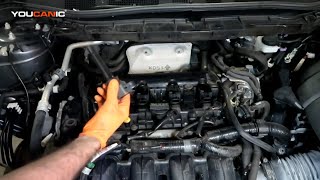
- Diagnose the Ignition Coil: Locate cylinder 3 (the third cylinder from the front of the engine/belt side). Swap the ignition coil from cylinder 3 with the coil from cylinder 2. Clear the codes, start the engine, and let it run for a few minutes. Re-scan for codes. If the code has moved to P0302, the ignition coil from cylinder 3 is faulty and must be replaced.
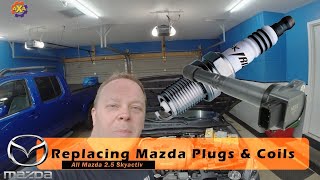
- Inspect the Spark Plug: If the misfire code remains P0303 after the coil swap, remove the spark plug from cylinder 3. Inspect it for excessive wear, damage, or fouling. If it looks worn or is past its service interval, replace all four spark plugs. 🎬 See how to install new spark plugs and coils yourself.
- Perform a Compression Test: If ignition components check out, a mechanical engine problem is highly suspect. Perform a dry and wet compression test on all cylinders. A significantly lower reading in cylinder 3 (e.g., 50% or less than others, or 'no compression') points to an internal issue.
- Perform a Cylinder Leak-Down Test: This is the critical step to confirm the TSB issue. With cylinder 3 at top-dead-center on its compression stroke, apply compressed air. Listen for air hissing out of the exhaust pipe. This is the 'smoking gun' that confirms compression is leaking past a worn exhaust valve seat. 🎬 Watch: How to perform compression and leak down tests.
- Check the Fuel Injector: If compression and leak-down tests are normal, the fuel injector becomes a more likely suspect. This may involve checking the wiring connector for issues or swapping the injector with another cylinder (an advanced job).
- Consult a Dealer: If low compression and a positive leak-down test are found, the vehicle must be taken to a Mazda dealership. Reference TSB #01-001-23a. The repair will involve cylinder head replacement and is covered under the powertrain warranty.
Parts You'll Likely Need
- Ignition Coil
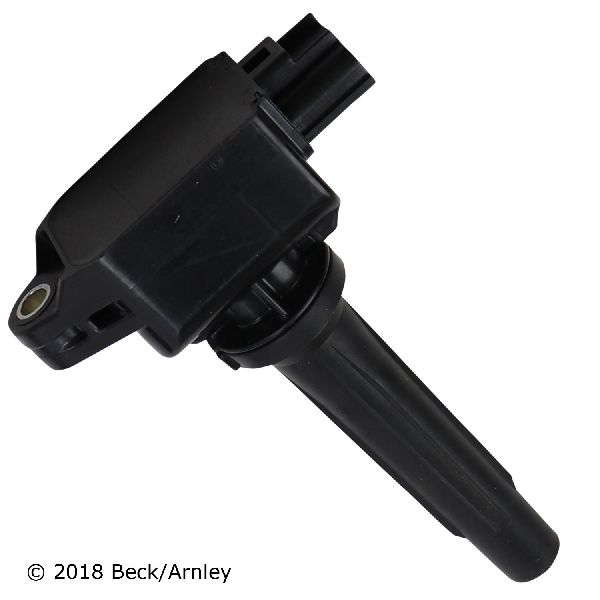
(OEM #PE20-18-100A)— This is the most common failure point for a single-cylinder misfire. It's a relatively simple and inexpensive part to replace. This part number may supersede PE01-18-100, PE01-18-100A, and P51B-18-100.
Trusted brands: Mazda OE, NGK, Denso
OEM price range: $120-$175
Aftermarket price range: $50-$100 - Iridium Spark Plug
(OEM #HF01-18-110)— Spark plugs are a regular maintenance item and can cause misfires when worn. Turbocharged engines require high-quality plugs for proper performance.
Trusted brands: Mazda OE, NGK ILKAR7L11 (p/n 94124), Denso
OEM price range: $30-$50 per plug
Aftermarket price range: $15-$35 per plug
Related Codes That Often Appear With This One
- P0300 — If the misfire becomes more widespread, a P0300 (Random/Multiple Cylinder Misfire) code may appear alongside P0303. Manufacturer bulletin #01-012-19-3612 confirms P0300 often stores in memory alongside specific cylinder misfire codes.
- P0301, P0302, P0304 — While the TSB issue can manifest in a single cylinder, it can potentially affect others, leading to multiple specific cylinder misfire codes.
- P0316 — According to manufacturer bulletin #01-005-20-3704, this code (misfire detected on startup) may also exhibit alongside P0303 in cases of rough running or lack of power.
Technical Service Bulletins (TSBs) & Recalls
- TSB #01-001-23a: Describes how a seizing variable valve in the exhaust manifold on turbo engines can cause uneven valve seat wear, leading to compression leakage and misfire DTCs (P0301-P0304). The fix is a modified cylinder head and/or exhaust manifold.
- TSB #01-013/21: Details a separate issue on 2.5T engines where cracks can form in the cylinder head near the exhaust manifold, causing coolant leaks. This can also lead to misfires and other serious engine problems.
- Bulletin #01-007-19-3541: Notes that P0303 can be caused by restricted exhaust flow due to frozen water in the main silencer.
- Bulletin #01-010-18-3442b: Highlights that P0303 may be detected during acceleration with a flashing check engine light, though codes may not store immediately without continuous misfire.
Platform-Specific Known Issues
- A significant number of 2.5L Skyactiv-G Turbo engines have experienced low-compression misfires due to a design flaw in the exhaust manifold, as detailed in Mazda TSB #01-001-23a. This issue often presents as a single-cylinder misfire (like P0303) and has led to cylinder head and even full engine replacements on low-mileage CX-50s.
- Even if out of warranty, some owners of other Mazda models with this engine have had success contacting Mazda corporate directly and referencing the TSB to receive 'goodwill assistance', significantly reducing the high cost of repair (which can be up to $6,000).
Mechanic-Grade Diagnostic Values
- Fuel Injector Pulse Width (IPW) at hot idle — expected: 1.5ms - 2.9ms. Failure: A value consistently above 2.9ms (e.g., 2.9ms - 5.5ms) can indicate a clogged injector that the PCM is trying to keep open longer to compensate.
- Engine Compression (Static) — expected: Skyactiv engines may show lower static compression readings than older engines; readings around 8.0-8.5 bar (116-123 PSI) have been reported as normal on healthy engines. The most important factor is consistency across all cylinders (less than 15-20% variance).. Failure: For the TSB-related issue, a cylinder reading 'no compression' or a value 50% or more below the other cylinders is a definitive failure.
Hidden / Shadow Codes Worth Checking
- Mode $06, TID $Ax, CID $0x: While not a 'hidden code,' advanced scanners can access OBD-II Mode $06 data to view raw misfire counts for each cylinder. For P0303, you would monitor the counter for cylinder 3. This can help determine the severity and frequency of the misfire before it's bad enough to trigger the check engine light. (see via An advanced OBD-II scan tool that supports Mode $06 data display.)
Scan Tool Commands That Help
- Mazda MDARS (Mazda Modular Diagnostic System): Power Balance Test — This is a primary diagnostic step to confirm which cylinder is not contributing power. The tool deactivates one cylinder at a time and measures the drop in engine RPM. If disabling cylinder 3 results in little or no RPM drop compared to other cylinders, it confirms the misfire is located there. This should be performed after reading codes but before swapping parts.
Wiring & Ground Locations
- Cylinder 3 Location — On the transverse-mounted 2.5L Turbo engine, cylinder 1 is on the passenger side (belt side). Cylinder 3 is the third cylinder from the passenger side.. Correctly identifying cylinder 3 is the first step for any physical diagnosis, such as swapping coils or inspecting the spark plug.
- Main Chassis Ground — The main ground strap connects the negative battery terminal to the vehicle's chassis, typically on the strut tower or inner fender near the battery.. A CX-50 owner reported that a poor connection at the main chassis ground caused numerous electrical issues, including low charging voltage and poor engine response. While not a direct cause of a single-cylinder misfire, unstable system voltage can affect PCM calculations, sensor readings, and ignition/injector performance, potentially contributing to a misfire code. Cleaning this connection is a valuable preventative step.
Real Owner Repair Stories
- Mazdas247 Forum User (2007 Mazda CX-7 2.3L Turbo (similar direct-injection turbo architecture)) — P0303 code at 121,000 miles. Compression test showed cylinder 3 had only half the pressure of the other cylinders.
❌ Tried (didn't work) Replacing the spark plug for cylinder 3., Replacing the ignition coil for cylinder 3.
✅ What actually fixed it The low compression was caused by failed fuel injector seals. Replacing the injector seals on cylinder 3 restored compression and resolved the P0303 code. - Mazdas247 Forum User (2018 Mazda 6 2.5L Turbo) — Rough running, engine bouncing/vibrating heavily when in gear at a stop, check engine light with misfire code.
❌ Tried (didn't work) Carbon cleaning (decarb) service., Replacing spark plugs.
✅ What actually fixed it A compression test revealed one cylinder was significantly lower than the others. The dealer ultimately replaced the entire engine under warranty to resolve the issue.
OEM Part Supersession History
PE01-18-100, PE01-18-100A, P51B-18-100→PE20-18-100A— Manufacturer revision to improve reliability or change supplier.
Heads up: The newest part number, PE20-18-100A, is the correct replacement for the specified vehicle and is backward compatible with models using the older part numbers.
Model Year Variations Within This Range
- 2023 vs 2024: For the 2024 model year, Mazda made slight tweaks to the suspension and steering calibration and changed some standard equipment packages. There are no documented changes to the PY-VPTS engine or its core components that would alter the diagnosis or common causes for a P0303 code compared to the 2023 model.
Diagnostic Flowchart
Other Known Issues on This Vehicle
Issues unrelated to this code that are worth knowing about as an owner of this generation:
- Premature CV Axle Failure 🔴 High — Reported on very low-mileage vehicles (under 2,000 miles), causing clicking noises. Requires axle replacement.
- Infotainment System Glitches 🟡 Low — Moderately common owner complaint. Includes issues like random system reboots, frozen screens, and connectivity problems with Apple CarPlay/Android Auto.
- ABS Hydraulic Control Unit (HCU) Malfunction 🔴 High — Affects certain 2023 models, can result in reduced braking ability. (Ref: Recall #23V135000)
- Accessory Trailer Hitch Failure 🟠 Medium — Affects vehicles equipped with the Mazda Genuine Accessory trailer hitch. Bolts can loosen or the harness can detach. (Ref: Recall #24V649000, #23V135000)
- Rough/Vibrating Cold Idle 🟡 Low — Some owners report a noticeable cabin vibration and rough idle for about 30-40 seconds on a cold start, which then smooths out. Often occurs without a check engine light.
Used vs. New Parts: Buying Guide for This Vehicle
When a used part is the smart pick: For a simple, external engine component like an ignition coil, a used OEM part from a low-mileage (under 50,000 miles) wrecked vehicle can be a cost-effective option if the warranty has expired.
Donor-vehicle mileage cap: roughly under 50000 miles for the part to have meaningful remaining life.
What to inspect on the donor part:
- Check for any cracks or damage to the plastic housing of the coil.
- Inspect the electrical connector for corrosion or bent pins.
- Ensure the rubber boot that seals over the spark plug is pliable, not dry, cracked, or brittle.
OEM-only on this vehicle (don't cheap out):
- Cylinder Head: Due to the known TSB for a manufacturing defect, only a new, updated OEM cylinder head should be installed. A used head from another vehicle will likely have the same original flaw.
- Fuel Injectors: Direct fuel injectors are high-precision components. To ensure proper flow, spray pattern, and longevity, it is strongly recommended to use new OEM injectors rather than used ones.
Aftermarket brands forum-validated for this vehicle:
- NGK (for ignition coils and spark plugs)
- Denso (for ignition coils and spark plugs)
Brands owners have reported issues with on this vehicle:
- No-name, unbranded ignition coils from online marketplaces often have high failure rates and should be avoided.
Real Owner Stories
Aggregated from forums and TSBs cited above. Mileages and costs reflect what owners reported in those sources.
2023 Mazda CX-50 TPP 2.5L Turbo — 31500 miles
Symptoms: P0303 code present; dealer diagnosed low compression in cylinder 3.
What fixed it: Full engine replacement under warranty.
Source hint: Reddit r/CX50 - Full Engine Replacement at 31.5k Miles
2023 Mazda CX-50 TPP 2.5L Turbo — ~30000 miles
Symptoms: Recurring P0303 code; dealer compression test found 'no compression' in cylinder 3.
What fixed it: Cylinder head replacement authorized by Mazda.
Source hint: Reddit r/CX50 - Cylinder Head Replacement at ~30k Miles
Related OBD-II Codes
Frequently Asked Questions
Does TSB #01-001-23a apply to my 2023-2025 Mazda CX-50 with the 2.5L Turbo engine?
What should I do if my Check Engine Light is flashing while driving my CX-50?
Is the cylinder head replacement for a P0303 code covered under warranty?
Can I get help with repair costs if my CX-50 is out of warranty?
Are there other cylinder head issues besides the valve seat wear mentioned in TSB #01-001-23a?
Why is my turbocharged CX-50 more prone to spark plug issues than the non-turbo version?
Helpful Videos
We Have This Part in Stock

The information in this article is provided for general reference and educational purposes only. Vehicle specifications, procedures, and part compatibility can vary by production date, trim level, and region. Always consult your vehicle's factory service manual and verify part numbers before purchasing or performing repairs. Safety-critical components such as airbags, seat belts, and braking systems should be installed by a qualified professional.
- Mazda CX-50:
- 🧭 Diagnostic Flowchart
- 🎬 Helpful Videos
- 🛍️ Shop This Part
- What's Unique About the 2023-2025 Mazda CX-50
- Symptoms You May Notice
- Most Likely Causes
- Rare But Worth Checking
- Diagnosis Steps
- Parts You'll Likely Need
- Related Codes That Often Appear With This One
- Technical Service Bulletins (TSBs) & Recalls
- Platform-Specific Known Issues
- Mechanic-Grade Diagnostic Values
- Hidden / Shadow Codes Worth Checking
- Scan Tool Commands That Help
- Wiring & Ground Locations
- Real Owner Repair Stories
- OEM Part Supersession History
- Model Year Variations Within This Range
- Other Known Issues on This Vehicle
- Used vs. New Parts: Buying Guide for This Vehicle
- Real Owner Stories
- 2023 Mazda CX-50 TPP 2.5L Turbo — 31500 miles
- 2023 Mazda CX-50 TPP 2.5L Turbo — ~30000 miles
- Related OBD-II Codes
- Frequently Asked Questions
- 🎟️ Get 5% Off