

P0303 on 2006-2011 Saab 9-3 2.8L V6: Cylinder 3 Misfire Causes and Fixes
P0303 on a Saab 9-3 2.8L V6 almost always means a failed ignition coil on cylinder 3. Due to intense heat, coils on this engine are a common failure item. Since cylinder 3 is in the difficult-to-access rear bank, expect a higher labor cost ($300-$500) if you don't DIY. Replacing all three rear coils and plugs at once is highly recommended. Be extremely careful with brittle vacuum lines near the firewall during the repair, as they are easily broken.
- P0303 on this Saab points to a misfire on cylinder 3, located in the hard-to-reach rear cylinder bank.
- The most likely cause by a wide margin is a failed ignition coil, a very common problem on this engine due to high heat.
- Because accessing cylinder 3 is labor-intensive (requiring ECU removal), it is highly recommended to replace all three rear ignition coils and all six spark plugs at the same time.
- Always use high-quality OEM (Bosch) or reputable aftermarket ignition coils, as cheap alternatives are known to fail quickly.
- A flashing check engine light means the misfire is severe and can damage your catalytic converter; avoid driving the vehicle.
What's Unique About the 2003-2011 Saab 9-3
On the Saab 9-3 with the B284 2.8L Turbo V6, this code points to a cylinder in the rear bank, against the firewall (cylinders are numbered 2-4-6 front, 1-3-5 rear). This location is critical because the rear bank suffers from immense heat soak in the tightly packed engine bay, leading to a very high failure rate for ignition coils. Unlike a misfire on the front bank, accessing cylinder 3 requires significant labor, including the removal of the engine control unit (ECU) and associated brackets, which complicates diagnosis and repair. A detailed walkthrough of this process is available on YouTube.
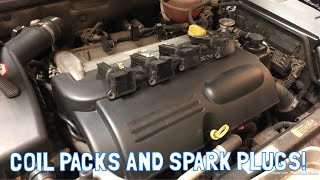
🎬 Watch: Step-by-step guide to removing rear coils and the ECU.Generation note: The specified vehicle range (2003-2011) covers the entire second generation of the Saab 9-3. However, the B284 2.8L Turbo V6 engine was only available from the 2006 to 2011 model years. This guide is only applicable to those specific years and engine.
Symptoms You May Notice
- Rough or shaking idle
- Engine hesitation or stumbling during acceleration
- Noticeable loss of power
- Flashing or solid Check Engine Light
- Reduced fuel economy
- Smell of unburnt fuel from the exhaust
- Replacing only the spark plug when the ignition coil is the true cause.
- Replacing a fuel injector before confirming the ignition coil and spark plug are good.
- Assuming a front bank (e.g., cylinder 2) component failure due to easier access, without confirming the code is P0303.
- Breaking a brittle vacuum line while replacing the rear coils/plugs and then diagnosing the resulting vacuum leak as the original problem.
Most Likely Causes
- Failed Ignition Coil 🔴 High Probability → Shop Ignition Coil The B284 engine bay is notoriously hot, and the ignition coils, particularly for the rear bank (cylinders 1, 3, 5), are exposed to extreme heat that causes the plastic housings to crack and the internal electronics to fail over time. Aftermarket coils have a poor reputation for longevity in this application.
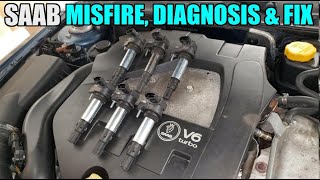
How to confirm: The standard test is to swap the cylinder 3 ignition coil with one from an accessible front cylinder (e.g., cylinder 2 or 4). Clear the codes and drive. If the code changes to P0302 or P0304, the coil is faulty. 🎬 See this video for a deep dive into diagnosing Saab misfires. However, this is difficult on the rear bank and requires removing the ECU for access.
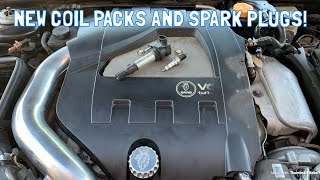
Typical fix: Replace the failed ignition coil. It is strongly recommended to replace all three coils on the rear bank at the same time, along with the spark plugs, to avoid repeating the extensive labor. 🎬 Watch: Full spark plug and ignition coil replacement walkthrough. Many owners also replace the front three for peace of mind.
Est. part cost: $45-$110 per coil - Worn or Fouled Spark Plug 🟡 Medium Probability → Shop Spark Plug As a turbocharged engine, spark plugs are a critical maintenance item and can wear out, leading to a weak spark and misfires. An increased gap from wear requires more energy from the coil, which can expose a weak coil, especially after a performance tune.
How to confirm: After accessing the cylinder, remove the spark plug and inspect it. Look for heavy carbon deposits, oil fouling, or a worn/damaged electrode. If the plug appears old or fouled, replace it.
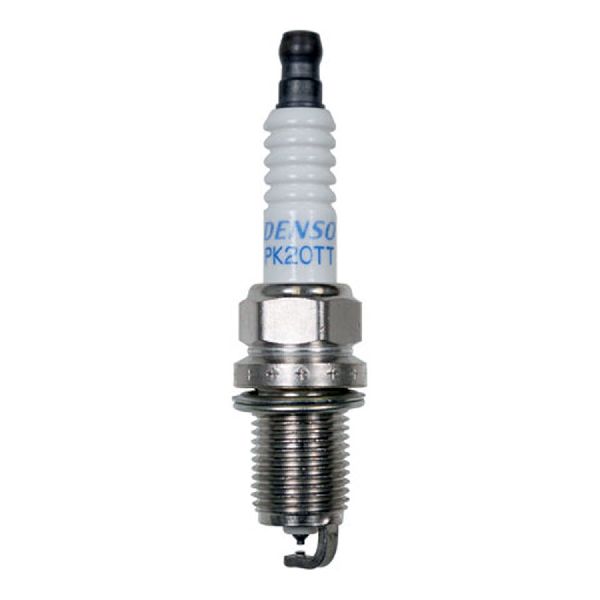
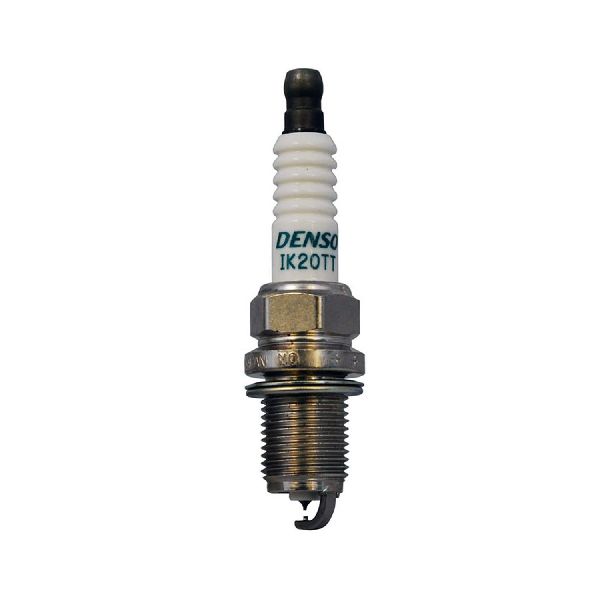
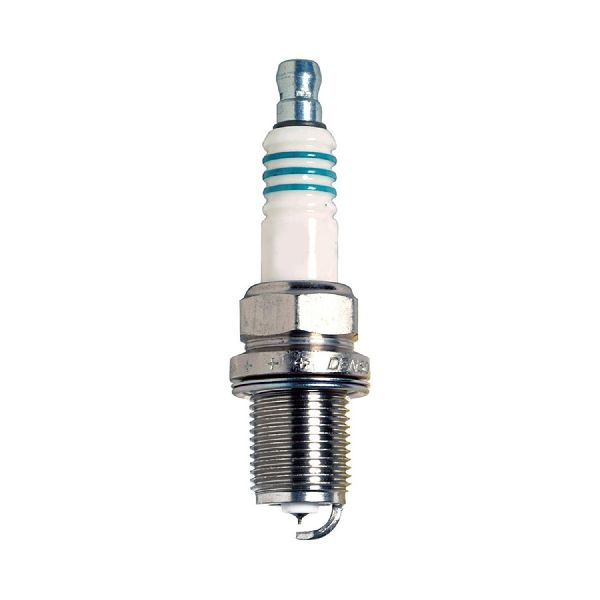
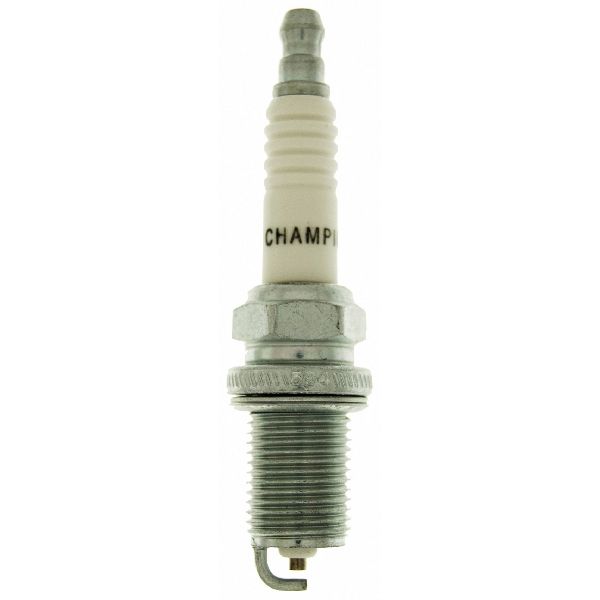
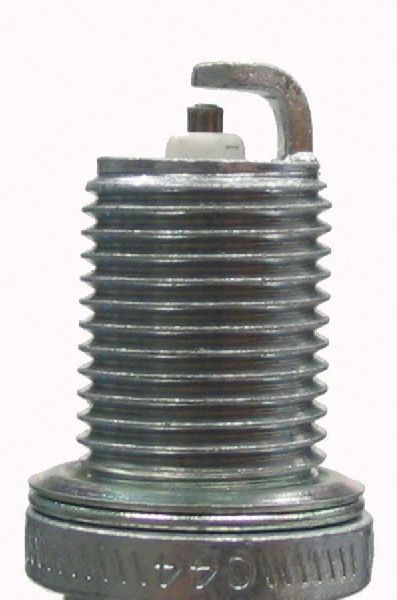
Typical fix: Replace the spark plug. The recommended plug is the NGK LFR7AIX. For tuned cars, some specialists recommend reducing the gap to 0.80-0.85mm to reduce the chance of misfire.
Est. part cost: $15-$25 per plug - Faulty Fuel Injector ⚪ Low Probability → Shop Fuel Injector
How to confirm: If swapping the coil and plug doesn't resolve the P0303 code, the injector is the next suspect. This can be tested by listening for a clicking sound with a mechanic's stethoscope or by performing a resistance test. A more definitive test involves swapping the injector with another cylinder, but this is a labor-intensive job.
Typical fix: Replace the faulty fuel injector. This requires de-pressurizing the fuel rail.
Est. part cost: $70-$150
Rare But Worth Checking
- Vacuum Leak: A leak in a vacuum hose or intake manifold gasket can lean out the air-fuel mixture and cause misfires. The vacuum lines routed over the rear of the engine are known to become brittle from heat and can easily crack or break during service, creating a new leak. This would typically be accompanied by other codes or affect multiple cylinders (P0300).
- Low Engine Compression: Internal engine issues like a worn piston ring, a problem with a valve, or stretched timing chains (a known but less common issue on the B284) can cause a loss of compression and a persistent misfire. A compression test is needed to diagnose this. A TSB for worn intake valves exists for the 4-cylinder 2.0T engine but explicitly does not apply to the B284 V6.
- Faulty Engine Control Module (ECM): → Shop Engine Control Module (ECM) In very rare cases, the driver circuit for the cylinder 3 ignition coil or fuel injector within the ECM can fail. This would typically only be considered after all other possibilities have been exhaustively ruled out.
Diagnosis Steps
- Confirm the code is P0303 using an OBD-II scanner.
- Plan for the repair: due to the location of cylinder 3, accessing it requires removing the engine cover, disconnecting the battery, and removing the ECU and its mounting bracket.
- While accessing the rear bank, carefully inspect all plastic vacuum lines and connectors near the firewall. They are notoriously brittle from heat and can crack or break easily.
- Once cylinder 3 is accessible, swap its ignition coil with the coil from cylinder 4 (an easier-to-reach front cylinder).
- Reassemble enough to run the engine, clear the codes, and drive the vehicle to see if the misfire code returns.
- If the code changes to P0304, the ignition coil is the confirmed problem.
- If the code remains P0303, the coil is likely good. Proceed to swap the spark plug from cylinder 3 with cylinder 4 and repeat the test.
- If the code remains P0303 after swapping both the coil and plug, the issue is likely a fuel injector, wiring, or a mechanical engine problem (compression).
- At this stage, a compression test on cylinder 3 is recommended to rule out mechanical issues before replacing the fuel injector.
Parts You'll Likely Need
- Ignition Coil
(OEM #12629037 (Bosch P/N: 0221604112, Alt GM P/N: 12613057))— This is the most common failure item for a P0303 code on the B284 engine due to extreme heat exposure in the rear cylinder bank.
Trusted brands: Bosch (OEM), ACDelco
OEM price range: $60-$110
Aftermarket price range: $45-$80 - Spark Plug
(OEM #NGK LFR7AIX (Saab P/N: 55564998))— A necessary maintenance item that is the second most likely cause of a misfire. It is always recommended to replace when performing labor-intensive work on the ignition system.
Trusted brands: NGK (Iridium IX), Bosch
OEM price range: $15-$25
Aftermarket price range: $10-$20
Related Codes That Often Appear With This One
- P0300 — If the misfire is intermittent or affects other cylinders, a P0300 (Random/Multiple Cylinder Misfire) code may appear alongside P0303. This could point towards a vacuum leak or fuel delivery issue.
- P0301, P0305 — Since the rear bank of cylinders (1, 3, 5) shares the same harsh, high-heat environment, it's common for multiple coils in that bank to fail around the same time.
Technical Service Bulletins (TSBs) & Recalls
- No specific TSB for B284 V6 ignition coil failures was identified. A known TSB for misfires (P0300-P0304) on 2007-2011 Saab 9-3 models due to worn intake valves applies only to the 2.0L 4-cylinder (B207) engine and explicitly excludes the 2.8L V6 (B284).
Platform-Specific Known Issues
- The rear bank of cylinders (1, 3, 5) is notoriously difficult to access, requiring removal of the ECU. This significantly increases labor time and cost compared to a misfire on the front bank.
- Ignition coils on the B284 V6 have a high failure rate due to heat, and many owners choose to replace all six as a preventative measure when one fails.
- Plastic vacuum lines routed near the rear cylinder bank become very brittle over time and frequently break during coil and plug service, which can cause a new P0300 code or rough running if not noticed and repaired.
Mechanic-Grade Diagnostic Values
- Ignition Coil Primary Resistance — expected: 0.3 to 3.0 ohms (general specification). Failure: A reading outside of the specified range, especially an open circuit (infinite resistance) or a dead short (zero resistance).
- Ignition Coil Secondary Resistance — expected: 5,000 to 20,000 ohms (general specification). Failure: A reading significantly outside this range points to a faulty coil winding.
- Fuel Injector Resistance — expected: ~10.5 to 16.0 ohms (vehicle dependent). Failure: A reading far outside the expected range for the other injectors on the engine. Consistency across injectors is key.
- Live Misfire Count (per cylinder) — expected: 0, or very few counts at idle/steady cruise.. Failure: A rapidly accumulating number of misfires on a specific cylinder (e.g., cylinder 3) under load or at idle, visible with a capable scan tool like a Tech 2.
Hidden / Shadow Codes Worth Checking
- P0353 / P2306 / P2307: These codes relate specifically to the ignition coil circuit for cylinder 3 (P0353: Ignition Coil 'C' Primary/Secondary Circuit, P2306/P2307: Ignition Coil 'C' Primary Control Circuit Low/High). While P0303 indicates a misfire, these codes point more directly to an electrical fault in the coil's circuit, strengthening the diagnosis of a bad coil or wiring. (see via A comprehensive OBD-II scanner or a dealer-level tool like the Tech 2.)
Scan Tool Commands That Help
- Tech 2: Misfire Counter / Misfire Graph — This is the primary function for diagnosing a P0303. It allows a technician to view misfire events on each cylinder in real-time while driving. This is used to confirm that cylinder 3 is the source of the misfire, especially if the misfire is intermittent or only occurs under specific load/RPM conditions.
- Tech 2: Injector Test / Activation — After ruling out the ignition coil and spark plug, a technician can use this function to command the cylinder 3 fuel injector to open and close. By listening with a stethoscope, one can confirm the injector is mechanically actuating. This helps differentiate between a failed injector and a wiring/driver issue.
Wiring & Ground Locations
- G25 — On the left-hand engine mounting.. This is a primary grounding point for the engine block. A poor connection here can cause a host of electrical issues, including weak spark or erratic sensor readings that could lead to misfires.
- G7 — On the engine control module's top right attachment lug.. This is the direct ground for the ECM. Since the ECM controls the ignition coil drivers, a faulty ground here can cause unpredictable behavior, including misfire codes. This should be checked for corrosion and tightness, especially since the ECM is removed for rear bank service.
- Extra ground cable (V6 only) — Between the cylinder banks.. The Saab Workshop Information System notes an extra ground cable specifically for the V6 engine running between the cylinder banks. Ensuring this strap is clean and secure is critical for proper ignition system operation, as it helps maintain a consistent ground potential between the front and rear banks.
Real Owner Repair Stories
- Reddit user in r/saab (2008 Saab 9-3 Turbo X (2.8L V6)) — P0303 code appeared during normal driving, but with no noticeable rough running, power loss, or noise.
❌ Tried (didn't work) The owner noted that the plugs and coils had been replaced just 2,500 miles prior during an engine rebuild.
✅ What actually fixed it The user reported that a hose to the intercooler had come off. After reattaching the hose, the problem was resolved. This indicates a significant boost leak was leaning out the mixture enough to cause a misfire on one cylinder under certain conditions.
OEM Part Supersession History
12583514→12613057, then 12629037— Standard part evolution for improved reliability or manufacturing changes.
Heads up: The most current part number is Bosch 0221604112, which corresponds to GM/Saab P/N 12629037. While older numbers may still be found, it is best practice to use the latest revision. All listed numbers are generally interchangeable for the 2006-2009 B284 engine.
Model Year Variations Within This Range
- 2010-2011: For the 2010 model year, Saab discontinued the 2.8L V6 engine in the 9-3 lineup in some markets, including the US. Aero models switched to using the 4-cylinder 2.0T engine. Therefore, a P0303 on a 2010-2011 9-3 is highly likely to be on a 4-cylinder engine, for which the diagnosis and repair procedure (especially access) is different.
- 2008-2009: For 2008, the Aero V6 received a power increase to 280 hp. The limited edition Turbo X was also introduced with this engine and the XWD all-wheel-drive system. For 2009, the Aero models came standard with the 280 hp engine and XWD. These changes do not fundamentally alter the P0303 diagnosis but mean the vehicle may have different drivetrain components (XWD) to work around.
Diagnostic Flowchart
Real Owner Stories
Aggregated from forums and TSBs cited above. Mileages and costs reflect what owners reported in those sources.
2008 Saab 9-3 Turbo X
Symptoms: Check engine light came on, code P0303. Owner reported the car did not seem to be running rough, had no loss of power, and no weird noises.
What fixed it: Reconnected a hose to the intercooler that had come off.
Source hint: Reddit r/saab thread titled "'08 9-3 TX P0303 help"
2003-2011 Saab 9-3 2.8T
Symptoms: Misfires and P0300/P0303 codes.
What fixed it: Replaced the rear coils and plugs after removing the ECU for access.
Source hint: AnotherSAABChannel on YouTube video titled "SAAB 2.8T Misfires P0300 Coils and Plugs"
2003-2011 Saab 9-3 2.8L V6 (Tuned)
Symptoms: Misfires under high boost after a performance tune.
What fixed it: Reduced the spark plug gap to 0.80-0.85mm to prevent misfires under high boost.
Source hint: Vermont Tuning LLC Forums thread titled "Official Misfire Thread"
Related OBD-II Codes
Frequently Asked Questions
Does the TSB for worn intake valves causing misfires apply to my 2.8L V6?
Why do mechanics recommend replacing all three rear ignition coils at once on the B284?
What spark plugs should I use for my 2.8L V6, and what should the gap be?
I broke a plastic line near the firewall while checking cylinder 3. Will this cause issues?
Can I use aftermarket ignition coils to save money on my Saab 9-3 V6?
How can I test if the cylinder 3 ignition coil is bad before buying a new one?
Helpful Videos
We Have This Part in Stock


The information in this article is provided for general reference and educational purposes only. Vehicle specifications, procedures, and part compatibility can vary by production date, trim level, and region. Always consult your vehicle's factory service manual and verify part numbers before purchasing or performing repairs. Safety-critical components such as airbags, seat belts, and braking systems should be installed by a qualified professional.
- Saab 9-3:
- 🧭 Diagnostic Flowchart
- 🎬 Helpful Videos
- 🛍️ Shop This Part
- What's Unique About the 2003-2011 Saab 9-3
- Symptoms You May Notice
- Most Likely Causes
- Rare But Worth Checking
- Diagnosis Steps
- Parts You'll Likely Need
- Related Codes That Often Appear With This One
- Technical Service Bulletins (TSBs) & Recalls
- Platform-Specific Known Issues
- Mechanic-Grade Diagnostic Values
- Hidden / Shadow Codes Worth Checking
- Scan Tool Commands That Help
- Wiring & Ground Locations
- Real Owner Repair Stories
- OEM Part Supersession History
- Model Year Variations Within This Range
- Real Owner Stories
- 2008 Saab 9-3 Turbo X
- 2003-2011 Saab 9-3 2.8T
- 2003-2011 Saab 9-3 2.8L V6 (Tuned)
- Related OBD-II Codes
- Frequently Asked Questions
- 🎟️ Get 5% Off