

P0304 on 2017-2024 Jeep Compass: Cylinder 4 Misfire Causes and Fixes
P0304 on a Jeep Compass indicates a misfire in cylinder 4. For 2017-2022 models with the 2.4L engine, the most common cause is an oil-fouled spark plug or an oil-damaged ignition coil due to a leaking valve cover gasket, a known issue with this engine. For 2023+ models with the 2.0L Turbo, it's more likely standard wear of the spark plug or coil. This is often a straightforward DIY fix costing between $20 for a spark plug and $75 for an ignition coil.
- P0304 specifically points to a misfire in cylinder 4, which is the cylinder closest to the driver's side on your Compass.
- The most likely cause is a bad ignition coil or a worn/fouled spark plug. Swapping these parts between cylinders is a simple and effective diagnostic step.
- If you have a 2017-2022 model with the 2.4L engine, check your oil level immediately. Low oil or an oil-fouled spark plug is a very common cause for this code on your specific vehicle.
- Do not ignore a flashing check engine light, as it signals a severe misfire that can quickly damage your catalytic converter, leading to a much more expensive repair.
What's Unique About the 2017-2024 Jeep COMPASS
The 2017-2024 Jeep Compass uses two different engines, and the likely cause of a P0304 can vary significantly. Models from 2017-2022 with the 2.4L 'Tigershark' engine are notorious for excessive oil consumption, an issue that has led to class-action lawsuits. This oil consumption can quickly foul spark plugs and lead to misfires. Furthermore, the valve cover gasket's spark plug tube seals are prone to leaking, which saturates the ignition coil and spark plug in oil, causing a guaranteed misfire. For these engines, a P0304 is very often traced back to an oil-related failure. Newer 2023-2024 models with the 2.0L Turbo 'Hurricane' engine do not have the same widespread oil consumption issue, so misfires are more likely due to standard ignition component wear.
Diagnostic Flowchart
Tap your situation to follow the diagnostic path that matches what you're seeing on this vehicle.
Symptoms You May Notice
- Rough running engine, especially at idle.
- Noticeable shaking or vibrating from the engine bay.
- Flashing or solid Check Engine Light.
- Hesitation or lack of power during acceleration.
- Reduced fuel economy.
- Engine stalling.
- Smell of unburned fuel or a 'rotten egg' smell from the exhaust.
- Replacing only the spark plug or ignition coil without addressing an oil leak from the valve cover gasket's tube seal. The new parts will quickly become contaminated with oil and fail again.
- Replacing fuel injectors when the actual problem is a simpler and more common ignition component failure.
- Attributing the misfire solely to a tune-up without checking for underlying issues like oil consumption or vacuum leaks, especially on the 2.4L engine.
Most Likely Causes
- Faulty Ignition Coil 🔴 High Probability → Shop Ignition Coil Ignition coils are a common wear item. On the 2.4L engine, oil leaking from the valve cover gasket's spark plug tube seals is a very frequent problem that saturates the coil boot in oil, causing it to fail and trigger a P0304.
How to confirm: Swap the ignition coil from cylinder 4 with another cylinder (e.g., cylinder 3). Clear the codes and drive the vehicle. If the code changes to P0303, the ignition coil is faulty. When you remove the coil, inspect it and the spark plug well for any signs of oil.
Typical fix: Replace the faulty ignition coil. If oil was present, you MUST also replace the valve cover gasket and spark plug tube seals to prevent the new coil from failing. It is often recommended to replace all coils if they are original and the vehicle has high mileage.
Est. part cost: $40 - $75 - Worn or Fouled Spark Plug 🔴 High Probability → Shop Spark Plug On the 2.4L Tigershark engine, the known oil consumption issues can cause spark plugs to become fouled with carbon and oil deposits, leading to a weak or non-existent spark. This is a primary cause of misfires on this specific engine.
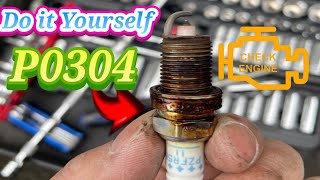
How to confirm: Remove the spark plug from cylinder 4 and inspect it. Look for heavy black carbon buildup, wet oil contamination, or a worn-down center electrode. Compare it to a plug from a healthy cylinder.
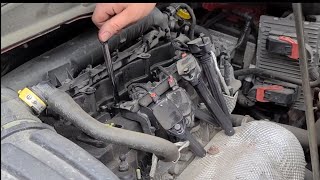
Typical fix: Replace the spark plug. The recommended gap for the 2.4L engine is typically between 0.024 to 0.047 inches, but always verify for your specific model year. If the plug was oil-fouled, it's a strong indicator of either the internal oil consumption problem or a leaking valve cover gasket. It is best practice to replace all four spark plugs at the same time. 🎬 Watch: Step-by-step spark plug and coil replacement for the 2.4L engine.
Est. part cost: $15 - $30 - Faulty Fuel Injector 🟡 Medium Probability → Shop Fuel Injector
How to confirm: If swapping the coil and plug doesn't resolve the issue, the injector is a possible cause. A mechanic can perform a fuel injector balance test. You can also listen for a consistent clicking sound from the injector using a mechanic's stethoscope; a silent or erratically clicking injector is likely faulty.
Typical fix: Replace the faulty fuel injector. This is a more involved repair as it requires depressurizing and opening the fuel system.
Est. part cost: $50 - $150 - Leaking Valve Cover Gasket / Faulty PCV 🟡 Medium Probability → Shop Engine Valve Cover This is a very common issue on the 2.4L engine. The valve cover gasket kit includes seals for the spark plug tubes. When these fail, oil fills the tube, ruining the coil and plug. Additionally, the PCV valve is integrated into the valve cover; if it sticks open or closed, it can alter crankcase pressure and contribute to oil leaks or introduce unmetered air, potentially causing misfires (P0300-P0304).
How to confirm: Visual inspection is key. Remove the ignition coil on cylinder 4. If there is liquid oil on the coil boot or in the bottom of the spark plug well, the tube seal has failed. 🎬 See why oil leaks into spark plug wells and how to fix it. A hissing sound, rough idle, or oil consumption can point to a failed PCV valve.
Typical fix: Replace the entire valve cover gasket set, which includes the main gasket, spark plug tube seals, and bolt grommets. If the PCV valve is confirmed bad, the entire valve cover assembly often needs to be replaced as the valve is integrated.
Est. part cost: $30 (gasket kit) - $300 (full valve cover assembly)
Rare But Worth Checking
- Low Engine Compression: This indicates a serious internal engine problem. On the 2.4L engine, this can be a consequence of the oil consumption issue causing damage to piston rings or cylinder walls. It can also be caused by a burnt valve or a failed head gasket. A compression test is required to confirm; if cylinder 4 is significantly lower than the others, a mechanical fault is present.
- PCM Software Update Needed: Multiple TSBs for Jeep vehicles, including the Compass, mention updating the PCM software to improve misfire detection logic and address correlation issues with other sensors. [Bulletin #14-009-25 REV. D, #14-003-26] This is a dealer-level fix that can resolve phantom misfire codes.
Diagnosis Steps
- Read all trouble codes with an OBD-II scanner and note any other codes present, which can provide valuable clues.
- Identify cylinder 4. On the inline 4-cylinder engines in the Compass, the cylinders are numbered 1-2-3-4, starting from the passenger side (front of the engine/belt side) and moving toward the driver's side (transmission side). Cylinder 4 is closest to the driver's side/transmission.
- Move the ignition coil from cylinder 4 to cylinder 3. Clear the codes and run the engine until it misfires again. If the code changes to P0303, the ignition coil is bad.
- While the coil is out, look deep into the spark plug well with a flashlight. If you see pooled oil, the valve cover's spark plug tube seal is leaking and must be replaced. This is the most likely cause of the coil failure.
- If the code remains P0304, move the spark plug from cylinder 4 to cylinder 2 (using a different cylinder helps avoid confusion). If the code changes to P0302, the spark plug is the culprit. Inspect the plug for oil fouling or wear.
- If the misfire is still on cylinder 4, the issue is likely fuel-related or mechanical. Check the wiring connector for the fuel injector on cylinder 4 for damage. Listen to the injector with a stethoscope to confirm it's clicking.
- Perform a compression test on all cylinders and compare the readings. A significant drop (more than 15-20%) in cylinder 4 indicates an internal engine problem like bad piston rings or a valve issue.
- If all else fails, have a professional check for vacuum leaks with a smoke machine or investigate a potential PCM software issue by checking for available TSBs.
Parts You'll Likely Need
- Ignition Coil
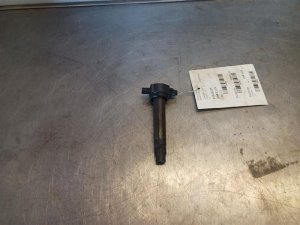
(OEM #68242286AA (2.4L), 68395453AA (2.0L))— This is one of the most common failure points for a single-cylinder misfire. On the 2.4L, failure is often caused by oil contamination from a leaking valve cover gasket.
Trusted brands: Mopar, NGK, Delphi, Denso
OEM price range: $60 - $90
Aftermarket price range: $40 - $75 - Spark Plug
(OEM #SP148183AB (often NGK ZFR5F-11 for 2.4L), 68292346AA (2.0L))— Spark plugs are a maintenance item and are especially prone to fouling on 2.4L models with oil consumption issues, directly causing misfires.
Trusted brands: NGK, Champion, Bosch
OEM price range: $20 - $35
Aftermarket price range: $10 - $25
Related Codes That Often Appear With This One
- P0300 — This code for 'Random/Multiple Cylinder Misfire' will appear if the issue causing P0304, such as a large vacuum leak or systemic oil fouling, is also intermittently affecting other cylinders. [Bulletin #08-027-20]
- P0301, P0302, P0303 — Misfire codes for other cylinders may be present if the root cause, such as low fuel pressure, a bad PCV valve, or severe oil consumption, affects the entire engine. [Bulletin #14-003-26]
- P0520 — This code for 'Engine Oil Pressure Sensor Circuit' is common on the 2.4L engine and can sometimes appear alongside misfire codes, pointing to the broader oil system issues that plague this engine. TSB 18-034-14 REV. A addresses this with a revised sensor.
Technical Service Bulletins (TSBs) & Recalls
- Bulletin #14-009-25 REV. D: Lists P0304 as a possible DTC related to fuel/propulsion system issues in 2024 models.
- Bulletin #14-003-26: Notes P0304 in relation to unstable idle and abnormal engine noise in 2022 models.
- Bulletin #08-027-20: Cites P0304 as a potential code when customers experience a rough running engine in 2017 models.
- Bulletin #09-026-25: Includes P0304 as a misfire detection code for 2024 engine diagnostics.
- Bulletin #09-016-25: Lists P0304 along with other codes for the 2024 fuel/propulsion system.
Platform-Specific Known Issues
- The 2.4L Tigershark engine (2017-2022) is widely known for excessive oil consumption due to piston ring design, which has been the subject of class-action lawsuits. This issue can cause spark plugs to become severely fouled, leading directly to misfire codes like P0304. While replacing the spark plug provides a temporary fix, the underlying oil consumption may require dealer intervention or more extensive engine repair if severe.
Mechanic-Grade Diagnostic Values
- Ignition Coil Primary Resistance (2.4L Engine) — expected: 0.56 - 0.68 Ω. Failure: A reading outside this range, or an open circuit (OL), indicates a faulty coil.
- Ignition Coil Secondary Resistance (2.4L Engine) — expected: 7.8 - 9.6 kΩ. Failure: A reading outside this range suggests the internal windings are compromised.
- Fuel Injector Resistance (2.4L Engine) — expected: ~12 Ω. Failure: A reading that is significantly different from the other injectors, or is an open (OL) or shorted (near zero) circuit, points to a bad injector.
Hidden / Shadow Codes Worth Checking
- Mode $06 Data: This is not a trouble code but a diagnostic function. Advanced scan tools can access Mode $06 to view misfire counts per cylinder for the current and last driving cycles. A high number of misfire counts for cylinder 4 (Test ID $53, Component ID $04) can confirm the misfire is real, even if the Check Engine Light is not flashing. (see via An advanced OBD-II scan tool with Mode $06 capability.)
Scan Tool Commands That Help
- wiTECH (Dealer) or advanced aftermarket: Cylinder Power Balance / Cylinder Cutout Test — This function allows a technician to disable one cylinder at a time and monitor the drop in engine RPM. If disabling cylinder 4 causes little or no change in RPM, it confirms that cylinder was not contributing power, pinpointing the misfire without swapping parts.
Wiring & Ground Locations
- Cylinder 4 Fuel Injector Control — On the 2018 Compass 2.4L, this is Pin 85 of the C2 PCM connector (the larger engine harness connector). The wire color is Brown/Light Green.. If ignition and mechanical checks pass, a technician would test for a pulsed ground signal at this pin to verify the PCM is commanding the injector to fire. A break in this wire or a failed PCM driver would cause the misfire.
- Cylinder 4 Ignition Coil Control — On the 2018 Compass 2.4L, this is Pin 74 of the C2 PCM connector. The wire color is Dark Blue/Gray.. This is the trigger wire from the PCM to the ignition coil. A technician can check for a signal on this wire to determine if the coil is receiving the command to fire. A fault here could indicate a wiring issue or a problem with the PCM.
Real Owner Repair Stories
- Reddit user in r/MechanicAdvice (Jeep with P0304) — Persistent P0304 check engine light after replacing coil and plug twice.
❌ Tried (didn't work) Replaced ignition coil, Replaced spark plug, Replaced ignition coil a second time
✅ What actually fixed it The top-voted solution from other mechanics was to check for oil in the spark plug tube, indicating a leaking valve cover gasket tube seal, which is a very common cause for repeat coil failure on these engines. - Car Talk Community Forum user (2007 Jeep Compass 2.4L with 140k miles) — Random P0304 at idle only.
❌ Tried (didn't work) Swapped spark plug with another cylinder, Swapped ignition coil with another cylinder, Swapped fuel injector with another cylinder
✅ What actually fixed it The user had not posted a final fix, but the expert advice given was that with all ignition and fuel components ruled out by swapping, the next mandatory step is a compression test to check for a mechanical engine problem (like a bad valve or piston ring), which is the likely culprit.
"I Checked Everything" — The Actual Cause
- In cases where a P0304 persists after common ignition/fuel parts are replaced and a smoke test for vacuum leaks comes back clean, the cause can be non-physical. Multiple Technical Service Bulletins (TSBs) exist for the Jeep Compass where the fix for a P0304 is a PCM software update. [Bulletin #14-009-25 REV. D, #14-003-26] The original software may have overly sensitive misfire detection logic. A smoke test cannot identify a software issue.
Model Year Variations Within This Range
- 2017-2022 (2.4L MultiAir Engine): These models are uniquely susceptible to misfires caused by low engine oil levels. The MultiAir valve actuation system relies on oil pressure to open the intake valves; if the oil is low, the engine can stall or misfire, especially during cornering as oil sloshes away from the pickup tube. They can also experience hard starting or no-starts after sitting for long periods as oil drains out of the MultiAir 'brick'.
Helpful Videos

We Have This Part in Stock

The information in this article is provided for general reference and educational purposes only. Vehicle specifications, procedures, and part compatibility can vary by production date, trim level, and region. Always consult your vehicle's factory service manual and verify part numbers before purchasing or performing repairs. Safety-critical components such as airbags, seat belts, and braking systems should be installed by a qualified professional.
- Jeep COMPASS:
- 🧭 Diagnostic Flowchart
- 🎬 Helpful Videos
- 🛍️ Shop This Part
- What's Unique About the 2017-2024 Jeep COMPASS
- Symptoms You May Notice
- Most Likely Causes
- Rare But Worth Checking
- Diagnosis Steps
- Parts You'll Likely Need
- Related Codes That Often Appear With This One
- Technical Service Bulletins (TSBs) & Recalls
- Platform-Specific Known Issues
- Mechanic-Grade Diagnostic Values
- Hidden / Shadow Codes Worth Checking
- Scan Tool Commands That Help
- Wiring & Ground Locations
- Real Owner Repair Stories
- "I Checked Everything" — The Actual Cause
- Model Year Variations Within This Range
- 🎟️ Get 5% Off