

P0305 on 2015-2026 Ford Transit 3.5L V6: Cylinder 5 Misfire Causes and Fixes
On a 2015-2026 Ford Transit with the 3.5L V6, code P0305 is most often caused by a faulty ignition coil or spark plug on cylinder 5, frequently due to a known water leak from the cowl panel dripping onto the driver's side of the engine. A new Motorcraft ignition coil costs about $70-$100, and the repair is DIY-friendly. Addressing the water leak is key to a permanent fix.
- P0305 on a Ford Transit almost always points to a bad ignition coil or spark plug on cylinder 5 (middle, driver's side).
- The root cause is often water leaking from the cowl directly onto the cylinder 5 coil. Check for moisture and corrosion.
- This is a DIY-friendly repair, as cylinder 5 is on the easily accessible side of the engine.
- If the check engine light is flashing, pull over safely to prevent expensive damage to your catalytic converter.
- When replacing the coil, it's highly recommended to also replace the spark plug and apply dielectric grease to the boot to prevent future moisture intrusion.
What's Unique About the 2015-2026 Ford Transit
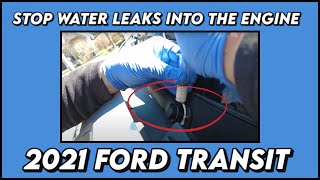
For the Ford Transit, the P0305 code has a very common platform-specific cause: water intrusion. 🎬 Watch: How to stop water from leaking into your engine bay. The design of the cowl panel can allow rainwater to drip directly onto the driver's side of the engine, where cylinders 4, 5, and 6 are located. This moisture pools in the spark plug well for cylinder 5, causing the ignition coil and spark plug to corrode and fail prematurely. While ignition components fail on all vehicles, on the Transit, it's often an external water leak, not just normal wear and tear, that causes the problem for this specific cylinder. This is a widely discussed issue in owner forums and has been acknowledged by Ford via a Technical Service Bulletin (TSB) for other models with similar engine architecture.
Symptoms You May Notice
- Rough or shaky idle
- Engine hesitation or stumbling during acceleration
- Noticeable loss of power
- Flashing or solid Check Engine Light
- Poor fuel economy
- Fuel smell from the exhaust
- Engine RPMs oscillating at idle.
- Replacing the O2 sensors. O2 sensors report on the overall state of the exhaust, they do not cause a single-cylinder misfire.
- Replacing the catalytic converter. A misfire can damage a catalytic converter, but a bad converter will not cause a P0305 code.
Most Likely Causes
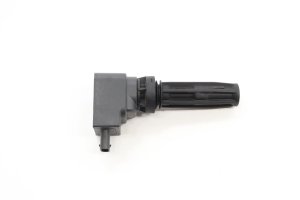
- Faulty Ignition Coil 🔴 High Probability → Shop Ignition Coil A known water leak from the cowl area often drips directly onto the ignition coil for cylinder 5, causing corrosion and failure. This is the most common cause for P0305 on this platform.
How to confirm: Swap the ignition coil from cylinder 5 with an adjacent cylinder (e.g., cylinder 4 or 6). Clear the codes and drive. If the code changes to P0304 or P0306, the coil is bad. Inspect the coil boot for white residue or rust and the coil itself for carbon tracking (thin black lines), which indicates electricity arcing.
Typical fix: Replace the ignition coil on cylinder 5. It is highly recommended to replace the spark plug at the same time. Apply a small amount of dielectric grease to the inside of the new coil boot to seal out moisture and on the electrical connector seal.
Est. part cost: $40-$100 - Worn or Fouled Spark Plug 🔴 High Probability → Shop Spark Plug The 3.5L EcoBoost engine is known to be hard on spark plugs due to direct injection and turbocharging. Additionally, the aforementioned water intrusion will cause the plug to rust and foul.
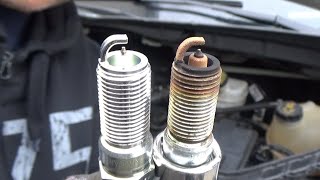
How to confirm: After confirming the coil is good, remove the spark plug from cylinder 5. Inspect for wear, oil/fuel fouling, carbon tracking (a thin black line on the porcelain), cracks, or an excessively large gap. The recommended gap for the 3.5L EcoBoost is critical, often around 0.028-0.032 inches. Plugs often come pre-gapped, but should always be verified.
Typical fix: Replace the spark plug. It is best practice to replace all six spark plugs at the same time to ensure even performance, especially if they are near their service interval (typically 60,000-100,000 miles).
Est. part cost: $10-$25 per plug - Clogged Fuel Injector 🟡 Medium Probability → Shop Fuel Injector On direct injection (GDI) engines like the 3.5L EcoBoost, injectors operate under high pressure and can be prone to clogging from carbon deposits over time. Using non-"Top Tier" gasoline can accelerate this.
How to confirm: If the ignition system is confirmed to be working, the fuel injector is the next likely cause. This is harder to diagnose for a DIYer. A professional can perform an injector balance test. A DIY method is to swap the injector with another cylinder, but this is significantly more labor-intensive than swapping a coil.
Typical fix: Replace the fuel injector for cylinder 5. This is a more involved job that may require removing the intake manifold.
Est. part cost: $50-$150
Rare But Worth Checking
- Intake Valve Carbon Buildup: The 3.5L EcoBoost is a Gasoline Direct Injection (GDI) engine, which means fuel is sprayed directly into the cylinder, not over the intake valves. Over time, oil vapor from the PCV system can bake onto the back of the valves, causing airflow issues and misfires. This usually causes random misfires (P0300) but can eventually affect a single cylinder. This typically requires professional cleaning like walnut blasting.
- Low Compression: A mechanical engine problem like a burnt valve, worn piston rings, or a bad head gasket can cause a loss of compression in cylinder 5. NHTSA ODI #11652376 describes a case where a P0305 code was triggered by low compression on cylinder #5 (110 PSI) compared to others at 145-150 PSI. Furthermore, Bulletin #SSM 46363 notes that misfire codes including P0305 may be linked to the cylinder heads or the long block if accompanied by oil pressure codes.
- Vacuum Leak: A vacuum leak near cylinder 5, such as a leaking intake manifold gasket or a cracked injector O-ring, can lean out the air/fuel mixture and cause a misfire. This can sometimes be found by carefully spraying brake cleaner near the suspected area with the engine running and listening for a change in idle speed.
- Crankshaft Pulley Issues: Manufacturer Bulletin #SSM 46391 notes that multiple misfire codes, including P0305, may be due to an under-torqued crankshaft pulley bolt on certain engine builds.
Diagnosis Steps
- Confirm the code P0305 is present using an OBD-II scanner. Check for any other codes and note if the Check Engine Light is flashing.
- Identify Cylinder 5. On a RWD Ford Transit with the 3.5L V6, the engine is mounted longitudinally. Bank 1 (cylinders 1-2-3) is on the passenger side, front to back. Bank 2 (cylinders 4-5-6) is on the driver's side, front to back. Cylinder 5 is the middle cylinder on the driver's side. 🎬 See this step-by-step diagnostic and repair guide for cylinder misfires.
- Inspect for water intrusion. Look for signs of water, rust, or corrosion around the ignition coil and in the spark plug well of cylinder 5. This is a very common issue and a strong indicator of the problem's source.
- Swap the ignition coil. Unplug and remove the 8mm bolt holding the ignition coil for cylinder 5. Swap it with cylinder 6 (the rearmost coil on the driver's side). Clear the codes and run the engine, accelerating to see if the misfire returns. If the code returns as P0306, the ignition coil is faulty and needs to be replaced.
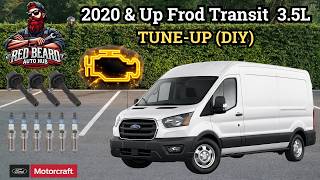
- If the code remains P0305, inspect the spark plug. Remove the spark plug from cylinder 5 (a 5/8" swivel spark plug socket is recommended). Check for cracks in the porcelain, heavy carbon buildup, or oil fouling. Verify the gap is correct (approx. 0.028"-0.032" for EcoBoost). If the plug is damaged or worn, replace it. It's best to replace all six. 🎬 Watch: DIY walkthrough for replacing all spark plugs and coils.
- If the code remains P0305 after confirming the coil and plug are good, the issue is likely with the fuel injector or, more rarely, a mechanical engine problem or wiring.
- Inspect the fuel injector wiring for any damage. If the wiring is intact, the injector itself may be clogged or faulty. Consider running a quality fuel system cleaner like Techron through the tank.
- If all else fails, a compression test should be performed on cylinder 5 to rule out mechanical engine damage. This is best left to a professional.
Parts You'll Likely Need
- Ignition Coil (Coil-on-Plug)
(OEM #DG-564 (Verify by VIN, as DG-549 is for earlier/different 3.5L versions))— This is the most common failure point for a P0305 code on this vehicle, often due to water damage.
Trusted brands: Motorcraft, Denso, NGK
OEM price range: $70-$100
Aftermarket price range: $40-$75 - Spark Plug
(OEM #SP-580 (supersedes SP-534, now superseded by SP-580X))— Often fails along with the ignition coil or due to wear. The 3.5L EcoBoost engine requires high-quality iridium plugs changed at regular intervals.
Trusted brands: Motorcraft, NGK, Autolite
OEM price range: $15-$25
Aftermarket price range: $10-$20 - Cowl Panel Shield/Cover
(OEM #CK4Z-6102408-AA (Water Deflector Kit))— To permanently fix the root cause of water leaks described in various TSBs, a water deflector kit can be installed to divert water away from engine components. While TSB 21-2147 for Rangers addresses a similar issue, this part number is from a Transit-specific TSB (19-2091) for water intrusion.
Trusted brands: Ford
OEM price range: $20-$50
Related Codes That Often Appear With This One
- P0300 — If the misfire is intermittent or affects multiple cylinders, a P0300 (Random Misfire) code may appear alongside P0305.
- P0304, P0306 — If the water leak from the cowl is severe, it can affect the neighboring cylinders on the same bank (Bank 2), causing misfires on cylinders 4 and 6 as well.
- P0316 — This code indicates a misfire detected on startup. Bulletin #TSB 24-2191 notes that P0316 and P0305 may set together due to the software level of the powertrain control module (PCM).
Technical Service Bulletins (TSBs) & Recalls
- TSB 21-2147: Although officially for 2019-2021 Ranger, this TSB describes the exact issue seen on Transits: water building up in spark plug wells, causing corrosion and misfire DTCs. The fix is to replace corroded components and install a new engine cover to prevent recurrence.
- TSB 22-2221: For 2020-2022 Transit 3.5L EcoBoost, this TSB addresses a missing diagnostic parameter (PID) in the PCM software and calls for a PCM reprogram. This highlights that software updates are sometimes required for proper engine management.
- TSB 24-2191: This bulletin notes that vehicles equipped with a 3.5L PowerBoost may exhibit an illuminated MIL and set misfire codes like P0305 due to the software level of the PCM, requiring a software update to correct.
- SSM 50412: For 2021-2022 F-150s with the 3.5L EcoBoost, this Special Service Message advises technicians to confirm a coil is bad by swapping it before replacement, as other issues could be the cause. It also recommends applying dielectric grease.
- SSM 46363: This bulletin addresses excessive oil consumption and MIL illumination with codes P0300-P0306, suggesting the cylinder heads as a potential cause.
- SSM 46391: This bulletin identifies that multiple misfire codes, including P0305, may be caused by an under-torqued crankshaft pulley bolt on specific engine builds.
Platform-Specific Known Issues
- Water Leak from Cowl: Ford issued Technical Service Bulletin (TSB) 21-2147 for some Ranger vehicles, addressing a water leak into the spark plug wells affecting cylinders 4 and 5. The fix involves inspecting/replacing affected ignition components and installing a new engine appearance cover to shield the area. Owners of Ford Transits report an identical problem, making this a well-known platform issue even without a Transit-specific TSB for this exact fault.
- PCM Software: For some 2020-2022 Transit models with the 3.5L EcoBoost, TSB 22-2221 was issued for various charging system concerns that could be resolved by reprogramming. Additionally, TSB 24-2191 highlights that PCM software levels can directly cause cylinder misfire codes like P0305.
Mechanic-Grade Diagnostic Values
- Ignition Coil Primary Resistance — expected: 0.4 - 2.0 ohms. Failure: A reading outside this range (especially an open circuit) indicates a faulty coil winding.
- Ignition Coil Secondary Resistance — expected: 6,000 - 10,000 ohms (6kΩ - 10kΩ). Failure: A reading significantly outside this range suggests the secondary winding has failed.
- Low-Pressure Fuel System Pressure (KOER) — expected: 50 - 60 PSI (for PFDI engines) or 70 - 85 PSI (for EcoBoost low-pressure side at idle). Failure: Significantly low pressure could indicate a weak in-tank fuel pump, though this typically causes lean codes or multiple misfires, not a single cylinder misfire.
- High-Pressure Fuel System Pressure (EcoBoost, KOER) — expected: Varies widely based on demand; can be 400 kPa (60 PSI) at idle and exceed 9600 kPa (1400 PSI) under load.. Failure: Pressure that does not match the PCM's desired pressure reading on a scan tool can indicate a failing high-pressure fuel pump (HPFP) or sensor.
- Long Term Fuel Trim (Bank 2) — expected: Within +/- 10%. Failure: A high positive fuel trim (e.g., > +20%) indicates the PCM is adding fuel to compensate for a lean condition, which could be caused by a failing injector or vacuum leak near cylinder 5.
Hidden / Shadow Codes Worth Checking
- Mode $06, Test ID $A4: This is not a DTC, but a diagnostic monitor in the PCM. Test ID $A4 corresponds to the misfire count for Cylinder 5. Technicians can view this raw data to see if misfires are occurring, even if they aren't frequent enough to set the P0305 code. (see via A professional scan tool or an OBD2 adapter with software like FORScan that can access Mode $06 test results.)
Scan Tool Commands That Help
- Ford IDS, FORScan, high-end bidirectional scanners: Power Balance Test — This is a primary diagnostic step for a misfire. The command allows a technician to shut off fuel to each cylinder one by one while the engine is running. A good cylinder will cause a noticeable RPM drop when disabled. If disabling cylinder 5 causes little or no change in RPM, it confirms that cylinder is not contributing power, isolating the fault.
Real Owner Repair Stories
- YouTube user 'tryityourself' (2020 Ford Transit 350, 3.5L, 89,000 miles) — Multiple cylinder misfire codes: P0300, P0302, P0304, P0305.
✅ What actually fixed it The owner replaced all six ignition coils and spark plugs to resolve the multiple misfire codes. The video notes that the front-most coil bolt was corroded, indicating water intrusion. - YouTube user 'T Automotive' (Ford Transit (year not specified), 3.5L) — Misfire on cylinders 4 and 5 due to water getting inside the spark plug wells.
✅ What actually fixed it The mechanic replaced the faulty coils and plugs. He strongly recommended applying silicone sealant around the top of the ignition coils on the driver's side (Bank 2) to prevent future water intrusion from the cowl, which he identifies as a stupid design flaw. - NHTSA ODI #11407153 — An owner reported that their engine started misfiring both while stationary and in motion. They pulled code P0305 and replaced the coils and spark plugs, but the engine continued to misfire, indicating a deeper issue.
OEM Part Supersession History
SP-534→SP-580, which was then superseded by SP-580X— Updates to materials and design for improved performance and longevity in GDI engines.
Heads up: SP-580X is the latest recommended service part for most 3.5L EcoBoost applications. Always verify with VIN, but SP-580X is the correct replacement for SP-580 and SP-534.
Model Year Variations Within This Range
- 2020-Present: For the 2020 model year, Ford introduced a new standard 3.5L V6 with Port Fuel and Direct Injection (PFDI), which replaced the previous 3.7L V6. The 3.5L EcoBoost V6 remained an option. All engines were paired with a new 10-speed automatic transmission, replacing the 6-speed. This means a 2020+ '3.5L V6' could be the naturally aspirated PFDI version or the twin-turbo EcoBoost, which may have different diagnostic values or part requirements.
Diagnostic Flowchart
Real Owner Stories
Aggregated from forums and TSBs cited above. Mileages and costs reflect what owners reported in those sources.
2022 Ford Transit
Symptoms: Cylinder 4 and 5 misfire with extreme corrosion found in the spark plug tubes.
What fixed it: Replaced the corroded ignition coils and addressed the water intrusion.
Source hint: Reddit r/Justrolledintotheshop - '2022 Ford Transit Cylinder 4 and 5 misfire. Water intrusion corroded everything in the spark plug tubes.'
2015 Ford Transit
Symptoms: Check engine light with a P0305 code.
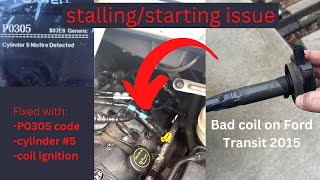
What fixed it: Replaced the ignition coil on cylinder 5.
Cost: $140
Source hint: YouTube - 'Ford Transit 2015 P0305 Code - How to replace starter coil'
Ford Transit (General)
Symptoms: P0304, P0305, and P0306 misfires caused by water intrusion from the cowl or windshield seals.
What fixed it: Replaced the affected ignition coils and spark plugs, and sealed the leak source at the cowl.
Source hint: Ford Transit USA Forum
Related OBD-II Codes
Frequently Asked Questions
Is there a specific TSB for the water leak causing my P0305 code on the Transit?
Where exactly is cylinder 5 located on my 3.5L V6 Transit?
What spark plug gap should I use to fix a misfire on the 3.5L EcoBoost?
Could my 2020-2022 Transit need a software update for engine issues?
How can I confirm the cylinder 5 ignition coil is bad before buying a new one?
Helpful Videos
We Have This Part in Stock

The information in this article is provided for general reference and educational purposes only. Vehicle specifications, procedures, and part compatibility can vary by production date, trim level, and region. Always consult your vehicle's factory service manual and verify part numbers before purchasing or performing repairs. Safety-critical components such as airbags, seat belts, and braking systems should be installed by a qualified professional.
- Ford Transit:
- 🧭 Diagnostic Flowchart
- 🎬 Helpful Videos
- 🛍️ Shop This Part
- What's Unique About the 2015-2026 Ford Transit
- Symptoms You May Notice
- Most Likely Causes
- Rare But Worth Checking
- Diagnosis Steps
- Parts You'll Likely Need
- Related Codes That Often Appear With This One
- Technical Service Bulletins (TSBs) & Recalls
- Platform-Specific Known Issues
- Mechanic-Grade Diagnostic Values
- Hidden / Shadow Codes Worth Checking
- Scan Tool Commands That Help
- Real Owner Repair Stories
- OEM Part Supersession History
- Model Year Variations Within This Range
- Real Owner Stories
- 2022 Ford Transit
- 2015 Ford Transit
- Ford Transit (General)
- Related OBD-II Codes
- Frequently Asked Questions
- 🎟️ Get 5% Off