

P0305 on 2022-2025 Kia Carnival: Cylinder 5 Misfire Causes and Fixes
P0305 means cylinder #5 is misfiring. On this Kia Carnival, the most common causes are a bad ignition coil or spark plug. However, a known issue with faulty fuel injectors covered by a Technical Service Bulletin (TSB FUE060) is also a strong possibility, especially on 2022 models. Accessing cylinder 5 is difficult as it is on the rear bank against the firewall.
- P0305 on a 2022-2025 Carnival is a serious issue that requires prompt attention to avoid damaging the catalytic converter.
- The easiest and most common fixes are a faulty ignition coil or spark plug, but diagnosis is complicated by the difficult access to cylinder 5 on the rear bank.
- For 2022 models, a faulty fuel injector is a distinct possibility covered by a Kia Technical Service Bulletin (FUE060).
What's Unique About the 2022-2025 Kia Carnival
The 2022-2025 Kia Carnival is part of the fourth generation (KA4) and uses the Lambda III 3.5L GDI V6 engine. While ignition parts are a common cause for any misfire, early production 2022 models have a documented issue with fuel injectors. Kia issued a Technical Service Bulletin (TSB FUE060) for air-fuel imbalance issues that are often caused by faulty high-pressure fuel injectors, which can directly lead to a misfire. Additionally, as a Gasoline Direct Injection (GDI) engine, the intake valves are susceptible to carbon buildup over time, which can restrict airflow and cause misfires, though a Reddit user noted this engine also has Multi-Port Injection (MPI) which should help reduce this issue.
Symptoms You May Notice
- Rough or shaky idle
- Hesitation or stumbling during acceleration
- Noticeable loss of engine power
- Flashing Check Engine Light (indicates a severe, active misfire)
- Solid (non-flashing) Check Engine Light
- Potential fuel smell from the exhaust
- Engine vibration
- Replacing oxygen sensors. While O2 sensors can cause fuel trim issues, they are unlikely to cause a consistent misfire on a single cylinder.
- Replacing the catalytic converter. A misfire can damage the converter, but the converter itself is not the cause of the misfire code. The damage is a symptom, not the cause.
Most Likely Causes
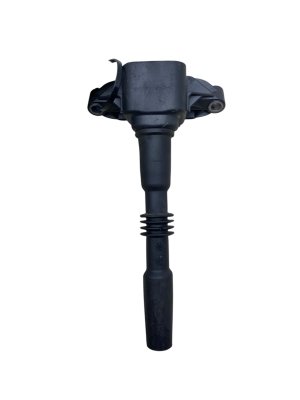
- Faulty Ignition Coil 🔴 High Probability → Shop Ignition Coil Ignition coils are a common failure point on most modern vehicles, leading to single-cylinder misfires.
How to confirm: Swap the ignition coil from cylinder 5 with another cylinder (e.g., cylinder 2 from the front bank). Clear the codes and drive the vehicle. If the code changes to P0302, the ignition coil is faulty. This is the most effective DIY diagnostic step.
Typical fix: Replace the faulty ignition coil. Cylinder 5 is on the rear bank (firewall side), which requires removing the upper intake manifold for access, making the job significantly more difficult 🎬 See how to remove the intake manifold for rear access. than for the front cylinders.
Est. part cost: $100-$150 - Worn or Fouled Spark Plug 🔴 High Probability → Shop Spark Plug Spark plugs are a standard wear item with a finite service life. Misfires can occur as they approach their replacement interval.
How to confirm: After ruling out the ignition coil, swap the spark plug from cylinder 5 with another cylinder. If the misfire code follows the plug, the spark plug is the issue. Visually inspect the spark plug for wear, carbon/oil fouling, or damage to the electrode or ceramic insulator.
Typical fix: Replace the spark plug. It is best practice to replace all six spark plugs at the same time if they are near the end of their service life (typically 60,000-100,000 miles). Access to the rear bank is difficult.
Est. part cost: $25-$35 per plug - Faulty Fuel Injector 🟡 Medium Probability → Shop Fuel Injector A known issue exists, particularly for 2022 models produced between Jan 2021 and Nov 2021, as documented in Kia TSB FUE060. This TSB specifically addresses cylinder air-fuel ratio imbalance caused by faulty high-pressure fuel injectors. Historical Kia records such as NHTSA ODI #10320360 have linked P0305 to the fuel injector and associated wiring on Bank 1.
How to confirm: This is difficult for a DIYer. A professional can perform a fuel injector balance test. 🎬 Watch this guide on how to diagnose faulty GDI injectors. A key indicator is the presence of code P21A000 alongside P0305. Check if the vehicle's VIN falls under TSB FUE060.
Typical fix: Replace the fuel injector for cylinder 5. Per the TSB, the high-pressure fuel pipe and cross-over pipe must also be replaced. This is an involved job due to the high-pressure GDI fuel system and should likely be left to a professional.
Est. part cost: $150-$200 for the injector, plus pipes
Rare But Worth Checking
- Intake Valve Carbon Buildup: This is a known long-term issue with GDI engines. Fuel does not wash over the intake valves, allowing carbon to accumulate, which can restrict airflow and cause misfires. This usually develops over higher mileage (50,000+ miles) and may affect multiple cylinders.
- Low Compression: This indicates a serious mechanical engine problem, such as a worn piston ring, a leaking valve, or a head gasket issue. A compression test is needed to confirm this. This is an expensive, professional-level repair.
- Vacuum Leak: A leak in a vacuum hose or intake manifold gasket near cylinder 5 can lean out the air-fuel mixture and cause a misfire. This can sometimes be found by carefully spraying brake cleaner around the intake area with the engine running and listening for a change in idle speed.
Diagnosis Steps
- Read the codes: Use an OBD-II scanner to confirm P0305 is the active code. 🎬 Watch: A deep dive into why cylinder 5 misfires. Note any other codes present, especially P0300 or P21A000.
- Check for a flashing CEL: If the light is flashing, the misfire is severe. Do not drive the vehicle to prevent catalytic converter damage.
- Swap the ignition coil: Cylinder 5 is on the rear bank (firewall side). Access requires removing the plastic engine cover and likely the upper intake manifold. Swap its coil with an easier-to-access coil from the front bank (e.g., cylinder 2, 4, or 6). Clear codes and see if the misfire code moves to the new cylinder (e.g., P0302, P0304, P0306). If it does, the coil is bad.
- Swap the spark plug: If the coil swap didn't change anything, move the original coil back and swap the spark plug from cylinder 5 with another cylinder. If the code follows the plug, the plug is bad.
- Inspect the fuel injector: If the misfire remains on cylinder 5, the problem is likely the fuel injector or a mechanical issue. Check if your vehicle's VIN falls under TSB FUE060 for faulty injectors, especially if code P21A000 is also present.
- Perform a compression test: If the injector is not the suspected cause, a compression test on cylinder 5 can rule out or confirm a mechanical engine problem like bad rings or valves.
Parts You'll Likely Need
- Ignition Coil (Rear Bank)
(OEM #27310-3N290)— An ignition coil failure is a very common cause of a single-cylinder misfire. This part number is specifically for the rear bank.
Trusted brands: Kia (OEM), NGK, Denso
OEM price range: $120-$150
Aftermarket price range: $70-$120 - Spark Plug
(OEM #18877-11075)— Spark plugs are a routine maintenance item and can foul or wear out, causing a weak or no spark.
Trusted brands: Kia (OEM), NGK, Champion
OEM price range: $25-$35
Aftermarket price range: $15-$25 - High-Pressure Fuel Injector
(OEM #35310-F0200)— A known issue on 2022 models, documented in TSB FUE060, can cause misfires. This part number appears to be associated with this engine family, though verification against a specific VIN is critical.
Trusted brands: Kia (OEM)
OEM price range: $150-$200
Aftermarket price range: Not Recommended
Related Codes That Often Appear With This One
- P0300 — If the misfire becomes more widespread or is intermittent across multiple cylinders, a 'Random/Multiple Cylinder Misfire' code may appear.
- P21A000 — This Kia-specific code for 'Cylinder #5 Air-Fuel Ratio Imbalance' is directly related to the fuel injector issue described in TSB FUE060 and is a strong indicator that the injector is the root cause.
- P0301, P0303 — If other odd-numbered cylinders (1 or 3) also show misfire codes, it could point to a systemic issue on the rear bank, such as a problem with the shared fuel rail or a vacuum leak affecting that side of the intake manifold.
Technical Service Bulletins (TSBs) & Recalls
- FUE060 - Cylinder Imbalance DTC P219XX00 Inspection and Injector Replacement
- FUE062 - ECM Logic Update for DTC P2118 and Throttle Body Freezing
- TSB ENG222 - Kia service bulletin regarding abnormal oil consumption (over 1 quart per 1,000 miles) which can lead to fouled spark plugs and misfires on cylinders 1, 3, 4, and 5 (as referenced in NHTSA ODI #11717327).
Platform-Specific Known Issues
- TSB FUE060: Affects some 2022MY Carnival vehicles produced from Jan 26, 2021, through Nov 10, 2021. It addresses cylinder air-fuel ratio imbalance (often code P21A000) caused by faulty high-pressure fuel injectors, which can lead to misfires like P0305. The fix involves replacing the injector and associated high-pressure fuel pipes.
- Difficult Rear Bank Access: Cylinder 5 is part of the rear bank of cylinders located against the firewall. Replacing the ignition coil or spark plug requires the removal of the upper intake manifold, adding significant time and complexity to the repair compared to the front bank.
- Oil Consumption and Plug Fouling: Some Kia platforms have documented issues where oil consumption fouls spark plugs, leading to active misfires on multiple cylinders including cylinder 5, often accompanied by codes P0300, P0301, P0303, P0304, and P0305 (NHTSA ODI #11717327).
Mechanic-Grade Diagnostic Values
- Ignition Coil Primary Winding Resistance — expected: 0.8 - 1.2 Ohms at 68°F (20°C). Failure: A reading of OL (open circuit) or significantly outside the expected range indicates a faulty primary winding.
- Ignition Coil Secondary Winding Resistance — expected: 6.0 - 10.0 kOhms (kilo-ohms) at 68°F (20°C). Failure: A reading of OL (open circuit) or significantly outside this range points to a failure in the secondary winding.
- GDI Fuel Injector Resistance — expected: ~2.2 Ohms. Failure: An open circuit (infinite resistance) or a reading far from the specification indicates a failed internal injector coil.
- Low-Pressure Fuel System Pressure (at idle) — expected: ~55 psi (379.5 kPa). Failure: Significantly lower pressure indicates a weak in-tank fuel pump or clogged filter. This value is based on a similar Lambda V6 engine and should be used as a strong reference.
Scan Tool Commands That Help
- Kia GDS (Global Diagnostic System): Power Balance Test / Actuation Test — This function allows a technician to individually disable the fuel injector for each cylinder. When cylinder 5 is disabled, if there is no change in engine RPM or smoothness, it confirms that cylinder 5 was not contributing, pinpointing the misfire.
- Kia GDS (Global Diagnostic System): Reset Adaptive Values — After replacing a component like a fuel injector or cleaning carbon buildup, the PCM's long-term fuel trim adaptations should be reset. This forces the computer to relearn the fuel delivery strategy with the new/clean component, ensuring smooth operation.
Wiring & Ground Locations
- Engine Block Ground — A primary ground strap connecting the engine block directly to the vehicle's chassis/frame, typically near a motor mount or the transmission.. This is the main ground path for the entire engine. Corrosion or looseness here can cause intermittent and hard-to-diagnose electrical issues, including weak spark or erratic injector performance that can lead to a misfire.
- Cylinder Head Ground — Smaller ground wires bolted directly from the wiring harness to the cylinder head(s).. The ignition coils and fuel injectors may rely on these grounds. A compromised ground on the rear bank (Bank 1) could specifically affect cylinder 5.
- Intake Manifold Ground — Some sensors on or near the intake manifold may have a dedicated ground point on the manifold itself.. While less likely to cause a single-cylinder misfire, a bad ground here could affect sensor readings that the PCM uses to calculate fuel and spark timing, indirectly contributing to performance issues.
OEM Part Supersession History
35310-F0200 (Possibly incorrect)→35310-3NGA0— This is the correct OEM part number for the high-pressure GDI (Gasoline Direct Injection) fuel injector for the 2022-2025 Carnival 3.5L engine.
Heads up: The Lambda III V6 in this vehicle uses a dual injection system. 35310-3NGA0 is the direct injector. Do not confuse it with the port injector.N/A→35310-3NTB0— This is the OEM part number for the low-pressure MPI (Multi-Port Injection) fuel injector. This engine uses both GDI and MPI injectors for each cylinder to improve performance and reduce carbon buildup.
Heads up: This is the port injector and is not interchangeable with the high-pressure GDI injector. A failure of this injector is less common but can still cause a misfire.
Other Known Issues on This Vehicle
Issues unrelated to this code that are worth knowing about as an owner of this generation:
- Power Sliding Door Malfunction 🟠 Medium — Common enough to trigger a recall and numerous owner complaints. The auto-reverse feature may fail to detect obstructions. (Ref: Recall 22V754000)
- Fuel Leak at Fuel Rail Pipe Connection 🔴 High — Affects a wide range of 2022-2026 models, leading to a major recall due to fire risk. (Ref: Recall SC368 / NHTSA 26V232)
- Detaching Roof Molding 🟡 Low — A recall was issued for 2022-2024 models as the roof molding could detach, creating a road hazard. (Ref: Recall SC292)
- Parasitic Battery Drain / Dead Battery 🟠 Medium — Numerous owner complaints filed with the NHTSA for 2024-2025 models describe batteries that drain unexpectedly, leaving the vehicle unable to start.
- Potential for Oil Consumption 🟠 Medium — While not as widespread as on other Kia/Hyundai engines, some owners and mechanics report concerns about oil consumption. A Reddit user notes the Carnival's 3.5L V6 has both GDI and MPI, which is intended to mitigate carbon buildup issues seen on older GDI-only engines.
Used vs. New Parts: Buying Guide for This Vehicle
When a used part is the smart pick: For this specific repair, using a used part is only advisable for the ignition coil. A used coil from a low-mileage (under 50,000 miles) donor vehicle can be a cost-effective alternative to a new OEM part.
Donor-vehicle mileage cap: roughly under 50000 miles for the part to have meaningful remaining life.
What to inspect on the donor part:
- For an ignition coil, check the plastic housing for any cracks or signs of heat stress.
- Ensure the electrical connector pins are clean and free of corrosion.
- Verify the part number on the used coil matches the OEM number (27310-3N290 for the rear bank).
OEM-only on this vehicle (don't cheap out):
- High-Pressure Fuel Injector (GDI): Due to the precision required, the high operating pressures, and the known TSB issue, only a new OEM GDI injector (35310-3NGA0) should be used. Remanufactured or used GDI injectors are a significant risk for repeat failure or performance issues.
- High-Pressure Fuel Pipes: The TSB requires replacing the fuel pipes when replacing an injector. These are one-time-use parts and must be purchased new from the OEM to ensure a proper seal under extreme pressure.
Aftermarket brands forum-validated for this vehicle:
- Ignition Coils: NGK, Denso
- Spark Plugs: NGK, Champion
Brands owners have reported issues with on this vehicle:
- Unbranded, 'white-box' ignition coils and fuel injectors from online marketplaces should be avoided. They often have high failure rates and do not meet OEM specifications for performance and longevity.
Real Owner Stories
Aggregated from forums and TSBs cited above. Mileages and costs reflect what owners reported in those sources.
2022 Kia Carnival 3.5L V6
Symptoms: Cylinder air-fuel ratio imbalance and misfire codes.
What fixed it: Replacement of high-pressure fuel injectors and associated high-pressure fuel pipes as per TSB FUE060.
Source hint: TSB FUE060 - Cylinder Imbalance DTC P219XX00 Inspection and Injector Replacement
2024 Kia Carnival 3.5L V6
Symptoms: Batteries that drain unexpectedly, leaving the vehicle unable to start.
What fixed it: Not specified; reported as parasitic battery drain issues filed with NHTSA.
Source hint: NHTSA owner complaints for 2024-2025 models
Kia Owner (Multiple Models)
Symptoms: Intermittent misfires across all cylinders (P0300 through P0306) accompanied by fuel system codes like P0087 and P2096.
What fixed it: Owners reported these codes appearing and disappearing, sometimes linked to fuel/propulsion system issues as described in NHTSA ODI #11513767 and #11499800.
Source hint: NHTSA ODI #11513767, #11499800
Kia Minivan Owner
Symptoms: Check engine light on the instrument panel with diagnostic codes P0305 and P0300.
What fixed it: An owner reported taking the vehicle to the dealer four times with no resolution for these specific misfire codes (NHTSA ODI #10243343).
Source hint: NHTSA ODI #10243343
Related OBD-II Codes
Frequently Asked Questions
Does TSB FUE060 apply to my 2022 Kia Carnival?
Why is the labor for replacing a cylinder 5 ignition coil more expensive on the 3.5L V6?
My Check Engine Light is flashing while I'm driving; is it safe to continue?
Is there a specific code I should look for that indicates a fuel injector issue rather than a spark plug?
Does the 3.5L V6 in the 2022-2025 Carnival suffer from the same carbon buildup issues as older Kia GDI engines?
What parts must be replaced if a fuel injector fails on my 2022 Carnival?
Helpful Videos
We Have This Part in Stock

The information in this article is provided for general reference and educational purposes only. Vehicle specifications, procedures, and part compatibility can vary by production date, trim level, and region. Always consult your vehicle's factory service manual and verify part numbers before purchasing or performing repairs. Safety-critical components such as airbags, seat belts, and braking systems should be installed by a qualified professional.
- Kia Carnival:
- 🎬 Helpful Videos
- 🛍️ Shop This Part
- What's Unique About the 2022-2025 Kia Carnival
- Symptoms You May Notice
- Most Likely Causes
- Rare But Worth Checking
- Diagnosis Steps
- Parts You'll Likely Need
- Related Codes That Often Appear With This One
- Technical Service Bulletins (TSBs) & Recalls
- Platform-Specific Known Issues
- Mechanic-Grade Diagnostic Values
- Scan Tool Commands That Help
- Wiring & Ground Locations
- OEM Part Supersession History
- Other Known Issues on This Vehicle
- Used vs. New Parts: Buying Guide for This Vehicle
- Real Owner Stories
- 2022 Kia Carnival 3.5L V6
- 2024 Kia Carnival 3.5L V6
- Kia Owner (Multiple Models)
- Kia Minivan Owner
- Related OBD-II Codes
- Frequently Asked Questions
- 🎟️ Get 5% Off