

P0308 on 2007-2011 Audi S6 5.2L V10: Cylinder 8 Misfire Causes and Fixes
P0308 on a 2007-2011 Audi S6 V10 is most often caused by a failed ignition coil or a worn spark plug in cylinder 8. If those are not the cause, severe carbon buildup on the intake valves is the next most likely culprit, a well-documented issue with FSI engines. A single ignition coil costs around $30-$70, but carbon cleaning can cost over $1,000.
- P0308 on the Audi S6 V10 is a misfire on cylinder 8. Do not drive if the check engine light is flashing.
- The most likely cause is a bad ignition coil. A simple swap test with a neighboring coil can confirm this in minutes.
- If the coil and spark plug are good, the next most probable cause is severe carbon buildup on the intake valves, a known weakness of this direct-injection engine.
- Less common causes include a faulty fuel injector, vacuum leaks, or oil leaking onto the spark plug from a bad valve cover gasket.
- When replacing one coil or plug, it is highly recommended to replace all 10 to prevent future misfires on other cylinders.
What's Unique About the 2007-2011 Audi S6
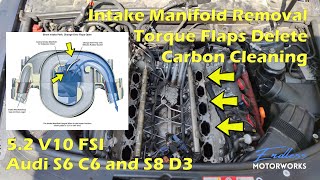
The 5.2L V10 in the C6-generation S6 is a direct-injection (FSI) engine. This design is notoriously prone to heavy carbon buildup on the intake valves because fuel is injected directly into the cylinder and never washes over the valves to clean them. Oil vapor from the Positive Crankcase Ventilation (PCV) system bakes onto the hot intake valves, restricting airflow and causing misfires that can be isolated to a single cylinder or spread across multiple cylinders 🎬 See how to remove the manifold and address swirl flap issues.. The symptoms of carbon buildup—rough idle and misfires—are nearly identical to those of a failing ignition coil, which is also a very common failure item on this engine. This overlap often leads to misdiagnosis if a thorough diagnostic process isn't followed.
Symptoms You May Notice
- Flashing or solid Check Engine Light
- Rough or vibrating idle, sometimes worse on cold start
- Engine hesitation or stumbling during acceleration, sometimes in a specific RPM range (e.g., 3-4k RPM)
- Noticeable loss of engine power
- Increased fuel consumption
- Smell of fuel from the exhaust
- Engine shaking or shuddering
- Replacing only the spark plug when the ignition coil was the actual cause (or vice-versa).
- Replacing fuel injectors before confirming they are faulty, when the actual issue is carbon buildup on the intake valves.
- Assuming a single cylinder misfire code (P0308) cannot be caused by carbon buildup, when in fact it can start in one cylinder before affecting others.
Most Likely Causes
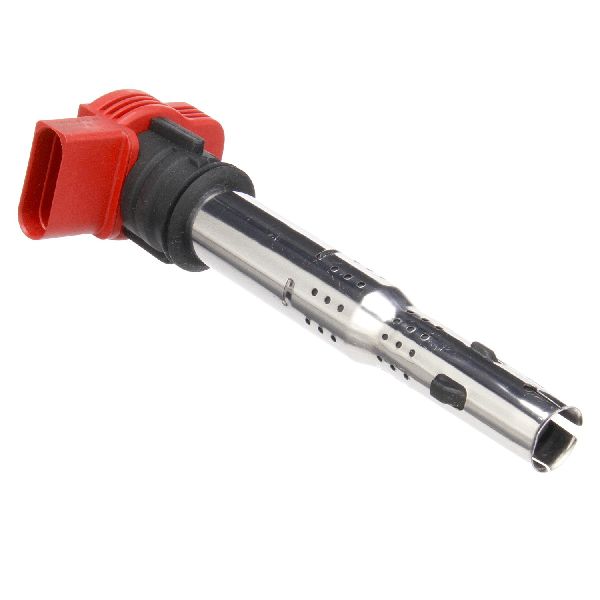
- Faulty Ignition Coil 🔴 High Probability → Shop Ignition Coil Ignition coils are a very common failure item on Audi engines of this era due to high heat and voltage stress. Some owners report coils failing in succession.
How to confirm: Swap the ignition coil from cylinder 8 with another cylinder (e.g., cylinder 7). Cylinder 8 is on the driver's side, third from the front. Clear the codes and drive the vehicle. If the code changes to P0307, the ignition coil is faulty.
Typical fix: Replace the failed ignition coil. It is often recommended to replace all 10 coils and spark plugs at the same time for preventative maintenance, especially on higher mileage vehicles.
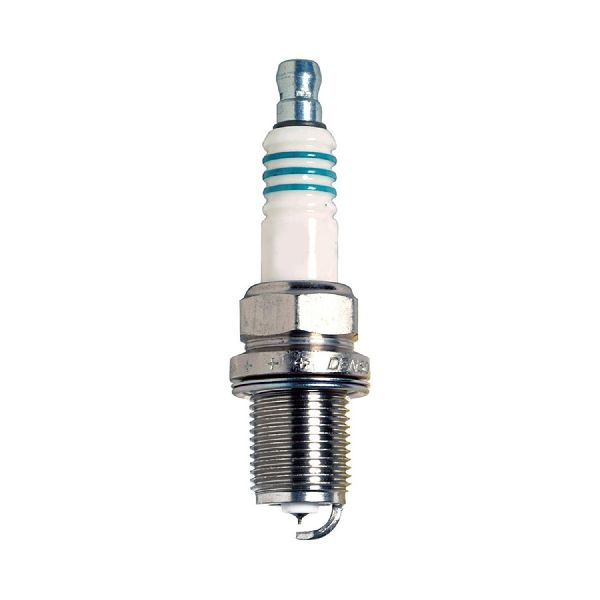
Est. part cost: $30-$70 for one coil - Worn Spark Plug 🔴 High Probability → Shop Spark Plug Spark plugs are a standard maintenance item that wear out over time, leading to a weak or inconsistent spark. Oil from a leaking valve cover gasket can also foul the plug.
How to confirm: After ruling out the ignition coil, swap the spark plug from cylinder 8 with another cylinder. If the misfire code follows the plug, the plug is bad. Visually inspect the plug for wear, carbon fouling, oil contamination, or damage to the ceramic insulator.
Typical fix: Replace the spark plug. It is best practice to replace all 10 spark plugs as a set, especially if their age is unknown.
Est. part cost: $15-$25 for one plug - Carbon Buildup on Intake Valves 🟡 Medium Probability The BXA engine uses Fuel Stratified Injection (FSI), where fuel is injected directly into the cylinder. This means gasoline never washes over the intake valves, allowing oil deposits from the PCV system to bake onto the hot valves, restricting airflow and causing misfires. This is considered a routine maintenance item, often required every 60,000-80,000 miles.
How to confirm: This requires a visual inspection using a borescope inserted into the intake port for cylinder 8. This is typically done after ignition and basic fuel delivery issues have been ruled out.
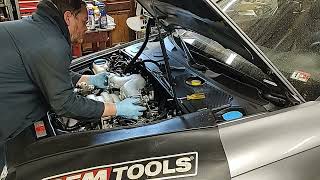
Typical fix: The intake manifold must be removed and the valves must be physically cleaned. 🎬 Watch: Step-by-step guide to removing the intake and cleaning valves. The most effective method is walnut shell blasting. This is a labor-intensive job that can take 8+ hours.
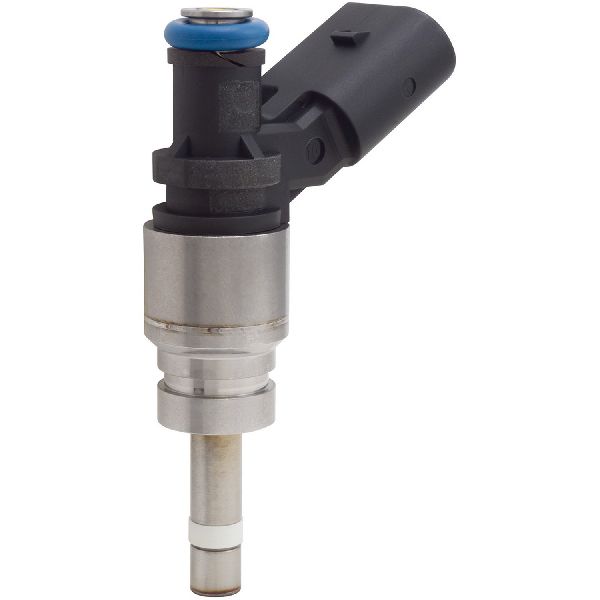
Est. part cost: $50-$100 for gaskets and supplies for DIY, but labor is the main cost. Professional service can range from $800-$1500+. - Faulty Fuel Injector ⚪ Low Probability → Shop Fuel Injector Direct injectors operate under high pressure and can become clogged with carbon deposits at the tip, disrupting the spray pattern, or fail electronically. This is a known issue, though less frequent than coils or carbon buildup.
How to confirm: This is more complex. It involves checking injector electrical signals or swapping the injector with another cylinder, which is labor-intensive as it requires removing the intake manifold. A mechanic can perform a flow test on a bench.
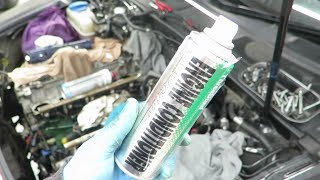
Typical fix: Replace the faulty fuel injector. Some owners report success using a high-quality fuel system cleaner like LiquiMoly Valve Clean as a first step, which was reportedly developed at Audi's request for this issue. If replacement is needed, it's often done in full sets.
Est. part cost: $100-$200 for one injector
Rare But Worth Checking
- Leaking Valve Cover Gasket: → Shop Engine Valve Cover The valve cover or spark plug tube seals can leak oil directly into the spark plug well, which can short out and destroy the ignition coil. If you find oil when removing the coil for cylinder 8, the gasket must be replaced. 🎬 Watch this walkthrough on fixing V10 oil leaks and carbon buildup.
- Vacuum Leak: A leak in a vacuum hose, PCV system component, or intake manifold gasket can introduce unmetered air and cause a lean condition, leading to misfires. A smoke test is the most effective way to find such leaks.
- Low Compression: A mechanical engine problem, such as a worn piston ring, a faulty valve, or cylinder wall scoring, can cause a loss of compression in cylinder 8, preventing proper combustion. A compression test can confirm this. While rare, some V10s have experienced significant internal issues.
- Intake Manifold Runner Flap Issue: → Shop Engine Intake Manifold The intake manifold has motorized flaps that adjust runner length. If these flaps or their mechanisms stick or break, it can disrupt airflow and cause misfires, often across multiple cylinders or in specific RPM ranges.
Diagnosis Steps
- Read the codes with an OBD-II scanner to confirm P0308 and check for any other codes (e.g., P0300, P2189).
- Identify Cylinder 8: It is on the US Driver's Side (Bank 2), the third cylinder from the firewall. The firing order is 1-6-5-10-2-7-3-8-4-9.
- Visually inspect the area around cylinder 8 for obvious issues like a disconnected coil connector, damaged wiring, or oil leaks from the valve cover.
- Swap the ignition coil from cylinder 8 with a coil from an adjacent cylinder (e.g., cylinder 7). Clear the codes, run the engine, and see if the misfire moves to cylinder 7 (now showing a P0307 code). If it does, the coil is bad.
- If the misfire stays on cylinder 8, perform the same swap test with the spark plug. If the misfire moves, the spark plug is bad.
- If the coil and plug are good, inspect the spark plug tube for oil. If oil is present, the valve cover and tube seals are leaking and must be replaced.
- If ignition components are good, the next likely causes are a fuel injector or carbon buildup. Try a bottle of a quality GDI-specific fuel system cleaner (like LiquiMoly) as a low-cost first step.
- Use a borescope to inspect the intake valves for cylinder 8 for signs of heavy carbon buildup. This is a very common cause on the 5.2L FSI.
- If no cause is found, perform a compression test on cylinder 8 to rule out mechanical engine problems.
- Check for vacuum leaks using a smoke machine, paying attention to the intake manifold gaskets and PCV hoses.
Parts You'll Likely Need
- Ignition Coil
(OEM #07K905715G)— This is the most common failure point for a single-cylinder misfire on this engine. The part has been through many revisions; 'G' or later is the most current.
Trusted brands: Bosch, NGK, Eldor, Beru
OEM price range: $50-$70
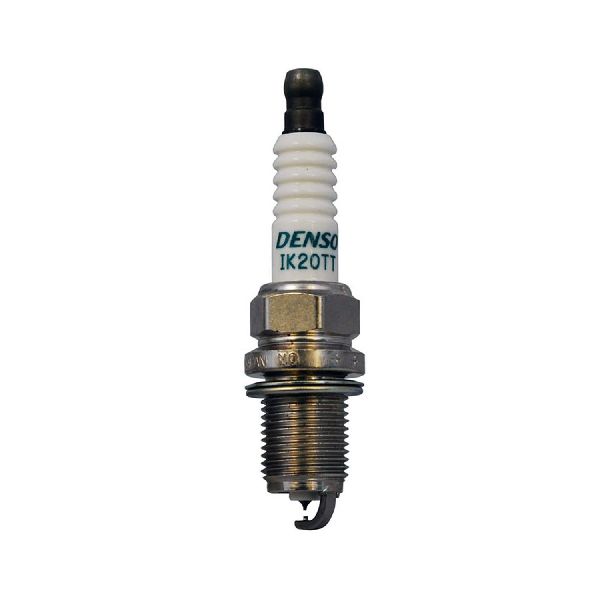
Aftermarket price range: $30-$50 - Spark Plug
(OEM #101905622A)— A standard wear item that is a frequent cause of misfires. It's recommended to replace them when replacing coils.
Trusted brands: NGK (PFR7W-TG), Bosch (FR6KPP332S)
OEM price range: $20-$30
Aftermarket price range: $15-$25 - Fuel Injector
(OEM #07L906036K (supersedes 06E906036C))— A less common but significant cause of misfires if ignition components are good. Injectors can get clogged or fail electronically.
Related Codes That Often Appear With This One
- P0300 — If multiple cylinders are misfiring due to a systemic issue like a vacuum leak, low fuel pressure, or widespread carbon buildup, a P0300 (Random/Multiple Cylinder Misfire) code may accompany P0308.
- P030x — Other cylinder-specific misfire codes (e.g., P0307, P0309, P0310) may appear if multiple ignition coils are failing around the same time or if carbon buildup is affecting several cylinders.
- P2189 — A "System Too Lean at Idle, Bank 2" code can be caused by a vacuum leak or injector issue on that bank, which could also be the root cause of the misfire in cylinder 8 (which is on Bank 2).
Technical Service Bulletins (TSBs) & Recalls
- While no specific TSB for P0308 was found, Audi has issued numerous TSBs for oil consumption on FSI engines (e.g., TSB 2026742/10) which contributes to the carbon buildup problem.
- An older service action (28E9) was mentioned in forums for a free replacement of ignition coils on eligible vehicles, indicating a known high failure rate.
- Manufacturer TSB Bulletin #A01166020322224 for similar Audi models explains how to update the ECM software to correct an issue that causes DTCs P0300 through P0308.
Platform-Specific Known Issues
- The 5.2L FSI V10 engine is highly susceptible to carbon accumulation on intake valves, which can directly cause misfire codes. This is not a matter of 'if' but 'when', and it requires a manual cleaning service (walnut blasting) for resolution, typically every 60-80k miles.
- Oil leaks from valve cover gaskets into the spark plug tubes are common and will destroy ignition coils.
- While less common for a single cylinder misfire, issues with the variable intake manifold runner control flaps can cause misfires, often at specific RPMs.
Mechanic-Grade Diagnostic Values
- Low-Pressure Fuel System — expected: 5.0 to 7.0 bar (72 to 101 PSI). Failure: Pressure that is significantly below 5.0 bar at idle or under load can starve the high-pressure pumps, causing misfires.
- High-Pressure Fuel System (at idle) — expected: Approximately 40.0 bar (580 PSI). Failure: A specified pressure of ~6.4 bar while the actual is 40 bar is normal for VCDS readings at idle; however, significant deviation or inability to build pressure under load points to a failing HPFP.
- Engine Compression — expected: New: 10.0 to 14.0 bar (145 to 203 PSI). Failure: Wear limit is 9.0 bar (130 PSI). A difference between cylinders greater than 3.0 bar (43.5 PSI) indicates a mechanical engine issue.
Scan Tool Commands That Help
- VCDS (VAG-COM): Misfire Counter in Measuring Blocks — To diagnose an active misfire in real-time without waiting for a CEL. Use Measuring Block Groups 015, 016, and 017 to watch the misfire counters for each cylinder. Cylinder 8's counter is in Group 017. This allows a technician to confirm the misfire is on cylinder 8 and see if it occurs under specific conditions (idle, load, cold, hot).
- VCDS (VAG-COM): Fuel Pressure Reading (Low and High) — To check fuel system health. Use Measuring Block 103 for the low-pressure side and check fuel rail pressure in other blocks. This helps differentiate between a fuel supply issue and an ignition or mechanical problem before replacing expensive parts like the high-pressure fuel pumps.
Wiring & Ground Locations
- Engine Ground Strap — Main ground straps are located on both sides of the engine bay, connecting the engine block to the chassis frame rails. A smaller ground wire comes from the main harness behind the oil filter housing.. A loose or corroded main engine ground can cause all manner of erratic electrical issues, including weak spark or inconsistent sensor readings that can lead to misfire codes. The ignition coils for all cylinders rely on a solid engine ground.
- ECU Box / Plenum Chamber — The Engine Control Unit (ECU) is housed in a plastic box in the plenum area, under the windshield wipers.. The plenum drains in this area are notorious for clogging with leaves and debris. This causes the box to fill with water, flooding the ECU and its connectors, leading to corrosion and a host of electrical failures, including phantom misfire codes or a complete no-start.
Real Owner Repair Stories
- Audi Revolution Forum (2007 Audi S5 (with similar PCV system design)) — Cold start misfires and misfires under load.
❌ Tried (didn't work) Initial diagnosis pointed towards common ignition or fuel issues.
✅ What actually fixed it The ultimate cause was a torn diaphragm in the PCV valve/oil separator, which was sucking engine oil into the intake manifold at idle, fouling the cylinders. Replacing the PCV valve and cleaning the related hoses resolved the misfires. - AudiWorld Forum (2004 Audi S4 (different engine, but illustrates diagnostic path)) — P0306 & P0308 codes (Cylinder 6 & 8 misfire).
❌ Tried (didn't work) Replaced ignition coils., Replaced all spark plugs., Replaced all four fuel injectors on the affected bank (Bank 2).
✅ What actually fixed it The user was advised that using a generic OBD-II scanner was insufficient and that a VCDS scan was necessary to pull all manufacturer-specific codes that would point to the true root cause, as the parts-swapping approach had failed. The thread highlights the limitation of basic scanners for these complex vehicles.
"I Checked Everything" — The Actual Cause
- A common scenario on the 5.2L V10 is a failed PCV (oil separator) diaphragm. This creates an internal vacuum leak, allowing unmetered air and oil vapor into the crankcase and then the intake. A standard smoke test of the intake tract may not reveal this leak, as the failure is within the PCV component itself. Symptoms include a hissing noise, high oil consumption, and lean-condition misfires that can be random or isolated to one bank.
OEM Part Supersession History
06H-905-115, 07K-905-715→07K-905-715-G— Multiple revisions (A, B, C, D, E, F) were released to improve reliability and resistance to heat and vibration failure.
Heads up: While older revisions may physically fit, the latest 'G' revision (or newer, if available) is strongly recommended for longevity. Using a mix of old and new revision coils on the same engine is discouraged by many technicians.07L127026A / 07L127026AD→07L127026E, 07L127026F, 07L127026J— Revisions to the High-Pressure Fuel Pump (HPFP) to improve durability and performance.
Heads up: Failure of one HPFP can cause misfires across an entire bank. While not a direct cause of a single cylinder misfire initially, a failing pump is a known issue that can present with hesitation and misfires under load.
Model Year Variations Within This Range
- 2007-2011: The BXA engine in the S6 uses a dual-path intake manifold with variable runner flaps. These plastic flaps and their mechanisms are known to break or stick over time, causing rattling noises and airflow disruption that can lead to misfires, often with specific fault codes for the flaps themselves (e.g., P2006, P2007). While the part is the same across the model years, failure is more common on higher-mileage examples regardless of year.
Diagnostic Flowchart
Real Owner Stories
Aggregated from forums and TSBs cited above. Mileages and costs reflect what owners reported in those sources.
Audi S6 V10
Symptoms: Experienced misfires on cylinders 5, 7, and 8 shortly after having a carbon cleaning performed on the intake valves.
What fixed it: Used LiquiMoly Valve Clean fuel additive to clear out clogged fuel injector tips, which resolved the misfires.
Source hint: AudiWorld Forums - S6 V10 engine misfires - low cost solution
2011 Audi S6
Symptoms: Vehicle exhibited misfires alongside a P2189 (Bank 2 Lean at Idle) code. The misfires persisted even after the ignition coils and spark plugs were replaced.
What fixed it: Diagnosed as heavy intake valve carbon buildup and leaking valve cover gaskets requiring replacement and manual cleaning.
Source hint: Ross-Tech Forums - 2011 Audi S6 - misfires
Audi S6 V10
Symptoms: Encountered a persistent misfire code that did not go away after replacing the spark plugs and ignition coils.
What fixed it: Identified faulty fuel injectors and stuck variable intake manifold runner control flaps as the underlying causes.
Source hint: AudiSRS.com - S6 V10 Misfire
Related OBD-II Codes
Frequently Asked Questions
Is there a recall or known service action for the ignition coils on my 2007-2011 Audi S6?
How often does the 5.2L V10 need carbon cleaning to prevent misfires like P0308?
Where exactly is cylinder 8 located on the 5.2L BXA V10?
I have a P0308 code and found oil in the spark plug tube. What causes this?
Can a fuel additive fix my P0308 misfire on the S6?
Does TSB 2026742/10 apply to my P0308 code?
Helpful Videos
We Have This Part in Stock


The information in this article is provided for general reference and educational purposes only. Vehicle specifications, procedures, and part compatibility can vary by production date, trim level, and region. Always consult your vehicle's factory service manual and verify part numbers before purchasing or performing repairs. Safety-critical components such as airbags, seat belts, and braking systems should be installed by a qualified professional.
- Audi S6:
- 🧭 Diagnostic Flowchart
- 🎬 Helpful Videos
- 🛍️ Shop This Part
- What's Unique About the 2007-2011 Audi S6
- Symptoms You May Notice
- Most Likely Causes
- Rare But Worth Checking
- Diagnosis Steps
- Parts You'll Likely Need
- Related Codes That Often Appear With This One
- Technical Service Bulletins (TSBs) & Recalls
- Platform-Specific Known Issues
- Mechanic-Grade Diagnostic Values
- Scan Tool Commands That Help
- Wiring & Ground Locations
- Real Owner Repair Stories
- "I Checked Everything" — The Actual Cause
- OEM Part Supersession History
- Model Year Variations Within This Range
- Real Owner Stories
- Audi S6 V10
- 2011 Audi S6
- Audi S6 V10
- Related OBD-II Codes
- Frequently Asked Questions
- 🎟️ Get 5% Off