

P0308 on 2011-2018 Chevrolet Volt: Meaning of a Misfire on a Non-Existent Cylinder
A P0308 code on a 4-cylinder Chevy Volt is a 'ghost code,' as there is no cylinder 8. It indicates a serious diagnostic system error or a misfire on an actual cylinder (1-4) that the ECU is misreporting. Diagnosis requires a professional scan tool to find the true source of the misfire, which is most commonly a faulty ignition coil or spark plug.
- P0308 on a Chevy Volt is a 'ghost code' because the car only has 4 cylinders.
- The code points to a real misfire problem, but the ECM is incorrectly reporting the cylinder number.
- DO NOT look for an 8th cylinder. Instead, the first step is to use a quality scan tool to find the actual misfiring cylinder (1-4).
- The most likely underlying causes are a bad ignition coil or worn spark plug on one of the four actual cylinders.
- Professional diagnosis is highly recommended to avoid wasting money on incorrect parts.
What's Unique About the 2011-2018 Chevrolet VOLT
The Chevrolet Volt's 4-cylinder engine makes a literal P0308 impossible. General Motors issued a broad Technical Service Bulletin (TSB #PIP5628G) for misfire diagnosis that includes the entire P0300-P0308 range, but this document applies to their entire vehicle lineup, including V8 trucks. For a Volt, seeing P0308 means you should disregard the '8' and treat the issue as a significant, but unidentified, engine misfire that requires deeper investigation with advanced tools to find the actual failing cylinder (1-4).
Diagnostic Flowchart
Tap your situation to follow the diagnostic path that matches what you're seeing on this vehicle.
Generation note: This guide covers the 1st generation (2011-2015) with the 1.4L engine and the 2nd generation (2016-2018) with the 1.5L engine. The diagnostic principle for this ghost code is the same for both, but specific parts like coils and plugs will differ. The Gen 1 uses a single ignition coil cassette, while the Gen 2 uses individual coil-on-plug units. The Gen 2 also features a high-pressure direct injection fuel system.
Symptoms You May Notice
- Check Engine Light is on or flashing
- Rough or shaky engine operation when the gas engine is running
- Hesitation or stumbling during acceleration
- Reduced power from the gasoline engine
- Possible fuel smell from the exhaust.
- Searching for a non-existent 8th cylinder.
- Replacing parts without first using a scan tool to identify the actual misfiring cylinder.
- Replacing an O2 sensor, as a misfire can sometimes trigger a fuel mixture code like P2196.
Most Likely Causes
- Engine Control Module (ECM) Software Anomaly 🔴 High Probability → Shop Engine Control Module (ECM) The existence of a code for a non-existent cylinder is, by definition, a logic error. This may be triggered by a fault in another component that the ECM misinterprets. This is a known behavior in the GM engine family that includes the Volt.
How to confirm: A technician would first check for ECM software updates. Then, using a GM GDS2 scan tool, they would check the misfire history data for cylinders 1, 2, 3, and 4 to find the actual source.
Typical fix: Diagnose and fix the true source of the misfire (e.g., a bad coil on cylinder 2). In rare cases, the ECM may need a software update or replacement.
Est. part cost: $0-$1000 - Failed Ignition Coil 🟡 Medium Probability → Shop Ignition Coil Ignition coils are a common failure item on most modern engines, leading to a misfire on a specific cylinder. The Gen 1 1.4L coil cassette is known for corrosion on the internal contact springs.
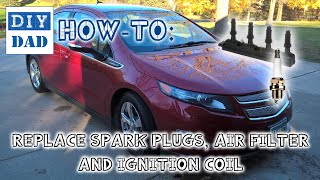
How to confirm: After identifying the actual misfiring cylinder with a proper scan tool, swap the ignition coil with a known good cylinder (only possible on Gen 2). If the misfire code follows the coil (e.g., moves from P0302 to P0304), the coil is bad. For Gen 1, the entire cassette must be tested or replaced. 🎬 See this walkthrough for replacing Gen 1 plugs and coils
Typical fix: Replace the failed ignition coil. The Gen 1 Volt uses a single coil pack assembly, while the Gen 2 uses individual coils.
Est. part cost: $70-$150 - Worn or Fouled Spark Plugs 🟡 Medium Probability → Shop Spark Plug
How to confirm: Inspect the spark plugs on all four cylinders. Look for heavy carbon buildup, oil fouling, or a worn electrode. Spark plugs are a regular maintenance item.
Typical fix: Replace all four spark plugs. It is recommended to replace them as a set.
Est. part cost: $30-$80 - Faulty Fuel Injector ⚪ Low Probability → Shop Fuel Injector
How to confirm: A technician can perform a fuel injector balance test using a professional scan tool to see if an injector is flowing less fuel than the others.
Typical fix: Replace the faulty fuel injector. GM TSB 20-NA-098 provides guidelines on selecting the correct flow-rated injector.
Est. part cost: $70-$150
Rare But Worth Checking
- Low Engine Compression: A mechanical engine issue like a bad valve or worn piston rings can cause a persistent misfire. A compression test would be needed to verify this after ignition and fuel systems are ruled out.
- Vacuum Leak: A significant vacuum leak can lean out the air-fuel mixture and cause random or specific cylinder misfires. This would typically be accompanied by a lean code (P0171). On 1.4L engines, a failed PCV diaphragm in the valve cover is a common source.
- Damaged Wiring Harness: Rodent damage or chafing of the wiring harness leading to an ignition coil or fuel injector can cause an intermittent misfire that the ECM may struggle to identify correctly.
Diagnosis Steps
- Connect a professional-grade scan tool (GM GDS2 recommended) to the OBD-II port.
- Ignore the P0308 code's cylinder designation. Navigate to the engine control module data.
- Access the 'Misfire Data' or 'Misfire History' screen to view the lifetime and current misfire counters for cylinders 1, 2, 3, and 4.
- Identify which of the actual cylinders has a high misfire count.
- If a single cylinder is identified (e.g., Cylinder 3), proceed with diagnosing that specific cylinder. For Gen 2 models, swap the ignition coil with a neighboring cylinder and clear codes. Run the engine to see if the misfire moves with the coil. For Gen 1, this is not possible as it's a single cassette.
- If the misfire does not move (or for Gen 1), inspect the spark plug for that cylinder. Replace if it appears worn or fouled.
- If the plug and coil are good, the issue may be the fuel injector or a mechanical problem (compression). A fuel injector balance test can be performed with the scan tool.
- If multiple cylinders are misfiring (indicating a P0300 condition), investigate causes that affect the whole engine, such as vacuum leaks (especially the valve cover on 1.4L), fuel quality issues, or a faulty MAF sensor.
Parts You'll Likely Need
- Ignition Coil Assembly
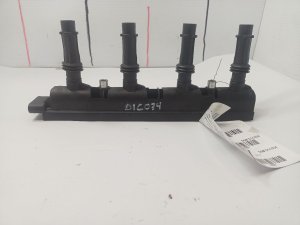
(OEM #ACDelco 55579072 (for 1.4L LUU engine))— A common cause of a single-cylinder misfire, which is the likely underlying issue. The 1.4L engine uses a single cassette-style coil pack.
Trusted brands: ACDelco, Delphi, NGK
OEM price range: $90-$160
Aftermarket price range: $70-$120 - Spark Plugs
(OEM #ACDelco 41-121 (for 1.4L LUU engine), ACDelco 41-162 (for 1.5L L3A engine))— A routine maintenance item and a frequent cause of misfires. Should be replaced as a set.
Trusted brands: ACDelco, NGK
OEM price range: $40-$90 (set of 4)
Aftermarket price range: $30-$70 (set of 4)
Related Codes That Often Appear With This One
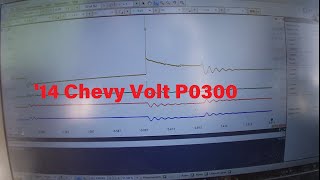
- P0300 — If the ECM is confused, it may log a P0308 alongside a P0300 (Random Misfire) 🎬 Watch: Diagnosing a secondary ignition misfire on a 2014 Volt as it detects instability but cannot pinpoint it to a single valid cylinder.
- P0301, P0302, P0303, P0304 — A professional scan tool will likely reveal one of these codes stored in the misfire history, indicating the true source of the problem.
- P0171 — If the underlying cause of the misfire is a vacuum leak or fuel delivery issue, a P0171 (System Too Lean) code may also be present. A failed PCV valve in the valve cover is a common cause of P0171 on the 1.4L engine.
Technical Service Bulletins (TSBs) & Recalls
- PIP5628G: A general diagnostic aid for GM technicians dealing with engine misfires (P0300-P0308). Its inclusion of the Volt means the procedure is applicable, but confirms the code range is for the entire GM lineup, not just the Volt. It instructs technicians to gather specific data with a GDS2 scan tool before contacting technical assistance.
- 20-NA-098: Provides information on fuel injector replacement, noting that injectors are flow-matched at the factory and care must be taken to order the correct replacement part number, which may differ from the number printed on the injector itself.
Mechanic-Grade Diagnostic Values
- Ignition Coil Cassette Resistance (Gen 1, 1.4L Engine) — expected: Primary: ~0.660 ohms. Secondary: ~6.1K ohms.. Failure: Readings significantly outside these values indicate a faulty coil cassette.
- Short Term (STFT) & Long Term (LTFT) Fuel Trims — expected: Within +/- 10% at idle on a warm engine. Ideally close to 0%.. Failure: Consistently high positive values (e.g., >10%) indicate the ECM is adding fuel to compensate for a lean condition (like a vacuum leak).
- Mass Airflow (MAF) Sensor Reading — expected: At warm idle, g/s reading should be close to engine displacement. (e.g., ~1.4 g/s for 1.4L engine, ~1.5 g/s for 1.5L engine).. Failure: A significantly lower reading suggests the sensor is under-reporting airflow, which can cause lean conditions and misfires.
- Injector Pulse Width (Port Injection, Gen 1) — expected: 2-4 milliseconds (ms) at idle.. Failure: Values outside this range at idle can indicate a fueling problem or other issue affecting the required fuel amount.
Scan Tool Commands That Help
- GM GDS2 / Tech2Win: Crankshaft Position Variation Learn — Required after replacing the crankshaft position sensor, ECM, or performing some transmission work. Failure to perform this relearn can cause the ECM to inaccurately detect or report misfires. The ECM may reject the command if other DTCs are present.
- Professional Scan Tool: Injector Balance Test / Pulse Test — To test if a fuel injector is clogged or failing electronically. The tool commands each injector to fire and measures the corresponding drop in fuel rail pressure; drops should be equal across all cylinders.
Wiring & Ground Locations
- K20 ECM Connector X2 (Gen 1, 2012 model) — Engine Control Module, located in the engine compartment.. Provides direct test points for ignition and injector circuits. Pin 1 (VT/L-BU) is Ignition Control Cyl 1, Pin 29 (D-GN) is Ignition Control Cyl 2, Pin 17 (L-GN/L-BU) is Ignition Control Cyl 3, Pin 30 (L-BU/D-BU) is Ignition Control Cyl 4. Pins 2, 5, 3, and 4 are for injector control for cylinders 1, 2, 3, and 4 respectively.
- G102 — Typically located on the left rear of the engine block/cylinder head.. This is a primary ground point for the ignition coils. A poor connection here can cause weak spark and lead to random misfires (P0300) or mis-identified single cylinder misfires.
- G103 — Typically located on the front of the passenger side (right side) cylinder head.. This is a primary ground for the Engine Control Module (ECM). A poor connection can cause a wide range of erratic behavior, including false misfire codes.
Real Owner Repair Stories
- Carly Forum User (2019 Chevrolet Volt (Gen 2), 200,000+ km) — Check engine light, engine stalling at idle, reduced power.
❌ Tried (didn't work) Initial visual inspection of wiring.
✅ What actually fixed it The vehicle was setting codes P008A (Low Pressure Fuel System Pressure - Too Low) and P00C6 (Fuel Rail Pressure Too Low). The root cause was a failed high-pressure fuel pump, which was replaced to solve the issue. - Reddit user on r/volt (2012 Chevrolet Volt (Gen 1)) — P0171 (System Too Lean), which often accompanies random misfires.
❌ Tried (didn't work) Searching for a vacuum leak with brake cleaner spray around the intake manifold.
✅ What actually fixed it The suggested, and very common, fix for this on the 1.4L engine is replacing the entire valve cover. A diaphragm for the PCV system is integrated into the cover and fails, creating a significant, un-metered vacuum leak that is difficult to detect with a smoke or spray test.
"I Checked Everything" — The Actual Cause
- On 1.4L (Gen 1) engines, a persistent lean condition (P0171) and/or random misfires (P0300) that seem like a vacuum leak but don't show up on a smoke test are very often caused by a failed PCV diaphragm inside the valve cover. The entire valve cover assembly must be replaced to fix the internal leak.
Model Year Variations Within This Range
- 2011-2015 (Gen 1): Uses a 1.4L LUU port-injected engine with a single, cassette-style ignition coil pack (ACDelco 55579072). A common failure point causing misfires is a torn PCV diaphragm inside the valve cover, requiring full valve cover replacement.
- 2016-2018 (Gen 2): Uses a 1.5L L3A direct-injected engine with four individual coil-on-plug ignition units. This system has both a low-pressure in-tank fuel pump and a high-pressure mechanical fuel pump on the engine. Failure of the high-pressure pump is a possible cause of misfire/stalling symptoms.
Helpful Videos
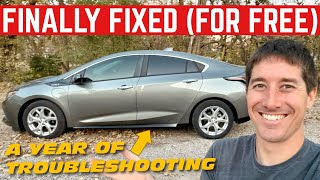
We Have This Part in Stock

The information in this article is provided for general reference and educational purposes only. Vehicle specifications, procedures, and part compatibility can vary by production date, trim level, and region. Always consult your vehicle's factory service manual and verify part numbers before purchasing or performing repairs. Safety-critical components such as airbags, seat belts, and braking systems should be installed by a qualified professional.
- Chevrolet VOLT:
- 🧭 Diagnostic Flowchart
- 🎬 Helpful Videos
- 🛍️ Shop This Part
- What's Unique About the 2011-2018 Chevrolet VOLT
- Symptoms You May Notice
- Most Likely Causes
- Rare But Worth Checking
- Diagnosis Steps
- Parts You'll Likely Need
- Related Codes That Often Appear With This One
- Technical Service Bulletins (TSBs) & Recalls
- Mechanic-Grade Diagnostic Values
- Scan Tool Commands That Help
- Wiring & Ground Locations
- Real Owner Repair Stories
- "I Checked Everything" — The Actual Cause
- Model Year Variations Within This Range
- 🎟️ Get 5% Off