

P0322 on 2002-2009 Audi A8: Engine Speed Sensor Failure Causes and Fixes
P0322 on a D3 Audi A8 almost always means the Engine Speed Sensor (G28), also known as the Crankshaft Position Sensor, has failed. This causes a 'crank-no-start' condition or sudden stalling, especially when the engine is hot. The fix is to replace the sensor, which is located on the driver's side of the transmission bell housing, and is a difficult DIY job due to extremely tight access.
- P0322 on your A8 means the Crankshaft Position Sensor (G28) has no signal, which will prevent the car from starting or cause it to stall.
- The most likely cause is a failed sensor, followed by heat-damaged wiring.
- The sensor is located on the driver's side of the transmission bell housing; replacement is a difficult DIY job due to poor access.
- Do not continue to drive the vehicle, as a sudden stall in traffic is a serious safety hazard.
- Always inspect the wiring harness for melting or damage before replacing the sensor itself.
What's Unique About the 2002-2009 Audi A8
On the D3 generation A8, both the 4.2L V8 and 5.2L V10 engines position the G28 Engine Speed Sensor in a difficult-to-access location on the transmission bell housing, tucked behind the engine. A common point of failure, aside from the sensor itself, is the wiring harness which is susceptible to heat damage from the nearby exhaust manifold. Owners often report that the sensor fails intermittently when hot, leading to stalling, and the car may not restart until it has cooled down. This makes diagnosis tricky until it fails completely.
Symptoms You May Notice
- Engine cranks but will not start
- Engine stalls suddenly while driving, often when hot, and may not restart until it cools down
- Rough idling or engine misfires
- Check Engine Light (CEL) and/or Electronic Power Control (EPC) light is illuminated
- Tachometer may not work or may behave erratically, often dropping to zero during a stall.
- Flashing Glow Plug light (on TDI models, though less common for this specific engine guide)
- Replacing the fuel pump, as a crank-no-start condition can mimic fuel delivery issues.
- Replacing camshaft position sensors, as they are part of the ignition timing system but are less likely to cause a complete 'no signal' fault for this code.
Most Likely Causes
- Failed Engine Speed Sensor (G28) / Crankshaft Position Sensor 🔴 High Probability → Shop Engine Crankshaft Position Sensor The sensor is exposed to significant heat cycles at the back of the engine, leading to internal electronic failure over time. It's a common failure item on high-mileage Audis of this era.
How to confirm: Scan live data for Engine RPM while cranking; a '0' reading points to the G28 circuit. Test the sensor's signal with a multimeter (set to AC voltage) or an oscilloscope while cranking the engine. A lack of a fluctuating signal indicates a failed sensor. Often, the sensor tests fine when cold but fails when hot. Some owners have had success simply removing and cleaning the magnetic tip of the sensor if it's covered in metallic debris, though this is often a temporary fix.
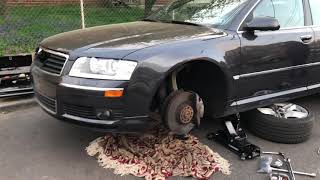
Typical fix: Replace the Engine Speed Sensor. This requires accessing it from underneath the car or through the driver's side wheel well after removing heat shields. It is a single bolt, but access is very tight. 🎬 Watch: Locate the sensor on the 4.2L engine
Est. part cost: $40-$150 - Damaged Wiring or Connector 🟡 Medium Probability The sensor's wiring harness runs near the exhaust manifold, and over time the heat can cause the insulation to become brittle, crack, or melt, leading to a short or open circuit.
How to confirm: Visually inspect the entire length of the sensor's wiring harness from the sensor body to its connector on the firewall. Look for any signs of melted plastic, chafed wires, or corrosion on the connector pins. The connector is often a gray plug located near two others (red and black) under a plastic cover.
Typical fix: Repair the damaged section of wiring or replace the connector pigtail. Ensure the repaired harness is secured away from heat sources using high-temperature wire loom and zip ties.
Est. part cost: $10-$30
Rare But Worth Checking
- Faulty Engine Control Module (ECM): → Shop Engine Control Module (ECM) This is extremely rare. Before condemning the ECM, all other possibilities, including the sensor and its entire wiring circuit, must be exhaustively tested and ruled out. Coolant wicking into the ECM harness has been noted on other VW/Audi platforms as a cause for G28 codes.
- Damaged Reluctor Wheel: The sensor reads teeth from a reluctor wheel on the crankshaft. It is very rare for this wheel to be damaged, but it can happen during major engine or transmission work. This would typically present with other codes and symptoms.
Diagnosis Steps
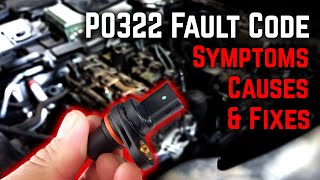
- Scan for codes: Use a VAG-COM/VCDS scanner if possible. Confirm P0322 is the primary code. 🎬 Watch: P0322 code causes and symptoms explained Note any other codes present, like P0321 or misfire codes.
- Check Live Data: While cranking the engine, monitor the 'Engine RPM' parameter. A consistent '0' RPM reading strongly suggests a fault in the G28 sensor circuit.
- Check when the fault occurs: Note if the car stalls only when hot and restarts when cool. This is a classic symptom of a failing sensor.
- Visually inspect the wiring: Safely raise the vehicle. Locate the sensor on the driver's side of the transmission bell housing. This is best accessed by removing the driver's side front wheel and heat shields. Carefully inspect the wiring harness for any signs of melting, chafing, or damage from heat.
- Inspect the connector: Trace the wire up to the firewall and inspect the gray electrical connector for corrosion, damage, or loose pins.
- Test the sensor signal: If the wiring looks good, test the sensor's output. Using an oscilloscope is the most reliable method. A multimeter on the AC voltage setting can also be used; probe the signal and ground wires while cranking the engine. You should see a small, fluctuating AC voltage. No voltage indicates a dead sensor.
- Replace the sensor: If the sensor signal is absent, replace the Engine Speed Sensor (G28). Use of an OEM or Bosch sensor is highly recommended, as aftermarket sensors have a high failure rate. 🎬 See this step-by-step Audi crank sensor replacement
- Clear codes and test drive: After replacement, clear the trouble codes and perform a test drive, allowing the engine to reach full operating temperature to ensure the issue is resolved.
Parts You'll Likely Need
- Engine Speed Sensor / Crankshaft Position Sensor (G28)
(OEM #077905381F)— This sensor is the primary cause of the P0322 code due to electronic failure from heat and age.
Trusted brands: Bosch (OEM supplier), NTK, Delphi
OEM price range: $100-$180
Aftermarket price range: $40-$90
Related Codes That Often Appear With This One
- P0321 — This code indicates an 'Implausible Signal' from the same Engine Speed Sensor (G28). It can appear before a complete failure that triggers P0322, suggesting the sensor is failing intermittently.
- P0300, P0301-P0310 — Random or specific cylinder misfire codes can be logged because without a correct crankshaft signal, the ECM cannot properly time ignition, leading to misfires.
Platform-Specific Known Issues
- Access to the sensor is notably difficult, requiring removal of the driver's side wheel and heat shields. The single retaining bolt can be hard to reach and remove.
- The electrical connector is often located high up on the firewall, making it a 'blind' job to disconnect and reconnect.
- A YouTube video by 'Car Fan' titled 'G28 2005 Audi A8 D3 Crankshaft Positioning Sensor (Speed Sensor) Location' provides a clear visual guide to finding the sensor and its connector, which many owners struggle with.
Mechanic-Grade Diagnostic Values
- Engine Speed Sensor (G28) internal resistance — expected: 480-1000 Ω. Failure: A reading outside this range, or an open circuit, indicates a faulty sensor.
- Engine Speed Sensor (G28) internal resistance (alternate source) — expected: 450 to 1200 Ω. Failure: A reading outside of this range suggests the sensor is defective.
- Engine RPM via VCDS/Scan Tool Live Data (while cranking) — expected: A fluctuating value greater than cranking speed (typically >200 RPM). Failure: A consistent '0' RPM reading while the engine is physically cranking.
Scan Tool Commands That Help
- VCDS (VAG-COM): Engine -> Measuring Blocks -> Group 001 — This is the primary method to monitor live engine RPM as seen by the ECM. While cranking, if the value in field 1 (Engine Speed) remains at 0, it confirms the ECM is receiving no signal from the G28 circuit.
Wiring & Ground Locations
- G28 Sensor Connector — A gray 3-pin connector located on a bracket high on the firewall, often near a red and black connector, under a plastic cover.. This is the primary connection point to test the sensor's wiring and signal back to the ECM. Corrosion or damage here will cause a 'No Signal' fault.
- Engine to Chassis Ground — There are multiple ground connections. Key locations are in the engine compartment on the left and right side frame rails.. A poor engine ground can cause a variety of electrical issues, including erratic sensor signals. While not a primary cause for a complete 'No Signal' fault, it should be checked if other diagnostics are inconclusive.
Real Owner Repair Stories
- AudiWorld Forums user 'tozoM8' (1998 Audi A8 4.2 (D2 platform, but directly relevant experience)) — Car turns over with ease, but won't start. No CEL. VAG-COM scan showed code 16706 / P0322 - Engine Speed Sensor (G28): No Signal.
❌ Tried (didn't work) Initially considered fuel pump or spark plug issues.
✅ What actually fixed it The user found the wiring to the G28 sensor had melted together due to proximity to the exhaust. After separating and cleaning the wires, the car started and the code was resolved. - AudiWorld Forums user 'audinut' (2000 Audi A8) — Would not start. Turned over but sounded fuel starved.
❌ Tried (didn't work) The user suspected a bad fuel pump or spark plugs.
✅ What actually fixed it Removed the G28 sensor and found its magnetic tip was covered in metallic debris. Cleaned the tip with a shop towel and MAF cleaner, reinstalled it, and the car started immediately with no code. - NHTSA ODI #11325248 (Audi A6 cross-reference) — An owner reported that their vehicle threw codes P0322 and P0421, noting that P0322 was for the "engine ignition distributor no signal" and the car experienced a rev limiter issue.
Model Year Variations Within This Range
- 2005-2009: In 2005, the D3 A8 received a facelift that included the introduction of the tall, single-frame trapezoidal grille. While this was a major cosmetic change, the underlying engine architecture and the location/function of the G28 Engine Speed Sensor for the V8 and V10 engines remained consistent through the end of the generation in 2009.
Diagnostic Flowchart
Other Known Issues on This Vehicle
Issues unrelated to this code that are worth knowing about as an owner of this generation:
- Adaptive Air Suspension Failure 🔴 High — Common on higher mileage vehicles (over 80,000 miles). Leaking air springs or a failing compressor are the usual culprits.
- Timing Chain Guide Failure (4.2L V8) 🔴 High → Shop Engine Timing Chain — The plastic timing chain guides, located at the rear of the engine, can become brittle and fail, typically after 100,000 miles. This is an engine-out repair and is extremely expensive.
- MMI (Multi Media Interface) Failure 🟠 Medium — Can manifest as a black/non-responsive screen, random shutdowns, or a screen that fails to open/close. Causes range from blown fuses and software glitches to failed control modules or broken screen gears.
- Carbon Buildup on Intake Valves (FSI Engines) 🟠 Medium — Direct injection engines like the 4.2L FSI and 5.2L V10 are prone to carbon buildup on intake valves, leading to misfires, rough idle, and power loss, typically noticeable after 60,000 miles.
- Water Ingress in Rear Light Clusters 🟡 Low — Poor seals can allow water to enter the tail light assemblies, causing LED failure and corrosion of the electronics.
- Electronic Parking Brake Motor Failure 🟠 Medium — The motors for the electronic parking brake can fail due to water ingress from cracked housings, causing the parking brake to be stuck on or off.
Used vs. New Parts: Buying Guide for This Vehicle
When a used part is the smart pick: Due to the high labor cost for replacement and the critical nature of this sensor, a used part is not recommended. The cost savings are minimal compared to the risk of premature failure.
Donor-vehicle mileage cap: roughly under 150000 miles for the part to have meaningful remaining life.
What to inspect on the donor part:
- Verify the part number on the sensor itself matches the required OEM number (077905381F).
- Inspect the wiring pigtail for any signs of brittleness, cracking, or heat damage.
- Ensure the plastic connector housing is not cracked or damaged.
OEM-only on this vehicle (don't cheap out):
- Engine Speed Sensor (G28) / Crankshaft Position Sensor
Aftermarket brands forum-validated for this vehicle:
- Bosch (this is the Original Equipment Manufacturer, or OEM, for this part)
Brands owners have reported issues with on this vehicle:
- Unnamed, low-cost sensors from online marketplaces have a high failure rate. Forum users consistently report that using non-OEM/Bosch sensors for critical components like the G28 can lead to repeat failures.
Real Owner Stories
Aggregated from forums and TSBs cited above. Mileages and costs reflect what owners reported in those sources.
2000 Audi A8
Symptoms: No-start condition; the user investigated the G28 engine speed sensor location and function.
What fixed it: Cleaning the magnetic tip of the G28 sensor, which had accumulated metallic debris, preventing a proper reading.
Source hint: AudiWorld Forums: A thread titled 'G28 engine speed sensor...questions about sensor location etc..' from 2006
2005 Audi A8 D3
Symptoms: Difficulty locating the Crankshaft Positioning Sensor (Speed Sensor) and its firewall connector.
What fixed it: Replacement of the G28 sensor following a visual guide to navigate the tight access behind the driver's side wheel and heat shields.
Source hint: YouTube video by 'Car Fan' titled 'G28 2005 Audi A8 D3 Crankshaft Positioning Sensor (Speed Sensor) Location'
Audi A6 (Cross-Manufacturer Reference)
Symptoms: An owner reported the vehicle threw codes P0322 and P0421, describing the P0322 fault as an "engine ignition distributor no signal" issue that triggered a rev limiter.
Source hint: NHTSA ODI #11325248
Related OBD-II Codes
Frequently Asked Questions
Where is the G28 Engine Speed Sensor located on my Audi A8 with the 4.2L or 5.2L engine?
Why does my A8 stall when the engine is hot but restart after it cools down?
Can I just clean the sensor instead of replacing it?
Is there a specific brand of sensor I should buy for my Audi?
My tachometer dropped to zero while driving before the engine stalled. Is this related to P0322?
Is the P0322 code related to the timing chain guide issues common on the 4.2L V8?
Helpful Videos
We Have This Part in Stock


The information in this article is provided for general reference and educational purposes only. Vehicle specifications, procedures, and part compatibility can vary by production date, trim level, and region. Always consult your vehicle's factory service manual and verify part numbers before purchasing or performing repairs. Safety-critical components such as airbags, seat belts, and braking systems should be installed by a qualified professional.
- Audi A8:
- 🧭 Diagnostic Flowchart
- 🎬 Helpful Videos
- 🛍️ Shop This Part
- What's Unique About the 2002-2009 Audi A8
- Symptoms You May Notice
- Most Likely Causes
- Rare But Worth Checking
- Diagnosis Steps
- Parts You'll Likely Need
- Related Codes That Often Appear With This One
- Platform-Specific Known Issues
- Mechanic-Grade Diagnostic Values
- Scan Tool Commands That Help
- Wiring & Ground Locations
- Real Owner Repair Stories
- Model Year Variations Within This Range
- Other Known Issues on This Vehicle
- Used vs. New Parts: Buying Guide for This Vehicle
- Real Owner Stories
- 2000 Audi A8
- 2005 Audi A8 D3
- Audi A6 (Cross-Manufacturer Reference)
- Related OBD-II Codes
- Frequently Asked Questions
- 🎟️ Get 5% Off