

P0322 on 2003-2024 Honda Accord: Crankshaft Sensor Failure Causes and Fixes
P0322 on a Honda Accord almost always means the Crankshaft Position (CKP) sensor has failed, causing a no-start or stalling condition. The most likely fix is replacing the sensor itself. For V6 models, this sensor can be under the timing cover, making replacement significantly more labor-intensive. Expect to pay $40-$100 for an aftermarket part or $80-$150 for an OEM sensor. DIY difficulty varies significantly by generation and engine.
- P0322 means the engine computer has lost the signal from the crankshaft position sensor, which will likely cause the engine to not start or to stall while driving.
- The most common fix by a wide margin is to replace the crankshaft position sensor (CKP).
- Before replacing parts on a 2008-2009 4-cylinder Accord, check TSB 09-050, as a software update might be the correct fix, especially if the battery was recently low.
- The difficulty of this repair varies from easy (1/5) to very difficult (5/5) depending on your Accord's engine and year, as some require removing the timing belt.
- After replacing the sensor, a 'crank pattern learn' procedure with a scan tool is recommended to ensure proper engine operation.
What's Unique About the 2003-2024 Honda Accord
For the Honda Accord, code P0322 is overwhelmingly linked to a failed Crankshaft Position (CKP) sensor, with some sources estimating an 85% probability. However, a key difference exists for 2008-2009 models with the 4-cylinder engine. Honda issued a Technical Service Bulletin (TSB 09-050) noting that cranking the engine with a low battery could trigger a related code (P0339) by causing the computer to misinterpret the sensor's signal; the fix in this case is a software update, not a new sensor. Additionally, the difficulty of replacing the sensor varies dramatically across generations. On many V6 models, the sensor is located under the timing belt cover, requiring a significant amount of labor to access, making it a job often done concurrently with a timing belt change.
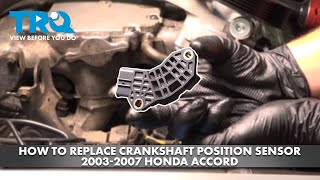
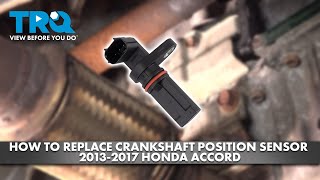
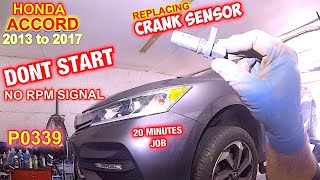
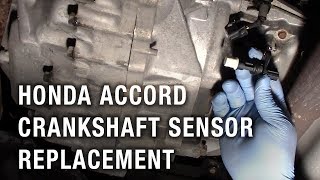
Generation note: The 2003-2024 range covers the 7th, 8th, 9th, 10th, and 11th generations of the Honda Accord. The primary cause (CKP sensor) is the same, but the sensor's location and the difficulty of the repair change significantly. - 7th Gen (2003-2007): On 2.4L 4-cylinder (K24) engines, the sensor is on the front of the engine block near the crankshaft pulley. 🎬 Watch: 7th Gen Honda Accord crankshaft sensor replacement walkthrough. On the 3.0L V6 (J30), it is located under the timing belt cover, making replacement a much more labor-intensive job. - 8th Gen (2008-2012): On the 3.5L V6 (J35), the sensor is located on the oil pump housing, near the crankshaft pulley, but still requires significant disassembly to access. On the 2.4L 4-cylinder (K24) models from 2008-2009, they are subject to TSB 09-050 🎬 See this step-by-step DIY for 2008-2012 2.4L models. for a related software issue that can be triggered by a low battery. - 9th Gen (2013-2017): The sensor is typically located on the engine block, near the passenger side CV axle, sometimes behind a small protective plate. 🎬 Watch: How to replace the sensor on 2013-2017 Accords. The V6 (J35) location is similar to the 8th gen. - 10th/11th Gen (2018-2024): The sensor is on the lower part of the engine block, near the transmission, and may be protected by a heat shield. Access is typically from underneath the vehicle.
Symptoms You May Notice
- Engine cranks but will not start.
- Engine stalls intermittently while driving, often at low speeds or when coming to a stop.
- Check Engine Light is on.
- Tachometer needle stays at zero or fluctuates wildly during cranking or while running.
- Rough idling and engine misfires.
- Reduced engine power and poor acceleration.
- Poor fuel economy.
- Replacing the Camshaft Position (CMP) Sensor: While the CMP sensor also provides engine position data, P0322 specifically points to a loss of the primary engine speed signal, which comes from the CKP sensor.
- Replacing the PGM-FI Main Relay: On some Honda models, a faulty main relay can cause stalling and no-start issues, but it typically does not set code P0322.
- Replacing the Ignition Switch: The electrical portion of the ignition switch was a common failure on older Hondas causing stalling, but it is not the typical cause for a P0322 code.
Most Likely Causes
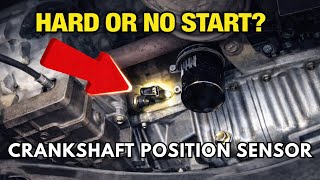
- Failed Crankshaft Position (CKP) Sensor 🔴 High Probability → Shop Engine Crankshaft Position Sensor The CKP sensor is an electronic component that operates in a high-heat, high-vibration environment. Over time, internal electronics can fail due to thermal stress, leading to a loss of signal. This is the most common failure point for P0322 on Accords.
How to confirm: Use a scan tool to monitor Engine RPM (Live Data) while cranking the engine. If the RPM reads '0', the PCM is not receiving a signal from the CKP sensor circuit. This points strongly to a bad sensor or a wiring problem.
Typical fix: Replace the Crankshaft Position Sensor. After replacement, a 'crank pattern relearn' procedure using a capable scan tool is often required to synchronize the new sensor with the PCM.
Est. part cost: $40-$150 - Wiring Harness or Connector Issue 🟡 Medium Probability The sensor's wiring is often routed near hot exhaust components or moving parts. Wires can become brittle, frayed, or melted. Connectors can also suffer from corrosion or loose pins, interrupting the signal.
How to confirm: Visually inspect the entire wiring harness from the CKP sensor back to the PCM. Check for any signs of damage, melting, or chafing. Unplug the connector and inspect for corrosion, moisture, or bent/broken pins. A multimeter can be used to check for continuity and shorts in the wiring.
Typical fix: Repair the damaged section of wiring or replace the pigtail connector. For V6 models, a specific sub-harness (P/N 37501-RCA-A01 for 7th gen) is available. Ensure the wiring is properly secured away from heat sources.
Est. part cost: $15-$75 - PGM-FI Software Issue (2008-2009 L4 only) ⚪ Low Probability Per Honda TSB 09-050, cranking the engine with a low battery can cause the PCM to incorrectly flag a fault with the CKP sensor circuit, typically setting code P0339 but sometimes related to P0322.
How to confirm: This issue applies specifically to 2008-2009 Accords with the 4-cylinder engine. A Honda dealer or a shop with a Honda Diagnostic System (HDS) can check the current software version against the one specified in the TSB.
Typical fix: Update the PGM-FI (engine computer) software using a factory-level scan tool. The TSB also calls for a CKP pattern clear and learn procedure.
Est. part cost: $0 (if done under warranty/goodwill) or shop labor cost for flashing
Rare But Worth Checking
- Weak or Failing Battery: → Shop Vehicle Battery A battery with low voltage can cause various electronic issues at startup. As noted in Honda TSB 09-050, it can prevent the sensor from generating a recognizable pulse, triggering the code. Always ensure the battery is fully charged and healthy before diagnosing sensor circuits.
- Faulty Powertrain Control Module (PCM): → Shop Engine Control Module (ECM) This is extremely rare. The PCM itself can fail, but this should only be considered after the sensor and its entire circuit have been thoroughly tested and proven to be good.
- Stretched Timing Chain / Failed VTC Actuator: → Shop Engine Timing Chain In some cases, particularly on K24 engines, the P0322/P0339 code is not caused by a bad sensor, but by the sensor correctly detecting a mechanical timing issue. A rattling noise on cold start is a key symptom of a failing VTC actuator, which can lead to a stretched timing chain and incorrect crank/cam correlation.
Diagnosis Steps
- Connect an OBD-II scanner and confirm P0322 is the primary code. Note any other codes present, especially P0339 or misfire codes.
- Access the 'Live Data' or 'Data Stream' function on the scanner. Monitor the 'Engine RPM' parameter while cranking the engine.
- If the RPM reads 0 while the engine is physically turning over, it confirms the PCM is not receiving a signal from the CKP circuit. Proceed with diagnosis.
- If the RPM shows a value, the problem may be intermittent or related to another component.
- Perform a thorough visual inspection of the CKP sensor's wiring and connector. Look for obvious damage, corrosion, or loose connections. Pay close attention to areas near heat sources or moving parts.
- If wiring appears intact, the next step is to test the sensor itself. This can be done by checking its internal resistance with a multimeter or, more definitively, by viewing its signal output on an oscilloscope while cranking. A good sensor should produce a clean square wave.
- If the sensor tests bad or if it's the most probable cause (especially on high-mileage vehicles), replace the Crankshaft Position Sensor. Using an OEM or a reputable brand like Denso or NTK is highly recommended.
- After replacement, clear the codes and perform the 'CKP Pattern Learn' procedure as recommended by Honda, using a bidirectional scan tool.
- If the problem persists after replacing the sensor, re-examine the wiring for an intermittent open or short circuit, and verify power and ground at the sensor connector. Also consider rare causes like a faulty PCM or mechanical timing issues.
Parts You'll Likely Need
- Crankshaft Position Sensor
(OEM #Varies by generation/engine. Examples: 37500-RAA-A01 (7th Gen 2.4L), 37500-RCA-A01 (7th Gen 3.0L V6), 37500-R40-A01 (8th/9th Gen 2.4L/3.5L).)— This sensor is the direct cause of code P0322 in the vast majority of cases on the Honda Accord.
Trusted brands: Honda (Genuine OEM), Denso, NGK/NTK, Hitachi, Delphi, Standard Motor Products (SMP) - Crankshaft Sensor Connector/Pigtail
(OEM #37501-RCA-A01 (Sub-harness for 7th Gen V6))— If the connector or wiring is damaged by heat or vibration, replacing the pigtail is necessary to ensure a solid connection to the new sensor.
Related Codes That Often Appear With This One
- P0339 — P0339 is 'Crankshaft Position Sensor 'A' Circuit Intermittent.' It means the signal is dropping out, whereas P0322 means the signal is completely gone. P0339 often precedes a complete sensor failure that results in P0322.
- P0300-P0304 — Misfire codes (P0300 for random, P0301-P0304 for specific cylinders) can occur alongside P0322 because without a stable crank signal, the PCM cannot properly time spark and fuel, leading to misfires. TSB 09-050 specifically mentions P0302 and P0303 may accompany P0339.
Technical Service Bulletins (TSBs) & Recalls
- Honda TSB 09-050: MIL Comes On With DTC P0339 and Possible P0302 and P0303. Addresses a software issue on 2008-2009 4-cylinder models where a low battery during cranking can cause a false CKP sensor code.
- Honda TSB 09-010: Engine Rattles at Cold Start-Up. While not directly for P0322, it addresses a faulty VTC actuator on 2008-2012 Accords, which can cause timing issues that might be misdiagnosed as a sensor problem.
Platform-Specific Known Issues
- TSB 09-050: For 2008-2009 Accord L4 models, a PGM-FI software update may be required to fix a P0339 (intermittent no signal) code triggered by cranking with a low battery, which can prevent an unnecessary sensor replacement.
- Labor-Intensive V6 Repair (7th Gen): On 2003-2007 Accords with the 3.0L V6, the CKP sensor is located behind the timing cover. Replacing it requires significant labor, including removal of the crankshaft pulley and timing belt components, turning a simple part swap into a major job.
Mechanic-Grade Diagnostic Values
- CKP Sensor Resistance (2-wire inductive type, e.g., 7th Gen V6) — expected: 1,850 - 2,450 Ohms. Failure: A reading of zero Ohms (short circuit) or infinite/OL (open circuit).
- CKP Sensor AC Voltage (2-wire inductive type, while cranking) — expected: 0.7 - 1.2 Volts AC. Failure: No AC voltage produced while the engine is physically turning over.
- CKP Sensor Power Supply (3-wire Hall Effect type, Key On Engine Off) — expected: ~5 Volts DC reference and a good ground (<0.1V).. Failure: Missing 5V reference or high resistance on the ground circuit points to a wiring or PCM issue, not a sensor failure.
- Timing Chain Tensioner Extension (K24 engines) — expected: Less than 13mm.. Failure: If the tensioner piston is extended more than 13mm, the timing chain is considered stretched and must be replaced.
Scan Tool Commands That Help
- Honda HDS (or capable bidirectional scanner like Launch X431): CKP Pattern Clear — This must be performed after replacing the CKP sensor or PCM to erase the stored crankshaft runout data from the old sensor.
- Honda HDS (or capable bidirectional scanner): CKP Pattern Learn — Immediately after performing the 'CKP Pattern Clear'. The engine is warmed up and held at a specific RPM (e.g., 3,000-3,500) for the PCM to learn the pulse pattern of the new sensor. Failure to do this can result in rough running or persistent codes even with a good new sensor.
- Honda HDS: PGM-FI Software Update — Specifically for 2008-2009 Accords with the L4 engine showing P0339. Per TSB 09-050, this is the primary fix for an issue where a low battery on startup causes the PCM to misinterpret the CKP signal.
Wiring & Ground Locations
- G101 — Typically located on the driver's side of the engine bay, often bolted to the thermostat housing or the intake manifold plenum.. This is a primary ground point for the PCM/ECU. A corroded or loose G101 ground can cause a wide range of erratic electrical issues, including a no-signal code from the CKP sensor, even if the sensor and its wiring are perfectly fine.
- CKP Sensor Connector (K20 vs K24) — At the crankshaft position sensor.. K20 and K24 engines can use physically different CKP sensor connectors with different pinouts. During an engine swap, if the harness doesn't match the sensor, the connector must be re-pinned. For example, when putting a K24-style connector on a K20 harness, the blue wire moves from pin 1 to pin 2, and the yellow/black wire moves from pin 3 to pin 1.
- PCM Connector A (K20A Engine) — At the Powertrain Control Module.. On K20A engines, the CKP signal wire is typically a Blue wire that terminates at Pin A7 of the PCM connector. This is a key point for continuity testing if a wiring break is suspected between the sensor and the computer.
Real Owner Repair Stories
- Reddit user post (2008 Honda Accord 2.4L Automatic, 160k miles) — Initially a slow crank from a bad starter. After starter replacement with an aftermarket unit, code P0339 began appearing intermittently. Eventually, the car would run for 10 seconds, then run very poorly with flashing CEL and codes P0300, P0302, P0303, and P0339.
❌ Tried (didn't work) Replacing the CKP sensor with a new Denso part., Having a non-Honda shop perform a 'relearn' procedure., Replacing spark plugs.
✅ What actually fixed it The final post was unresolved, but the user's experience highlights a critical correlation: the problems started after installing a slow-cranking aftermarket starter. This aligns perfectly with Honda TSB 09-050, which states that slow cranking from a weak battery (or weak starter) can cause the PCM to misinterpret the CKP signal and set P0339. The ultimate fix would likely involve performing the official Honda PGM-FI software update.
When the Usual Fixes Don't Work
- In a case involving a 2008 Accord with P0339 and misfires, replacing the crankshaft sensor (a Denso part), replacing spark plugs, and having a non-dealer shop perform a 'relearn' did not fix the issue. The problem, which included a slow crank, began after an aftermarket starter was installed. This strongly suggests the root cause was not the sensor itself, but rather the condition described in TSB 09-050, where slow cranking speed leads to a software-level misinterpretation of the crank signal. The owner replaced the aftermarket starter with an OEM unit which resolved the slow crank, but the codes remained, indicating the PCM software update was still necessary.
Model Year Variations Within This Range
- 2008-2009 (L4 Engine Only): These model years are subject to Technical Service Bulletin 09-050. A P0339 code is likely caused by a software issue triggered by low battery voltage during cranking, not a failed sensor. The fix is a PGM-FI software update at a dealership.
- 2003-2007 (V6 Engine Only): On the 7th generation 3.0L V6, the CKP sensor is located under the timing belt cover. This makes replacement significantly more labor-intensive (3-5+ hours) compared to 4-cylinder models where it is more accessible. The repair is often done concurrently with a timing belt service.
Diagnostic Flowchart
Used vs. New Parts: Buying Guide for This Vehicle
When a used part is the smart pick: For a critical electronic sensor like the Crankshaft Position Sensor, a used part is almost never a smart choice. The labor cost for replacement, especially on V6 models, far outweighs the small savings on a used part with unknown remaining life.
Donor-vehicle mileage cap: roughly under 50000 miles for the part to have meaningful remaining life.
What to inspect on the donor part:
- Verify the donor vehicle had no running issues or engine-related codes.
- Inspect the connector for any cracks, brittleness, or corrosion.
- Check the wiring pigtail for any signs of melting, fraying, or previous repairs.
OEM-only on this vehicle (don't cheap out):
- Crankshaft Position Sensor (CKP)
Aftermarket brands forum-validated for this vehicle:
- Denso
- NGK/NTK
- Hitachi
Brands owners have reported issues with on this vehicle:
- Unnamed or 'white-box' brands from online marketplaces are frequently reported as being defective out of the box or failing prematurely, leading to a repeat of the P0322 code and wasted diagnostic time.
Real Owner Stories
Aggregated from forums and TSBs cited above. Mileages and costs reflect what owners reported in those sources.
2008 Accord 2.4L
Symptoms: The vehicle was throwing code P0339 and misfire codes.
What fixed it: After replacing the starter, CKP sensor, and spark plugs, the issue persisted. The discussion highlighted the critical importance of performing the 'relearn' procedure and checking coil pack connections to resolve the problem.
Source hint: Reddit r/accord: Nightmare accord problems, crankshaft position sensor, misfires...
2008 Accord
Symptoms: The owner experienced classic CKP failure symptoms along with a cold-start rattle.
What fixed it: The actual problem was a bad VTC actuator. The CKP sensor was not faulty but was correctly reporting the timing fault caused by the actuator.
Source hint: Reddit r/accord: I have a problem I don't know how to solve, the crankshaft position sensor
2000 Acura 3.2 TL (J-series V6)
Symptoms: The owner was chasing random misfire codes (P0300, P0302, P0303) without a specific crank sensor code being present.
What fixed it: Replacing the Crankshaft Position Sensor, which is located under the timing cover on this shared J-series V6 engine, resolved the misfire issues.
Source hint: YouTube: 2000 Acura 3.2 TL Camshaft Position Sensor and Crankshaft Position Sensor Replacement D.I.Y.
Related OBD-II Codes
Frequently Asked Questions
My 2008 Accord has a P0322 code, but the battery was low. Should I replace the sensor?
Is it a big job to replace the crankshaft position sensor on my 2005 V6 Accord?
I replaced the CKP sensor, but the Check Engine Light is still on. What did I miss?
My Accord has a P0322 and a rattling noise on cold starts. Are these related?
How can I be sure the CKP sensor is bad before I buy a new one?
I need to repair the wiring for the CKP sensor on my V6 Accord. Is there a specific part for that?
Helpful Videos
We Have This Part in Stock


The information in this article is provided for general reference and educational purposes only. Vehicle specifications, procedures, and part compatibility can vary by production date, trim level, and region. Always consult your vehicle's factory service manual and verify part numbers before purchasing or performing repairs. Safety-critical components such as airbags, seat belts, and braking systems should be installed by a qualified professional.
- Honda Accord:
- 🧭 Diagnostic Flowchart
- 🎬 Helpful Videos
- 🛍️ Shop This Part
- What's Unique About the 2003-2024 Honda Accord
- Symptoms You May Notice
- Most Likely Causes
- Rare But Worth Checking
- Diagnosis Steps
- Parts You'll Likely Need
- Related Codes That Often Appear With This One
- Technical Service Bulletins (TSBs) & Recalls
- Platform-Specific Known Issues
- Mechanic-Grade Diagnostic Values
- Scan Tool Commands That Help
- Wiring & Ground Locations
- Real Owner Repair Stories
- When the Usual Fixes Don't Work
- Model Year Variations Within This Range
- Used vs. New Parts: Buying Guide for This Vehicle
- Real Owner Stories
- 2008 Accord 2.4L
- 2008 Accord
- 2000 Acura 3.2 TL (J-series V6)
- Related OBD-II Codes
- Frequently Asked Questions
- 🎟️ Get 5% Off