

P0322 on 2012-2017 Hyundai Azera 3.3L: Causes and Fixes for No Crank Signal
P0322 on a 2012-2017 Hyundai Azera almost always means the crankshaft position sensor has failed. This can cause a no-start or stalling condition, often intermittently and when the engine is warm. Replacing the sensor is the most common fix, with the OEM part costing between $82 and $148 and aftermarket options available for less.
- P0322 on your Azera means the engine's computer has lost the signal from the crankshaft position sensor.
- Do not drive the vehicle, as it can stall at any time, creating a serious safety hazard.
- The most likely cause is a failed crankshaft position sensor, which is a common repair. The failure is often intermittent and occurs when the engine is hot.
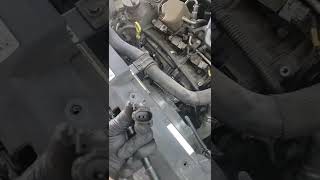
- The sensor is located under the airbox, below the thermostat housing, and is relatively easy to access for a DIY repair.
What's Unique About the 2012-2017 Hyundai Azera
For the Hyundai Azera with the 3.3L Lambda II GDI V6, the P0322 code is a straightforward issue, typically pointing directly to the crankshaft position sensor or its circuit. Unlike some platforms where this code can be ambiguous, on this Hyundai engine, the diagnostic path is generally clear. The crankshaft position sensor is a known high-failure component on this engine due to repeated exposure to high engine heat and vibration. The failure is often intermittent at first, causing symptoms that appear when the engine is warm and disappear after it cools down. A video for a 2012 Azera shows the sensor is located on the lower part of the engine, underneath the thermostat housing, making it accessible after removing the airbox.
🎬 Watch: 2012 Azera crankshaft sensor location and removal guideSymptoms You May Notice
- Engine cranks but will not start.
- Engine stalls intermittently, especially when warm, at idle, or when coming to a stop.
- Rough idling and engine misfires.
- Noticeable loss of power and poor acceleration.
- Illuminated Check Engine Light.
- Decreased fuel economy.
- Tachometer needle drops to zero or fluctuates randomly while driving.
- Replacing the camshaft position sensor. While related, the camshaft sensor has its own set of codes (e.g., P0340, P0345) and typically won't cause a P0322, which specifically points to a loss of the primary engine speed signal from the crankshaft.
- Replacing ignition coils or spark plugs. While a no-start or misfire can be caused by ignition components, P0322 specifically points to a loss of the engine speed signal, which is a prerequisite for the ECM to command spark. This should be diagnosed first.
Most Likely Causes
- Faulty Crankshaft Position Sensor (CKP) 🔴 High Probability → Shop Engine Crankshaft Position Sensor Crankshaft position sensors are common failure points on many vehicles due to their location, which exposes them to extreme heat and vibration. On the Lambda II V6, it is a known high-failure part, with failures often starting intermittently when the engine gets hot before becoming a hard failure.
How to confirm: Use an OBD-II scanner to check for a lack of RPM reading while cranking the engine. If the RPM reads '0' while the engine is turning over, it strongly suggests a problem with the CKP circuit. Test the sensor's resistance and voltage output with a multimeter against factory specifications. An oscilloscope provides the most definitive test by visualizing the sensor's square wave signal pattern (or lack thereof).
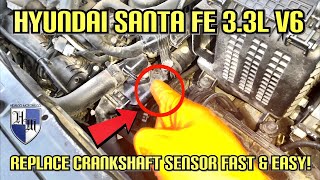
Typical fix: Replace the crankshaft position sensor. A YouTube video on a 2012 Azera shows the sensor location below the thermostat housing, held by a single 10mm bolt. 🎬 See this step-by-step replacement on a 3.3L engine
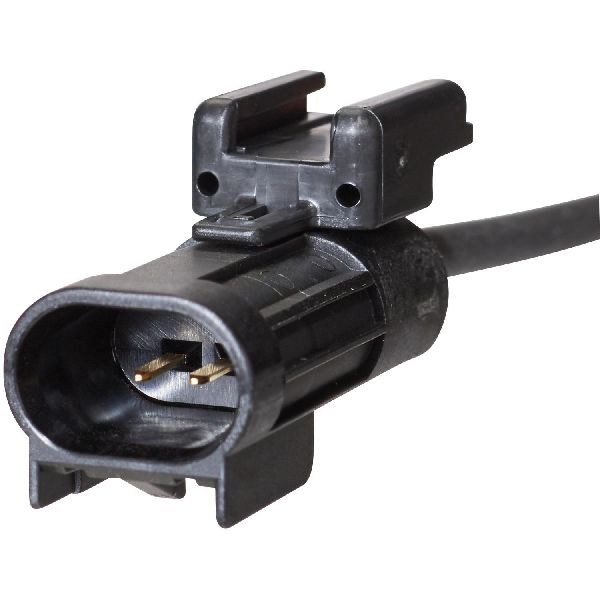
Est. part cost: $40-$150 - Damaged Wiring or Connector 🟡 Medium Probability The wiring harness to the CKP sensor can become brittle from heat cycles or damaged by road debris or leaking fluids like oil. The connector pins can also corrode or become loose, causing an intermittent or total loss of signal.
How to confirm: Visually inspect the entire length of the wiring harness from the sensor to the ECM for any signs of melting, chafing, or breaks. Check the connector for corrosion, bent pins, or a loose fit. Perform a continuity test on the wires with a multimeter to check for opens or shorts.
Typical fix: Repair the damaged section of wiring or replace the connector pigtail.
Est. part cost: $10-$50
Rare But Worth Checking
- Faulty Powertrain Control Module (PCM): → Shop Engine Control Module (ECM) This is very uncommon and should be considered a last resort. Before condemning the PCM, all other possibilities, including the sensor and its entire circuit, must be exhaustively tested and ruled out. Sometimes a PCM software update may be required.
- Damaged Reluctor Ring/Tone Wheel: The toothed wheel that the crankshaft sensor reads can be damaged, bent, or covered in debris, preventing the sensor from getting a clear signal. This usually requires more significant engine work to inspect and is not a common cause for this code alone.
Diagnosis Steps
- Connect an OBD-II scanner and confirm P0322 is the primary code. Check for any other related codes.
- Monitor the live data screen on the scanner for Engine RPM while cranking the engine. If the RPM reads '0' while the engine is turning over, it strongly suggests a problem with the CKP circuit.
- Visually inspect the crankshaft position sensor's wiring harness and connector for any obvious damage, melting, corrosion, or loose connections. The sensor is located on the lower engine block, below the thermostat housing.
- If the wiring appears intact, disconnect the sensor and test for proper voltage and ground at the connector using a multimeter. You should find a 5V reference, a ground, and a signal wire.
- If power and ground are present, test the sensor itself. You can check its internal resistance with a multimeter and compare it to the manufacturer's specifications. A more advanced test involves using an oscilloscope to view the signal waveform while cranking the engine; a good sensor will produce a clean square wave.
- If the sensor tests bad or the wiring inspection fails, replace the faulty component.
- If the sensor and wiring are confirmed to be good, the issue may be with the reluctor ring or, in very rare cases, the ECM.
- After any repair, clear the trouble codes and perform a test drive, including warm-up cycles, to ensure the intermittent stalling issue is resolved.
Parts You'll Likely Need
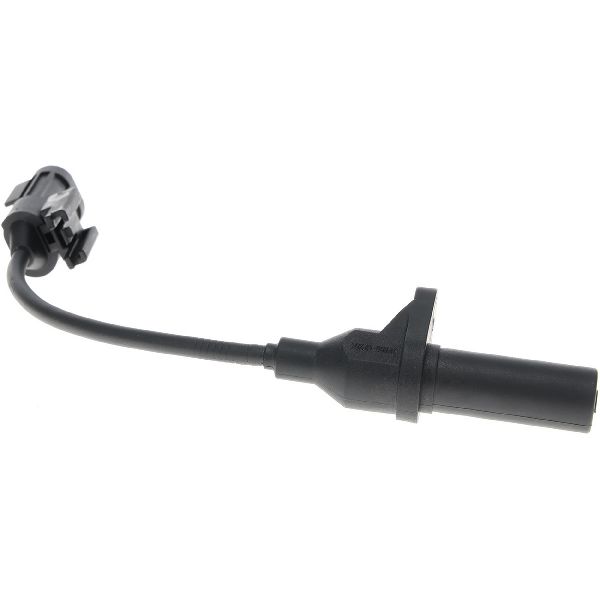
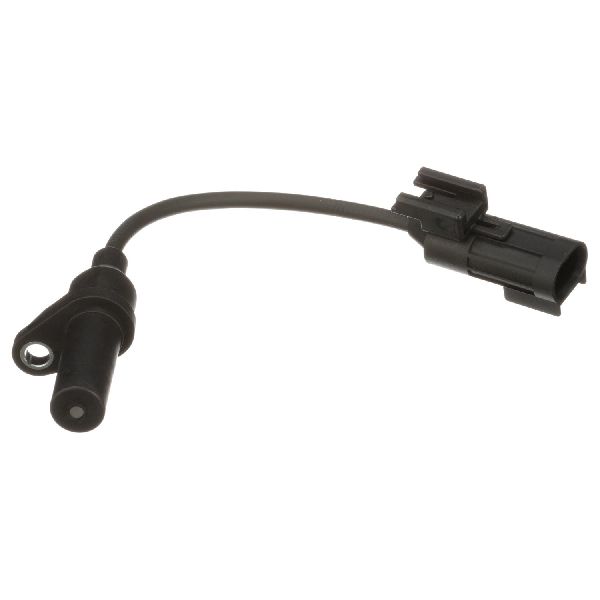
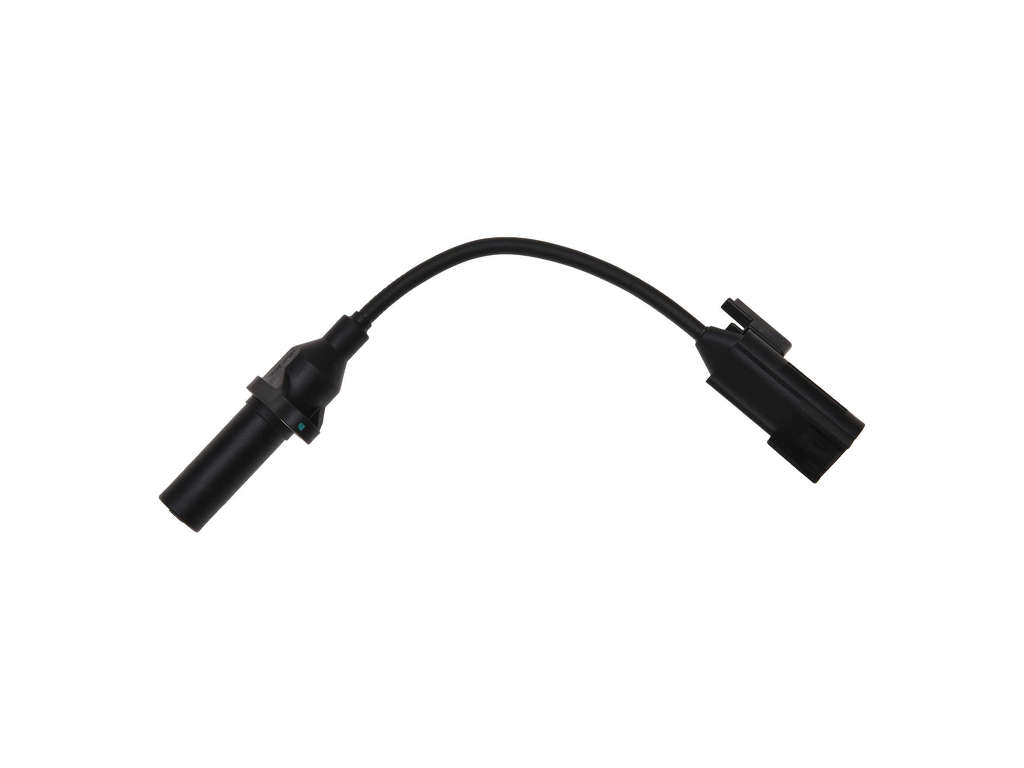
- Crankshaft Position Sensor
(OEM #39180-3C100)— This sensor is the most frequent cause of a P0322 code due to electronic failure over time from heat and vibration. This part number is widely referenced for this engine, though it may be superseded. Always verify with VIN.
Trusted brands: Hyundai (OEM), Bosch, NGK/NTK, Delphi, Duralast, Walker Products
OEM price range: $82-$148
Aftermarket price range: $40-$90
Related Codes That Often Appear With This One
- P0320 — P0320 indicates a general malfunction in the engine speed input circuit, while P0322 specifically indicates 'No Signal'. They are closely related and can sometimes appear together if the signal is intermittent before failing completely.
- P0300-P0306 — If the CKP signal is intermittent before failing, the erratic timing information can cause random or specific cylinder misfires, logging codes P0300 (random) or P0301-P0306 (specific cylinders).
- P0335 — P0335 ('Crankshaft Position Sensor 'A' Circuit Malfunction') is a very closely related code. On many platforms, P0322 and P0335 are used interchangeably or P0335 is the more common code for the same failure. Diagnosis for both codes is identical.
Platform-Specific Known Issues
- A Reddit user with a 2013 Azera with the 3.3L GDI engine reported the car stalling on the highway, suspecting it was related to a known engine issue.
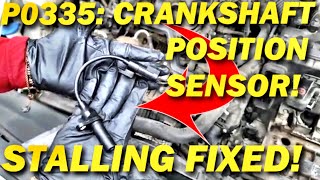
- The failure mode is often heat-related, with the car stalling when warm and restarting fine once it has cooled down, 🎬 Watch: Fixing the common stalling problem on a 3.3L only to stall again later.
Mechanic-Grade Diagnostic Values
- Crankshaft Position Sensor (CKP) Internal Resistance — expected: 630 - 770 Ohms at room temperature.. Failure: A reading of infinite resistance (open circuit) or near-zero resistance (short circuit). Note: A sensor may test within this range when cold but still fail when it gets hot.
- Crankshaft Position Sensor (CKP) Signal Waveform — expected: A clean digital square wave that switches between approximately 0V and 5V when viewed on an oscilloscope while the engine is cranking.. Failure: A missing, erratic, or inconsistent waveform indicates a faulty sensor or wiring issue.
Scan Tool Commands That Help
- Advanced Scan Tool (e.g., Snap-on, Autel, GDS): CKP/CMP Signal Test — This function, found in some professional scan tools, provides a guided test to verify if the PCM is receiving 'Good' or 'Bad' signals from the crankshaft and camshaft sensors, confirming the circuit's integrity without needing an oscilloscope immediately.
- Scan Tool or Manual Procedure: Crankshaft Position (CKP) Sensor Relearn — While not always required for this specific vehicle, if the engine runs rough, idles poorly, or sets other codes after replacing the CKP sensor, a relearn procedure may be necessary. This process synchronizes the new sensor with the PCM. A generic procedure involves disconnecting the battery for 15 minutes, letting the engine idle for 10-15 minutes, and then performing a varied drive cycle.
Wiring & Ground Locations
- Engine Wiring Harness — The main harness that connects all engine sensors, including the CKP, to the ECM.. The CKP sensor wiring is part of the larger engine harness (Part No. ~91450-3V012). Damage to this harness from heat, abrasion, or improper routing after a previous repair can cause a loss of signal for the CKP sensor.
- Engine Ground Cable — There are multiple ground points; a key one is the main ground cable connecting the engine block to the chassis.. A loose, corroded, or broken engine ground can cause a floating ground for various sensors, including the CKP. This can lead to an intermittent or complete loss of signal, triggering a P0322, even if the sensor and its direct wiring are good.
Real Owner Repair Stories
- Sandecar Serviços Automotivos YouTube Channel (Hyundai Azera (year not specified, but in the 2012-2017 body style)) — Car would not function correctly after a previous engine service. It was having trouble starting.
❌ Tried (didn't work) The video implies the focus was initially on the sensor itself.
✅ What actually fixed it The technician discovered that the wiring for the crankshaft position sensor ('sensor de rotação') was damaged and making contact with other wires ('estava tudo encostado no outro'). Repairing the damaged wiring resolved the no-start/hard-start condition.
OEM Part Supersession History
39310-3C200, 39310-3C400→39310-3C100— Standard part updates and supplier changes over the vehicle's production life.
Heads up: These part numbers are for the CRANKshaft position sensor. Do not confuse with the CAMshaft position sensor, which has a visually similar but incorrect part number (39180-3C100).N/A→39310-3C600 / 39310-3C601— Another valid OEM part number for this application, often cross-referenced to aftermarket part PC996.
Heads up: This is also a CRANKshaft position sensor. Always verify the correct part number with the vehicle's VIN at the dealership parts counter before purchasing.
Diagnostic Flowchart
Other Known Issues on This Vehicle
Issues unrelated to this code that are worth knowing about as an owner of this generation:
- Carbon Buildup on Intake Valves 🟠 Medium — Common to all GDI engines, including this one. Becomes noticeable after 60,000-80,000 miles, causing misfires, rough idle, and power loss.
- Connecting Rod Bearing Wear / Engine Failure 🔴 High — While more prevalent on the 4-cylinder Theta II, the 3.3L Lambda II V6 is also subject to premature bearing wear that can lead to knocking and catastrophic failure. Hyundai has extended the warranty for this issue on some models with this engine. (Ref: Warranty Extension TXX8 (TSB 25-EM-008H for Santa Fe))
- Timing Chain Stretch / Tensioner Rattle 🔴 High → Shop Engine Timing Chain — A known weakness, particularly over 100,000 miles. Often presents as a 2-4 second rattle on a cold startup and can lead to timing correlation codes (e.g., P0017, P0019) and, if ignored, engine damage. (Ref: Related engine warranty extensions may apply if failure occurs.)
- High-Pressure Fuel Pump (HPFP) Failure 🟠 Medium — The camshaft-driven HPFP is a documented failure point on early Hyundai/Kia GDI engines, leading to stalling, rough running, and fuel delivery codes like P0148.
- Oil Consumption 🟠 Medium — Some owners report increasing oil consumption at higher mileage (over 90,000 miles), which can exacerbate other issues like timing system faults if the oil level is not checked regularly.
Used vs. New Parts: Buying Guide for This Vehicle
When a used part is the smart pick: For this repair, a used crankshaft position sensor is NOT recommended. The part is a low-cost, high-failure electronic component. The labor involved in accessing it, while not extreme, makes it impractical to risk using a part with unknown history.
What to inspect on the donor part:
- If you must inspect a used part, ensure the connector is not cracked and the wiring pigtail is not brittle or frayed.
- Avoid any sensor from an engine that has obvious signs of severe oil leaks, overheating, or fire damage.
OEM-only on this vehicle (don't cheap out):
- While not strictly 'OEM-only', using a genuine Hyundai/Kia sensor or one from a known OEM supplier (like Bosch, Delphi, or NGK/NTK) is strongly recommended for reliability. Cheap, unbranded sensors are known to have high failure rates.
Aftermarket brands forum-validated for this vehicle:
- NGK/NTK
- Bosch
- Delphi
- Walker Products
Brands owners have reported issues with on this vehicle:
- Unbranded, no-name sensors from online marketplaces should be avoided due to inconsistent quality and high likelihood of premature failure.
Real Owner Stories
Aggregated from forums and TSBs cited above. Mileages and costs reflect what owners reported in those sources.
2013 Hyundai Azera 3.3L GDI
Symptoms: The car stalled while driving on the highway.
What fixed it: Suspected to be related to known engine issues/sensor failure, though the user was investigating the 3.3L GDI engine's reliability.
Source hint: vehicle_specific_issues citing Reddit user
2012 Hyundai Azera 3.3L V6 — 123000 miles
Symptoms: Potential buyer was warned to check for oil consumption and timing chain noise.
What fixed it: Maintenance check for timing chain stretch and oil levels to prevent sensor and correlation faults.
Source hint: Reddit r/Hyundai: "Should I buy?" (2012 Azera)
2012-2017 Hyundai Azera 3.3L
Symptoms: Stalling at various speeds, multiple warning lights appearing on the dash, and high fuel consumption.
What fixed it: Replacement of the Crankshaft Position Sensor (CKP) located below the thermostat housing.
Source hint: Hyundai Forum: Crankshaft Sensor A
Related OBD-II Codes
Frequently Asked Questions
Where is the crankshaft position sensor located on my 2012 Azera 3.3L?
My 2013 Azera stalled on the highway; is this a known issue for the Lambda II GDI V6?
Is there a warranty extension that covers engine-related failures for the 3.3L Lambda II?
Can I use a used crankshaft sensor from a salvage yard to fix P0322?
Why does my tachometer drop to zero while I'm still moving?
Could my rough idle and P0322 code be caused by carbon buildup?
Helpful Videos
We Have This Part in Stock

The information in this article is provided for general reference and educational purposes only. Vehicle specifications, procedures, and part compatibility can vary by production date, trim level, and region. Always consult your vehicle's factory service manual and verify part numbers before purchasing or performing repairs. Safety-critical components such as airbags, seat belts, and braking systems should be installed by a qualified professional.
- Hyundai Azera:
- 🧭 Diagnostic Flowchart
- 🎬 Helpful Videos
- 🛍️ Shop This Part
- What's Unique About the 2012-2017 Hyundai Azera
- Symptoms You May Notice
- Most Likely Causes
- Rare But Worth Checking
- Diagnosis Steps
- Parts You'll Likely Need
- Related Codes That Often Appear With This One
- Platform-Specific Known Issues
- Mechanic-Grade Diagnostic Values
- Scan Tool Commands That Help
- Wiring & Ground Locations
- Real Owner Repair Stories
- OEM Part Supersession History
- Other Known Issues on This Vehicle
- Used vs. New Parts: Buying Guide for This Vehicle
- Real Owner Stories
- 2013 Hyundai Azera 3.3L GDI
- 2012 Hyundai Azera 3.3L V6 — 123000 miles
- 2012-2017 Hyundai Azera 3.3L
- Related OBD-II Codes
- Frequently Asked Questions
- 🎟️ Get 5% Off