

P0322 on 2013-2018 Hyundai Santa Fe 3.3L: Crank Sensor Circuit No Signal Causes and Fixes
On a 2013-2018 Santa Fe 3.3L V6, code P0322 is almost always caused by a failed crankshaft position sensor. This can cause the engine to stall or not start. Expect to pay $85-$130 for an OEM sensor, with a DIY difficulty of 2/5.
- P0322 on your Santa Fe 3.3L means the crankshaft position sensor has almost certainly failed.
- Key symptoms are the engine cranking but not starting, or stalling unexpectedly while driving, often when warm.
- Do not drive the vehicle, as a sudden stall in traffic is a major safety risk.
- The sensor is located on top of the engine at the back, making it a relatively easy DIY replacement in about an hour after removing the battery.
- Always use a quality OEM or reputable aftermarket sensor and verify the part number (39310-3C600) for your vehicle before purchasing.
What's Unique About the 2013-2018 Hyundai Santa Fe
The 3.3L Lambda II V6 engine, while generally reliable, is known for crankshaft position sensor failures. These failures are often heat-related and can start intermittently, causing confusing symptoms like stalling only when the engine is warm. Unlike the 4-cylinder Santa Fe models where the sensor is in a difficult-to-reach location underneath the vehicle near the exhaust, the sensor on the 3.3L V6 is located on top of the transmission bellhousing. This makes it much more accessible for a DIY repair after removing the battery and its tray.
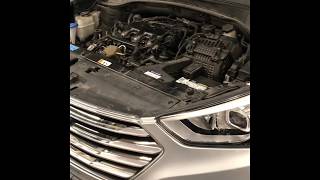
🎬 Watch: Step-by-step 3.3L crankshaft sensor replacement guide.Symptoms You May Notice
- Engine cranks but will not start
- Engine stalls unexpectedly, often when warm or when coming to a stop
- Hard starting (takes longer than usual for the engine to fire up)
- Rough or unstable idle
- Hesitation or stumbling during acceleration
- Check Engine Light is on
- Tachometer drops to zero while driving, just before or during a stall
- Replacing the camshaft position sensors. Camshaft sensors have their own specific trouble codes (P034x range) and are not the cause of a P0322 code.
- Replacing the starter motor. If the engine cranks over normally but refuses to start, the issue is not the starter. A bad CKP sensor prevents the engine from firing, which can be mistaken for a starter problem by those unfamiliar with the symptom.
Most Likely Causes
- Failed Crankshaft Position Sensor (CKP) 🔴 High Probability → Shop Engine Crankshaft Position Sensor The crankshaft position sensor is a known common failure item on Hyundai's Lambda V6 engine family due to heat and vibration exposure over time. The sensor is a magnetic type that can develop internal shorts or open circuits when it gets hot, leading to intermittent signal loss.
How to confirm: Test the sensor's output with a multimeter or oscilloscope while cranking the engine; a lack of signal confirms failure. A diagnostic scan tool will also show 0 RPM during cranking, which is a classic sign. Given the high failure rate, low part cost, and accessibility on the V6, many owners and technicians replace it as the first step after confirming the code.
Typical fix: Replace the crankshaft position sensor.
Est. part cost: $85-$130 - Damaged Wiring or Connector 🟡 Medium Probability The wiring harness runs near hot engine components and can become brittle or damaged over time. The connector itself can also corrode, fill with debris, or develop a loose connection from engine vibration.
How to confirm: Visually inspect the wiring harness leading to the CKP sensor for any signs of melting, chafing, or breaks. Check the connector for corrosion, bent pins, or a loose fit. Perform a 'wiggle test' on the harness and connector with the engine running (if possible) to see if it induces a stall. Use a multimeter to check for proper voltage and ground at the connector with the key on.
Typical fix: Repair the damaged section of wire or replace the connector pigtail.
Est. part cost: $5-$30
Rare But Worth Checking
- Faulty Powertrain Control Module (PCM): → Shop Engine Control Module (ECM) This is very uncommon. Before condemning the PCM, all other possibilities, including the sensor and its entire circuit (wiring, connectors, power, and ground), must be exhaustively tested and ruled out.
Diagnosis Steps
- Scan for Codes: Confirm P0322 is the primary code. Note any other codes present, such as P0335.
- Check for RPM Signal: Use a scan tool to monitor engine RPM while cranking. If the RPM reads 0, it strongly suggests a problem with the CKP sensor or its circuit.
- Visual Inspection: To access the sensor, you will likely need to remove the engine cover, air intake snorkel, and the battery with its tray. Locate the CKP sensor on the top of the transmission bellhousing, toward the driver's side. Inspect the sensor's connector for corrosion or damage. Follow the wiring harness as much as possible, looking for signs of melting, chafing, or breaks.
- Test the Circuit: Disconnect the sensor. With the key on, use a multimeter to verify that the connector has power (typically 5V reference) and a good ground on the appropriate pins.
- Test the Sensor: If the wiring is good, the sensor itself is the most likely culprit. You can test the sensor's resistance or check for an AC voltage signal while cranking the engine (specifications required). However, due to the intermittent, heat-related nature of these failures, the sensor may test good when cold.
- Replace the Sensor: Given the high probability of sensor failure and its accessibility on this engine, replacing the crankshaft position sensor is the most common and effective repair. It is held in by a single 10mm bolt. 🎬 Watch this video to see the sensor's exact location.
- Final Check: After replacement, reassemble all removed components (battery tray, battery, intake). Clear the codes and start the vehicle to ensure the problem is resolved. Road test the vehicle to confirm the fix under various conditions.
Parts You'll Likely Need
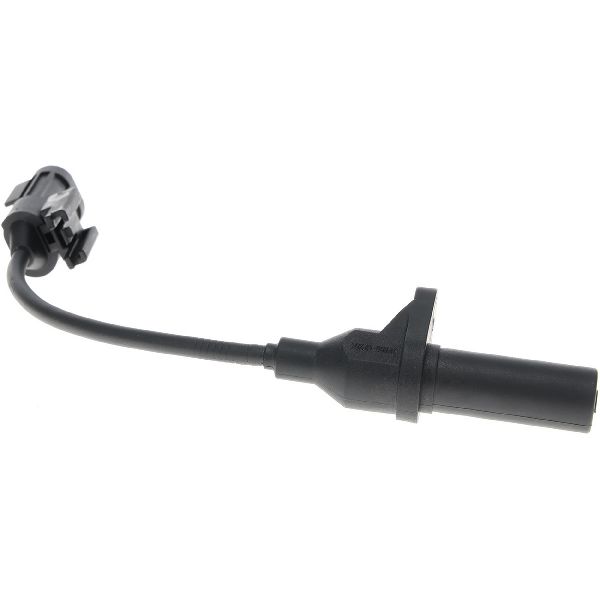
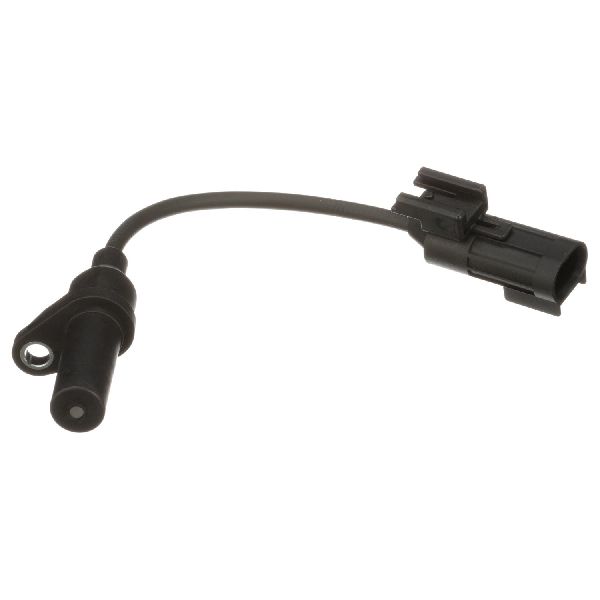
- Crankshaft Position Sensor
(OEM #39310-3C600)— This sensor is the primary cause of code P0322 on this engine and is a known high-failure part due to heat soak.
Trusted brands: Hyundai (OEM), Delphi, Mando, Hitachi, Standard Motor Products (SMP)
OEM price range: $85-$130
Aftermarket price range: $30-$90
Related Codes That Often Appear With This One
- P0335 — P0335 ('Crankshaft Position Sensor A Circuit Malfunction') is a closely related code. P0322 specifically indicates 'No Signal', while P0335 can indicate a more general circuit fault (e.g., intermittent signal, incorrect range). They often point to the same root cause: a failing crankshaft sensor.
Technical Service Bulletins (TSBs) & Recalls
- TSB 24-EM-003H: While not for P0322 specifically, this TSB details the extended warranty (15 years/150,000 miles) for the 3.3L Lambda II engine due to internal wear issues, which is important context for owners of this vehicle.
Platform-Specific Known Issues
- No recalls or specific Technical Service Bulletins (TSBs) were found for code P0322 on this vehicle, but the failure of the crankshaft position sensor is a widely documented common issue for the 3.3L Lambda II engine.
Mechanic-Grade Diagnostic Values
- Crankshaft Position Sensor (CKPS) Resistance — expected: 630-770 Ohms. Some general sources cite a wider range of 200-900 Ohms for similar sensors.. Failure: A reading of infinite resistance (open circuit) or near-zero resistance (short circuit). However, a sensor may test within spec when cold and still fail intermittently when hot.
- CKP Sensor Connector Voltage (Key On, Engine Off) — expected: One pin should have a 5V reference from the PCM, one pin should have a good ground (near 0V), and the third is the signal wire.. Failure: Absence of the 5V reference or a high voltage reading on the ground pin points to a wiring or PCM issue, not a sensor failure.
- CKP Sensor Signal Waveform (Oscilloscope) — expected: A clean digital square wave signal that switches between approximately 0V and 5V as the engine is cranked.. Failure: A missing, erratic, or distorted waveform indicates a faulty sensor or a problem with the reluctor wheel.
Scan Tool Commands That Help
- Hyundai GDS (Global Diagnostic System) or equivalent professional scanner (e.g., Snap-on): CKP/CMP Signal Test or Cam/Crank Signal Test — This function allows the technician to verify if the PCM is receiving a 'Good' or 'Bad' signal from the crankshaft and camshaft sensors without needing an oscilloscope. It's a quick way to confirm signal integrity directly from the PCM's perspective.
- Hyundai GDS or equivalent: Resetting Adaptive Values — While a crankshaft variation relearn is not typically required for a simple sensor replacement on this model, resetting the engine's adaptive values after the repair can sometimes help the PCM adjust to the new sensor's signal more quickly, potentially smoothing out idle quality faster.
Wiring & Ground Locations
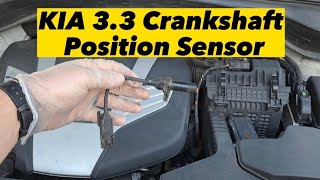
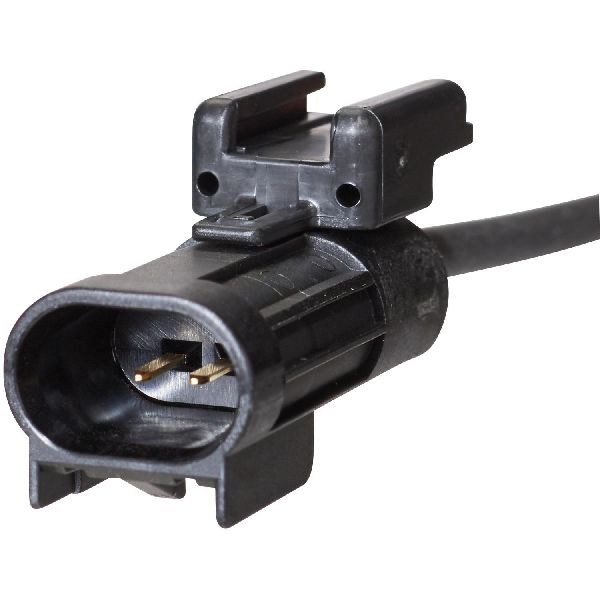
- CKP Sensor Connector — On the sensor itself, located on the top of the transmission bellhousing, under the air intake snorkel and battery tray.. This 3-pin connector is the primary point for testing voltage, ground, and signal. It is exposed to significant heat and vibration, making it a potential point of failure due to corrosion or loose pins.
- Engine Ground (Example: GE03 / GE04) — A primary engine compartment ground point is often located on the chassis frame rail near the battery tray or on the left side of the engine compartment.. A poor engine ground can cause floating voltages and erratic behavior in various sensors, including the CKP sensor. Verifying this ground is clean and tight is a crucial step if basic circuit tests at the sensor connector are inconclusive.
Real Owner Repair Stories
- YouTube user 'zinsight' (2013 Hyundai Santa Fe 3.3L GDI with 108,000 miles) — Intermittent crank-no-start and occasional stalling when coming to a stop. No trouble codes were initially present, but the symptoms are classic for a P0322.
✅ What actually fixed it Replacing the crankshaft position sensor resolved the issue. The owner noted that upon removal, the magnetic tip of the old sensor was covered in fine metallic flakes, which may have interfered with the signal. Cleaning the mounting area and installing a new sensor was the definitive fix. - Reddit user 'catfishman' (2013 Hyundai Elantra (different model, but same sensor failure pattern)) — Car would bog down in wet weather, tachometer would not read, and speed was limited. No error codes were stored.
✅ What actually fixed it Replacing the crankshaft position sensor fixed the issue. The owner also noted that general performance, including idling, acceleration, and shifting, became significantly smoother, indicating the old sensor had been degrading for some time.
OEM Part Supersession History
39310-3C600→39310-3C600— No supersession found. The part number appears to be stable for the entire 2013-2018 model year range for the 3.3L V6.
Model Year Variations Within This Range
- 2017-2018: The Santa Fe received a facelift for the 2017 model year, which included revised exterior styling and interior updates. However, the 3.3L Lambda II GDI V6 engine and its core components, including the crankshaft position sensor (PN 39310-3C600), remained the same. The diagnosis and repair procedure for P0322 is identical for all 2013-2018 LWB/XL models.
Diagnostic Flowchart
Other Known Issues on This Vehicle
Issues unrelated to this code that are worth knowing about as an owner of this generation:
- Catastrophic Engine Failure (Rod Bearing Wear) 🔴 High — Common enough to trigger class-action lawsuits and a warranty extension. Failures can occur at various mileages, some as low as 70,000-80,000 miles. (Ref: Hyundai has extended the warranty to 15 years/150,000 miles. See TSB 24-EM-003H for details. A recall (17V-623) was also issued for some 2017 models for improperly heat-treated crankshafts.)
- GDI Intake Valve Carbon Buildup 🟠 Medium — Considered an inevitable maintenance item on GDI engines. Performance degradation (rough idle, hesitation, misfires) can start around 60,000 miles, often requiring professional cleaning (walnut blasting) by 100,000 miles. (Ref: Hyundai has issued TSB 23-EM-007H related to combustion chamber cleaning procedures.)
- Worn Steering Coupler 🟡 Low — Very common. Owners typically notice a clicking or knocking sound in the steering column when turning the wheel, especially at low speeds or when stationary. The rubber coupler disintegrates over time. (Ref: No recall, but it is a widely recognized service issue. The part is inexpensive, but labor can be moderate as the steering column must be partially disassembled.)
- ABS Module Fire Risk 🔴 High — Affects many 2016-2018 models. The ABS module can malfunction and cause an electrical short, potentially leading to an engine compartment fire, even when the vehicle is parked. (Ref: Recall 22V-312 (Hyundai recall number 227) was issued. Owners are advised to park outside and away from structures until the repair is completed.)
Used vs. New Parts: Buying Guide for This Vehicle
When a used part is the smart pick: For this specific repair, buying a used crankshaft position sensor is NOT recommended. The part is a known high-failure item due to thermal stress, and a used sensor from a junkyard has an unknown history and is likely to fail prematurely, if it works at all. The cost of a new, quality aftermarket part is low enough to make a used part a poor value proposition.
What to inspect on the donor part:
- Not applicable as used sensors are not recommended.
OEM-only on this vehicle (don't cheap out):
- While not strictly 'OEM-only', using a genuine Hyundai/Kia sensor or one from a known OEM supplier like Mando is highly recommended for reliability. Some low-quality aftermarket sensors have been reported to be dead-on-arrival or fail very quickly.
Aftermarket brands forum-validated for this vehicle:
- Mando (often the OEM supplier for Hyundai/Kia)
- NTK
- Delphi
- Hitachi
Brands owners have reported issues with on this vehicle:
- Generic, unbranded sensors from online marketplaces should be avoided. User reports suggest these parts can cause immediate drivability issues or fail within a short period.
Real Owner Stories
Aggregated from forums and TSBs cited above. Mileages and costs reflect what owners reported in those sources.
2013 Hyundai Santa Fe 3.3L V6
Symptoms: Intermittently the car would not start, it will crank over but not fire. No trouble codes, and an occasional stall when stopped.
What fixed it: Replacing the crankshaft position sensor (KPS).
Cost: $0-$80
Source hint: YouTube comment from 'Dad does stuff for fun'
2013 Hyundai Santa Fe 3.3L V6
Symptoms: Intermittent no-start and stalling symptoms; required removing the battery for access to the sensor.
What fixed it: Replacing the sensor (a ~$80 part).
Cost: $80-$80
Source hint: YouTube - '2013 Hyundai Santa Fe crankshaft position sensor replacement with 3.3L engine'
2014-2020 Kia Sorento 3.3L V6
Symptoms: Stalling and no-start symptoms identical to the Santa Fe due to the shared platform and engine.
What fixed it: Crankshaft position sensor replacement.
Source hint: Platform mates section referencing Kia Sorento 3.3L V6
2013-2018 Hyundai Santa Fe 3.3L V6
Symptoms: Stalling in traffic; owner used a 10mm socket with extension and swivel to reach the sensor on the bellhousing.
What fixed it: Replacement with OEM part 39310-3C600.
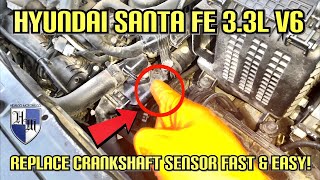
Source hint: YouTube - 'REPLACE CRANKSHAFT POSITION SENSOR FAST & EASY HYUNDAI SANTA FE 3.3L'
Related OBD-II Codes
Frequently Asked Questions
Does TSB 24-EM-003H cover the replacement of my crankshaft position sensor on my 2015 Santa Fe 3.3L?
I'm seeing P0322 and my tachometer just dropped to zero while driving. Is this common for the 3.3L Lambda II V6?
Is there a specific part number I should look for when replacing the sensor to fix P0322?
Can I replace the CKP sensor myself on a 2013-2018 Santa Fe, or is it too difficult?
My Santa Fe stalls when the engine gets warm but starts fine when cold. Could this be P0322?
Are there any recalls for the P0322 code on the 2017 Santa Fe?
Helpful Videos
We Have This Part in Stock

The information in this article is provided for general reference and educational purposes only. Vehicle specifications, procedures, and part compatibility can vary by production date, trim level, and region. Always consult your vehicle's factory service manual and verify part numbers before purchasing or performing repairs. Safety-critical components such as airbags, seat belts, and braking systems should be installed by a qualified professional.
- Hyundai Santa Fe:
- 🧭 Diagnostic Flowchart
- 🎬 Helpful Videos
- 🛍️ Shop This Part
- What's Unique About the 2013-2018 Hyundai Santa Fe
- Symptoms You May Notice
- Most Likely Causes
- Rare But Worth Checking
- Diagnosis Steps
- Parts You'll Likely Need
- Related Codes That Often Appear With This One
- Technical Service Bulletins (TSBs) & Recalls
- Platform-Specific Known Issues
- Mechanic-Grade Diagnostic Values
- Scan Tool Commands That Help
- Wiring & Ground Locations
- Real Owner Repair Stories
- OEM Part Supersession History
- Model Year Variations Within This Range
- Other Known Issues on This Vehicle
- Used vs. New Parts: Buying Guide for This Vehicle
- Real Owner Stories
- 2013 Hyundai Santa Fe 3.3L V6
- 2013 Hyundai Santa Fe 3.3L V6
- 2014-2020 Kia Sorento 3.3L V6
- 2013-2018 Hyundai Santa Fe 3.3L V6
- Related OBD-II Codes
- Frequently Asked Questions
- 🎟️ Get 5% Off