

P0322 on 2011-2019 Hyundai Sonata 2.4L: Crank Sensor Failure Causes and Fixes
On a 2011-2019 Sonata with the 2.4L engine, P0322 almost always means the crankshaft position sensor has failed, causing a no-start or sudden stalling. The replacement part costs between $25 for an aftermarket sensor and $150 for an OEM one, and it's a moderately difficult DIY job.
- P0322 on a 2.4L Sonata means the crankshaft position sensor has almost certainly failed.
- This is a critical code; the engine can stall without warning, making the car unsafe to drive.
- For 2011-2014 models, ALWAYS check for open engine recalls related to stalling before paying for a sensor replacement, as the symptoms are identical.
- The fix is to replace the crankshaft position sensor, which is located on the back of the engine near the transmission.
- Do not confuse this with a camshaft sensor or fuel pump issue; the P0322 code is very specific to the crankshaft signal.
What's Unique About the 2011-2019 Hyundai Sonata
For the Hyundai Sonata with the 2.4L Theta II GDI engine, the P0322 code is very specific and almost always points directly to a failed crankshaft position sensor, rather than other possibilities like the camshaft sensor. However, it is critical to be aware that 2011-2014 models were subject to a major engine recall for bearing wear that can also cause stalling. Before replacing the sensor, owners of these specific years should verify if their vehicle has an open recall (like Recall 198) and has had the Knock Sensor Detection System (KSDS) software update, as the symptoms can overlap.
Generation note: The 2011-2019 model years span two Sonata generations: the YF (2011-2014) and the LF (2015-2019). Both used the 2.4L Theta II GDI engine. The primary cause (crankshaft sensor) is the same for both. However, a major engine recall for stalling symptoms primarily affects the YF generation (2011-2014), which is important to check before performing repairs. The class action lawsuits and lifetime engine warranty extensions cover vehicles from both generations.
Symptoms You May Notice
- Engine cranks but will not start
- Engine stalls suddenly and unexpectedly, often after warming up
- Tachometer stays at 0 RPM while cranking the engine
- Rough engine idle and misfires
- Noticeable loss of power and poor acceleration
- Check Engine Light is illuminated
- Replacing the camshaft position sensor. A bad camshaft sensor typically sets other codes, such as P0340 or P0341.
- Replacing the fuel pump. While a no-start can be a fuel issue, the P0322 code specifically indicates a problem with the engine speed signal, which is required for both spark and fuel injector commands.
Most Likely Causes
- Failed Crankshaft Position Sensor (CKP) 🔴 High Probability → Shop Engine Crankshaft Position Sensor The CKP sensor is an electronic component exposed to significant heat and vibration at the back of the engine, leading to failure over time. This is a widely reported issue on Hyundai/Kia vehicles with the 2.4L engine. The failure is often heat-related, causing the car to stall after reaching operating temperature and then refusing to restart until it cools down.
How to confirm: Confirm by testing the sensor's output with a multimeter or oscilloscope for a signal while cranking the engine. A lack of signal confirms failure. A visual inspection may show damage, but failure is often internal. A common real-world test is to see if the car starts after cooling down completely, which points strongly to a heat-soaked, failing sensor.
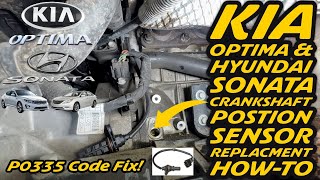
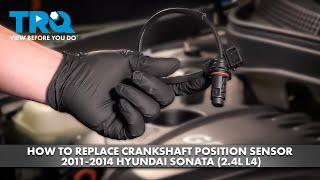
Typical fix: Replace the crankshaft position sensor. The sensor is held by a single 10mm bolt and is located on the back of the engine block, on top of the transmission bell housing, where it meets the engine. Access is from underneath the vehicle after removing splash shields. 🎬 Watch: Step-by-step crankshaft sensor replacement for 2011-2014 models
Est. part cost: $25-$150 - Damaged Wiring or Connector 🟡 Medium Probability The wiring harness runs close to hot exhaust components and can become brittle, frayed, or melted over time. The connector itself can also become corroded or loose, especially given its location exposed to road debris and heat.
How to confirm: Visually inspect the entire wiring harness from the CKP sensor to the main engine harness. Check for breaks, melting, or corrosion. Wiggle the connector and harness while the engine is idling (if it runs) to see if it causes a stall. Check the connector for a secure fit and clean contacts.
Typical fix: Repair the damaged section of wire or replace the connector pigtail. Ensure the wiring is properly secured away from heat sources.
Est. part cost: $10-$50
Rare But Worth Checking
- Failed Powertrain Control Module (PCM): → Shop Engine Control Module (ECM) This is very rare. Before condemning the PCM, all other possibilities, including the sensor and its entire circuit, must be exhaustively tested and ruled out.
- Damaged Flexplate/Reluctor Ring: The crankshaft position sensor reads teeth on a reluctor ring (or tone ring) mounted to the flexplate. While rare, a cracked flexplate or a damaged/missing tooth on the ring can cause a loss of signal and trigger P0322. This is usually accompanied by a metallic rattling or grinding noise from the bellhousing area.
Diagnosis Steps
- Verify the code with an OBD-II scanner. Note if the engine cranks but the tachometer shows 0 RPM, a classic sign of no CKP signal.
- IMPORTANT for ALL 2011-2019 models: Check the vehicle's VIN for open recalls and warranty extensions, specifically related to the Theta II engine failures (e.g., Recall 198, Campaign 953) and the KSDS update. A dealer can check this for free. Stalling symptoms can be caused by the underlying engine defect.
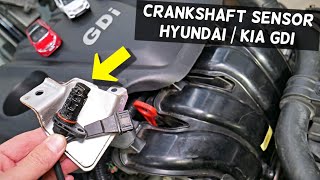
- Visually inspect the crankshaft position sensor's wiring harness and connector. The sensor is on the top of the transmission bell housing, at the rear of the engine. 🎬 Watch: Finding the sensor location on the 2.4 GDI engine Look for any signs of melting, chafing, or corrosion. Ensure the connector is securely plugged in.
- If the wiring appears intact, the most common failure is the sensor itself. Test the sensor's signal. Using a multimeter set to AC voltage, probe the signal wire while a helper cranks the engine. You should see a fluctuating voltage. No voltage indicates a dead sensor. 🎬 See how to locate and test the sensor on 2015 models For a more thorough test, check the sensor's internal resistance; it should typically fall within a range of 200 to 1,000 ohms.
- If the sensor and wiring test good, the issue could be a rare fault within the PCM. This step should be performed by a professional.
- Replace the crankshaft position sensor if it is found to be faulty. It is held by a single 10mm bolt and is accessed from below the vehicle.
- After replacement, clear the DTCs with the scanner and perform a test drive to ensure the issue is resolved. It is also recommended to reset the engine adaptive values with a capable scanner.
Parts You'll Likely Need
- Crankshaft Position Sensor
(OEM #39180-25300 (Primarily for 2011-2014 YF generation) or 39180-2G000 (Common for 2015-2019 LF generation))— This sensor is the primary point of failure for the P0322 code on this engine, failing from heat and vibration over its service life. It is crucial to verify the correct part number with the vehicle's VIN.
Trusted brands: Hyundai (OEM), Delphi, NTK, Mando, Beck/Arnley
OEM price range: $90-$150
Aftermarket price range: $25-$75
Related Codes That Often Appear With This One
- P0335 — P0335 is a generic code for 'Crankshaft Position Sensor A Circuit Malfunction.' P0322 is more specific, indicating a complete loss of signal. They point to the same root cause and have an identical diagnostic procedure.
- P0300-P0304 — Random or specific cylinder misfire codes can be triggered because the loss of the crank signal prevents the ECM from correctly timing ignition spark, leading to misfires.
- P1326 — This code is specific to Hyundai/Kia and relates to the Knock Sensor Detection System (KSDS). It may appear if the engine stalls or runs erratically, as the KSDS may interpret the event as potential engine damage. It's crucial to address the P0322 first.
Technical Service Bulletins (TSBs) & Recalls
- Hyundai Recall Campaign 198 (NHTSA 20V-746) / TSB 21-01-022H-1: Addresses potential connecting rod bearing wear that can cause engine stalling. While not directly for P0322, the symptoms overlap, making this a critical check. The remedy includes an engine inspection/replacement and installation of a Knock Sensor Detection System (KSDS).
- Hyundai Engine Class Action Settlement (Lifetime Warranty): As a result of lawsuits, Hyundai extended a lifetime warranty on the engine short block for vehicles affected by bearing failure, contingent on the vehicle receiving the KSDS update. This makes it critical to have a dealer diagnose any stalling issue.
Platform-Specific Known Issues
- Engine Stalling Recall: 2011-2019 Sonatas with the 2.4L engine were part of major recalls, class-action lawsuits, and warranty extensions for premature engine bearing failure. A key symptom is engine stalling, which can be misdiagnosed as a faulty crankshaft sensor. Owners should always check for open recalls and the lifetime engine warranty with a Hyundai dealer before paying for this repair.
- Heat-Related Failure: Many owners report that the P0322 code and associated stalling/no-start symptom only appear after the engine has fully warmed up. The car may run fine when cold, but will stall and refuse to restart until it has cooled down for 30-60 minutes. This behavior is highly indicative of an internally failing crankshaft position sensor.
Mechanic-Grade Diagnostic Values
- Crankshaft Position Sensor (2-wire inductive type) internal resistance — expected: 200 - 1,000 Ohms. Failure: A reading of 0 Ohms indicates a short circuit, while an infinite (OL) reading indicates an open circuit. Both mean the sensor has failed.
- Crankshaft Position Sensor (2-wire inductive type) AC voltage output — expected: Fluctuating AC voltage signal (typically >200mV AC) when the engine is cranking. Failure: No AC voltage or a very weak, non-fluctuating signal indicates the sensor is not generating a signal.
- Crankshaft Position Sensor (3-wire Hall-effect type) signal wire voltage — expected: A square wave signal switching between approximately 0V and 5V when viewed on an oscilloscope while cranking.. Failure: A flat line at 0V, 5V, or an intermediate voltage indicates a failed sensor or circuit issue.
Scan Tool Commands That Help
- Hyundai GDS (Global Diagnostic System): Fault Code Searching / DTC Analysis — The GDS provides more specific fault descriptions and guided troubleshooting procedures than generic OBD-II scanners. It can access all vehicle modules, not just the ECM, to check for related codes in the TCM, BCM, etc.
- Hyundai GDS (Global Diagnostic System): Data Analysis (Live Data) — Use this to monitor 'Engine Speed' while cranking. A reading of 0 RPM while the engine is physically turning is a definitive confirmation that the ECM is not receiving a signal from the CKP sensor.
- Hyundai GDS (Global Diagnostic System): ECU Upgrade / Vehicle S/W Management — This function is used to perform software updates, such as the critical Knock Sensor Detection System (KSDS) update associated with the Theta II engine recalls. This should be checked to see if it has been performed.
Wiring & Ground Locations
- G13 / G14 (ENG ROOM) — In the engine room, typically on the left side near the shock tower or inner fender.. These are main engine compartment grounds. While not directly for the CKP sensor, a poor main ground can cause floating voltages and erratic behavior in multiple sensor circuits, including the CKP.
- GHG01 / GHG02 — GHG01 is on the left side of the engine compartment; GHG02 is at the center rear of the top of the engine (for 2.4L).. These are primary engine grounds. The CKP sensor circuit relies on a solid ground connection to the PCM, which is referenced to the main engine grounds. A loose or corroded engine ground strap can cause a no-signal condition like P0322.
- CKP Sensor Connector — On the sensor itself, located at the top of the transmission bellhousing where it meets the rear of the engine.. This is the most likely point for wiring failure due to heat and vibration. The connector pins can corrode, and the wiring pigtail can become brittle and break, causing an open or short in the signal, ground, or power wire.
OEM Part Supersession History
39180-25200→39180-25300— Likely an updated design for improved reliability or manufacturing consistency.N/A→N/A— 39180-2G000 is the primary part number for the LF generation (2015-2019) Sonata and does not appear to have a direct public supersession history from an older number within this vehicle's range.
Heads up: The 39180-25300 and 39180-2G000 sensors are not interchangeable. They have different connectors and/or mounting designs. Using the wrong sensor will result in a no-start condition.
Model Year Variations Within This Range
- 2011-2014 (YF Generation): Uses the 2.4L Theta II GDI engine rated at ~198 hp. Primarily uses crankshaft position sensor P/N 39180-25300. This generation is the main focus of the engine bearing failure recalls that cause stalling.
- 2015-2019 (LF Generation): Uses a revised 2.4L Theta II GDI engine, with power slightly de-tuned to 185 hp for better low-end responsiveness. Primarily uses crankshaft position sensor P/N 39180-2G000. While still covered by engine warranty extensions, the initial manufacturing defect causing bearing failure was more prevalent in the earlier YF generation.
Diagnostic Flowchart
Other Known Issues on This Vehicle
Issues unrelated to this code that are worth knowing about as an owner of this generation:
- Catastrophic Engine Failure (Rod Bearing Failure) 🔴 High — Extremely common on 2011-2014 models, but affects the entire 2011-2019 range. Caused by manufacturing debris restricting oil flow to rod bearings. Led to massive recalls and class-action lawsuits. (Ref: Hyundai Recall 198 (NHTSA 20V-746), TSB 21-01-022H-1, and others. Resulted in lifetime warranty extension for the short block for affected vehicles that received the KSDS update.)
- Excessive Oil Consumption 🔴 High — Widespread across all years of the 2.4L GDI engine. Often becomes noticeable after 60,000 miles. Caused by carbon buildup on piston oil control rings, preventing them from sealing properly. Owners report consuming over a quart of oil every 1,000 miles. (Ref: Hyundai TSB 23-EM-008H provides guidelines for dealers to perform an oil consumption test and potential engine cleaning or repair.)
- Steering Coupler Failure 🟠 Medium — Very common, especially on 2011-2014 models. The flexible rubber coupler in the steering column disintegrates, causing a prominent clicking or 'clunking' noise when turning the steering wheel. (Ref: Hyundai extended the warranty for this part to 10 years/100,000 miles. Not a safety recall in all regions, but a well-known service campaign.)
- Knock Sensor Detection System (KSDS) Over-Sensitivity 🟠 Medium — A consequence of the engine failure recalls. The KSDS software update, designed to detect bearing failure, can be overly sensitive and incorrectly place the car into limp mode (reduced power, flashing CEL) even when no mechanical failure is present. (Ref: Part of the recall service (e.g., Recall 198). The fix often involves confirming no engine damage and clearing the code.)
- High-Pressure Fuel Pump (HPFP) Failure 🟡 Low — A known failure point where the internal seal of the pump can fail, leaking gasoline directly into the engine crankcase. This thins the engine oil, which can accelerate bearing wear if not caught. Symptoms include a fuel smell in the oil.
Used vs. New Parts: Buying Guide for This Vehicle
When a used part is the smart pick: For this specific repair, a used crankshaft position sensor is NOT recommended. It is a low-cost electronic part where the primary failure mechanism is heat and age. A used sensor from a junkyard has unknown history and may fail shortly after installation, repeating the labor-intensive replacement process.
OEM-only on this vehicle (don't cheap out):
- Crankshaft Position Sensor - While some aftermarket brands are reliable, the OEM Hyundai sensor is strongly recommended by forum veterans and mechanics to ensure compatibility and longevity. The cost difference is often minimal compared to the labor required for a potential second replacement.
Aftermarket brands forum-validated for this vehicle:
- NTK (a division of NGK)
- Delphi
Brands owners have reported issues with on this vehicle:
- Unnamed, low-cost 'white box' brands from online marketplaces should be avoided, as their quality control is questionable and failure rates are reportedly high.
Real Owner Stories
Aggregated from forums and TSBs cited above. Mileages and costs reflect what owners reported in those sources.
2011 Hyundai Sonata 2.4L
Symptoms: Engine cranks but will not start (crank-no-start condition) and the tachometer read zero during cranking.
What fixed it: Replaced the crankshaft position sensor located on the bell housing.
Source hint: Hyundai-Forums thread titled '2011 sonata 2.4 won't start code p0322'
2013 Hyundai Sonata 2.4L GDI
Symptoms: Stalling and P0322 code; owner required a guide for the specific sensor location on the YF generation.
What fixed it: Replacement of the crankshaft position sensor accessed from below the vehicle.
Source hint: YouTube video 'HYUNDAI SONATA CRANKSHAFT POSITION SENSOR REPLACEMENT REMOVAL LOCATION'
Related OBD-II Codes
Frequently Asked Questions
Does Hyundai Recall 198 (NHTSA 20V-746) apply to my 2011-2019 Sonata stalling issue?
Where is the crankshaft position sensor located on my 2.4L Theta II GDI engine?
Why does my Sonata only stall or refuse to start after the engine is warm?
Is there a warranty extension that covers engine stalling for the 2011-2019 Sonata?
My tachometer stays at 0 RPM while I'm cranking the engine; is this related to P0322?
Can I confirm a CKP sensor failure on my Sonata without professional tools?
Helpful Videos
We Have This Part in Stock

The information in this article is provided for general reference and educational purposes only. Vehicle specifications, procedures, and part compatibility can vary by production date, trim level, and region. Always consult your vehicle's factory service manual and verify part numbers before purchasing or performing repairs. Safety-critical components such as airbags, seat belts, and braking systems should be installed by a qualified professional.
- Hyundai Sonata:
- 🧭 Diagnostic Flowchart
- 🎬 Helpful Videos
- 🛍️ Shop This Part
- What's Unique About the 2011-2019 Hyundai Sonata
- Symptoms You May Notice
- Most Likely Causes
- Rare But Worth Checking
- Diagnosis Steps
- Parts You'll Likely Need
- Related Codes That Often Appear With This One
- Technical Service Bulletins (TSBs) & Recalls
- Platform-Specific Known Issues
- Mechanic-Grade Diagnostic Values
- Scan Tool Commands That Help
- Wiring & Ground Locations
- OEM Part Supersession History
- Model Year Variations Within This Range
- Other Known Issues on This Vehicle
- Used vs. New Parts: Buying Guide for This Vehicle
- Real Owner Stories
- 2011 Hyundai Sonata 2.4L
- 2013 Hyundai Sonata 2.4L GDI
- Related OBD-II Codes
- Frequently Asked Questions
- 🎟️ Get 5% Off