

P0325 on 2018-2023 Kia Stinger: Knock Sensor Circuit Malfunction Explained
P0325 indicates a fault with the knock sensor circuit on Bank 1. The most common cause is a failed knock sensor, but the repair is labor-intensive and costly as the sensor is located under the intake manifold. Expect a shop to charge between $900 and $1,300 for the 3.3L V6, with the part itself being relatively inexpensive.
- P0325 on a Kia Stinger means there is an electrical fault in the Bank 1 knock sensor circuit.
- The most likely fix is replacing the knock sensor itself, but wiring should always be checked first, especially for rodent damage in the engine valley.
- This repair is unusually expensive due to high labor costs, as the sensor is located under the intake manifold.
- Driving with this code is not recommended as the engine's ability to protect itself from harmful detonation is compromised. On 2.0L models, it also disables the KSDS engine failure detection system.
- For the 3.3L V6, ensure you are purchasing the correct sensor for Bank 1 (OEM Part #39320-3L000). Always replace the intake manifold gaskets during the repair.
What's Unique About the 2018-2023 Kia Stinger
While P0325 is a generic code, its implications on modern Kia vehicles are notable. Many Kia engines, particularly the 2.0L Theta II, are part of a product improvement campaign involving a Knock Sensor Detection System (KSDS) software update. This system is designed to detect early signs of connecting rod bearing failure, a known issue on other Kia models. A P0325 fault means this critical protective system is effectively blind, as it cannot receive a signal from the sensor. This can prevent the KSDS from triggering the more serious P1326 code and putting the vehicle into limp mode to save the engine. Although the Stinger's engines are not the primary focus of the widespread engine failure recalls, a malfunctioning knock sensor circuit still disables a key engine protection feature.
Symptoms You May Notice
- Check Engine Light is on
- Reduced engine power and acceleration
- Decreased fuel economy
- Audible engine pinging or knocking, especially under load
- Hesitation during acceleration
- Replacing spark plugs or ignition coils. While these can cause performance issues, they will not directly set a P0325 circuit code.
- Assuming the engine is knocking. P0325 is an electrical circuit code, not a code indicating that knock has been detected. The root cause is electrical unless other symptoms are present. 🎬 Watch: Understanding P0325 causes and fixes
Most Likely Causes
- Failed Knock Sensor 🔴 High Probability → Shop Ignition Knock (Detonation) Sensor The sensor operates in a high-heat, high-vibration environment in the engine valley, which can lead to internal failure of the piezoelectric element over time.
How to confirm: After checking wiring, test the sensor's internal resistance with a multimeter. Compare the reading to the manufacturer's specification (typically looking for a very high resistance, often in the mega-ohm range, but an open circuit reading of infinite resistance indicates failure). The torque specification for the sensor bolt is also critical; an improperly torqued sensor will not function correctly. The spec is often around 14-17 lb-ft. 🎬 See: How to diagnose a faulty knock sensor
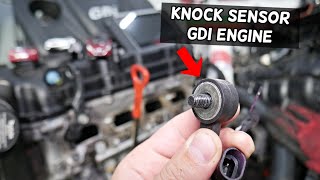
Typical fix: Replace the knock sensor. On the 3.3L V6, P0325 refers to the Bank 1 (right/passenger side) sensor. The intake manifold and associated gaskets must be removed and replaced to perform this job. 🎬 Watch: Kia intake manifold removal walkthrough
Est. part cost: $30-$100 - Wiring Harness or Connector Damage 🟡 Medium Probability The knock sensor wiring is located in the engine valley, a warm, sheltered area that is attractive to rodents. Owners of the platform-mate Genesis G70 have specifically reported rodent damage to this harness as a cause for P0325. Heat can also make insulation brittle over time.
How to confirm: Visually inspect the wiring harness leading to the knock sensor for any signs of chewing, cracking, melting, or physical damage. Check the connector for corrosion or loose pins. This often requires at least partial removal of the intake manifold for a clear view.
Typical fix: Repair the damaged section of the wire or replace the connector pigtail. In some cases, a sub-harness may need to be replaced.
Est. part cost: $10-$50
Rare But Worth Checking
- Loose Knock Sensor: → Shop Ignition Knock (Detonation) Sensor The sensor must be torqued to a specific value (e.g., 14-17 lb-ft) to work correctly. If the bolt has loosened, it cannot properly detect engine vibrations. Always check that the sensor is secure before replacing it.
- Powertrain Control Module (PCM) Fault: → Shop Engine Control Module (ECM) In very rare cases, the internal circuit in the PCM that processes the knock sensor signal can fail. This should only be considered after the sensor and wiring have been definitively ruled out through testing.
Diagnosis Steps
- Verify the code with an OBD-II scanner.
- Visually inspect the knock sensor and its wiring harness for obvious damage. This will require removing the engine cover and may require removing the intake manifold for a clear view into the engine valley.
- Check that the sensor is securely bolted to the engine block and torqued to the correct specification (approx. 14-17 lb-ft).
- Disconnect the sensor and check its internal resistance with a multimeter. Compare this to the manufacturer's specification. An open circuit (infinite resistance) confirms a failed sensor.
- Check for 5V reference voltage and ground at the sensor connector to verify the integrity of the circuit back to the PCM.
- If the sensor and wiring are confirmed to be good, the issue may lie with the PCM, which requires advanced diagnostics.
Parts You'll Likely Need
- Knock Sensor (Bank 1 / Right Side for 3.3L)
(OEM #39320-3L000)— This is the sensor for Bank 1 (passenger side) on the 3.3L V6 engine, which is the most common failure point for a P0325 code.
Trusted brands: Genuine Kia, Bosch, NGK/NTK, Standard Motor Products
OEM price range: $75-$100
Aftermarket price range: $40-$80 - Knock Sensor (2.0L Engine)
(OEM #39250-2CTA0)— This is the single knock sensor used on the 2.0L Turbo engine.
Trusted brands: Genuine Kia, Bosch, NGK/NTK
OEM price range: $30-$50
Aftermarket price range: $20-$40 - Intake Manifold Gasket Set — These gaskets are single-use and must be replaced anytime the intake manifold is removed to access the knock sensors.
Trusted brands: Genuine Kia, Mahle, Fel-Pro
OEM price range: $40-$60
Aftermarket price range: $20-$40
Related Codes That Often Appear With This One
- P0330 — On the 3.3L V6 engine, this code is for the Knock Sensor 2 Circuit (Bank 2). Seeing both codes together strongly suggests a wiring issue common to both sensors, such as rodent damage in the engine valley, rather than two sensors failing simultaneously.
- P1326 — This code is triggered by the KSDS when it detects vibrations consistent with engine bearing failure. A P0325 fault can mask or prevent a P1326 from being set. If both appear, it requires immediate attention as it could mean the engine is failing AND the circuit to detect it is compromised.
Diagnostic Flowchart
Other Known Issues on This Vehicle
Issues unrelated to this code that are worth knowing about as an owner of this generation:
- Paint Chipping/Peeling (Sunset Yellow) 🟠 Medium — Specific to the 'Sunset Yellow' color on 2018 models. An error in the factory paint process led to poor adhesion. (Ref: Voluntary Service Campaign (SC166) was issued for affected vehicles, offering a full repaint.)
- High-Pressure Fuel Pump (HPFP) Failure 🔴 High — Affects 2018-2021 models. The fuel control valve plunger can stick, causing over-pressurization and a potential loss of drive power. (Ref: NHTSA Recall 23V-634 (Kia SC281))
- Differential Whine/Grinding at Low Speeds (AWD Models) 🟡 Low — Some owners of AWD models report a grinding or humming noise from the front or rear differential during slow turns, like in a parking lot. It is often attributed to the OEM differential fluid lacking sufficient friction modifier.
- Left Turbocharger Oil Feed Pipe Leak (3.3L V6) 🟠 Medium — Affects 2018-2023 models with the 3.3L engine. The oil feed pipe and hose assembly for the left turbo may deteriorate and leak oil. (Ref: NHTSA Recall 23V-263)
- Front Wiring Harness Damage 🔴 High — Reported on some 2018 models. The harness could contact a burr on the fender panel, potentially causing a short circuit and fire risk. (Ref: A recall was issued for affected 2018 models.)
Real Owner Stories
Aggregated from forums and TSBs cited above. Mileages and costs reflect what owners reported in those sources.
2019 Genesis G70 3.3L Twin-Turbo V6
Symptoms: Check Engine Light with code P0325; inspection revealed damage to the wiring harness located in the engine valley.
What fixed it: Repair of the wiring harness that had been damaged by rodents.
Source hint: 2019-2023 Genesis G70 (2.0L Turbo I4, 3.3L Twin-Turbo V6) platform-mate notes
Kia Owner Experience (Cross-Model Reference)
Symptoms: An owner reported being unable to drive more than 20mph and was informed by a shop that the vehicle had an error code of P0325 and the engine had seized.
What fixed it: The vehicle was towed to a dealership for further inspection following the P0325 diagnosis (NHTSA ODI #11671686).
Related OBD-II Codes
Frequently Asked Questions
Where is the knock sensor located on the 3.3L V6 Kia Stinger?
Why is the repair for P0325 considered labor-intensive on the Stinger?
Is there a specific torque setting I should use when installing a new knock sensor?
Could the P0325 code be caused by something other than a bad sensor?
Are there any recalls for the 2018 Stinger that might be related to engine wiring issues?
What are the symptoms of a P0325 on a Kia Stinger?
Helpful Videos
We Have This Part in Stock

The information in this article is provided for general reference and educational purposes only. Vehicle specifications, procedures, and part compatibility can vary by production date, trim level, and region. Always consult your vehicle's factory service manual and verify part numbers before purchasing or performing repairs. Safety-critical components such as airbags, seat belts, and braking systems should be installed by a qualified professional.
- Kia Stinger:
- 🧭 Diagnostic Flowchart
- 🎬 Helpful Videos
- 🛍️ Shop This Part
- What's Unique About the 2018-2023 Kia Stinger
- Symptoms You May Notice
- Most Likely Causes
- Rare But Worth Checking
- Diagnosis Steps
- Parts You'll Likely Need
- Related Codes That Often Appear With This One
- Other Known Issues on This Vehicle
- Real Owner Stories
- 2019 Genesis G70 3.3L Twin-Turbo V6
- Kia Owner Experience (Cross-Model Reference)
- Related OBD-II Codes
- Frequently Asked Questions
- 🎟️ Get 5% Off