

P0327 on 2020-2025 Audi Q7: Knock Sensor Circuit Low Causes and Fixes
This code indicates a fault in the Bank 1 knock sensor circuit, usually due to a failed sensor or wiring issue. On the Audi Q7 3.0T, the sensor is located under the intake manifold, making replacement a labor-intensive job. Expect a professional repair to cost between $600 and $950, with some estimates reaching higher depending on the shop.
- P0327 on a 2020-2025 Audi Q7 points to a low voltage signal from the Bank 1 knock sensor.
- Driving with this code is not recommended as the engine is vulnerable to damage from detonation.
- The most common causes are a failed knock sensor or a damaged wiring harness.
- This is not a simple DIY repair. The sensor is buried under the intake manifold, making labor costs the most significant part of the repair bill.
- It is best practice to replace both knock sensors (Bank 1 and Bank 2) and the intake manifold gaskets at the same time.
What's Unique About the 2020-2025 Audi Q7
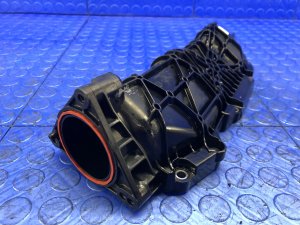
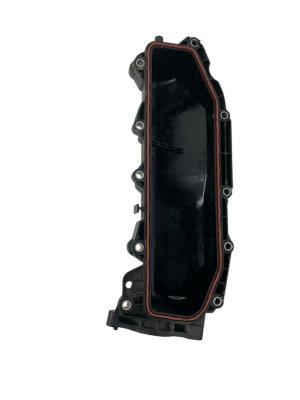
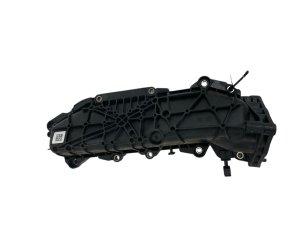
For the 2020-2025 Audi Q7 with the 3.0L V6 TFSI engine (engine code DCBD), this code is specifically mentioned in an Audi Technical Service Bulletin (TSB). [TSB_2081342_1] This indicates it's a recognized issue on this platform. The primary challenge is the sensor's location; like many modern V-type engines, Audi places the knock sensors in the valley between the cylinder banks, underneath the intake manifold. Access requires removing the entire intake assembly, a job that is significantly more complex and labor-intensive than on engines where the sensors are on the exterior of the block.
Diagnostic Flowchart
Tap your situation to follow the diagnostic path that matches what you're seeing on this vehicle.
Symptoms You May Notice
- "Drive System Malfunction" message on the instrument cluster [TSB_2081342_1]
- Check Engine Light is on
- Reduced engine power and sluggish acceleration
- Hesitation or stumbling during acceleration
- Audible engine pinging or knocking, especially under load
- Decreased fuel economy
- Rough or uneven idle
- Replacing spark plugs or ignition coils hoping to solve a performance issue without first addressing the specific circuit fault indicated by P0327.
- Replacing the knock sensor without thoroughly inspecting the wiring harness, leading to a recurring code.
Most Likely Causes
- Faulty Knock Sensor (Bank 1) 🔴 High Probability → Shop Ignition Knock (Detonation) Sensor The sensor operates in a high-heat environment in the engine valley, which can lead to premature failure. Water and oil can also pool in the valley from leaking gaskets or spills, submerging the sensor and its connector, causing corrosion and failure.
How to confirm: After verifying the wiring is intact, testing the sensor's internal resistance with a multimeter can confirm failure. A professional will use a scan tool to monitor the sensor's live voltage data; a flatline or near-zero reading points to a bad sensor or circuit. 🎬 Watch: How to diagnose and test for P0327 and P0332 codes.
Typical fix: Replace the knock sensor. It is highly recommended to replace the intake manifold gaskets, the sensor's sub-harness, and the Bank 2 sensor at the same time due to the labor involved.
Est. part cost: $110-$180 - Wiring Harness or Connector Issue 🟡 Medium Probability The engine valley is a common place for rodents to build nests, leading to chewed wires. The wiring can also become brittle and crack from constant heat cycles, causing a short to ground or an open circuit. A pinched wire during a previous repair is also a possibility.
How to confirm: A visual inspection of the harness for damage is the first step. A multimeter is used to check for continuity from the sensor connector to the ECM connector and to check for a short to ground.
Typical fix: Repair the damaged section of the wiring harness or replace the connector pigtail. Often, a dedicated sub-harness for the knock sensors is replaced as a unit.
Est. part cost: $20-$80 - Powertrain Control Module (PCM) Fault ⚪ Low Probability
How to confirm: Requires advanced diagnostics by a qualified technician or dealership to test the PCM's internal circuits.
Typical fix: The PCM would need to be repaired or replaced and reprogrammed.
Est. part cost: $800-$1500
Rare But Worth Checking
- Improperly Torqued Knock Sensor: → Shop Ignition Knock (Detonation) Sensor Knock sensors are piezoelectric and rely on a specific mounting torque to correctly detect vibrations. If it was recently replaced and torqued incorrectly, it can set a circuit code. The correct torque is often cited as 20 Nm (15 ft-lb) for Audi engines.
- Vacuum Leak: In some cases, a broken vacuum line near the knock sensor wiring harness can cause issues that are misdiagnosed as a sensor failure. One AudiWorld user reported that fixing a broken vacuum line resolved their P0327 and P0332 codes.
Diagnosis Steps
- Read the fault codes with an OBD-II scanner to confirm P0327 is present and note any other codes, especially P0332 for the other bank.
- Use an advanced scan tool to view the live data stream for Knock Sensor 1. A reading near zero volts or a flat line indicates a problem.
- Perform a visual inspection of the engine bay. While the sensor itself is hidden, check visible portions of the engine harness for signs of damage, especially from rodents.
- To perform a full inspection and repair, the intake manifold must be removed to access the sensor in the engine valley.
- Once the intake is off, carefully inspect the knock sensor harness for brittle wires, corrosion, or signs of being pinched or chewed.
- Test the circuit. Disconnect the sensor and the ECM, and use a multimeter to check for continuity in the signal wire and to ensure there is no short to ground.
- If the wiring is confirmed to be good, the knock sensor itself is the most likely culprit.
- Replace the knock sensor(s). It is best practice to replace both sensors and the sub-harness at the same time.
- Ensure the new sensor is torqued to the manufacturer's specification, which is critical for proper function. A commonly cited value is 20 Nm.
- A Reddit user on r/MechanicAdvice suggests applying RTV sealant where the sensor harness passes through the valley plate to prevent future water intrusion.
- Always replace the intake manifold gaskets during reassembly to prevent vacuum leaks.
- Clear the fault codes and perform a test drive, monitoring live data to ensure the repair was successful.
Parts You'll Likely Need
- Knock Sensor (Bank 1)
(OEM #06E905377A)— This is the most common failure point for a P0327 code after wiring issues are ruled out. It often has a green connector.
Trusted brands: Bosch, Hamburg Tech, Genuine Audi
OEM price range: $120-$160
Aftermarket price range: $70-$110 - Intake Manifold Gasket Set
(OEM #06M129717F)— These must be replaced whenever the intake manifold is removed 🎬 Watch: How to clean your intake valves while the manifold is off. to access the knock sensors to prevent future vacuum leaks.
Trusted brands: Victor Reinz, Elring, Genuine Audi
OEM price range: $60-$90
Aftermarket price range: $30-$50 - Knock Sensor Wiring Harness — The short harness in the engine valley that connects both knock sensors is prone to heat damage and is often replaced along with the sensors as a preventative measure.
Trusted brands: Genuine Audi
OEM price range: $50-$80
Related Codes That Often Appear With This One
- P0332 — This is the code for Knock Sensor 2 Circuit Low (Bank 2). The sensors are often replaced in pairs since they are subjected to the same conditions and require the same amount of labor to access. The TSB also groups them together. [TSB_2081342_1]
- P0328 — This is the code for Knock Sensor 1 Circuit High. It's also mentioned in the same TSB and points to a problem in the same circuit, just a different type of electrical fault (e.g., an open circuit). [TSB_2081342_1, 25]
Technical Service Bulletins (TSBs) & Recalls
- TSB_2081342_1: Provides information when there is a Drive System Malfunction, DTCs related to Knock Sensor P0327, P0332, P0328, P0333 - V6 TFS.
Platform-Specific Known Issues
- Audi TSB #TSB_2081342_1 directly addresses DTCs P0327, P0332, P0328, and P0333 in relation to a "Drive System Malfunction" warning on V6 TFSI engines, confirming this is a known issue for the manufacturer.
- A user on the Carly platform reported symptoms of a P0327 code on a 2020 Audi Q8 (platform mate) were resolved by fixing a pinched wire in the knock sensor harness, highlighting the vulnerability of the wiring in this area.
Mechanic-Grade Diagnostic Values
- Knock Sensor Signal Voltage — expected: Fluctuating AC voltage when tapping near the sensor; not a static value.. Failure: Voltage is less than 0.5V for more than 2 seconds.
- Knock Sensor Mounting Bolt Torque — expected: 20 Nm (15 ft-lb).. Failure: If over-torqued, the sensor can become overly sensitive and trigger false codes; if under-torqued, it may not detect real knock events.
Scan Tool Commands That Help
- VCDS (VAG-COM) / ODIS: Read Measuring Value Block (MVB), Group 015 and/or 016 — To functionally check the knock sensors and knock control system in real-time. This allows a technician to see the timing adjustments being made (or not made) per cylinder.
- Advanced Scan Tool (e.g., ODIS, Autel): Data List > KNOCK FB VAL (Knock Feedback Value) — To monitor the live feedback value from the knock sensor while driving under load (e.g., A/C on, accelerating). The values should change dynamically; if they are static or zero, it points to a fault in the sensor or circuit.
Wiring & Ground Locations
- Main Engine Ground Strap — Connects from the vehicle body/frame rail to the engine block or an engine mount bracket, often on the passenger side.. A loose or corroded main ground can cause a variety of erratic sensor readings, including the knock sensor circuit. Ensuring this connection is clean and tight is a crucial step in diagnosing any electrical fault.
- Ground Connection (Plenum Chamber) — In the plenum chamber (the area below the windshield), there are several factory ground points. For the Q7, specific points are noted as being in the center and right side of the plenum chamber.. The engine wiring harness, which includes the knock sensor circuits, often routes through or near the plenum chamber. A fault at one of these central grounding locations can affect multiple systems.
- Knock Sensor Connector (Bank 1) — In the engine valley, under the intake manifold, connected to the Bank 1 knock sensor (G61).. This is the primary connection point for the sensor. It is highly susceptible to corrosion from water and oil pooling in the valley, as well as heat damage, which can cause the low circuit voltage condition.
Real Owner Repair Stories
- Reddit user on r/Audi (2019 Audi SQ5 (similar 3.0T engine and platform)) — Check Engine Light with code P0328 (Circuit High, but related to the same sensor system) appeared after applying a Stage 1 ECU tune for 91 octane fuel.
❌ Tried (didn't work) The user considered replacing the knock sensor but first investigated other causes.
✅ What actually fixed it The user began adding an STP octane booster to each tank of 91 octane gasoline. The code did not return, indicating the issue was related to the combination of the aggressive tune and lower-than-ideal fuel quality, which was causing excessive (real) knock that the sensor was reporting.
OEM Part Supersession History
06E905377A→06E905377J— Part revision by the manufacturer, likely for improved durability or material changes.
Heads up: The new part number (06E905377J) is a direct replacement for the older 'A' revision and is compatible.
Helpful Videos
We Have This Part in Stock

The information in this article is provided for general reference and educational purposes only. Vehicle specifications, procedures, and part compatibility can vary by production date, trim level, and region. Always consult your vehicle's factory service manual and verify part numbers before purchasing or performing repairs. Safety-critical components such as airbags, seat belts, and braking systems should be installed by a qualified professional.
- Audi Q7:
- 🧭 Diagnostic Flowchart
- 🎬 Helpful Videos
- 🛍️ Shop This Part
- What's Unique About the 2020-2025 Audi Q7
- Symptoms You May Notice
- Most Likely Causes
- Rare But Worth Checking
- Diagnosis Steps
- Parts You'll Likely Need
- Related Codes That Often Appear With This One
- Technical Service Bulletins (TSBs) & Recalls
- Platform-Specific Known Issues
- Mechanic-Grade Diagnostic Values
- Scan Tool Commands That Help
- Wiring & Ground Locations
- Real Owner Repair Stories
- OEM Part Supersession History
- 🎟️ Get 5% Off