

P0330 on 2000-2006 Toyota Tundra 4.7L V8: Knock Sensor Circuit Causes and Fixes
P0330 on a 2000-2006 Tundra almost always means the knock sensor wiring harness under the intake manifold has been chewed by rodents. The soy-based wire insulation is a known attractant. Due to the high labor cost (4-6 hours) to access it, the standard, correct fix is to replace both knock sensors and the harness at the same time using OEM parts, costing $800-$1500 at a shop.
- P0330 on this Tundra is almost certainly caused by rodent damage to the wiring harness under the intake manifold.
- This is a difficult, labor-intensive repair (DIY Difficulty 5/5). Do not attempt unless you are an experienced mechanic.
- To avoid having to do the job twice, you MUST replace both knock sensors AND the wire harness at the same time.
- Use only high-quality OEM parts (Toyota or Denso) for the sensors and harness. Cheaper aftermarket parts are known to fail quickly.
- Consider replacing the starter motor during this repair, as it is in the same hard-to-reach location.
What's Unique About the 2000-2006 Toyota Tundra
The story of P0330 on the first-generation Tundra V8 is less about sensor failure and more about engine design and rodents. The two knock sensors and their connecting wire harness are located deep in the engine valley, underneath the entire intake manifold. This location provides a warm, sheltered nesting spot for mice and rats, who are notorious for chewing through the soy-based insulation on the wiring harness. As a result, the most common cause of P0330 is not a bad sensor, but a damaged harness, making a relatively inexpensive part a very labor-intensive repair.
Symptoms You May Notice
- Check Engine Light is on
- VSC and/or TRAC OFF lights may be illuminated
- Engine runs in 'limp mode', feeling very underpowered and sluggish
- Transmission will not shift into overdrive (the O/D OFF light may flash)
- Drastic decrease in fuel economy (MPG)
- Audible engine pinging or knocking, especially during acceleration (in some cases)
- Replacing only the Bank 2 knock sensor without replacing the harness. The harness is the most frequent point of failure, and leaving the old one can lead to the code returning.
- Using cheap, aftermarket knock sensors. Many owners and mechanics report that non-OEM sensors fail quickly or are dead on arrival, forcing them to redo this very labor-intensive job.
- Repairing/splicing the sub-harness wires. The knock sensor wires are shielded. An improper repair can introduce signal interference, causing the code to return. Replacement is the only reliable fix.
Most Likely Causes
- Rodent Damage to Knock Sensor Harness 🔴 High Probability → Shop Engine Wiring Harness The harness is located in the warm, protected engine valley under the intake manifold, a perfect nesting spot for rodents. The soy-based wire insulation is also attractive to them.
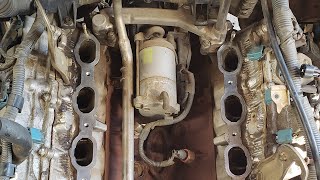
How to confirm: Visually inspect the engine valley for signs of rodents (droppings, nesting material, chewed foam) before disassembly. The damage will be obvious once the intake manifold is removed. 🎬 See what rodent damage looks like under the manifold.
Typical fix: Replace the short knock sensor sub-harness. It is highly recommended to also replace both knock sensors at the same time due to the labor involved.
Est. part cost: $30-$60 for the harness - Failed Knock Sensor (Bank 2) 🟡 Medium Probability → Shop Ignition Knock (Detonation) Sensor While less common than wire damage on this truck, the piezoelectric sensor itself can fail from age, heat cycles, and vibration.
How to confirm: After removing the intake manifold, test the sensor's resistance with a multimeter. A healthy sensor should have resistance, while a failed one will show an open circuit (infinite resistance). The specified resistance for a good sensor is between 120 and 280 kOhms at 20°C (68°F). However, given the labor, replacement is recommended regardless.
Typical fix: Replace the Bank 2 knock sensor. Best practice is to replace both sensors (Bank 1 and Bank 2) and the harness simultaneously.
Est. part cost: $140-$210 per OEM sensor
Rare But Worth Checking
- Damaged Main Engine Harness: A break or short can occur in the wiring between the knock sensor sub-harness connector and the ECU. This is difficult to diagnose and repair. One owner on Reddit reported this exact issue after replacing sensors and the sub-harness to no avail; the dealer determined a fault in the main harness, which was no longer available. The owner resorted to splicing the good sensor's signal to both ECU inputs as a workaround.
- Faulty Engine Control Unit (ECU): This is extremely rare. The ECU should only be considered as the cause after all other possibilities, including sensors and all wiring (both sub-harness and main harness), have been definitively ruled out.
Diagnosis Steps
- Confirm the code P0330 (and possibly P0325) is present using an OBD-II scanner.
- Inspect the top of the engine and around the intake manifold for signs of rodents, such as droppings, acorn shells, or nesting materials. This strongly suggests the likely cause.
- For advanced diagnosis, you can test the knock sensor circuit from the ECU connector pins to check for proper resistance (typically looking for an open circuit). This can confirm a wiring fault without removing the manifold first.
- Plan for disassembly. This is a 4-6 hour job requiring removal of the air intake, throttle body, fuel rails, and intake manifold.
- Once the intake manifold is removed, visually inspect the knock sensor harness and the sensors themselves in the engine valley. Look for chewed wires, frayed insulation, or corrosion.
- Given the high probability of wire damage and the labor involved, the most effective step is to replace both knock sensors and the sub-harness with OEM parts regardless of what the visual inspection shows.
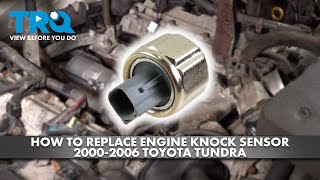
- 'While you're in there': Strongly consider replacing the starter motor, which is located in the same area and requires the same labor to access. 🎬 Watch how to replace the starter and sensors together. Also inspect and replace the coolant bypass pipe and hose running under the manifold, as they become brittle and are a common source of leaks.
- Clean all mating surfaces thoroughly and install new intake manifold gaskets.
- Reassemble all components, ensuring all connectors and hoses are properly reattached. Torque bolts to factory specifications. The knock sensor mounting nuts should be torqued to 15 ft-lbs (20 Nm).
- Clear the trouble codes with the scanner and perform a test drive to ensure the code does not return and the transmission shifts into overdrive properly.
Parts You'll Likely Need
- Knock Sensor
(OEM #89615-12090 (supersedes 89615-06010))— The sensor itself can fail, but it is primarily replaced as a preventative measure along with the harness due to the high labor cost of access. It's critical to replace both with OEM parts.
Trusted brands: Toyota (Genuine), Denso
OEM price range: $140-$210 each
Aftermarket price range: $40-$90 each - Knock Sensor Wire Harness
(OEM #82219-34010 (supersedes 82219-0C010))— This is the single most common point of failure for the P0330 code on this vehicle, almost always due to rodent damage. It is considered a mandatory replacement part for this job.
Trusted brands: Toyota (Genuine)
OEM price range: $30-$60
Aftermarket price range: $20-$40 - Intake Manifold Gasket Set
(OEM #17171-50021 (example, confirm for specific year))— These are single-use gaskets that must be replaced anytime the intake manifold is removed to prevent vacuum leaks.
Trusted brands: Toyota (Genuine), Fel-Pro
OEM price range: $40-$70
Aftermarket price range: $20-$40 - Water Bypass Pipe / Hose — This coolant pipe runs under the intake manifold and is prone to corrosion and leaking. It is highly recommended to replace it during a knock sensor job to prevent future coolant leaks.
Trusted brands: Toyota (Genuine)
OEM price range: $20-$50
Aftermarket price range: $15-$30
Related Codes That Often Appear With This One
- P0325 — P0325 is the equivalent code for the Bank 1 (passenger side) knock sensor. If rodents have damaged the harness, it's very common for them to chew through the wires for both sensors, causing both codes to appear together.
Technical Service Bulletins (TSBs) & Recalls
- EG034-07 - This Technical Service Bulletin provides official identification for engine banks, confirming that Bank 2 (for P0330) is the driver's side on the 2UZ-FE engine.
- EG014-03 - An earlier TSB that also discusses knock sensor codes and may provide diagnostic information.
Platform-Specific Known Issues
- The location of the knock sensors and harness in the engine valley makes them highly susceptible to rodent damage, which is the leading cause of P0330 on this platform.
- Due to the difficult access, this repair is often combined with the replacement of the starter motor and the under-intake coolant bypass pipe, which are located in the same area.
Mechanic-Grade Diagnostic Values
- Knock Sensor Resistance — expected: 120 to 280 kOhms at 20°C (68°F). Failure: An open circuit (infinite resistance) or a value outside the specified range indicates a failed sensor.
- Knock Sensor Mounting Nut Torque — expected: 15 ft-lbs (20 Nm). Failure: Improper torque can affect the sensor's ability to detect vibrations correctly. Over-tightening can damage the sensor, while under-tightening can lead to a poor connection.
- Knock Sensor Circuit at ECU — expected: No signal should be present at pins KNK1 or KNK2 with the engine off. With the engine running, an AC voltage signal should be present, viewable with an oscilloscope.. Failure: The absence of a signal to the ECM when the engine speed is between 1,700 and 5,400 rpm will trigger the code.
Wiring & Ground Locations
- EC — Rear bank of the left (driver's side) cylinder head.. This is a primary engine ground point for the driver's side of the engine (Bank 2). A corroded or loose ground here can cause a variety of electrical issues, including erratic sensor readings for components on this bank.
- EB — Rear bank of the right (passenger's side) cylinder head.. This is the primary engine ground for Bank 1. While P0330 is for Bank 2, a poor ground on either side can create electrical potential differences that may affect sensor readings across the engine.
- KNK2 (at ECU) — Pin 22 on the E7 ECU connector for a 2003 Tacoma with the 5VZ-FE, which shares a similar diagnostic architecture. For the 2UZ-FE, this is the specific input pin for the Bank 2 knock sensor.. This is the terminal where the ECU receives the signal from the Bank 2 knock sensor. Advanced diagnosis involves testing for an open or short in the harness between this pin and the sensor connector in the engine valley.
- KNK1 (at ECU) — Pin 23 on the E7 ECU connector for a 2003 Tacoma with the 5VZ-FE. This is the input pin for the Bank 1 knock sensor.. Relevant when diagnosing both P0325 and P0330 together. It allows for a side-by-side comparison of the wiring integrity from the ECU connector.
Real Owner Repair Stories
- Reddit user r/ToyotaTundra (2004 Toyota Tundra) — P0330 code, vehicle stuck in limp mode, MPG reduced to 8-9.
❌ Tried (didn't work) Replaced both knock sensors with aftermarket parts., Replaced the knock sensor sub-harness., Swapped the positions of the two new knock sensors to rule out a bad new sensor., Took to a Toyota dealership, who confirmed the new sensors were working and there was no engine knock. They suspected a wiring issue but could not locate it.
✅ What actually fixed it The dealership determined the main engine wiring harness had a fault, but the part was no longer manufactured. The owner performed a workaround by splicing the signal wire from the known-good Bank 1 sensor (P0325) and feeding it to the ECU input for Bank 2 as well. This resolved the code and limp mode. The owner noted that Toyota's wiring diagram was backward; the gray wire was for sensor 1 and the black for sensor 2. - Tundras.com forum user (2000 Toyota Tundra) — P0330 code.
❌ Tried (didn't work) Mechanic replaced the sensor with an aftermarket part., Mechanic then replaced it again with an OEM Toyota sensor., Mechanic then replaced the wiring harness., Mechanic then replaced the entire ECM (ECU).
✅ What actually fixed it The forum thread ends with the user still diagnosing the issue after multiple expensive parts were replaced to no effect, strongly pointing to an undiagnosed fault in the main engine wiring harness, similar to the Reddit story. Another user noted that for early models, the harness was not easily replaceable and required splicing in a newer style pigtail.
OEM Part Supersession History
89615-06010, 89615-12050, 89615-32010→89615-12090— Part consolidation and potential design updates over a long production life.
Heads up: The part number 89615-06010 is often associated with the later VVT-i engines (2005-2006), while the base part number has been used across many Toyota models. It is critical to use the vehicle's VIN to confirm the correct part number.
Model Year Variations Within This Range
- 2005-2006: The 2UZ-FE engine was updated with Variable Valve Timing-intelligent (VVT-i) starting in the 2005 model year. While the physical location and common failure mode of the knock sensors remain the same, the specific part number for the sensor may differ. Forum discussions indicate that the VVT-i engines might be more sensitive to sensor and wiring termination quality.
Diagnostic Flowchart
Other Known Issues on This Vehicle
Issues unrelated to this code that are worth knowing about as an owner of this generation:
- Frame Rust/Corrosion 🔴 High — Extremely common, especially in cold-weather states with road salt use. Affects all 2000-2006 models. (Ref: Major recall and warranty extension programs were issued (e.g., Safety Recall for 2000-2003 models), though many have expired.)
- Cracked Exhaust Manifolds 🟠 Medium — Very common issue on the 2UZ-FE, typically presenting as a ticking noise when the engine is cold that may disappear as it warms up.
- Lower Ball Joint Failure 🔴 High — Common on 2002-2006 models, can lead to separation of the wheel from the suspension and loss of control. (Ref: Safety Recall 50J / NHTSA 05V225000 was issued for 2002-early 2004 models.)
- Timing Belt Replacement 🔴 High — Not a failure, but a critical maintenance item. The 2UZ-FE is an interference engine, meaning a snapped belt will cause catastrophic engine damage. The replacement interval is every 90,000 miles.
- Secondary Air Injection System Failure 🟡 Low — Common on later models in this range (approx. 2005-2006). The pumps and valves are prone to failure from moisture, causing emissions-related check engine lights. (Ref: A warranty extension was offered for this issue on later generation Tundras, but it's a known problem on the 1st gen as well.)
Used vs. New Parts: Buying Guide for This Vehicle
When a used part is the smart pick: For this specific repair, using used parts is generally not recommended due to the extremely high labor cost to access the components. The only exception might be sourcing a complete, used main engine wiring harness from a low-mileage donor vehicle if an internal break is diagnosed and a new part is unavailable.
Donor-vehicle mileage cap: roughly under 100000 miles for the part to have meaningful remaining life.
What to inspect on the donor part:
- For a main engine harness, inspect the donor vehicle for any signs of rodent activity in the engine bay.
- Check all connectors for corrosion, brittleness, or broken locking tabs.
- Ensure the harness comes from a vehicle with the exact same engine and model year to avoid compatibility issues.
OEM-only on this vehicle (don't cheap out):
- Knock Sensor: This is the most critical part to buy OEM (or from the OEM supplier, Denso). Forum and mechanic consensus is overwhelming that aftermarket sensors are unreliable, fail quickly, or are dead-on-arrival, forcing a repeat of the 4-6 hour repair.
- Knock Sensor Harness: Given the low cost of the OEM sub-harness ($30-$60) and the high labor cost, using anything other than a new OEM part is a significant risk for a negligible savings.
Aftermarket brands forum-validated for this vehicle:
- Denso (OEM supplier for Toyota)
Brands owners have reported issues with on this vehicle:
- Unnamed or generic brands from online marketplaces (e.g., Amazon, eBay) are frequently cited as the cause of repeat failures.
Real Owner Stories
Aggregated from forums and TSBs cited above. Mileages and costs reflect what owners reported in those sources.
2000-2006 Toyota Tundra 2UZ-FE 4.7L V8
Symptoms: A frustrating diagnostic journey with a persistent P0330 code.
What fixed it: The issue was not resolved by replacing the sensor, harness, or even the ECM, indicating a deeper wiring issue in the main harness.
Source hint: Tundras.com: 'Knock sensor code po330'
2000-2006 Toyota Tundra 2UZ-FE 4.7L V8
Symptoms: Check engine light was on due to a chewed knock sensor harness.
What fixed it: The owner soldered in a new pigtail for the harness, which successfully resolved the check engine light.
Source hint: Tundras.com: 'Knock sensor wire harness replacement'
2004 Toyota Tundra 2UZ-FE 4.7L V8
Symptoms: A P0330 code persisted even after replacing the knock sensors and the sub-harness.
What fixed it: The owner discovered a fault in the main engine harness and implemented an ECU-side wiring workaround to fix the problem.
Source hint: Reddit r/ToyotaTundra: 'P0330 Code Experience and Fix on my 2004 Tundra'
Related OBD-II Codes
Frequently Asked Questions
What is the most common cause of a P0330 code on my 2000-2006 Tundra 4.7L V8?
My truck is in 'limp mode' and the O/D OFF light is flashing. Is this related to the P0330 code?
Which side of the engine is Bank 2 for the P0330 code?
Since the repair is so labor-intensive, what other parts should I replace at the same time?
Is it okay to just replace the one bad sensor or the harness?
What is the correct torque specification for the knock sensor mounting nuts?
Are other Toyota or Lexus vehicles with the 4.7L V8 also affected by this issue?
Helpful Videos
Used OEM Parts in Stock
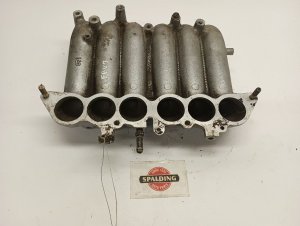
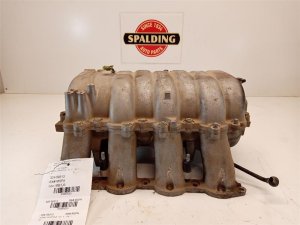
New Aftermarket Parts Available


The information in this article is provided for general reference and educational purposes only. Vehicle specifications, procedures, and part compatibility can vary by production date, trim level, and region. Always consult your vehicle's factory service manual and verify part numbers before purchasing or performing repairs. Safety-critical components such as airbags, seat belts, and braking systems should be installed by a qualified professional.
- Toyota Tundra:
- 🧭 Diagnostic Flowchart
- 🎬 Helpful Videos
- 🛍️ Shop This Part
- What's Unique About the 2000-2006 Toyota Tundra
- Symptoms You May Notice
- Most Likely Causes
- Rare But Worth Checking
- Diagnosis Steps
- Parts You'll Likely Need
- Related Codes That Often Appear With This One
- Technical Service Bulletins (TSBs) & Recalls
- Platform-Specific Known Issues
- Mechanic-Grade Diagnostic Values
- Wiring & Ground Locations
- Real Owner Repair Stories
- OEM Part Supersession History
- Model Year Variations Within This Range
- Other Known Issues on This Vehicle
- Used vs. New Parts: Buying Guide for This Vehicle
- Real Owner Stories
- 2000-2006 Toyota Tundra 2UZ-FE 4.7L V8
- 2000-2006 Toyota Tundra 2UZ-FE 4.7L V8
- 2004 Toyota Tundra 2UZ-FE 4.7L V8
- Related OBD-II Codes
- Frequently Asked Questions
- 🎟️ Get 5% Off