

P0331 on 2019 Alfa Romeo Giulia: Knock Sensor 2 Circuit Range/Performance Fixes
This code indicates a problem with Knock Sensor 2. On the 2019 Alfa Romeo Giulia, this is most often due to a required PCM software update per TSB #18-001-23 REV. A. If the software is up to date, a faulty sensor or wiring issue is likely. Expect to pay $555-$783 for a professional replacement, with the part itself costing around $67.
- P0331 on a 2019 Giulia means there's a fault in the circuit for Knock Sensor 2.
- The first and most important step is to check if a PCM software update is available per TSB #18-001-23 REV. A, as this is the most likely fix. [⭐ MANUFACTURER TSB — highest authority, 6]
- If software doesn't fix it, the most likely cause is a bad knock sensor, followed by a wiring or connector issue.
- Due to the sensor's difficult location on the engine block, hardware replacement is best left to a professional unless you are an experienced DIYer.
- Do not ignore this code, as a malfunctioning knock detection system can put the engine at risk of damage from detonation.
What's Unique About the 2019-2019 Alfa Romeo GIULIA
For the Alfa Romeo Giulia, the P0331 code is specifically called out in Technical Service Bulletin (TSB) #18-001-23 REV. A (superseding #1804623) from the manufacturer, indicating it's a known issue. [⭐ MANUFACTURER TSB — highest authority] Crucially, the TSB's primary recommended fix is to reprogram the Powertrain Control Module (PCM) with updated software. [⭐ MANUFACTURER TSB — highest authority] The TSB also links this code with others (P0106, P013A, P015A, etc.), suggesting a pattern of related electronic issues that the software update is designed to address. [⭐ MANUFACTURER TSB — highest authority] The 2.0L I4 engine and the 2.9L V6 in the Quadrifoglio model both have two knock sensors, one for each engine bank.
Diagnostic Flowchart
Tap your situation to follow the diagnostic path that matches what you're seeing on this vehicle.
Symptoms You May Notice
- Check Engine Light is on
- Audible engine knocking or pinging, especially under load
- Reduced engine power and acceleration
- Hesitation during acceleration
- Poor fuel economy
- Rough or uneven idle
- Replacing the knock sensor without first checking for the PCM software update specified in TSB #18-001-23 REV. A. [⭐ MANUFACTURER TSB — highest authority]
- Replacing spark plugs or ignition coils without first diagnosing the knock sensor circuit. While these can cause misfires, P0331 points specifically to the sensor's circuit performance.
Most Likely Causes
- ECM Software Issue 🔴 High Probability Manufacturer TSB #18-001-23 REV. A explicitly states that the fix for P0331 (and other codes) is to reprogram the PCM with the latest software. This is the official first step before hardware replacement. [⭐ MANUFACTURER TSB — highest authority]
How to confirm: A dealer or qualified shop can check the current software version on your PCM and determine if the update specified in the TSB is needed.
Typical fix: Reprogram the Powertrain Control Module (PCM) with the latest available software per TSB #18-001-23 REV. A. [⭐ MANUFACTURER TSB — highest authority]
Est. part cost: $0 (if under warranty) - $200 (for labor) - Faulty Knock Sensor 2 🟡 Medium Probability → Shop Ignition Knock (Detonation) Sensor While the TSB points to software first, sensor failure is still a common cause for this code across all vehicles. Heat and vibration can degrade the sensor's internal piezoelectric element over time.
How to confirm: After confirming the PCM software is up-to-date, this becomes the next likely cause. A technician can use a multimeter set to AC volts to see if the sensor generates a voltage signal when the engine block near it is tapped. Due to difficult access, replacement is often done based on the persistent code after the software fix.
Typical fix: Replace Knock Sensor 2.
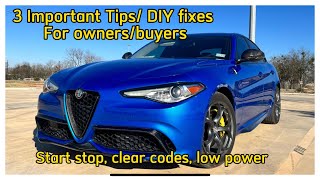
Est. part cost: $60-$75 - Wiring or Connector Issue 🟡 Medium Probability Engine vibrations and heat can damage wiring or connectors over time. A corroded main ground strap on the transmission is a known issue 🎬 See this video for common DIY fixes for Giulia owners. on this platform that can cause various electrical faults.
How to confirm: Visually inspect the wiring harness and connector leading to Knock Sensor 2 for any signs of damage, corrosion, or loose connections. Check the main ground strap from the transmission to the chassis for corrosion or damage. Check for continuity with a multimeter from the sensor connector to the ECM.
Typical fix: Repair the damaged section of the wiring harness, clean/replace the connector, or replace the main ground strap.
Est. part cost: $10-$50 - Engine Control Module (ECM) Fault ⚪ Low Probability → Shop Engine Control Module (ECM) While rare, a hardware failure within the ECM itself is a possibility if all other causes are ruled out. The TSB mentioning a software flash for these codes indicates the ECM is central to the issue. [⭐ MANUFACTURER TSB — highest authority]
How to confirm: This is a last resort after definitively ruling out the sensor, wiring, and software. Requires advanced diagnostics by a professional.
Typical fix: The ECM may need to be replaced and programmed.
Est. part cost: $800-$1500
Rare But Worth Checking
- Incorrect Fuel Octane: Using fuel with a lower octane rating than recommended (premium 91+ for the Giulia) can cause real engine knock, which might trigger a range/performance code if the knock is excessive.
- Improper Sensor Installation: Knock sensors are sensitive to torque. If the sensor is too loose or too tight, it won't detect vibrations correctly. Ensure the mounting surface on the engine block is clean before installation, as dirt or corrosion can interfere with the reading.
- Internal Engine Problem: In very rare cases, an actual mechanical issue causing a knock (like a worn rod bearing) could trigger this code if the vibration is outside the expected range. This would likely be accompanied by audible engine noise.
Diagnosis Steps
- Connect an OBD-II scanner and check for any available Powertrain Control Module (PCM) software updates. Specifically reference TSB #18-001-23 REV. A (or its latest revision) as this is the manufacturer's recommended first action for a 2019 Giulia with the 2.0L engine. [⭐ MANUFACTURER TSB — highest authority]
- If a software update is performed, clear the codes and perform the specified drive cycle to see if the code returns. If it does not, the issue is resolved.
- If the software is up-to-date or the code returns, proceed with hardware diagnosis. Read all stored fault codes again, noting any other codes present.
- Inspect the main transmission-to-chassis ground strap 🎬 Watch: How to clean battery posts and check electrical connections. for corrosion or damage, as this is a known failure point on the platform that can cause various electrical faults.
- Check that the correct premium fuel (91 octane or higher) is being used.
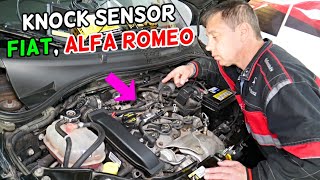
- Locate Knock Sensor 2 on the engine block. For the 4-cylinder engine, it will be on the block; for the V6, Bank 2 is the left side of the engine (driver's side in the US).
- Visually inspect the sensor's wiring and connector for any obvious damage, melting, corrosion, or loose connections.
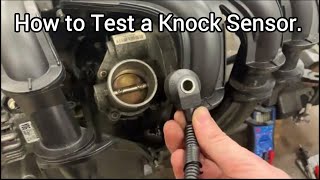
- If wiring looks good, test the sensor's output. Set a multimeter to a low AC voltage scale, connect it to the sensor's signal and ground wires, and gently tap the engine block near the sensor with a wrench. 🎬 Watch: How to test a knock sensor using a multimeter. A healthy sensor should generate a small AC voltage signal.
- If a new sensor is installed, ensure it is tightened to the manufacturer's specified torque. Over-tightening can make the sensor too sensitive and cause false codes, while under-tightening can prevent it from detecting knock.
- If the sensor, wiring, and grounds are confirmed to be good, the ECM itself may have a hardware fault, which requires professional diagnosis.
Parts You'll Likely Need
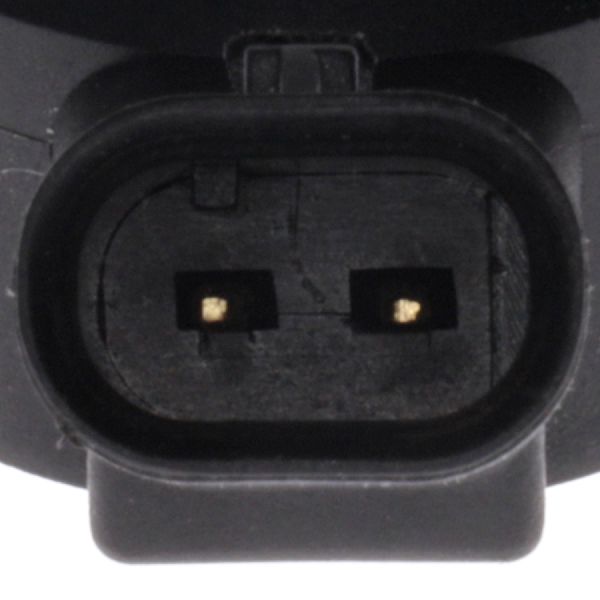
- Knock Sensor (2.0L I4)
(OEM #68223050AA (superseded by 68570138AA))— This is the most common hardware failure point for the P0331 code after a software issue is ruled out. The part number has been updated by Mopar.
Trusted brands: Mopar, Bosch, BWD Automotive
OEM price range: $70-$100
Aftermarket price range: $50-$70 - Knock Sensor (2.9L V6)
(OEM #670037253)— The Quadrifoglio model uses a different knock sensor than the 2.0L engine. If working on the 2.9L V6, this is the correct part to source.
Trusted brands: Mopar/Genuine Alfa Romeo, Bosch
OEM price range: $80-$120
Aftermarket price range: $60-$90
Related Codes That Often Appear With This One
- P0106 — Manifold Absolute Pressure/Barometric Pressure Circuit Range/Performance. This code is mentioned in the same TSB as P0331, suggesting a possible related electrical or ECM software issue. The TSB software update is designed to fix both. [⭐ MANUFACTURER TSB — highest authority]
- P013A — O2 Sensor Slow Response – Rich to Lean (Bank 1 Sensor 2). Also mentioned in TSB #18-001-23 REV. A, indicating a potential shared root cause resolved by the PCM flash. [⭐ MANUFACTURER TSB — highest authority]
- P0325 — Knock Sensor 1 Circuit Malfunction. If you see codes for both sensors, it could point towards a wiring harness issue common to both, a faulty main ground strap, or a more significant engine problem causing widespread knocking.
- P015A — O2 Sensor Delayed Response - Rich to Lean (Bank 1 Sensor 1). This is another code listed in TSB #18-001-23 REV. A, further strengthening the case for a PCM software update as the primary fix. [⭐ MANUFACTURER TSB — highest authority]
Technical Service Bulletins (TSBs) & Recalls
- 18-001-23 REV. A (formerly 1804623): Addresses Malfunction Indicator Lamp (MIL) illumination for the 2.0L engine. Recommends reprogramming the PCM with the latest software as the repair for a list of DTCs including P0331, P0106, P013A, and P015A. [⭐ MANUFACTURER TSB — highest authority]
- 18-061-19: A similar TSB for the 2.9L V6 engine, also recomme
Platform-Specific Known Issues
- A Technical Service Bulletin (TSB #18-001-23 REV. A, superseding #1804623) for the 2019 Giulia 2.0L states the primary fix for P0331 is a PCM software update. This should always be the first step. [⭐ MANUFACTURER TSB — highest authority]
- Electrical gremlins are a commonly reported quirk on Giulia forums. Many issues, including sensor faults, are sometimes traced back to a weak battery or poor ground connection, which can cause low voltage conditions. A specific known failure point is the main ground strap from the transmission to the chassis, which is exposed to the elements and can corrode.
Mechanic-Grade Diagnostic Values
- Knock Sensor AC Voltage Output (General Test) — expected: A small AC voltage signal should be generated when the engine block near the sensor is tapped with a wrench.. Failure: No voltage signal, or a significantly lower signal compared to the other bank's sensor, suggests a faulty sensor.
Wiring & Ground Locations
- Main Engine/Transmission Ground Strap — Under the car, connecting the transmission housing to the vehicle's chassis.. This strap is exposed to road salt and moisture and is a known failure point due to corrosion on the Giulia/Stelvio platform. A poor ground here can cause erratic electrical behavior and phantom sensor codes, including P0331, as the system seeks alternative ground paths, potentially overloading smaller wires.
- Remote Negative (-) Post — An exposed stud on the upper frame rail, next to the passenger side hood lock in the engine compartment.. This is the manufacturer-specified ground point for any electrical testing or jump-starting, ensuring a solid and safe ground connection for diagnostics.
OEM Part Supersession History
68223050AA→68570138AA— The reason for the supersession is not officially stated, but the new part (68570138AA) is used across a very wide range of Stellantis vehicles and engines, from the 1.3L Turbo to the 6.2L Supercharged V8. This suggests the update may be a consolidation to a more robust or standardized design.
Helpful Videos
We Have This Part in Stock


The information in this article is provided for general reference and educational purposes only. Vehicle specifications, procedures, and part compatibility can vary by production date, trim level, and region. Always consult your vehicle's factory service manual and verify part numbers before purchasing or performing repairs. Safety-critical components such as airbags, seat belts, and braking systems should be installed by a qualified professional.
- Alfa Romeo GIULIA:
- 🧭 Diagnostic Flowchart
- 🎬 Helpful Videos
- 🛍️ Shop This Part
- What's Unique About the 2019-2019 Alfa Romeo GIULIA
- Symptoms You May Notice
- Most Likely Causes
- Rare But Worth Checking
- Diagnosis Steps
- Parts You'll Likely Need
- Related Codes That Often Appear With This One
- Technical Service Bulletins (TSBs) & Recalls
- Platform-Specific Known Issues
- Mechanic-Grade Diagnostic Values
- Wiring & Ground Locations
- OEM Part Supersession History
- 🎟️ Get 5% Off