

P0331 on 2016-2017 Buick Envision: Knock Sensor Range/Performance Causes and Fixes
On a 2016-2017 Buick Envision, especially with the 2.0L Turbo engine, P0331 is often caused by loose intake manifold bolts, not a bad knock sensor. Before buying parts, check the torque on the intake manifold bolts as per GM Technical Service Bulletin #PIP5529B. The fix is to remove each bolt one by one, apply medium-strength threadlocker, and re-torque to 12 N.m (106 lb-in).
- For a P0331 code on a 2016-2017 Buick Envision, **check for loose intake manifold bolts first**, especially on the 2.0L Turbo engine.
- This code indicates a problem with the knock sensor circuit, which can lead to reduced power and potential long-term engine damage if ignored.
- Do not immediately assume the knock sensor is bad. A thorough diagnosis of the wiring and manifold bolts can save you from an expensive and unnecessary repair.
- If you do need to replace the sensor, it is likely located under the intake manifold, and the manifold gasket should be replaced at the same time.
What's Unique About the 2016-2017 Buick ENVISION
For this generation of Buick Envision and its platform mates (like the Chevy Malibu, Cadillac ATS, and Buick Regal) with the 2.0L LTG or 2.5L LCV engines, a very specific issue is often the root cause. A widely-known General Motors Technical Service Bulletin (TSB #PIP5529B) points to loose intake manifold bolts creating vibrations or a vacuum leak that the knock sensor misinterprets as engine knock. This condition can trigger P0331 along with a host of other seemingly unrelated codes. This makes it critical to check the intake manifold torque before assuming the knock sensor itself has failed, which is a more expensive and labor-intensive repair as the sensors are located under the intake manifold.
Diagnostic Flowchart
Tap your situation to follow the diagnostic path that matches what you're seeing on this vehicle.
Symptoms You May Notice
- Check Engine Light is on
- Audible engine knocking or pinging, especially under load
- Reduced engine power and acceleration
- Hesitation or stumbling during acceleration
- Worse-than-usual fuel economy
- Rough or unstable idle
- Vehicle may stall in rare cases
- Replacing the knock sensor without first checking for loose intake manifold bolts. This is a common and costly mistake that leads to unnecessary expense and labor, as the sensor is often located under the intake manifold and the problem will persist if the bolts are the true cause.
Most Likely Causes
- Loose Intake Manifold Bolts 🔴 High Probability → Shop Engine Intake Manifold A well-documented issue in GM Technical Service Bulletin #PIP5529B for engines including the 2.0L LTG and 2.5L LCV. The plastic intake manifold and aluminum cylinder head expand and contract at different rates, causing the bolts to loosen over time. The resulting vibration or vacuum leak is picked up by the highly sensitive knock sensors.
How to confirm: Visually inspect the intake manifold bolts for looseness; they may be only finger-tight. Use a torque wrench to check if they meet the factory specification of 12 N.m (106 lb-in). The presence of other codes like P0171, P0106, or P0068 strongly points to this cause. [⭐ MANUFACTURER TSB — highest authority]
Typical fix: Per TSB #PIP5529B, remove one bolt at a time, apply medium-strength threadlocker (e.g., Loctite Blue), reinstall, and torque to 12 N.m (106 lb-in) in the specified sequence. Do not replace the gasket unless a leak is confirmed after torquing.
Est. part cost: $5-$15 for threadlocker - Faulty Knock Sensor 🟡 Medium Probability → Shop Ignition Knock (Detonation) Sensor The sensors themselves can fail internally from heat and vibration over time, though this is less common than the loose manifold issue. A GM TechLink article also noted that on some 2.0L LTG engines, the knock sensor's own mounting bolt can come loose, causing a similar false signal.
How to confirm: After confirming wiring is okay, test the sensor's internal resistance. It should be between 93k and 110k Ohms. If it's an open circuit (OL) or far outside this range, the sensor is bad. Also check that its mounting bolt is properly torqued to 25 N.m (18 lb-ft).
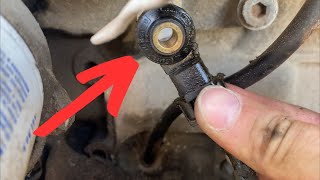
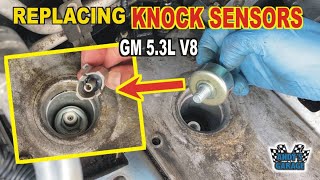
Typical fix: Replace the knock sensor. On the 2.0L LTG and 2.5L LCV engines, both knock sensors are located on the side of the engine block, underneath the intake manifold, requiring its removal for access. 🎬 Watch: This video shows the knock sensor location and replacement process.
Est. part cost: $40-$90 - Wiring or Connector Issue 🟡 Medium Probability The wiring harness to the knock sensors runs in a hot, tight environment. Chafing against the engine block, brackets, or melting from heat can cause shorts or open circuits. Connectors can also accumulate moisture or corrosion.
How to confirm: Inspect the wiring harness leading to the knock sensor for any signs of damage, chafing, or melting. Check the connector for corrosion, moisture, or bent pins. Perform a continuity test on the wiring between the sensor and the ECM; resistance should be close to 0 ohms.
Typical fix: Repair the damaged section of wire or clean/replace the connector. Use automotive-grade wiring and heat-shrink tubing for a durable repair.
Est. part cost: $10-$50 for wiring repair supplies - Actual Severe Engine Knock ⚪ Low Probability
How to confirm: Listen for audible, severe knocking. This could be caused by using low-octane fuel (these turbo engines require premium), excessive carbon buildup, or internal engine problems like worn rod bearings. The code sets because the ECM cannot retard timing enough to stop the knock.
Typical fix: Switch to the recommended premium octane fuel. Perform an engine carbon cleaning service (intake valve cleaning is common on direct-injection engines like the LTG). If knocking persists, further mechanical diagnosis is needed.
Est. part cost: $20-$200 for fuel additives or cleaning services
Rare But Worth Checking
- Faulty Engine Control Module (ECM): → Shop Engine Control Module (ECM) This is very rare. The ECM should only be considered after all other possibilities, including sensors, wiring, and mechanical issues, have been exhaustively ruled out.
Diagnosis Steps
- Scan for all DTCs. Note if any other codes from TSB #PIP5529B are present (e.g., P0171, P0106). Their presence makes loose intake bolts the prime suspect.
- Crucial First Step: Carefully inspect the intake manifold bolts to see if they are loose. Use a torque wrench to check that they are torqued to 12 N.m (106 lb-in). If loose, perform the TSB fix: remove one bolt at a time, apply medium-strength threadlocker, and torque to spec. Clear codes and test drive. This is often the entire fix.
- If the manifold is secure, inspect the knock sensor wiring harness. The sensors are under the intake manifold on the side of the block. Check for visible damage like melting, chafing against the engine block, or corrosion in the connector.
- If the wiring appears intact, disconnect the sensor and measure its internal resistance with a multimeter. A reading between 93k-110k Ohms is expected for a good GM sensor. An open circuit (OL) or a reading far outside this range indicates a failed sensor.
- If the sensor tests good, check for the DC bias voltage from the ECM at the connector (key on, engine off). You should see around 2.5V. If not, there may be a wiring or ECM issue.
- Check the knock sensor's mounting bolt to ensure it is tight. A loose sensor can cause false readings. Torque should be around 18 lb-ft (25 N.m).
- If all electronics check out, consider the possibility of real, severe engine knock from low-quality fuel or carbon buildup. The 2.0L LTG engine requires premium fuel. Try a higher-octane fuel or an intake valve cleaning service.
- If the code still returns, the knock sensor itself may be faulty despite testing within spec, or there may be an intermittent wiring issue. Replacement of the sensor is the next logical step, which requires removing the intake manifold.
Parts You'll Likely Need
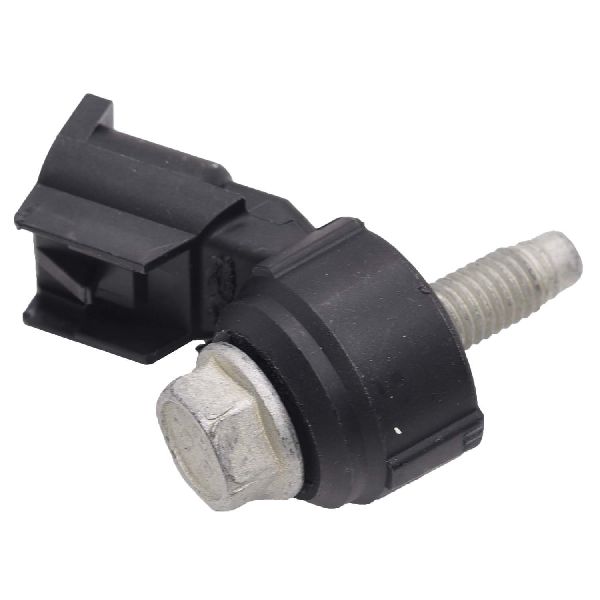
- Knock Sensor
(OEM #ACDelco 12644216 (Verify by VIN))— This sensor is the primary component in the circuit. It can fail internally, causing this code. However, it should only be replaced after checking for loose intake bolts and wiring issues.
Trusted brands: ACDelco, Delphi, Bosch
OEM price range: $60-$100
Aftermarket price range: $40-$90 - Intake Manifold Gasket
(OEM #ACDelco 12639249 (Verify by VIN))— If the knock sensor needs to be replaced, the intake manifold must be removed. It is critical to replace the gasket at the same time to prevent vacuum leaks. Note: TSB #PIP5529B explicitly states NOT to replace this gasket if only re-torquing the bolts, unless a leak is confirmed.
Trusted brands: ACDelco, Fel-Pro
OEM price range: $30-$50
Aftermarket price range: $15-$30 - Medium-Strength Threadlocker — Required for the TSB procedure to prevent the intake manifold bolts from backing out again.
Trusted brands: Loctite Blue 242/243, Permatex Medium Strength Threadlocker BLUE
Aftermarket price range: $5-$15
Related Codes That Often Appear With This One
- P0326 — This is the equivalent code for Knock Sensor 1. Both codes appearing together could point to a common cause like loose intake manifold bolts or a wiring harness issue affecting both sensors.
- P0068, P0101, P0106, P0171, P0131, P0137, P0324, P0506 — TSB #PIP5529B and #PIP5529A list P0331 in a large group of codes that can all be caused by loose intake manifold bolts. [⭐ MANUFACTURER TSB — highest authority] The presence of any of these codes (especially air/fuel/MAP codes like P0171 or P0106) alongside P0331 strongly suggests checking the intake manifold first. [2, ⭐ MANUFACTURER TSB — highest authority]
Technical Service Bulletins (TSBs) & Recalls
- PIP5529B: Mentions that P0331 can be
Platform-Specific Known Issues
- cause: A known issue, documented in TSB #PIP5529B, involves loose intake manifold bolts causing a variety of diagnostic trouble codes, including P0331. This is particularly noted on GM vehicles with the 2.0L LTG and 2.5L LCV engines. [2, ⭐ MANUFACTURER TSB — highest authority] The fix is to re-torque the bolts with medium-strength threadlocker. [2, ⭐ MANUFACTURER TSB — highest authority]
Mechanic-Grade Diagnostic Values
- Knock Sensor Internal Resistance — expected: 93k to 110k Ohms. Failure: An open circuit (OL) or a reading significantly outside this range.
- Knock Sensor Circuit Bias Voltage (Key On, Engine Off) — expected: Approximately 2.5V DC. Failure: No voltage or voltage significantly different from 2.5V suggests a wiring or ECM issue.
- Knock Sensor AC Voltage Output ('Tap Test') — expected: A small AC voltage spike should be visible on a multimeter or oscilloscope when the engine block is tapped near the sensor.. Failure: No voltage spike indicates the sensor's internal piezoelectric crystal is not generating a signal.
- Knock Sensor Mounting Bolt Torque — expected: 25 N.m (18 lb-ft). Failure: Incorrect torque can cause false signals. Over-tightening can damage the sensor, while under-tightening can cause a poor reading.
- Intake Manifold Bolt Torque — expected: 12 N.m (106 lb-in). Failure: Bolts being loose (e.g., finger-tight) is a primary indicator of the TSB-related issue.
Wiring & Ground Locations
- Knock Sensors (x2) — On the side of the engine block, underneath the intake manifold for both the 2.0L LTG and 2.5L LCV engines.. Their location makes replacement labor-intensive, which is why verifying the loose intake manifold TSB is the critical first step.
- K20 ECM Connector X3, Pin 62 — On the main Engine Control Module (ECM).. This is the specific pin for the Knock Sensor 1 Signal (Circuit 496). Probing this pin can confirm if the signal is reaching the ECM, isolating a wiring fault from an ECM fault. While this is for Sensor 1, the principle applies to finding the corresponding pin for Sensor 2 (P0331).
- G103 — Located at the rear of the left-hand (driver's side) engine head or on the cowl above the brake booster.. This is a primary ground point for the Engine Control Module (ECM). A poor or corroded ground here can cause erratic sensor readings and unpredictable behavior from the ECM, potentially triggering false codes like P0331.
Model Year Variations Within This Range
- 2016 vs 2017: For the 2016 model year, the Envision was only available with the 2.0L turbo engine. For 2017, the 2.5L LCV engine was introduced as the standard base engine, with the 2.0L LTG being optional or standard on premium trims. This means a 2017 model could have either engine, both of which are susceptible to the loose intake manifold bolt issue.
Helpful Videos
We Have This Part in Stock


The information in this article is provided for general reference and educational purposes only. Vehicle specifications, procedures, and part compatibility can vary by production date, trim level, and region. Always consult your vehicle's factory service manual and verify part numbers before purchasing or performing repairs. Safety-critical components such as airbags, seat belts, and braking systems should be installed by a qualified professional.
- Buick ENVISION:
- 🧭 Diagnostic Flowchart
- 🎬 Helpful Videos
- 🛍️ Shop This Part
- What's Unique About the 2016-2017 Buick ENVISION
- Symptoms You May Notice
- Most Likely Causes
- Rare But Worth Checking
- Diagnosis Steps
- Parts You'll Likely Need
- Related Codes That Often Appear With This One
- Technical Service Bulletins (TSBs) & Recalls
- Platform-Specific Known Issues
- Mechanic-Grade Diagnostic Values
- Wiring & Ground Locations
- Model Year Variations Within This Range
- 🎟️ Get 5% Off