

P0332 on 2019-2025 Audi A7: Knock Sensor 2 Circuit Low Causes and Fixes
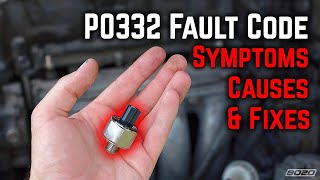
P0332 on a 2019-2025 Audi A7 almost always points to a failed knock sensor on Bank 2. The fix involves replacing the sensor, which is a significant labor-intensive job due to its location under the intake manifold in the 'V' of the engine. Using high-quality OEM parts is critical to avoid repeat repairs.
- P0332 specifically points to a problem with the Knock Sensor on Bank 2 (driver's side).
- The most common cause is a failed sensor, but wiring should always be checked.
- Due to the difficult location under the intake manifold in the engine's 'hot-V', this is a labor-intensive repair. It's wise to replace both sensors, the connecting harness, and the required gaskets at the same time.
- Driving with this code active will result in reduced engine power and poor fuel economy.
- Always use a high-quality OEM or equivalent sensor and torque it to the exact manufacturer specification to ensure proper function and avoid repeating the repair.
What's Unique About the 2019-2025 Audi A7
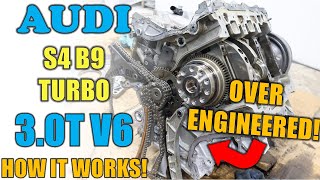
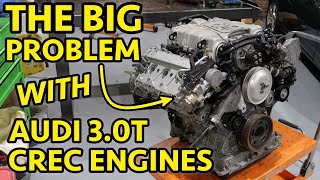
The 3.0L TFSI V6 engine (engine code DLZA) in the C8 generation Audi A7 is a sophisticated powerplant featuring a 'hot-V' design, where the single turbocharger is nestled between the cylinder banks. 🎬 Watch: See a teardown of this V6 engine's hot-V design. While this improves throttle response, it places critical components, including the knock sensors, deep within the engine valley. The sensors are located underneath the intake manifold assembly. This placement protects them from some elements but subjects them to extreme heat and makes replacement a much more involved and labor-intensive job compared to engines where the sensors are on the exterior of the block.
Diagnostic Flowchart
Tap your situation to follow the diagnostic path that matches what you're seeing on this vehicle.
Symptoms You May Notice
- Check Engine Light is on
- Reduced engine power and acceleration (limp mode)
- Hesitation or stumbling during acceleration
- Rough or irregular idle
- Decreased fuel economy
- Engine pinging or knocking noises (in rare cases, as the ECU will try to prevent this)
- Replacing spark plugs or ignition coils. While these can cause performance issues and misfires, they will not directly cause a P0332 circuit code. However, a severe misfire could theoretically be misinterpreted by the knock sensing system in rare cases.
Most Likely Causes
- Faulty Knock Sensor 2 (G66) 🔴 High Probability → Shop Ignition Knock (Detonation) Sensor The sensor is a piezoelectric device that can fail internally over time due to immense heat cycles and constant vibration. Its location in the hot-V of the engine, directly under the intake manifold, exposes it to a harsh environment.
How to confirm: After confirming no wiring issues, the most definitive test is to swap the Bank 1 and Bank 2 sensors. If the code changes to P0327 (Knock Sensor 1 Circuit Low), the sensor is confirmed bad. Alternatively, test the sensor's internal resistance with a multimeter against manufacturer specifications.
Typical fix: Replace the Knock Sensor for Bank 2 (Audi part G66). It is highly recommended to replace both knock sensors (Bank 1 and Bank 2) and the wiring harness that connects them at the same time due to the significant labor involved in accessing them. Using cheap aftermarket sensors is not advised, as forum members have reported them failing quickly, requiring the job to be done a second time.
Est. part cost: $50-$150 per sensor - Wiring or Connector Issue 🟡 Medium Probability The engine bay has tight packaging and high heat, which can make the wiring harness and connector plastics brittle over time. Rodents are also known to chew on the soy-based wire insulation used in many modern cars, and the hidden location in the engine valley can be an attractive place for a nest.
How to confirm: Visually inspect the wiring harness leading to the knock sensor for any signs of damage, melting, or corrosion. Use a multimeter to perform a continuity test from the sensor connector back to the ECU connector to check for an open circuit or short to ground.
Typical fix: Repair the damaged section of the wiring harness or replace the sub-harness entirely. Clean any corrosion from the connector terminals with electrical contact cleaner.
Est. part cost: $10-$100 for repair materials
Rare But Worth Checking
- Improperly Torqued Sensor: A knock sensor that is too loose or too tight will not 'hear' engine vibrations correctly, which can trigger a fault code. It is critical to use a torque wrench and follow the manufacturer's specification (typically around 20 Nm) during installation on a clean mounting surface.
- Swapped Sensor Connectors: During reassembly, it is possible to accidentally plug the Bank 1 sensor into the Bank 2 harness connector and vice-versa. This will immediately trigger a fault code. An owner on AudiForums reported this exact issue as the solution to their P0332 code after a repair.
- Significant Vacuum Leak: In some instances, a major vacuum leak can cause the engine to run lean, which may lead to detonation that the ECU struggles to control, potentially triggering knock-related faults. One owner on AudiWorld found that a broken vacuum line was the root cause of their P0327 and P0332 codes.
- Powertrain Control Module (PCM) Failure: This is extremely rare. Before condemning the expensive PCM, all other possibilities, including the sensor, wiring, and connections, must be exhaustively ruled out.
Diagnosis Steps
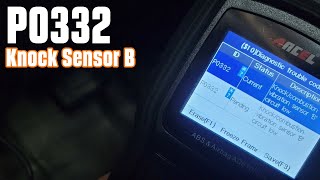
- Read the fault codes with an OBD-II scanner to confirm P0332 is present and note any other codes.
- Visually inspect the area around the intake manifold for any obvious signs of damage, such as rodent nests or chewed wires.
- Gain access to the knock sensors. On the 3.0L V6 TFSI (DLZA), this requires removing the intake manifold assembly.
- Inspect the Bank 2 knock sensor (G66) and its connector for physical damage, corrosion, or loose connections. Check that the Bank 1 and Bank 2 connectors are not swapped.
- Check the wiring harness for continuity and shorts. Test for a proper reference voltage and ground at the sensor connector.
- If wiring is good, test the sensor itself. You can measure its internal resistance or perform a tap test while monitoring voltage with a multimeter.
- The most reliable method: Swap the Bank 1 and Bank 2 sensors. Clear codes and run the engine. If the fault code changes to P0327 (Bank 1), the sensor you moved is faulty and needs replacement.
- If P0332 returns after the swap, the problem lies within the wiring for the Bank 2 circuit or, rarely, the ECU.
- When replacing the sensor, ensure the mounting surface on the engine block is perfectly clean and torque the new sensor to the manufacturer's specification (typically around 20 Nm). Do not over-tighten.
Parts You'll Likely Need
- Knock Sensor (G66)
(OEM #06M905377)— This is the electronic sensor that fails and is the root cause of the P0332 code in most cases. It is highly recommended to replace both sensors (Bank 1 and 2) at the same time.
Trusted brands: Bosch, Genuine Audi
OEM price range: $110-$180
Aftermarket price range: $50-$90 - Intake Manifold Gaskets — These are single-use gaskets that must be replaced anytime the intake manifold is removed to access the knock sensors.
Trusted brands: Victor Reinz, Elring, Genuine Audi
OEM price range: $40-$80
Aftermarket price range: $20-$50 - Knock Sensor Harness — While you have the intake manifold off, it is wise to replace the small wiring harness that connects the two knock sensors. The plastic can become extremely brittle from heat and often breaks during disassembly.
Trusted brands: Genuine Audi
OEM price range: $30-$60
Aftermarket price range: $15-$30
Related Codes That Often Appear With This One
- P0327 — This is the equivalent code for Knock Sensor 1 (Bank 1). If you see both P0327 and P0332, it might point to a common wiring harness issue, a systemic problem like a vacuum leak, or the rare possibility that both sensors failed.
- P0328 / P0333 — These are the 'Circuit High' equivalents. The TSB #TSB_2081342_1 mentions all four knock sensor codes (P0327, P0328, P0332, P0333) as being related, indicating a common area of concern for the V6 TFSI engine.
Technical Service Bulletins (TSBs) & Recalls
- TSB_2081342_1: Provides information when there is a Drive System Malfunction, DTCs related to Knock Sensor P0327, P0332, P0328, P0333 - V6 TFS.
Platform-Specific Known Issues
- A Technical Service Bulletin (TSB #TSB_2081342_1) was issued for the V6 TFSI engine concerning Drive System Malfunctions that can log DTCs P0327, P0332, P0328, and P0333, which are all related to the knock sensors. This indicates that knock sensor faults are a recognized issue on this powertrain.
Mechanic-Grade Diagnostic Values
- Knock Sensor (G66) Internal Resistance — expected: Infinity (no short between terminals 1 and 2). Failure: Any reading other than infinity indicates an internal short.
- Knock Sensor (G66) Wiring Harness Resistance — expected: Max 1.5 ohms. Failure: A reading higher than 1.5 ohms suggests an open circuit or high resistance in the wiring between the sensor connector and the ECM.
- Knock Sensor Mounting Bolt Torque — expected: 20 Nm (15 ft-lb). Failure: Incorrect torque can lead to improper vibration detection, causing false signals or a lack of signal.
Scan Tool Commands That Help
- VCDS (VAG-COM) or similar: Read Measuring Value Block (MVB) Group 020 and 021 — To monitor ignition angle delay (timing retard) for each cylinder. If the values increase significantly during a power loss event, it confirms the knock control system is actively retarding timing, which could be related to the P0332 fault.
- VCDS (VAG-COM) or similar: Read Measuring Value Block (MVB) Group 026 — To view the live voltage output from the knock sensors. This can help determine if the sensor is sending a weak or erratic signal compared to the sensor on the other bank.
Wiring & Ground Locations
- Knock Sensor (G66) Connector — Under the intake manifold in the 'V' of the engine, on the driver's side (Bank 2).. This is the primary connection point for the sensor. It is susceptible to heat damage, and the plastic can become brittle. A poor connection here will cause a 'Circuit Low' fault.
- Knock Sensor Ground — The sensor grounds through its mounting bolt to the engine block.. A clean, properly torqued mounting surface is critical for a good ground and accurate vibration sensing. Corrosion or debris on the block surface can interfere with the signal.
- Engine Control Module (ECM/J623) — Typically located in the plenum area at the base of the windshield, protected by a cover.. This is the termination point for the knock sensor wiring. A continuity test must be performed from the sensor connector to the corresponding pins at the ECM to rule out a wiring break.
Real Owner Repair Stories
- Reddit user in r/Audi (2018/2019 Audi SQ5 (Same EA839 engine family)) — Check Engine Light with P0328 (Knock Sensor 1 Circuit High) appeared after applying a Stage 1 91-octane aftermarket tune.
❌ Tried (didn't work) Initially planned to replace the knock sensor.
✅ What actually fixed it The user started adding an octane booster to each tank of 91-octane fuel, and the code did not return. This indicated the issue was related to fuel quality being insufficient for the aggressive tune, rather than a faulty sensor. - YouTube video by 'Fixing a P0332 code due to bad knock sensors' (Vehicle with P0332 (not specified, but job is in engine valley)) — P0332 code, Check Engine Light.
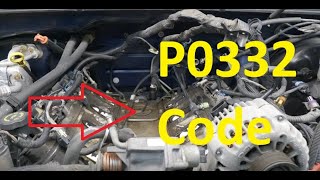
✅ What actually fixed it Upon removing the intake manifold to access the knock sensors, the mechanic discovered that several bolts for the valley plate underneath the sensors were loose. The final fix involved replacing both knock sensors and the harness, cleaning the sensor mounting surfaces, and tightening the loose valley plate bolts with blue Loctite before reassembly.
Model Year Variations Within This Range
- Early models (approx. 2018): Some early production EA839 engines (same family as the A7's DLZA) reportedly had issues with rocker arms. While this typically causes misfires and not a direct P0332 code, severe mechanical noise from a failing valvetrain could potentially be misinterpreted by the knock control system.
Helpful Videos
We Have This Part in Stock

The information in this article is provided for general reference and educational purposes only. Vehicle specifications, procedures, and part compatibility can vary by production date, trim level, and region. Always consult your vehicle's factory service manual and verify part numbers before purchasing or performing repairs. Safety-critical components such as airbags, seat belts, and braking systems should be installed by a qualified professional.
- Audi A7:
- 🧭 Diagnostic Flowchart
- 🎬 Helpful Videos
- 🛍️ Shop This Part
- What's Unique About the 2019-2025 Audi A7
- Symptoms You May Notice
- Most Likely Causes
- Rare But Worth Checking
- Diagnosis Steps
- Parts You'll Likely Need
- Related Codes That Often Appear With This One
- Technical Service Bulletins (TSBs) & Recalls
- Platform-Specific Known Issues
- Mechanic-Grade Diagnostic Values
- Scan Tool Commands That Help
- Wiring & Ground Locations
- Real Owner Repair Stories
- Model Year Variations Within This Range
- 🎟️ Get 5% Off