

P0333 on 2019-2025 Audi A6 3.0T: Knock Sensor Circuit High Causes and Fixes
This code indicates a 'Circuit High' fault from the Bank 2 knock sensor. The most likely cause is a failed sensor or a wiring short. On the 3.0T V6 EA839 engine, this sensor is located under the supercharger/intake manifold assembly in the engine valley, making replacement a labor-intensive job best left to professionals or experienced DIYers.
- P0333 means the Bank 2 knock sensor circuit is sending an abnormally high voltage signal to the computer.
- The most common fix is replacing the knock sensor, but wiring issues should be ruled out first.
- On the 2019-2025 Audi A6 3.0T, this is a major repair job because the sensor is located under the supercharger.
- Due to the high labor cost, it is wise to replace both knock sensors (Bank 1 and Bank 2) and all necessary gaskets at the same time.
- Do not ignore this code, as continued driving without a functional knock sensor can lead to severe and expensive engine damage.
What's Unique About the 2019-2025 Audi A6
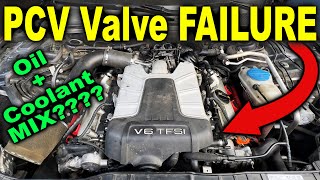
For the Audi A6 C8 with the 3.0T V6 engine (EA839 family), the knock sensors are a known point of failure, as highlighted by Audi's own Technical Service Bulletins. The primary challenge with this platform is the location of the sensors; they are buried deep in the engine valley, underneath the intake manifold and supercharger assembly. This means that what would be a simple sensor swap on many other vehicles becomes a multi-hour job requiring significant disassembly, including the removal of the supercharger and related components. 🎬 Watch: This PCV guide shows the supercharger removal process. This complex procedure increases labor costs and the risk of collateral issues if not performed correctly.
Diagnostic Flowchart
Tap your situation to follow the diagnostic path that matches what you're seeing on this vehicle.
Symptoms You May Notice
- Check Engine Light is illuminated
- Audible engine knocking or pinging, especially during acceleration
- Reduced engine power and poor acceleration
- Hesitation during acceleration
- Worse than normal fuel economy
- Engine may run rough
- Delayed or hanging transmission shifts as the ECU tries to protect the engine
- Replacing the knock sensor when the actual problem is a wiring short. It is critical to test the circuit before committing to the difficult sensor replacement.
- Replacing only the sensor when an ECM software update is the correct fix, particularly on tuned cars.
- Ignoring the importance of correct torque specification upon reinstallation, leading to a recurring code.
- Mistaking the Bank 1 and Bank 2 sensors, which can be physically identical but have different length harnesses or mounting orientations, leading to a repeat fault for the original or opposite bank.
Most Likely Causes
- Failed Knock Sensor (Bank 2) 🔴 High Probability → Shop Ignition Knock (Detonation) Sensor The sensor is subjected to extreme heat cycles in the engine valley, which can lead to internal failure over time. This is a documented issue for this engine family, and rodent damage to the wiring in this area is also common.
How to confirm: After accessing the sensor, test its internal resistance with a multimeter. An out-of-spec or infinite resistance reading indicates failure. Visually inspect the sensor and its wiring for any signs of damage, including from rodents. A 'tap test' can also be performed by monitoring the sensor's AC voltage output with a multimeter while tapping the engine block near the sensor; a lack of voltage indicates a faulty sensor.
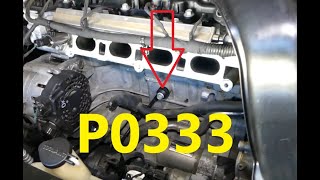
Typical fix: Replace the Bank 2 knock sensor. 🎬 See this walkthrough on diagnosing and fixing P0333 codes. Given the labor involved, it is highly recommended to replace the Bank 1 sensor (P0328) at the same time, along with any necessary gaskets for the supercharger and intake manifold. The OEM part number for the Bank 2 sensor is often cited as 06E905377J or a superseding number.
Est. part cost: $60-$180 - Wiring Harness or Connector Damage 🟡 Medium Probability The engine valley location makes the wiring susceptible to heat damage, oil contamination, or rodent damage. The plastic connectors can become brittle and break during service. A user on Audi-Sport.net fixed a persistent P0328 (the Bank 1 equivalent) by rewiring the sensor directly back to the ECU using screened cable.
How to confirm: Visually inspect the wiring harness leading to the knock sensor for any signs of melting, chafing, or breaks. Check the connector for corrosion or damage. Test for a short to voltage in the signal wire using a multimeter.
Typical fix: Repair the damaged section of the wiring harness or replace the connector pigtail. Ensure the wiring is properly secured away from heat sources.
Est. part cost: $20-$60
Rare But Worth Checking
- Engine Control Module (ECM) Software Glitch: → Shop Engine Control Module (ECM) An older Audi TSB for other models with similar codes noted that overly sensitive diagnostics could trigger the fault, and the fix was an ECM software update, not a new sensor. While not specific to this A6, it's a known possibility in the VAG ecosystem, especially on tuned vehicles. A dealer or specialist shop can check for available software updates.
- Loose or Incorrectly Torqued Knock Sensor: → Shop Ignition Knock (Detonation) Sensor If the sensor's retaining bolt is not torqued correctly to the engine block, it cannot properly detect vibrations. Over-torquing can make the sensor overly sensitive, while under-torquing can prevent it from detecting knock at all, potentially leading to circuit faults. The correct torque spec is critical and typically around 20-23 Nm (15-17 ft-lbs), but this should be verified for the specific engine.
- Bad Tank of Fuel: A user on AudiWorld forums reported getting a P0333 code shortly after filling up with gasoline, which was suspected to be of poor quality. Bad fuel can cause actual engine knock, which the sensor reports, but a persistent 'Circuit High' code is more likely a sensor or wiring fault.
- Faulty Engine Control Module (ECM): → Shop Engine Control Module (ECM) This is the least likely cause. The ECM itself may have an internal fault in the knock sensor circuit, but all other possibilities should be exhausted before condemning the ECM.
Diagnosis Steps
- Read all fault codes with an OBD-II scanner to see if other codes, especially for Bank 1 (P0328) or misfires, are present.
- Check for any available ECM software updates with a dealer or specialist shop, as this can sometimes be the prescribed fix per TSBs.
- If accessible, inspect the knock sensor connector and harness for damage, corrosion, or loose connections. This is difficult on the 3.0T without some disassembly.
- Using a multimeter, back-probe the knock sensor connector (with the key on, engine off) to check for the correct reference voltage (typically 5V) and for any voltage shorting to the signal wire.
- Begin disassembly to access the engine valley. This involves removing the supercharger/intake assembly.
- Once the sensor is accessible, perform a thorough visual inspection of the sensor and its wiring for heat damage, oil contamination, or rodent chew marks.
- Disconnect the sensor and measure its internal resistance. Compare this to the manufacturer's specification. An open or shorted sensor needs replacement.
- If the sensor tests good, perform a continuity test on the wiring harness between the sensor connector and the ECM to rule out opens or shorts in the loom.
- If both the sensor and wiring are confirmed to be good, the issue may be with the ECM, but this is extremely rare.
Parts You'll Likely Need
- Knock Sensor
(OEM #06E905377J (Bank 2, Cyls 4-6))— This is the most common component to fail and cause the P0333 code. It's highly recommended to replace both Bank 1 (06E905377A) and Bank 2 sensors at the same time.
Trusted brands: Genuine Audi/VW, Bosch, Facet
OEM price range: $100-$180
Aftermarket price range: $50-$100 - Supercharger Gasket & Seal Kit
(OEM #06E145601KT (Example Kit))— Required for re-installing the supercharger after accessing the knock sensors. These are one-time-use gaskets and seals. Kits often include intake manifold gaskets, injector seals, and coolant pipe o-rings.
Trusted brands: Victor Reinz, Elring, Genuine Audi
OEM price range: $150-$250
Aftermarket price range: $80-$150 - Coolant Crossover Pipe
(OEM #06E121065N (Plastic, often upgraded))— This plastic pipe is located in the engine valley and is prone to becoming brittle and breaking during supercharger removal. Many owners upgrade to an aluminum version as a preventative measure.
Trusted brands: Genuine Audi, Aftermarket Aluminum Upgrades
OEM price range: $40-$70
Aftermarket price range: $50-$100
Related Codes That Often Appear With This One
- P0328 — This is the corresponding code for 'Knock Sensor 1 Circuit High (Bank 1)'. Since both sensors live in the same harsh environment under the supercharger, they often fail around the same time. It is standard practice to replace both simultaneously.
- P0332 — This is for 'Knock Sensor 2 Circuit Low'. Seeing both high and low codes for the same sensor can indicate an intermittent wiring problem or a failing sensor.
- P0300, P0302, P0304, P0306 — These are misfire codes for Bank 2 cylinders. While a faulty knock sensor can cause timing adjustments that lead to misfires, it's also possible that an underlying misfire issue is causing excessive engine vibration, which can sometimes trigger knock sensor faults.
Technical Service Bulletins (TSBs) & Recalls
- TSB_2081342_1: Mentions DTCs P0327, P0332, P0328, and P0333 related to knock sensors on V6 TFSI engines, confirming this is a known fault area.
- TSB 2069038/6: While for misfire codes (P030x), it shows a precedent for Audi issuing software updates to correct engine management faults on the 3.0T engine, which could be relevant if the knock code is triggered by a software sensitivity issue.
Platform-Specific Known Issues
- A Technical Service Bulletin (#TSB_2081342_1) exists for 2019 V6 TFSI engines regarding a 'Drive System Malfunction' that can be caused by various knock sensor DTCs, including P0333, indicating this is a recognized issue by the manufacturer.
- The 3.0T EA839 engine, particularly in early B9 platform vehicles (like the S4/S5/SQ5), has documented cases of premature internal engine issues like rocker arm failure. While P0333 is typically a sensor issue, severe internal mechanical noise could theoretically trigger knock sensor faults as a secondary symptom.
- A Reddit user with a 2019 SQ5 (same engine family) experienced a similar knock sensor code (P0328) only after applying a Stage 1 ECU tune, suggesting that increased performance demands can expose weaknesses in the knock detection system or that some tunes may be overly sensitive.
Mechanic-Grade Diagnostic Values
- Knock Sensor Circuit Voltage (Live Data) — expected: Typically 0.5V - 4.5V during operation.. Failure: A static voltage reading greater than 1.0V with the engine running can trigger the fault code according to Audi documentation. A reading over 5.0V indicates a direct short to power.
- Knock Sensor AC Voltage (Tap Test) — expected: A small, fluctuating AC voltage (e.g., >100mV) should be generated when tapping the engine block near the sensor.. Failure: Little to no AC voltage (e.g., <10mV) is generated during the tap test, indicating the sensor's piezoelectric crystal is dead.
- Wiring Harness Continuity to ECM — expected: Approximately 0.1 ohms.. Failure: A reading significantly higher than 0.1 ohms, or an open circuit (OL), indicates a break in the wire between the sensor connector and the ECM pin.
Scan Tool Commands That Help
- VCDS (VAG-COM) or ODIS: Basic Settings - Knock Sensor Test — This function allows the technician to actively test the knock control system. The ECU will typically limit RPM to around 2000-2500 while the user holds the brake and applies full throttle (in Park/Neutral). The scan tool then displays the results for each sensor, helping to confirm if the control module is correctly processing the sensor signals under load.
Wiring & Ground Locations
- Main Engine Ground — On the C8 platform, a primary engine ground strap is located on the right (passenger side in US) of the engine compartment, near the alternator. Another major ground runs from the right side engine mount to a stud on the frame rail.. A poor engine ground can introduce electrical noise and voltage offsets, potentially causing the ECM to misinterpret the knock sensor's low-voltage signal and trigger a 'Circuit High' fault incorrectly.
- Battery Ground Cable — The main 12V battery on the C8 A6 is located in the trunk, on the right side. There are grounding points in the engine bay for jump-starting, but the primary chassis ground originates in the rear.. While less direct, corrosion or damage at the main battery ground can affect the entire vehicle's electrical stability, which could, in rare cases, contribute to sensor signal issues.
OEM Part Supersession History
06E905377A, 6E905376A→06E905377J— Part revision and consolidation. The -J version is listed as a replacement for the older numbers.
Heads up: While the sensors may be electrically similar, the harness length and connector color (e.g., green vs. blue) can differ between Bank 1 and Bank 2 parts. Using the wrong part may result in a harness that doesn't reach or a misdiagnosis if the banks are swapped.
Model Year Variations Within This Range
- 2017-2019 (applies to early EA839 engines): Early versions of the EA839 engine, used in sibling platforms like the B9 S4/S5/SQ5, were more prone to rocker arm bearing failure. While this A6 model range starts in 2019, early production 2019 models could still have the earlier engine component design. This failure can cause catastrophic engine damage and may present with knock sensor codes as a secondary symptom.
Helpful Videos
We Have This Part in Stock

The information in this article is provided for general reference and educational purposes only. Vehicle specifications, procedures, and part compatibility can vary by production date, trim level, and region. Always consult your vehicle's factory service manual and verify part numbers before purchasing or performing repairs. Safety-critical components such as airbags, seat belts, and braking systems should be installed by a qualified professional.
- Audi A6:
- 🧭 Diagnostic Flowchart
- 🎬 Helpful Videos
- 🛍️ Shop This Part
- What's Unique About the 2019-2025 Audi A6
- Symptoms You May Notice
- Most Likely Causes
- Rare But Worth Checking
- Diagnosis Steps
- Parts You'll Likely Need
- Related Codes That Often Appear With This One
- Technical Service Bulletins (TSBs) & Recalls
- Platform-Specific Known Issues
- Mechanic-Grade Diagnostic Values
- Scan Tool Commands That Help
- Wiring & Ground Locations
- OEM Part Supersession History
- Model Year Variations Within This Range
- 🎟️ Get 5% Off