

P0333 on 2018-2022 Audi S5 Cabriolet: Knock Sensor Circuit High Causes and Fixes
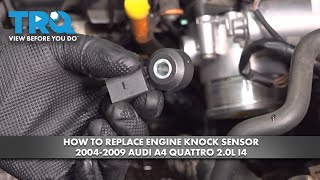
P0333 on a B9 Audi S5 indicates a 'Circuit High' fault for the knock sensor on Bank 2. This is most commonly caused by a failed knock sensor itself, followed by wiring issues, sometimes induced by coolant leaks in the engine 'V'. The sensor is extremely difficult to access under the turbo and intake manifold, making professional replacement necessary.
- P0333 on your S5 means there's a 'high voltage' fault in the circuit for the knock sensor on the driver's side of the engine (Bank 2).
- The most common cause is a failed sensor, but coolant leaks in the engine 'V' are a frequent underlying issue that damages the sensor or its wiring.
- This is not a DIY-friendly repair due to the sensor's location under the intake manifold and turbo, requiring 4-6 hours of professional labor.
- Driving is possible but not recommended, as performance will be significantly reduced and there's a risk of missing a real, damaging knock condition.
- For tuned cars, this code can be triggered by poor fuel quality causing excessive knock, without any hardware being faulty.
What's Unique About the 2018-2022 Audi S5 CABRIOLET
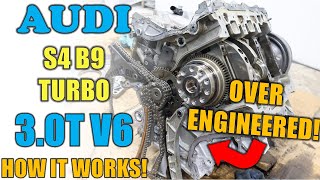
The 2018-2022 Audi S5 uses the EA839 3.0L V6 TFSI engine, which features a 'hot V' design. This places the single turbocharger and intake manifold deep within the 'V' of the engine. The knock sensors are located underneath all of this hardware, making them exceptionally difficult to access for diagnosis or replacement. Audi has issued Technical Service Bulletin #TSB 2081342/1 for V6 TFSI engines, which includes P0333, indicating a known pattern of issues with the knock sensor system on these powerplants.
Diagnostic Flowchart
Tap your situation to follow the diagnostic path that matches what you're seeing on this vehicle.
Symptoms You May Notice
- Check Engine Light is on
- Reduced engine power and acceleration (limp mode)
- Hesitation or sluggishness during acceleration
- Transmission holding gears longer or shifting at unusual RPMs.
- Audible engine pinging or knocking noise (in some cases)
- Decreased fuel economy.
- Replacing spark plugs or ignition coils without diagnosing the knock sensor circuit first.
- Attributing the power loss solely to a bad tank of gas without addressing the persistent P0333 code.
Most Likely Causes
- Failed Knock Sensor 2 🔴 High Probability → Shop Ignition Knock (Detonation) Sensor The existence of a TSB (#2081342/1) covering this code suggests a higher-than-average failure rate for the sensor or related components on this engine family. The sensor's location in the hot 'V' exposes it to extreme temperatures, potentially shortening its lifespan.
How to confirm: After verifying the wiring is intact, the most definitive test is to replace the sensor. Due to its difficult location, swapping sensors between banks to see if the code follows is not practical.
Typical fix: Replace the Bank 2 knock sensor. Given the extensive labor involved, it is highly recommended to replace both knock sensors (Bank 1 and Bank 2) and the associated wiring harness at the same time.
Est. part cost: $130-$160 - Wiring Harness or Connector Damage 🟡 Medium Probability
How to confirm: Visually inspect the wiring harness leading to the knock sensor for any signs of fraying, melting, or corrosion. This is difficult without removing the intake. A multimeter can be used at the ECM connector to check for a short to voltage in the signal wire.
Typical fix: Repair the damaged section of the wiring harness or replace the connector pigtail. A dedicated knock sensor sub-harness may be available.
Est. part cost: $20-$70 - Coolant Leak onto Sensor/Wiring 🟡 Medium Probability The EA839 engine is known for potential failures of the water pump, thermostat, and coolant shut-off valve, all of which are located in the engine 'V', directly above the knock sensors. A coolant leak can drip onto the sensor or its connector, causing corrosion and electrical shorts that lead to a P0333 'Circuit High' fault.
How to confirm: During disassembly to access the knock sensors, look for signs of coolant residue (white or pink crust) on the engine block, wiring harnesses, and the sensors themselves.
Typical fix: Replace the leaking cooling system component (e.g., water pump, thermostat) in addition to the damaged knock sensor and/or wiring. This significantly increases the scope and cost of the repair but is essential.
Est. part cost: $200-$500 (for cooling parts)
Rare But Worth Checking
- Engine Control Module (ECM) Fault: → Shop Engine Control Module (ECM) This is very rare, but a fault in the ECM's internal circuitry can cause it to misinterpret the sensor's signal. This should only be considered after the sensor and wiring have been definitively ruled out by a specialist.
- Severe Mechanical Engine Issues: While the code points to a circuit fault, an actual, severe engine knock (e.g., from rocker arm failure, common on 2018 models) could potentially cause erratic sensor readings. This would typically be accompanied by other serious symptoms like audible ticking/knocking noises and other codes.
- Excessive Knock on Tuned Engines: On vehicles with aftermarket ECU tunes (e.g., Stage 1), low-quality or low-octane fuel can cause severe detonation. This may drive the sensor's voltage output beyond the expected range, causing the ECU to log a 'Circuit High' fault instead of just a knock event. In these cases, the sensor and wiring may be perfectly fine.
Diagnosis Steps
- Scan the ECM for any other stored trouble codes. Address other codes first, especially those related to misfires or fuel mixture.
- Identify Bank 2. On the Audi 3.0L V6, Bank 2 is the driver's side of the engine (left side). The sensor is designated as G66.
- Due to access constraints, diagnosis often begins at the ECM connector. Obtain the vehicle-specific wiring diagram to identify the pins for Knock Sensor 2 (G66).
- With the ignition on and engine off, check the sensor's reference voltage and ground at the ECM connector.
- Check the signal wire for a short to voltage. A 'Circuit High' code often points to the signal wire being shorted to a power source, either internally in the harness or due to external factors like fluid contamination.
- If tests at the ECM are inconclusive, the intake manifold and turbocharger must be removed to gain access to the sensor and its connector for direct inspection and testing.
- Once accessed, inspect the sensor and harness for physical damage, melting, or signs of coolant contamination. If wiring appears intact, the knock sensor itself is the most likely culprit and should be replaced.
Parts You'll Likely Need
- Knock Sensor
(OEM #06M-905-377)— This is the most common failure point for a P0333 code, as indicated by repair trends and the existence of a manufacturer TSB.
Trusted brands: Bosch, HELLA, Genuine Audi
OEM price range: $140-$160
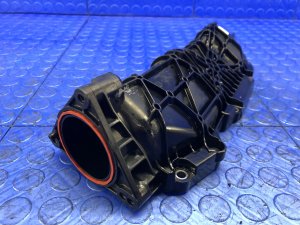
Aftermarket price range: $80-$120 - Intake Manifold Gaskets — These are single-use gaskets that must be replaced anytime the intake manifold is removed to access the knock sensors.
Trusted brands: Victor Reinz, Elring, Genuine Audi
OEM price range: $40-$60
Aftermarket price range: $20-$40 - Knock Sensor Connector Pigtail
(OEM #8E0-973-703B)— If the wiring connector is damaged by heat or coolant contamination, the pigtail will need to be replaced.
Trusted brands: Genuine Audi, Duralast, Various Aftermarket
OEM price range: $25-$40
Aftermarket price range: $10-$20
Related Codes That Often Appear With This One
- P0328 — This is the equivalent 'Circuit High' code for Knock Sensor 1 (Bank 1). If both appear, it could point to a shared wiring issue, a coolant leak affecting both sensors, or a common cause for failure.
- P0332 — This is the 'Circuit Low' code for the same sensor (Knock Sensor 2, Bank 2). Seeing both high and low codes intermittently could strongly suggest a wiring problem or a connector filled with fluid (like coolant).
Technical Service Bulletins (TSBs) & Recalls
- TSB 2081342/1: Provides diagnostic guidance for a group of knock sensor DTCs, including P0333, on V6 TFSI engines, acknowledging a known issue pattern.
Platform-Specific Known Issues
- Audi Technical Service Bulletin #TSB 2081342/1 was issued for Drive System Malfunctions on V6 TFSI engines, specifically citing DTCs P0327, P0332, P0328, and P0333, which points to a known issue with the knock sensor system.
- Early (2018) production models of the EA839 engine are known to be at higher risk for rocker arm bearing failure. While this typically causes misfires and ticking noises, not a P0333 circuit code, any owner of a 2018 model should be aware of this separate, serious potential issue.
Mechanic-Grade Diagnostic Values
- Knock Sensor (Piezoelectric) AC Voltage Output — expected: Generates a small, fluctuating AC voltage in the millivolt range when physically tapped.. Failure: No voltage generated when tapped indicates a dead sensor. A 'Circuit High' code specifically suggests the signal wire is shorted to a voltage source, or the sensor is producing a voltage higher than the ECU's predefined limit.
- Knock Sensor Resistance — expected: Modern piezoelectric sensors like this one do not have a standard resistance specification for testing with a multimeter.. Failure: An open or shorted reading is a definitive failure, but a random reading does not confirm the sensor is good. Testing resistance is not a reliable diagnostic method for this type of sensor.
Scan Tool Commands That Help
- VCDS (VAG-COM) or ODIS: Basic Settings - Knock Sensor Test — This function may be available to actively test the knock control system. On some VAG vehicles, it involves holding the brake and throttle while the ECU limits RPM to check sensor feedback. This can help verify if the knock control loop is functioning, though it may not isolate a specific circuit fault.
Wiring & Ground Locations
- G66 — Knock Sensor 2, located on the engine block for Bank 2 (Driver's Side in North America), underneath the intake manifold and turbocharger assembly.. This is the specific component monitored by the P0333 fault code.
- G61 — Knock Sensor 1, located on the engine block for Bank 1 (Passenger's Side in North America), in a similar position to G66.. Useful for comparison or if replacing both sensors simultaneously, which is highly recommended due to the labor involved.
- 8E0-973-703B — This is the part number for the 3-pin electrical connector that plugs into the knock sensor.. If the connector is damaged by heat or coolant contamination, this part number is needed to source a replacement pigtail for repair.
- Ground Point (220) — Described in a generic Audi wiring diagram as 'mass (-) (sensor) in the wiring harness of the engine control unit'.. A poor ground connection for the sensor circuit could cause erratic voltage readings. Locating and checking the integrity of this shared sensor ground in the harness near the ECU is a valid advanced diagnostic step.
Real Owner Repair Stories
- Reddit user on r/Audi (2019 Audi SQ5 with 3.0T EA839 engine and a 034 Motorsport Stage 1 91-octane tune) — Check Engine Light with code P0328 (Knock Sensor 1 Circuit High - the Bank 1 equivalent of P0333).
❌ Tried (didn't work) The user was considering replacing the knock sensor and harness.
✅ What actually fixed it The user began adding STP octane booster to every tank of 91-octane fuel. After starting this, the P0328 code did not return, indicating the issue was fuel-quality-related knock that was over-driving the sensor's voltage output, not a hardware fault.
Helpful Videos

Used OEM Parts in Stock
New Aftermarket Parts Available


The information in this article is provided for general reference and educational purposes only. Vehicle specifications, procedures, and part compatibility can vary by production date, trim level, and region. Always consult your vehicle's factory service manual and verify part numbers before purchasing or performing repairs. Safety-critical components such as airbags, seat belts, and braking systems should be installed by a qualified professional.
- Audi S5 CABRIOLET:
- 🧭 Diagnostic Flowchart
- 🎬 Helpful Videos
- 🛍️ Shop This Part
- What's Unique About the 2018-2022 Audi S5 CABRIOLET
- Symptoms You May Notice
- Most Likely Causes
- Rare But Worth Checking
- Diagnosis Steps
- Parts You'll Likely Need
- Related Codes That Often Appear With This One
- Technical Service Bulletins (TSBs) & Recalls
- Platform-Specific Known Issues
- Mechanic-Grade Diagnostic Values
- Scan Tool Commands That Help
- Wiring & Ground Locations
- Real Owner Repair Stories
- 🎟️ Get 5% Off