

P0335 on 2018-2023 Kia Stinger 3.3L: Crankshaft Sensor Causes and Fixes
This code almost always points to a failed crankshaft position sensor. Expect symptoms like engine stalling, long crank times, or a no-start condition. Replacing the sensor is a common fix, costing around $70-$105 for an OEM part (39310-3L100) and is a manageable DIY job for those comfortable with removing the battery and its tray to access the sensor from the top of the engine bay.
- P0335 on your Stinger 3.3L almost certainly means the crankshaft position sensor has failed.
- Key symptoms are the engine stalling, cranking for a long time, or not starting at all.
- The correct OEM part number is 39310-3L100. Using an OEM sensor is highly recommended to prevent compatibility issues.
- This is a very manageable DIY repair. The sensor is located on the engine block and can be reached from above after removing the battery and battery tray.
- Driving with this issue is a safety risk due to the potential for sudden engine stalling.
What's Unique About the 2018-2023 Kia Stinger
For the Kia Stinger with the 3.3L Lambda II V6, the P0335 code is not indicative of a widespread, common platform-specific flaw. Unlike some other Kia engines (like the Theta II) that have known issues leading to this code, on the Stinger it typically represents a standard part failure. The sensor is located on the engine block but is accessible from the top after removing the battery and battery tray, making it a more straightforward repair than on many other vehicles where it might be buried lower down and require access from underneath the car.
Symptoms You May Notice
- Engine cranks but fails to start
- Extended cranking time before the engine starts.
- Engine stalls unexpectedly while driving or at idle.
- Rough or unstable idle
- Noticeable loss of engine power and poor acceleration.
- Engine misfires
- Check Engine Light is illuminated
- Replacing camshaft position sensors when no camshaft-related codes (e.g., P0340, P0345) are present.
- Assuming a battery or starter issue due to the no-start or long-crank symptom without first checking for diagnostic trouble codes.
Most Likely Causes
- Failed Crankshaft Position Sensor 🔴 High Probability → Shop Engine Crankshaft Position Sensor The sensor operates in a high-heat environment and can fail electronically over time due to heat cycles and vibration. The magnetic pickup can also degrade, leading to an erratic or lost signal.
How to confirm: After confirming the wiring is intact, the most definitive test is to check the sensor's output signal with an oscilloscope while cranking the engine. A missing or erratic signal points to a bad sensor. However, given the high failure rate of the part itself and its relatively low cost, many technicians and DIYers will replace it if a visual inspection of the wiring reveals no issues, especially if symptoms like stalling and long crank are present.
Typical fix: Replace the crankshaft position sensor. It is highly recommended to use a Genuine Kia OEM part to avoid issues with incorrect sensor length or signal quality from aftermarket alternatives.
Est. part cost: $65-$105 - Wiring Harness or Connector Damage 🟡 Medium Probability The wiring harness can be susceptible to heat damage from the engine block or exhaust components, or the connector pins can corrode over time, causing a poor electrical connection.
How to confirm: Visually inspect the wiring harness leading to the sensor for any signs of melting, chafing, or breaks. Check the electrical connector for corrosion, moisture, or pushed-out pins. Use a multimeter to test for continuity and proper voltage at the connector.
Typical fix: Repair the damaged section of wiring or replace the connector pigtail.
Est. part cost: $15-$40
Rare But Worth Checking
- Damaged Reluctor Ring: The reluctor ring (or tone wheel) on the crankshaft, which the sensor reads, can be damaged or have debris on it, causing an incorrect signal. This is rare and typically only occurs during major engine work or in the event of a catastrophic internal failure.
- Faulty Engine Control Module (ECM): → Shop Engine Control Module (ECM) While extremely rare, the ECM itself can have a driver circuit failure for the CKP sensor. This should only be considered after all other possibilities have been exhaustively ruled out.
- Weak Battery or Starter Issues: → Shop Vehicle Battery In some cases, a very low battery or a weak starter motor can cause the engine to crank too slowly, which may intermittently trigger a P0335 code before the sensor itself has failed. This should be ruled out by ensuring the battery is fully charged and healthy.
Diagnosis Steps
- Read the trouble codes with an OBD-II scanner to confirm P0335 is the primary code.
- Perform a thorough visual inspection of the crankshaft position sensor's wiring harness and connector. Look for any signs of melting, fraying, or corrosion.
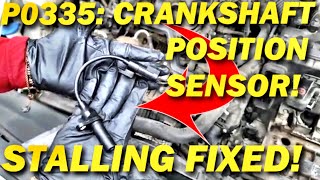
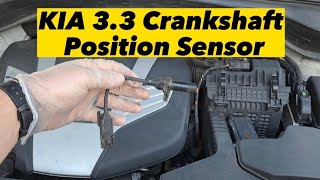
- To gain access, disconnect the negative battery terminal, remove the plastic engine cover, and then remove the battery and battery tray. 🎬 See this walkthrough for accessing the sensor from the top. This provides top-down access to the sensor area.
- Locate the sensor on the engine block, near the transmission bell housing. The connector is typically accessible from the top.
- Disconnect the sensor and check for 5V reference voltage and a good ground at the connector with the key on, engine off, using a multimeter.
- If wiring and voltages are correct, the sensor itself is the most likely culprit. For definitive proof, use an oscilloscope to monitor the sensor's signal while cranking the engine. A square wave pattern should be present; if it's missing or erratic, the sensor is bad.
- If the sensor and wiring are good, the next step would be a difficult inspection of the reluctor ring for damage, though this is highly unlikely.
- Replace the crankshaft position sensor if it is determined to be faulty. Apply a small amount of clean engine oil to the new sensor's O-ring before installation.
Parts You'll Likely Need
- Crankshaft Position Sensor
(OEM #39310-3L100)— This is the most common failure point for code P0335. It is an electronic sensor that fails over time due to heat and vibration. Using the OEM part is strongly recommended.
Trusted brands: Genuine Kia, Bosch, Standard Motor Products, NTK
OEM price range: $70-$105
Aftermarket price range: $45-$75
Related Codes That Often Appear With This One
- P0336 — This code indicates 'Crankshaft Position Sensor 'A' Circuit Range/Performance' and can appear if the sensor's signal is erratic or intermittent rather than completely lost.
Platform-Specific Known Issues
- Owner Experience with Stalling: Multiple owners across different Kia models with the 3.3L V6 report that the primary symptom leading to a P0335 diagnosis is the engine suddenly stalling while driving, often when coming to a stop or at low speeds. 🎬 Watch: This video shows how a bad sensor causes stalling. This is frequently preceded by a period of long crank times.
Mechanic-Grade Diagnostic Values
- Engine RPM on Scan Tool Live Data (while cranking) — expected: A non-zero RPM reading that reflects cranking speed.. Failure: A reading of 0 RPM while the engine is audibly cranking strongly points to a fault in the crankshaft position sensor circuit (sensor, wiring, or ECM).
- CKP Sensor Harness Resistance — expected: Less than 10 Ω. Failure: A resistance reading greater than 10 Ω indicates high resistance or an open circuit in the wiring harness, which can cause the P0335 code.
Scan Tool Commands That Help
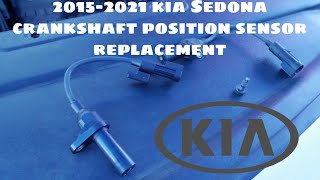
- Kia GDS, Autel, Snap-on, or other professional scan tool: CKP Variation Learn / Crankshaft Position Sensor Relearn / Crank Pattern Relearn — This procedure should be performed after replacing the crankshaft position sensor. It calibrates the new sensor to the ECM. 🎬 Watch: A mechanic's guide to replacing the 3.3L V6 sensor. Failure to perform this step may result in a persistent P0335 code, incorrect misfire detection, rough running, or setting a P1336 'Crankshaft Position Variation Not Learned' code.
Wiring & Ground Locations
- Engine Ground Wiring Assembly — Connects the engine harness to the chassis, often near the battery tray area.. A poor or corroded engine ground can cause a host of electrical issues, including erratic sensor signals. While not a primary cause, verifying the integrity of the main engine ground (Part # 91860-J5010 for the 3.3L) is a good practice when diagnosing sensor circuit codes.
Real Owner Repair Stories
- YouTube: FIX P0335 CRANKSHAFT POSITION SENSOR FIXED FAST & EASY KIA CADENZA... (2016 Kia Cadenza 3.3L V6 (Same Lambda II engine family as the Stinger)) — Car was dying/stalling when coming to a stop light or when the transmission was downshifting. It would lose all power and die.
✅ What actually fixed it The P0335 code was present. The owner replaced the crankshaft position sensor (located by removing the battery and tray for top-down access), which resolved the stalling issue. - Carly Community Forum (2020 Kia Stinger (Diesel engine)) — Reduced engine power, poor engine response, increased fuel consumption, and a 'crankshaft to camshaft reference value fault' diagnostic code.
✅ What actually fixed it A technician confirmed the crankshaft sensor was faulty. The sensor was replaced, which resolved all symptoms and restored normal engine performance.
Model Year Variations Within This Range
- 2022-2023: The Kia Stinger received a facelift for the 2022 model year which included revised styling and a minor 3hp power increase for the 3.3L V6 from a new variable exhaust. However, this change did not affect the crankshaft position sensor, its part number (39310-3L100), or the diagnostic procedure for P0335.
Diagnostic Flowchart
Other Known Issues on This Vehicle
Issues unrelated to this code that are worth knowing about as an owner of this generation:
- Paint Chipping/Adhesion Failure 🟠 Medium — Most prominent on early models (2018), especially the 'Sunset Yellow' color which had a specific manufacturing defect and recall/buyback offer. Other colors have also been reported by owners to have thin, easily chipped paint. (Ref: Voluntary Service Campaign for Sunset Yellow models (approx. 400 in the US).)
- High-Pressure Fuel Pump (HPFP) Failure 🔴 High — Affects 2018-2021 models. A manufacturing defect could cause the fuel control valve plunger to stick, leading to a loss of motive power at highway speeds. (Ref: Kia Recall SC198 (for 2020-2021 models with a different fuel pump issue) and a separate recall for 2018-2021 models for the HPFP plunger issue.)
- Turbocharger Wastegate Rattle 🟡 Low — Some owners report a metallic rattling or squeaking noise from the engine bay, particularly when revving or turning the engine off. This is often traced to the electronic wastegate actuator arm. It is usually considered an annoyance rather than a critical failure.
- Tailgate/Hatch Rattle 🟡 Low — A very common complaint where a rattling or clunking noise comes from the rear of the car over bumps. It's often caused by misaligned bump stops or the latch mechanism. Several DIY fixes are well-documented by the community. (Ref: Service Action SA322 was issued for early 2018 models to address this rattle.)
- Left Turbocharger Oil Feed Pipe Leak 🔴 High — Affects 2018-2023 models. The oil feed pipe and hose assembly for the left-side turbocharger can deteriorate from heat, leading to an oil leak. This poses a fire risk. (Ref: Kia Recall (Number not specified in search results, but affects 2018-2023 models).)
- HECU (Hydraulic Electronic Control Unit) Fire Risk 🔴 High — Affects 2018-2021 models. An electrical short within the HECU for the anti-lock brake system could occur, potentially causing an engine compartment fire while parked or driving. (Ref: Kia Recall (Expanded on Dec 30, 2020).)
Used vs. New Parts: Buying Guide for This Vehicle
When a used part is the smart pick: For this specific repair, using a used crankshaft position sensor is almost never a smart choice. The part is an electronic sensor that fails due to internal electronic breakdown from heat and vibration, not simple mechanical wear. A used part has an unknown history and remaining lifespan, and the labor to replace it is the same, making the risk of a repeat failure not worth the small cost savings.
What to inspect on the donor part:
- Not applicable. Avoid used sensors for this repair.
OEM-only on this vehicle (don't cheap out):
- Crankshaft Position Sensor (39310-3L100) - Strongly recommended. The engine's core timing relies on this signal. Aftermarket sensors are known to have issues with signal quality, incorrect physical dimensions, or premature failure, which can lead to persistent codes, poor running conditions, or a no-start situation. The cost difference is not significant enough to justify the risk.
Aftermarket brands forum-validated for this vehicle:
- NTK
- Bosch
- Standard Motor Products (SMP)
Brands owners have reported issues with on this vehicle:
- Generic, unbranded 'white-box' parts from online marketplaces should be avoided due to a high likelihood of poor quality control and immediate or premature failure.
Real Owner Stories
Aggregated from forums and TSBs cited above. Mileages and costs reflect what owners reported in those sources.
2018-2023 Kia Stinger 3.3L V6
Symptoms: The engine would suddenly stall while driving, particularly when coming to a stop or moving at low speeds. This was often preceded by the engine taking a long time to crank before starting.
What fixed it: Replacement of the crankshaft position sensor.
Source hint: vehicle_specific_issues: Owner Experience with Stalling
Kia 3.3L V6 (Cadenza/Stinger)
Symptoms: The vehicle experienced stalling and required a specific DIY approach involving battery removal for access.
What fixed it: Replacing the crankshaft position sensor using top-side access by removing the battery and tray.
Source hint: YouTube: FIX P0335 CRANKSHAFT POSITION SENSOR FIXED FAST & EASY KIA 3.3 V6 SENSOR LOCATION DIY! STALLING FIXED!
Kia 3.3L V6
Symptoms: Sluggish acceleration and stalling caused by the sensor desynchronizing the engine timing.
What fixed it: Replacing the faulty crankshaft sensor.
Source hint: Reddit r/kia: P0335 code
Documented NHTSA Reports
NHTSA ODI #11183623
Symptoms: An owner reported the vehicle having trouble starting, noting that the tachometer falls to 0 as the engine struggles. The OBD code reader identified P0335 for the Crankshaft Position Sensor A circuit.
NHTSA ODI #11459982
Symptoms: A Kia owner reported that after receiving a P0335 diagnostic code, the car continued to stall and struggle to start up even after the crankshaft sensor was replaced, suggesting further diagnostic investigation may be required in some cases.
Related OBD-II Codes
Frequently Asked Questions
What specific part number should I use for the crankshaft position sensor on my Stinger 3.3T?
Is there a TSB or recall for the P0335 code on the 2018-2023 Kia Stinger?
Do I need to go under the car to replace the sensor on the 3.3L V6?
Can a faulty crankshaft sensor cause my Stinger to stall while driving?
Does the Genesis G70 3.3T share this same crankshaft sensor issue?
What should I do to the new sensor before installing it?
Helpful Videos

The information in this article is provided for general reference and educational purposes only. Vehicle specifications, procedures, and part compatibility can vary by production date, trim level, and region. Always consult your vehicle's factory service manual and verify part numbers before purchasing or performing repairs. Safety-critical components such as airbags, seat belts, and braking systems should be installed by a qualified professional.
- Kia Stinger:
- 🧭 Diagnostic Flowchart
- 🎬 Helpful Videos
- What's Unique About the 2018-2023 Kia Stinger
- Symptoms You May Notice
- Most Likely Causes
- Rare But Worth Checking
- Diagnosis Steps
- Parts You'll Likely Need
- Related Codes That Often Appear With This One
- Platform-Specific Known Issues
- Mechanic-Grade Diagnostic Values
- Scan Tool Commands That Help
- Wiring & Ground Locations
- Real Owner Repair Stories
- Model Year Variations Within This Range
- Other Known Issues on This Vehicle
- Used vs. New Parts: Buying Guide for This Vehicle
- Real Owner Stories
- 2018-2023 Kia Stinger 3.3L V6
- Kia 3.3L V6 (Cadenza/Stinger)
- Kia 3.3L V6
- Documented NHTSA Reports
- NHTSA ODI #11183623
- NHTSA ODI #11459982
- Related OBD-II Codes
- Frequently Asked Questions
- 🎟️ Get 5% Off